Bio II exam 3
 Call Kai
 Learn
Learn Practice Test
 Spaced Repetition
 Match
Match Flashcards
 Knowt Play
1/83

There's no tags or description
Looks like no tags are added yet.
Name | Mastery | Learn | Test | Matching | Spaced | Call with Kai |
|---|
No analytics yet
Send a link to your students to track their progress
84 Terms
Systematists use several fundamental criteria to assign animals to phyla. Check all of the criteria that systematists would use to classify animals under specific phyla.
Adult body symmetry
Ultimate adult body size
Embryological formation of body cavities
Gene sequences
the number of tissue layers
What is meant by pentaradial symmetry?
Having five planes of symmetry
Round worms (Phylum: Nematoda) move by essentially thrashing from side to side. Segmented worms (Phylum: Annelida) are capable of much more controlled and intricate movements. What feature of annelids, missing in nematodes, allows for the annelids’ more complex locomotion?
Segmentation
All species of animal have general features in common. Select the features that would apply to animals.
Most animals have the capacity for active movement
Animal zygotes undergo mitotic divisions called cleavage
All animals are heterotrophs
You are working in a field station processing samples from the local rain forest. A worm from a local waterway is determined to be solid from the gut epithelium to the outermost epithelium. Based on this version of a body cavity the worm would be considered _________blank.
acoelomate
While reviewing for your Zoology exam, a classmate asks: which feature would only be found in the Bilateria? It is your turn to answer and explain; based on your knowledge, you choose which of the following?
Anterior Cephalization
Choanocytes _________blank.
filter particles out of the water
A/an _____ may become specialized and may aggregate with others.
Cell
A group of specialized cells of a specific type that grow and function as a unit is known as a/an ____
tissue
A structure composed of layers of cells of various types arranged in a specific pattern is a/an ___
organ
Different structures working together to perform a common function are recognized as a/an __
organ system
Characteristics of epithelial tissues
Includes squamous, cuboidal, and columnar cells
Lines kidney tubules, nasal passages, intestines
barrier
free surface and basal lamina
may be simple or stratified
secrets and absorbs
Characteristics of connective tissues
includes blood
includes fat
includes bone
includes cells scattered among an extracellular matrix
surrounds, actors and supports
Characteristics of nervous tissues
triggers rapid responses from neighboring cells
conducts electrical impulses
cells vary considerably in length
Characteristics of muscle tissues
surrounds and controls the emptying of hollow organs
one type produces a heartbeat
one type causes limb movement
may be smooth or striated
Which is NOT a feature of muscle cells?
Individual cells are suspended in a matrix.
If the lining of the respiratory tract developed as stratified epithelium, what would result?
This would greatly impair its absorptive function.
What are true statements about epithelial tissues?
May serve as a covering for structures
May serve as a barrier
Can specialize to form glands
Classified according to cell shape
Classified according to the number of layers of cells that are present
What are true statements about connective tissues?
Examples of connective tissues include fat and blood
cells are generally spaced widely apart
Connective tissue functions to support and connect other structures
T/F: Neuroglia conduct electrical impulses, passing messages to neurons.
False
A support cell of the CNS that produces the myelin sheath.
Oligodendrocytes
Association neurons that enable complex reflexes and higher functions such as learning and memory
Interneurons
Afferent neurons that carry impulses from sensory receptors to the central nervous system
Sensory neurons
Efferent neurons that carry impulses from the central nervous system to muscles and glands.
Motor neurons
A support cell of the peripheral nervous system that produces the myelin sheath.
Schwann Cells
Characteristics of the somatic nervous system
Always single innervation of effector
innervates skeletal muscles
Utilizes only acetylcholine
Always excites motor neurons
Characteristics of the autonomic nervous system
typically dual innervation of effector
utilizes norepinephrine
innervates cardiac and smooth muscle and exocrine glands
can excite or inhibit motor neurons
effects of the sympathetic nervous system stimulation
increases heart rate
inhibits gastric secretion
dilates bronchioles
causes sweating
dilates pupils
slight salivary secretion
effects of the parasympathetic nervous system stimulation
copious salivary secretion
constricts bronchioles
decreases heart rate
stimulates gastric activity
constricts pupils
You placate your cat with a bowl of his favorite treats, and he is now relaxing in a quiet room. What division of his nervous system has become more active?
Parasympathetic nervous system
Photoreceptors
detects light energy
Mechanoreceptors
Sense touch and hearing by detecting physical pressure
Chemoreceptors
Detects the levels of specific chemical signals
Interoceptors
Sense stimuli arising from within the body
Exteroceptors
Sense stimuli arising from the external environment
Sound waves passing through the ear canal produce vibrations of the
tympanic membrane
Vibrations of the tympanic membrane cause the incus, malleus, and stapes vibrate against an inner membrane known as the
oval window
Vibration of the oval window creates pressure waves in the fluid filling the vestibular and tympanic canals of the
cochlea
Pressure waves in the cochlear fluid cause the ___ of hair cells to bend, activating sensory neurons.
cilia
Invertebrate eyespots:
simple visual systems
photoreceptors clustered in small spots
detects the direction of light
Vertebrate eye:
sensory neurons attach i front of retina
color vision
blind spot
Chemoreceptors within the body are able to detect changes in blood pH to regulate breathing and levels of carbon dioxide. Based on what you know about other chemoreceptors, what class might these be related to?
Sour taste receptors
Which neuronal feature is incorrectly matched with its characteristic?
Axon—carries signals from other cells to the cell body
Characteristics of the central nervous system
interprets input
spinal cord
brain
integrates input
Characteristics of the peripheral nervous system
Sensory neurons
communicates signals to muscles or glands
motor neurons
ganglia
What changes will the sympathetic nervous system of a rabbit initiate when the rabbit is being chased by a coyote?
decrease motility in intestine
dilate bronchioles in lungs
dilate pupils
secretes adrenaline
speeds up heartbeat
Characteristics of the gastrovascular cavity
All cells are exposed to all stages of digestion
Cnidarians
One opening
Flatworms
No structural specialization
Characteristics of the digestive tract
ingested food may be stored in a specialized region
separate mouth and anus
vertebrates
earthworms
one way tube
Structures and characteristics of the small intestine:
digestive enzymes are produced by epithelial lining
contains ileum
nutrients are absorbed
villi and microvilli increase surface area
receives secretions from the pancreas
contains duodenum
4.5 meters log in adult human
contains jejunum
hydrolytic enzymes break down macromolecules
lymphatic capillaries absorb fat
Structures and characteristics of the large intestine:
empties into rectum
absorbs water and salts
contains cecum
stores and concentrates undigested material
contains he appendix
bacteria produce vitamin K
Which of the following is the correct order for the major parts of the gastrointestinal tract?
Mouth, esophagus, stomach, small intestine, large intestine
Involuntary muscle contractions which move a bolus through the gastrointestinal tract are called
peristalsis
The liver is not directly responsible for the digestion process, but releases bile and other compounds that break down fats. What would be a consequence if the liver was not able to release these compounds?
The small intestine would not be able to absorb fats.
What would a graph of internal lung pressure as compared to atmospheric pressure look like during one of your own, unforced inhalation/exhalation cycles?
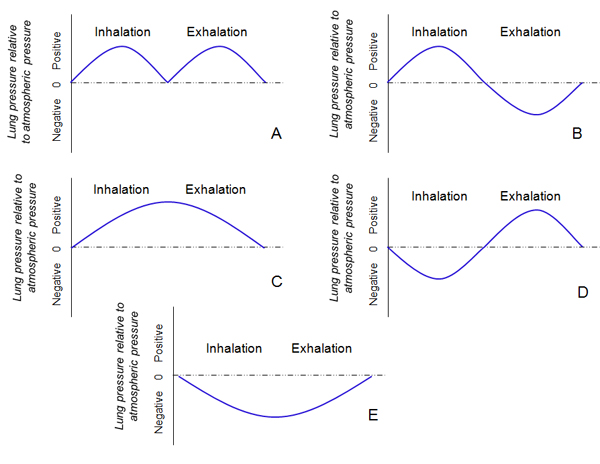
D
Inspiration begins as
the diaphragm contracts
Characteristics and examples of the open circulatory system:
vessels are open-ended
hemolymph is circulating fluid
most types of mollusks
arthropods
Characteristics and examples of the closed circulatory system:
earthworms
blood stays in vessels
frogs
blood flow to certain regions can be regulated
blood and interstitial fluid are separated
humans
characteristics of the arteries
multiple elastic layers
distributors of blood to organs
aorta
thick walled
characteristics of the veins
valves are present
skeletal muscles aid movement of blood
inferior vena cava
superior vena cava
lower pressure
characteristics of the capillaries
recapture their own fluid
smallest diameter
exchange occurs through pores or across cells
release nutrients to cells
gas exchange occurs here
wastes are picked up
What are the functions of the mouth in digestion.
food particles may be reduced in size
food is moistened and lubricated for easier swallowing
food is mixed with enzymes
receive secretions of salivary glands
Lipophilic Characteristics:
tends to act over longer periods
membrane permeable
fat soluble
binds intracellular receptors
carried in blood by binding proteins
Hydrophilic Characteristics:
water soluble
binds membrane receptors
tends to act over shorter periods
membrane impermeable
Since _________ hormones are _________, they cannot pass through the cell membrane. They instead elicit a cellular response by binding to a receptor on the plasma membrane and triggering the process of _________.
peptide; hydrophilic; signal transduction
Which statement about homeostasis is NOT correct?
Positive feedback mechanisms are common.
Insulin characteristics
produced by beta cells of pancreas
stimulated after a meal
lowers blood glucose
counteracts hyperglycemia
Glucagon characteristics
stimulated between meals
promotes hydrolysis of glycogen
produced by alpha cells of pancreas
increases blood glucose
counteracts hypoglycemia
Blood consists of red blood cells, white blood cells, and plasma proteins among some other components all in a fluid matrix. Based on this information, blood is classified as a connective tissue (T/F)
True
Which of the characteristics would you expect to find in all members of the bilateral?
specialized head region
Which answer choices is an example of the effector’s role in maintaining homeostasis?
increased sweating on a hot summer day
Individuals with type 2 diabetes produce insulin, but target cells do not respond to insulin by taking in sugar. In these individuals, blood glucose levels remain elevated. Which component of the feedback system is broken in these individuals?
the effector
The magnitude of the action potential is correlated with the strength of the stimulating input (T/F)
false
Which of the scenarios will most likely trigger an action potential? Select all that apply
A. Multiple excitatory postsynaptic potentials (EPSPs) arriving close in time at a single synapse (temporal summation) on the postsynaptic cell
B. Single excitatory postsynaptic potentials (EPSPs) arriving simultaneously at several different synapses (spatial summation) on the postsynaptic cell
C. an excitatory postsynaptic potential (EPSPs) and an inhibitory postsynaptic potential (IPSP) arriving simultaneously on the postsynaptic cell (cancellation)
A and B
Inhibitory synapses are important for? Select all that apply
A. Facilitating activation of the postsynaptic neuron
B. Filtering out unimportant information
C. Coordinating movement
D. Increasing the number of action potentials fired
B and C
The most commonly used dental anesthetic is lidocaine. It blocks voltage-gated Na+ channels. Where along a facial nerve would you expect lidocaine to be active?
along the axon

