Tango case
 Call Kai
 Learn
Learn Practice Test
 Spaced Repetition
 Match
Match Flashcards
 Knowt Play
1/55

There's no tags or description
Looks like no tags are added yet.
Name | Mastery | Learn | Test | Matching | Spaced | Call with Kai |
|---|
No analytics yet
Send a link to your students to track their progress
56 Terms
Which of the following are a part of the static examination?
1. history taking
2. conformation assessment
3. palpation
4. hoof examination
5. range of motion testing
Which of the following are a part of the dynamic examination?
1. baseline gait evaluation
2. flexion tests
3. lunging
4. diagnostic analgesia
Where is the cassette placed for a lateromedial view of stifle?
medial to the limb and perpendicular to the ground
Where is the beam traveling for lateromedial view of stifle?
parallel to the ground and centered at the proximal intertarsal joint
Where is the casette placed for a dorsoplantar view of the stifle?
plantar aspect of the limb and perpendicular to the ground
Where is the beam traveling for dorsoplantar view of stifle?
slightly proximodistal angled and centered at the proximal intertarsal joint
Where is the cassette placed for a DLPMO or DMPLO view of the stifle?
plantaromedial/lateral to the limb
Where is the beam traveling for a DLPMO or DMPLO view of stifle?
parallel to floor and 45 degrees off the DP view and centered at the proximal intertarsal joint
What is lameness?
clinical sign characterized by an abnormal gait or stance
Which of the following can cause lameness?
1. pain
2. mechanical dysfunction
3. neurological issues
What are ways that lameness can manifest?
1. altered gait
2. pain indicators
3. localized signs
4. behavioral signs
What are some diagnostic tools for hock osteochondrosis?
1. joint block
2. radiograph
3. ultrasound
4. arthrocentesis
What are some diagnostic tools for hock osteoarthritis?
1. joint block
2. radiograph
3. ultrasound
4. arthrocentesis
What are some diagnostic tools for suspensory desmitis?
1. nerve blocks
2. ultrasound
What are some diagnostic tools for chip fracture?
1. joint blocks
2. radiographs
What are some diagnostic tools for joint infections?
1. arthrocentesis
2. radiograph
3. ultrasound
What is the order that nerve blocks are performed?
distal to proximal
What does the abaxial sesamoid nerve block block?
medial and lateral palmar nerves
What structures are desensitized with abaxial sesamoid nerve block?
fetlock, coffin, pastern joints
What nerves does the low 4 point block target?
medial and lateral plantar nerves and medial and lateral plantar metatarsal nerves
What structures are desensitized by the low 4 point block?
fetlock and tissues distal to it
What is the landmark used to identify location for low 4 point block?
distal to the button of the splint bone, one inch proximal between the suspensory and flexor tendons
What are the nerves targeted in the high 4 point block?
1. medial and lateral plantar metatarsal nerves
2. dorsal metatarsal nerve
3. deep branch of the lateral plantar nerve
What is desensitized during the high 4 point block?
proximal metatarsal region and distal structures
What is arthrocentesis?
medical procedure in which a sterile needle is inserted into a joint space to collect synovial sample or inject medication
What does decreased viscosity, increased protein concentration, increased cells and neutrophils indicate from an arthrocentesis?
non-septic, degenerative joint disease
What tube color is most appropriate for collecting synovial fluid samples?
red top
What type of disease is osteochondrosis dissecans?
developmental orthopedic disorder
What type of disease is osteoarthritis?
degenerative joint disease
What is the cause of osteochondrosis dissecans?
failure of endochondral ossification
What is the cause of osteoarthritis?
progressive cartilage wear, synovial inflammation, subchondral changes
What is the age of onset with osteochondrosis dissecans?
young horses
What is the age of onset with osteoarthritis?
older horses usually >10 years or earlier if post-traumatic
What are the common locations for osteochondrosis dissecans?
tarsocrural joint
What is the common location for osteoarthritis?
distal intertarsal and tarsometatarsal joints
Which disease affects mostly low motion joints?
osteoarthritis
Which disease affects mostly high motion joints?
osteochondrosis dissecans
What are clinical signs for osteochondrosis dissecans?
1. joint effusion
2. mild to moderate lameness
What are clinical signs for osteoarthritis?
1. chronic lameness
2. stiffness
3. reduced range of motion
4. joint thickening
What are the expected radiographic findings for osteochondrosis dissecans?
1. flattening or irregularity of articular surfaces
2. subchondral bone defects
3. osteochondral fragments or loose bodies
What are the expected radiographic findings for osteoarthritis?
1. osteophyte formation
2. joint space narrowing
3. subchondral sclerosis
4. bone remodeling
5. ankylosis
What leads to inflammation in the joint with osteochondrosis dissecans?
cartilage and bone flaps or joint mice in the joint
What can osteochondrosis dissecans lead to?
arthritis
What are the nutrition factors for OCD?
diets with very high energy or have an imbalance in trace minerals
What is an example of a diet that can cause OCD?
low copper diets
What are the genetic factors for OCD?
may be partially inherited
What are the hormonal factors for OCD?
insulin and thyroid hormones during gestation
What are some other factors for OCD?
1. rapid growth and large body size
2. trauma and exercise
What is the best treatment option for OCD?
arthroscopy with removal of joint mice
What is the percentage of horses that return to work post arthroscopy?
81%
What is the post-op plan for 0-10 days after?
stall rest and pain management with NSAIDs
What do you begin doing on day 10 of post-op?
hand walking 5-10 minutes twice daily
What is the post-op plan for 2 weeks after?
suture removal, increase hand walking duration, physiotherapy exercises, vet reassessment
When is regenerative therapy administered post op?
2 weeks
What occurs 6-8 weeks post-op?
follow-up radiographs, transition to light exercise under saddle
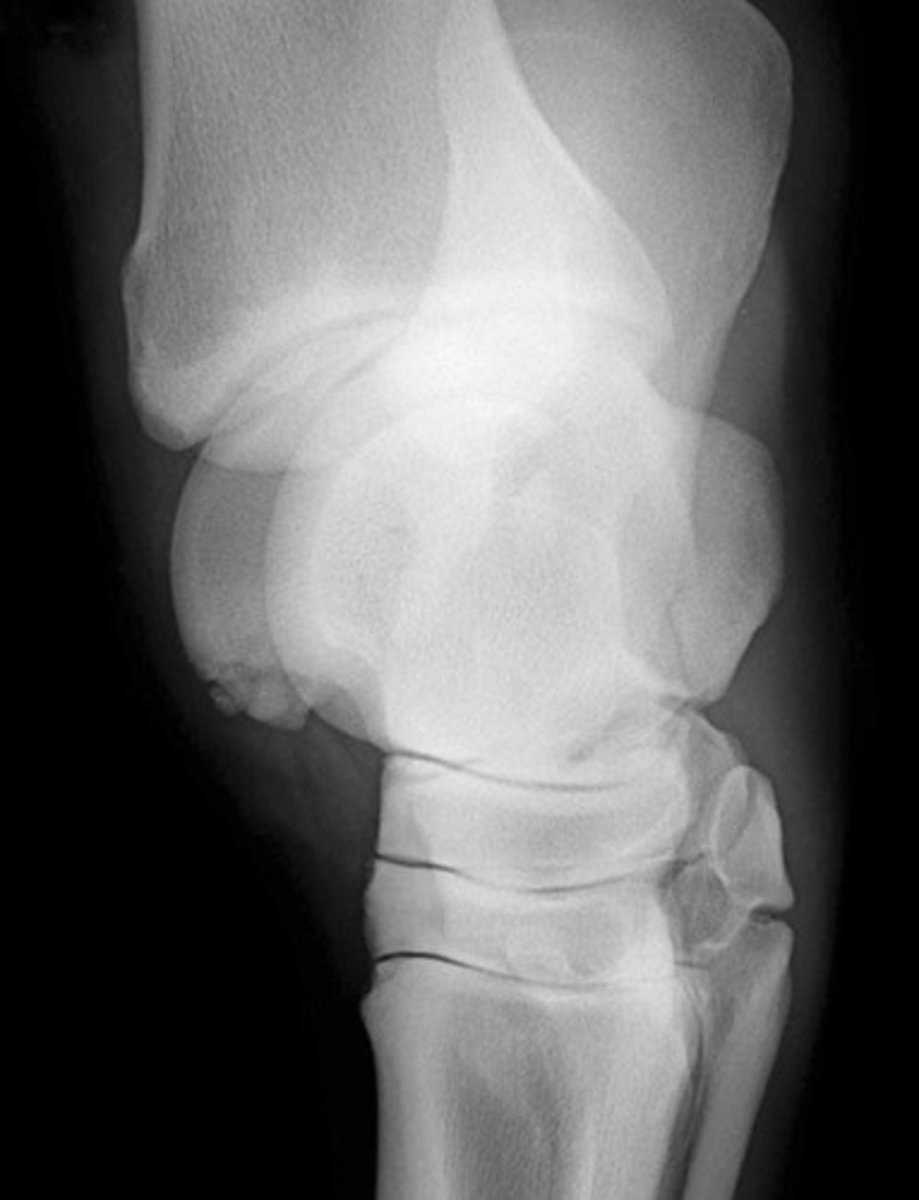
Irregular contour to lateral trochlear ridge to talus, joint mice - osteochondrosis dissecans
What is abnormal in the radiograph?