9. recap - power struggles for equality
 Studied by 0 people
 Call with Kai
 Learn
Learn Practice Test
 Spaced Repetition
 Match
Match Flashcards
 Knowt Play
1/16

There's no tags or description
Looks like no tags are added yet.
Name | Mastery | Learn | Test | Matching | Spaced | Call with Kai |
|---|
No study sessions yet.
17 Terms
civil society & democracy
= the space where people ‘do’ democratic politics
not just elections, but also lobbying and activities in civil society
play a key democratic role
advocating for rights & wishes (input)
checks and balances (accountability
civil society: what it does
Provides space for contestation over meaning & dissent
Shapes public policy (societal consensus)
Supports interest aggregation (articulation, collection and representation of interests)
Bringing together different ideas, interests and needs from people into meaningful wholes.
Constrain state power (accountability)
Recruit and train tomorrow’s leaders
Promote tolerance & compromise
Maintains pluralism & coherence: cross-cutt cleavages
Women’s movements
Made up of various kinds of groups and organisations but what binds them together is challenging the status quo (common political orientation)
Challengers: change & transformation of laws and policies for establishing gender equality - ‘outside’, but also allies in the state cf ‘State Feminism’
They differ in how they challenge the system, but there’s a shared goal
Women’s movements: three phases
Equal treatment 1970s → establish gender neutrality
individual women treated the same as individual men – tied to liberal feminism with a focus of equal treatment of invidual women v a v individual men –
key argument: women are the same as men so there should be no discrimination
anti-discrimination focus & focus on inclusion of women into existing rights and liberties
Positive action 1980s → acknowledgement of women being different from men
no inclusion but reversal: what was een as negative about women (them being different) is foregrounded as an argument for women
e.g., the claim that women were too emotional is now embraced instead of denied (as in first phase) and seen as an argument to include women in politics.
Gender mainstreaming 1990s
debate shifted from the individual (binary women vs men) to the institutional – institutions and gender roles are constructed and everything can be deconstructed. Male, female, masculinities femininities and the related politics are constructed
Gender mainstreaming
Every policy has a gender dimension, hence they all should be discussed from that angle to ensure there’s no inequality being established.
Gender mainstreaming: typology
integrationist GM (cf. inclusion 1970s)
integration of gender equality in existing policy paradigms
focus on experts (cf. WPA) & evidence-based knowledge
aim = neutral policy making
strength = effective integration
weakness = rhetorical entrapment
ticking the box without actual change
technocratic tools → exclusion of non-experts
utility > justice
requires WM to detach from grassroots, professionalize and assimilate with the state and policy
Agenda-setting GM (cf. reversal 1980s)
rethinking of existing policy paradigms from womens’ perspective
participation and empowerment of disadvantaged groups
aim = recognising marginalised voices
consultation with CSO’s
strength = recognition of groups’ perspectives and non-experts
weakness = reification
freezing group identities
obscuring intra-group differences and inter-group commonalities
Transformative GM (cf. displacement 1990s)
denaturalising institutionally accepted conceptions of equality by politicising them.
integration of intersectional perspectives
strength = sensitivity to diversity and intersectionality
weakness = difficult to implement
Success of WM
adherents
material success (laws, quota, …)
Conditions for WM succes
Framing
diagnosis → problem
prognosis → solution
motivation → call to action - how to get from problem to solution
framing = mobilising shared interests and values
marginal vs master frame
strategic framing
key to success
if WM can frame an issue in a way that corresponds with dominant policy issues (e.g., economy), they will be successful
BUT disconnects from the advocacy and policy work done by WM
Resource mobilisation
material
elite support
legitimacy
cultural knowledge
language skills
→ each of these have structural inequality in access and mobilisation
Strategies and tactics
conventional (lobbying, formal organisations, …)
unconventional (petitioning, civil disobedience, …)
gendered tactics (naked protest)
Political opportunity structure
open / closed windows of opportunity
exogenous shocks (e.g., war)
instability of elite arrangements (e.g., landslide victory or loss)
presence or absence of powerful allies (e.g., through quota)
state capacity and propensity for repression
State feminism
= state being and ally o women’s movements
Women’s policy agencies (WPA)
Gender equality machineries (GEM)
→ units within governments or parliaments
→ statutory commissions
→ advisory and consultative bodies
emergence → UN world conference Mexico City 1975
three waves
pre 1970s → focus on women and employment
mid 1980s → focus on gender & gender mainstreaming
late 1990s → shift to diversity
State response to women’s movements
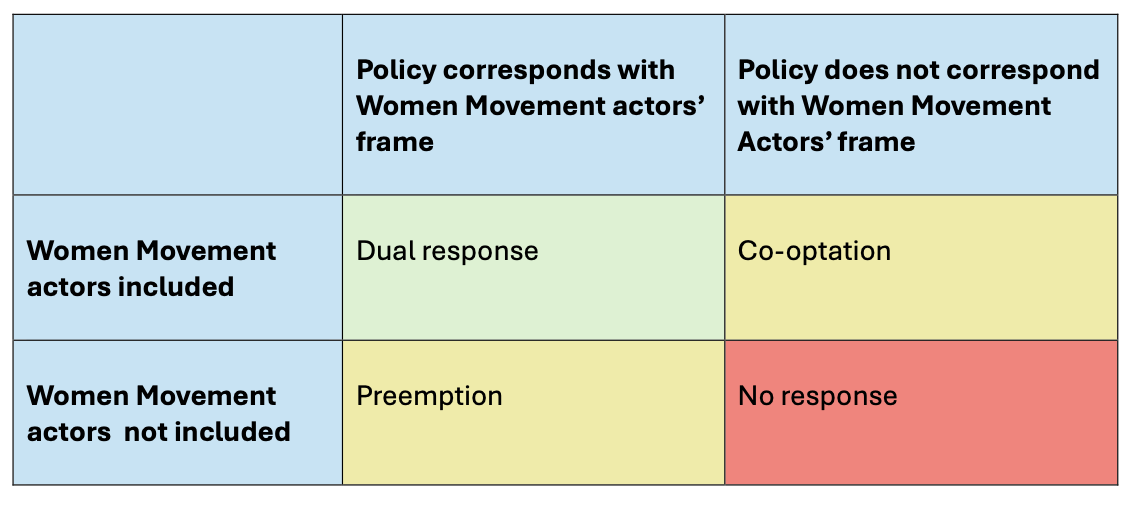
State alliance with women’s movements
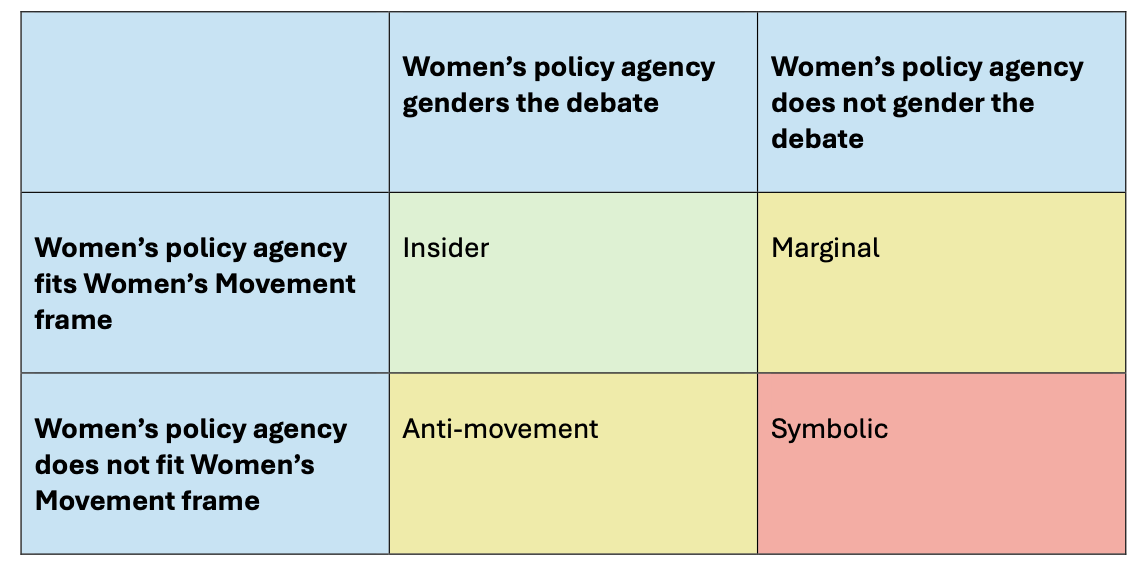
State response & alliance → research findings
dual response in 50%
insider = highest
Do you need an insider WPA to have dual response?
happens in 46% → helps, but not necessary nor sufficient!
WM can be successful bc of…
openness of the policy context
WM priorities
left-wing parties in power have NO IMPACT!
insider WPA is vital when other favourable contexts are absent
Should WM invest in state inclusion?
yes, especially in anti-gender times
but, not a magic bullet
dual strategy → lobbying both inside and outside the state
WM - intersectional problem
Internal struggles with intersectionality of social movement organizations is an important part in this debate
Many social movement organizations constantly have to evolve in response to external (e.g., windows of opportunities) and internal context (contestations, new requests, new understandings of equality, …)
many SMO are unmarked in terms of identity
e.g., women’s movement → marked for ‘women’ but nothing else
prototypical → prototype is served, but claim to represent all women in their diversity
Lépinard: feminist trouble
Femonationalism
feminist and gender equality issues are instumentalized for xenophobic and nationalist projects
“we” are gender equal and “they” represent cultural differences, opposed to gender equality
Feminist whiteness
white women’s interests are represented as universal
racialization and othering of non-archetypical women is done through three activities:
Ambivalence: questioning of them being adequately feminist – putting the othered feminist on the defend, having to prove they are real, good, feminists
Benevolence: Constructing them as objects of care and help → they have to be saved and helped because they are perceived as feminists that still have to see the light
Anger → switch from benevolence – nostalgia to earlier, more simple feminism – melancholy
Lépinard argues for a feminist ethic of responsibility. Here, feminism is…
A ‘political project’: values like autonomy, freedom and equality can mean many things (although not anything) – this disagreement turns it into a political project (diversity of perspectives)
A moral project: promise to create a community, relations of equality with other feminists, shared goals & acting together (but political because of constant debates)
Here, intersectionality is an important tool to rethink the feminist project as a democratic, political one.
Collins: black feminism, intersectionality and democratic possibilities
The ‘problem’ is that ‘othered’ women (muslim, black, …) object to their being opressed and dominatd within WM. This creates a specific issue of loyalty for these othered women – if black women say they are part of the black community, they accept sexism within the community – if they do so with women’s movements, they are accused of allying with people that are racists → a loyalty problem
Collins argues for flexible solidarity → flexibility is completely acceptable (accusations of racisms / sexism should be let go) – we should accept that loyalty is flexible and can be reconfigured to having specific solidarities for specific issues
= acceptance of intersectional difference within the movement
This acceptance creates intersectional solidarity & democratic possibilities:
Constructing political solidarity within black community across intersectional differences
Solidarity among people of colour (political identity): bottom-up process, constructed around similarities – internal cross-intersectional solidarity (e.g., discussing & critiquing sexism within the black community or racism within the women’s movement BUT within a framework of solidarity – common political goals)
With white allies (intersectional group as well – redefining white, rejecting white supremacy: white feminists important)
intersectional group-specific organisations
The aformentioned critiques have as also led to many intersectional groups leaving unmarked groups and create their own organisations.
Arguments pro:
Better reflect specific needs and experiences
Safe space for identifying experiences, and re-defining problems and solutions
‘safe’ = absence of three mechanisms described by Lépinard
‘Self help’
= similar reasons to why womens movements where once created
Arguments contra:
Accusations of segregation, problematic distancing; seen as threatening, diluting ‘common stride’
Resistance: set apart as ‘identity politics/movements’
Loss of influence
 Note
Note  Flashcards (41)