biology 2600 (ecology) - unit 14 (mutualism)
 Studied by 0 people
 Call Kai
 Learn
Learn Practice Test
 Spaced Repetition
 Match
Match Flashcards
 Knowt Play
1/22

There's no tags or description
Looks like no tags are added yet.
Name | Mastery | Learn | Test | Matching | Spaced |
|---|
No study sessions yet.
23 Terms
Mutualism
Interactions between individuals of different species that benefits both partners
Facultative Mutualism
Occurs when a species can live without its mutualistic partner
Obligate Mutualism
Occurs when a species is dependent on a mutualistic relationship
- Evidence that eukaryotes originated as mutualistic associations (Margulis and Fester)
Plants benefit from mutualistic partnerships with a wide variety of bacteria, fungi, and animals. Plants are the centre of mutualistic relationships that affect the structure and processes of terrestrial ecosystems.
What are some of these processes?
- Nitrogen fixation
- Nutrient absorption
- Pollination
- Seed dispersal
How do mycorrhizal fungi benefit plants?
Provides plants with greater access to inorganic nutrients (K, Cu, Zn, N)
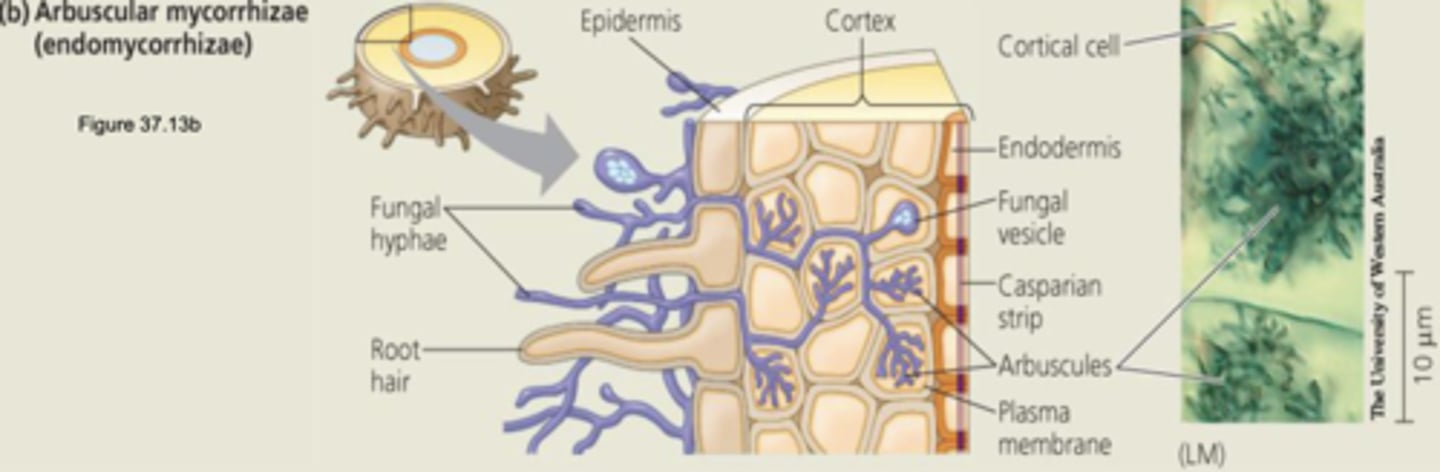
Endomycorrhizae (or Arbuscular) Fungi
Fungus provides arbuscules (exchange sites), hyphae (fungal filaments), and vesicles (energy storage organs)
- In 85% of plant species, including grains and legumes (because significant survival/growth benefits enabled plants to colonize land and thrive in diverse, often nutrient-poor environments)
- Fungal hyphae extends into root
- Penetrate cell wall (but not plasma membrane) to form arbuscules
Ectomycorrhizae Fungi
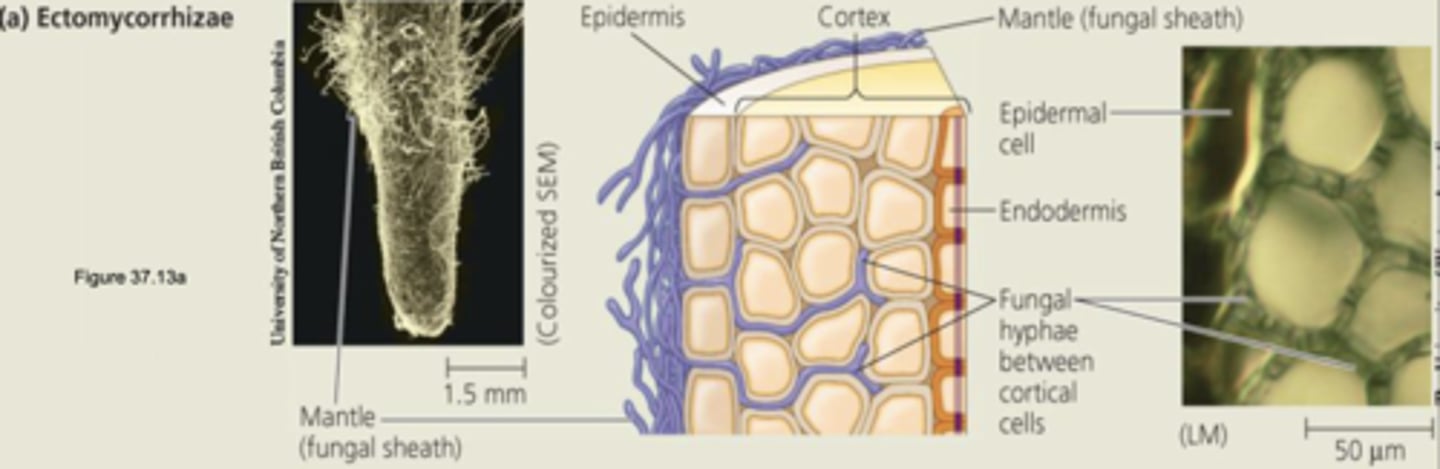
Fungus forms mantle around roots and net-like structure around root cells
- In 10% of plant families, including pine, spruce, oak, walnut, birch, willow, and eucalyptus
- Fungal mycelium forms dense sheath over surface of root
- Hyphae form network in apoplast, but do not penetrate root walls
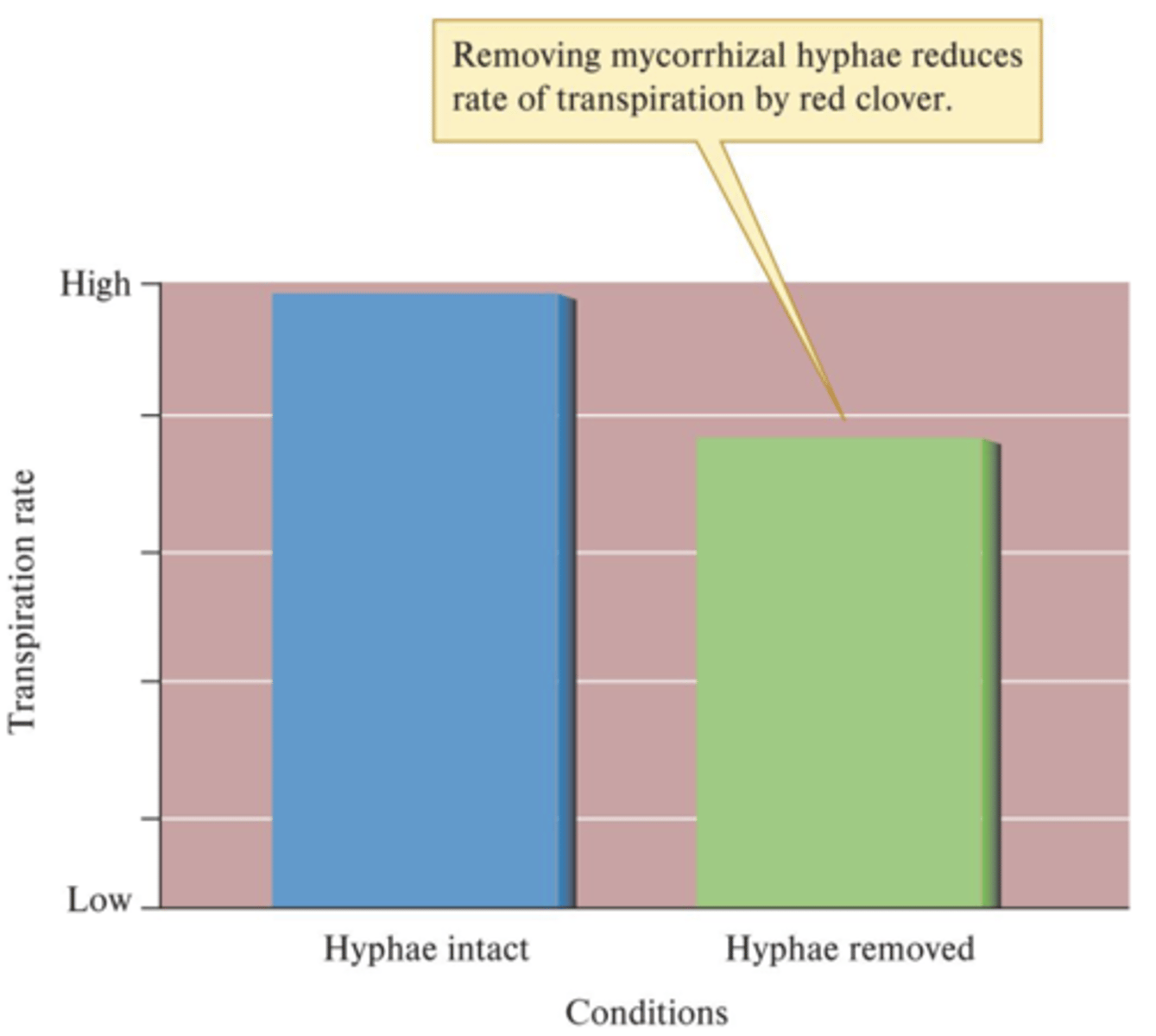
How might mycorrhizal fungi provide more extensive contact with moisture in the rooting site (Hardie)?
- Provide extra area for water absorption
- May be indirect effect; fungus may provide greater access to phosphorus, leading to greater root growth and more efficient extraction and conduction of water
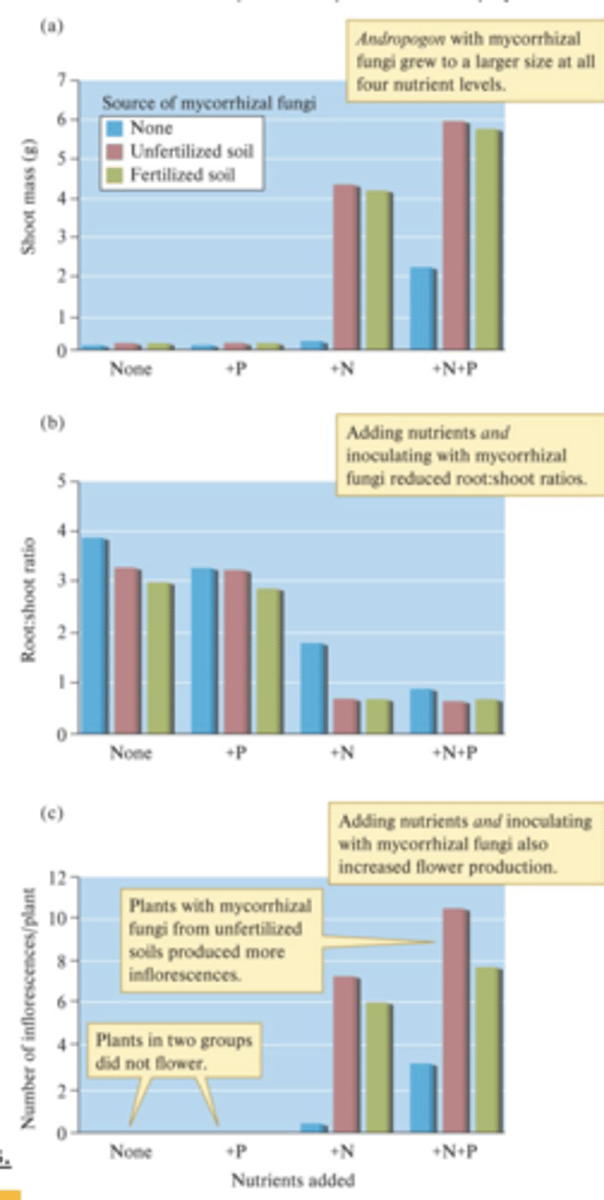
What is the effect of nutrient additions on mycorrhizae?
- Higher shoot mass with mycorrhizae and nutrient supplements (can invest more resources into shoot)
- Higher root:shoot ratios in low-nitrogen conditions (scarce nitrogen = more resources are allocated to roots)
- Inflorescences only with added nitrogen (flowering is expensive, and only with abundant nitrogen can it be invested into)
- Mycorrhiza transplanted from fertilized land results in fewer flowers than the one from unfertilized soil (fungi adapted to high-nutrient conditions, less priority in delivering nutrients; therefore, plant prioritizes survival instead of flowering in low-nutrient conditions)
How are ants mutualistic with swollen thorn acacias?
- Herbivores attempting to forage on acacia encounter many fast, agile, highly aggressive defenders
- In return, thorns provide living space to ants
- Foliar nectaries provide sugar to ants
- Beltian bodies provide oils and proteins
- Ants protect acacia from herbivores and competition from other plants
What is the evidence for ants significantly improving acacia performance (Jenzen)?
- Acacias without ants had more herbivorous insects
- Suckers (new vertical shoot that emerges from the root) growing from acacia stumps occupied by ants lengthened at seven times the rate of suckers without ants
- Suckers with ants survived at twice the rate of suckers without ants
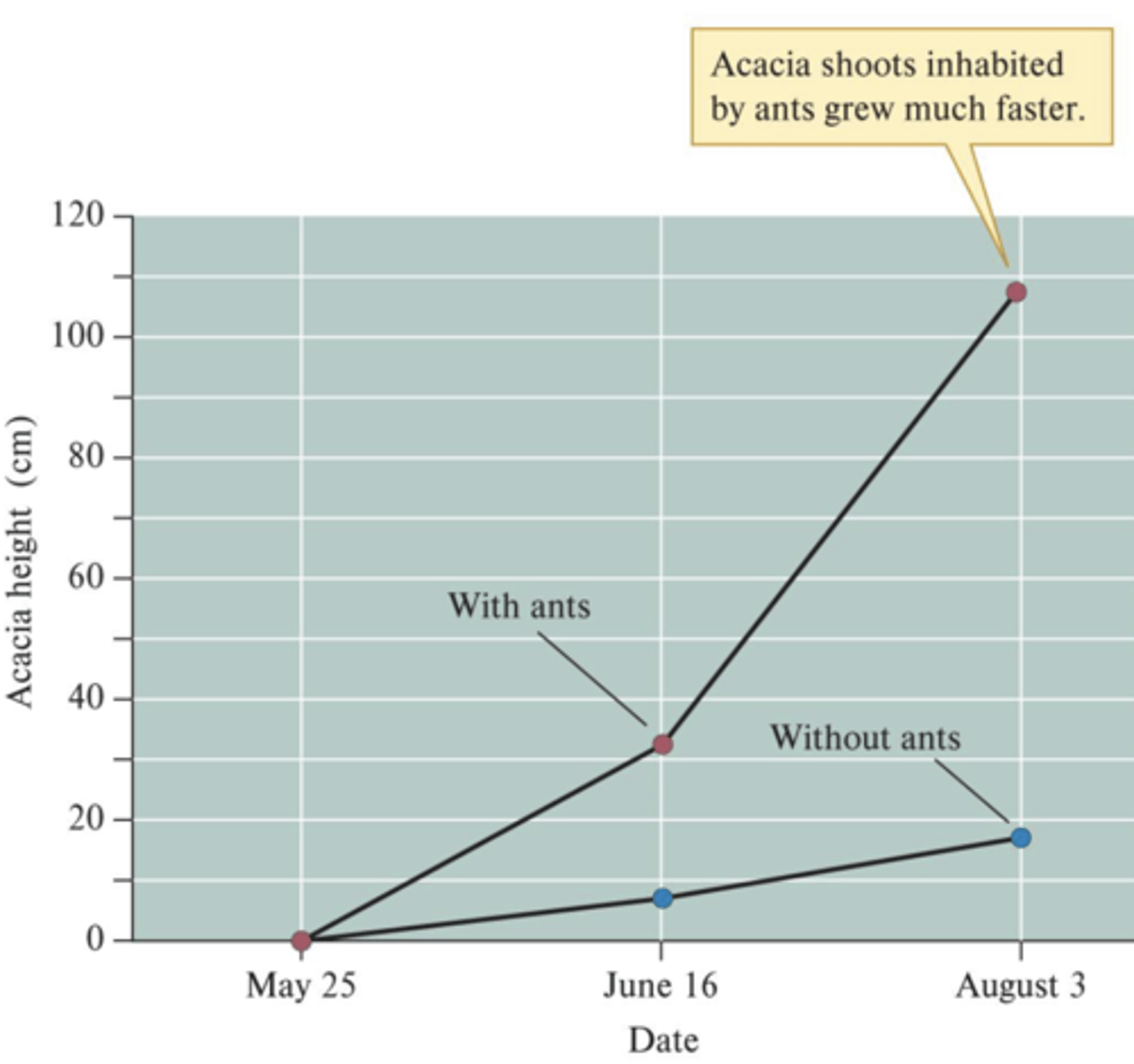
Acacia trees depend on other mutualisms as well. Can this cause potential conflict between mutualists?
- Acacia depends on mutualisms with nitrogen-fixing bacteria, mycorrhizae, and pollinators
- Potential for conflict between mutualists
- Ants and pollinators rarely overlap spatially
- Inflorescences also produce ant repellent
- Acacia's inflorescences do not produce nectar (only "foliar" by leaves to nourish the ants)
How do ants benefit from aspen sunflowers?
- Ants are attracted to aspen sunflowers because they produce nectar at extrafloral nectaries (rich in sucrose and amino acids)
- Inouye and Taylor observed 5 ant species collecting nectar from extrafloral nectaries, but never from blossoms nor tending aphids on plant (therefore, extrafloral nectaries are a sufficient attractant)
How do aspen sunflowers benefit from ants?
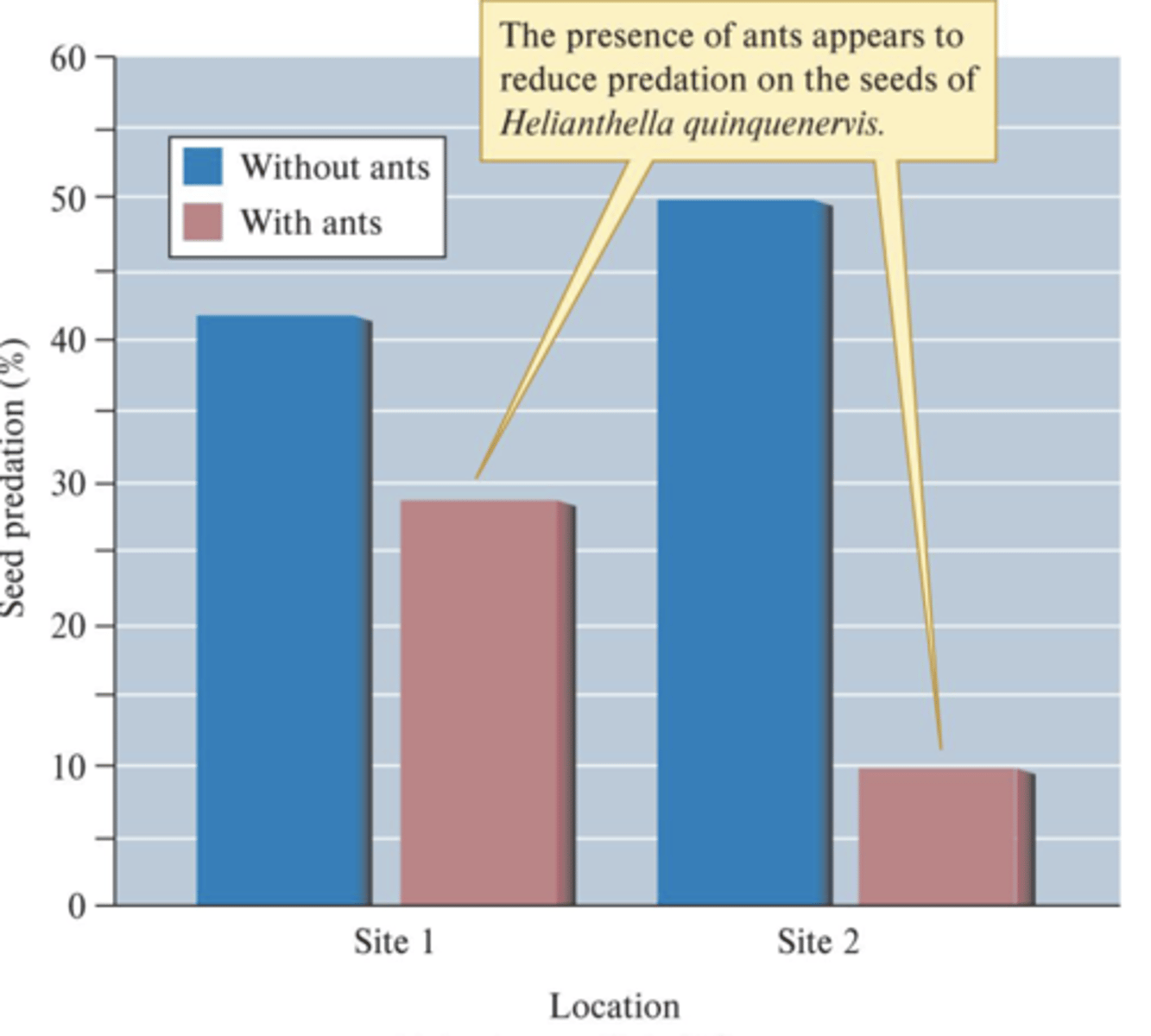
- Proposed ants may protect sunflower's developing seeds from seed predators (predators damaged over 90% of seeds produced by some flowers)
- Found flowers without ants suffered 2 to 4x more seed predation; excluding ants caused more seed predation
- Relationship is facultative; flowers are susceptible to frost, so it's not a reliable nectar source for ants
How do reef-building corals depend on a mutualistic relationship with algae and animals?
- Ecological integrity of coral reefs depends on mutualism
- Coral reefs have exceptional productivity and diversity (approx. 0.5 million species)
- Yet reefs are surrounded by nutrient-poor oceans (explained by mutualism with zooxanthellae)
What is the mutualistic relationship between zooxanthellae and corals?
- Zooxanthellae (dinoflagellate algae) live within coral tissues and receive nutrients from coral
- In return, coral receives organic compounds synthesized by zooxanthellae during photosynthesis
- Corals induce release of organic compounds with "signal compounds" that alter permeability of zooxanthellae cell membrane
How do corals control the rate of zooxanthellae population growth and density?
By influencing organic matter secretion; causes zooxanthellae to secrete 90 to 99% of their fixed carbon for coral to use
The main zooxanthellae benefit appears to be access to higher nutrient levels, especially nitrogen and phosphorus; also uptake ammonium secreted by coral
How do corals benefit from crustacean mutualists (Glynn)?
- Found 13 coral species were protected by crustacean mutualists
- Crustacean mutualists substantially improved chances that the coral will avoid attack by sea stars

What are the other benefits of crustaceans to corals (apart from protection)? How does the coral benefit the crustaceans?
- Crab activity promotes coral health and integrity
- Without crabs, corals showed tissue death
- Coral increases production of fat bodies in the presence of crabs (digestive tracts of crabs inhabiting corals showed large quantities of lipids; provides source of nutrition to crabs)
Theory predicts mutualism will evolve where the benefits of mutualism exceed the costs.
Keeler developed models representing the relative costs and benefits of several types of mutualistic interactions. What are these models?
1. Successful mutualists: give and receive benefits
2. Unsuccessful mutualists: give but do not receive benefit
3. Non-mutualists: neither give nor receive benefit
When does mutualism occur in a population?
For a population to be mutualistic, fitness of successful mutualists must be greater than unsuccessful mutualists or non-mutualists
Combined fitness of successful and unsuccessful mutualists must exceed that of non-mutualists. If not, natural selection will eventually eliminate the interaction
How would a facultative ant-plant mutualism evolve and persist (Keeler)?
Proportion of plant's energy budget that ants save from destruction by herbivores must exceed proportion of the plant's energy budget invested in extrafloral nectaries and nectar (for ants to feed on)
Plants surviving on a tight energy budget are unlikely to invest in attracting ants (may lack resources to support mutualism)
What are some conditions that might produce higher benefits than costs in an ant-plant mutualism?
- High probability of attracting ants
- High potential for herbivory
- Low effectiveness of alternative defences
- Highly effective ant defence
 Note
Note  Flashcards (118)