Ancient Civilizations: Art, Architecture, and Archaeological Discoveries

0.0(0)
Studied by 0 people
call kaiCall Kai
learnLearn
examPractice Test
spaced repetitionSpaced Repetition
heart puzzleMatch
flashcardsFlashcards
GameKnowt Play
Card Sorting

1/30

encourage image

There's no tags or description

Looks like no tags are added yet.

Last updated 4:53 AM on 4/2/26
Name
Mastery
Learn
Test
Matching
Spaced
Call with Kai

No analytics yet

Send a link to your students to track their progress

31 Terms

1
New cards

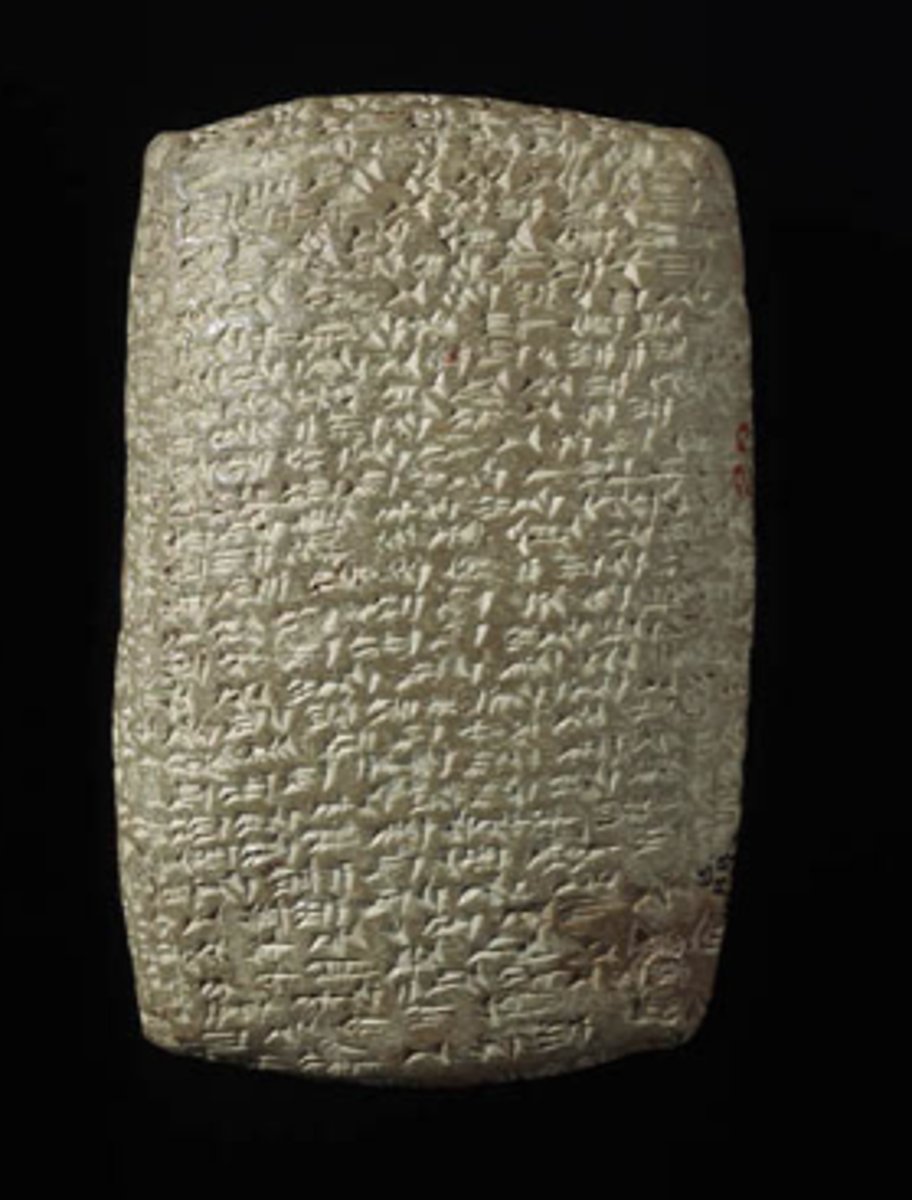
Amarna Letters

- A cache of ~380 clay tablets found at Amarna, Egypt, written in cuneiform script

- Date to the reigns of Amenhotep III and Akhenaten (c. 1360-1332 BCE)

- Represent diplomatic correspondence between Egypt and Near Eastern kingdoms

- Reveal a complex system of international diplomacy, gift exchange, and political alliance

- Written in Akkadian, the diplomatic language of the Bronze Age
<p>- A cache of ~380 clay tablets found at Amarna, Egypt, written in cuneiform script</p><p>- Date to the reigns of Amenhotep III and Akhenaten (c. 1360-1332 BCE)</p><p>- Represent diplomatic correspondence between Egypt and Near Eastern kingdoms</p><p>- Reveal a complex system of international diplomacy, gift exchange, and political alliance</p><p>- Written in Akkadian, the diplomatic language of the Bronze Age</p>
2
New cards

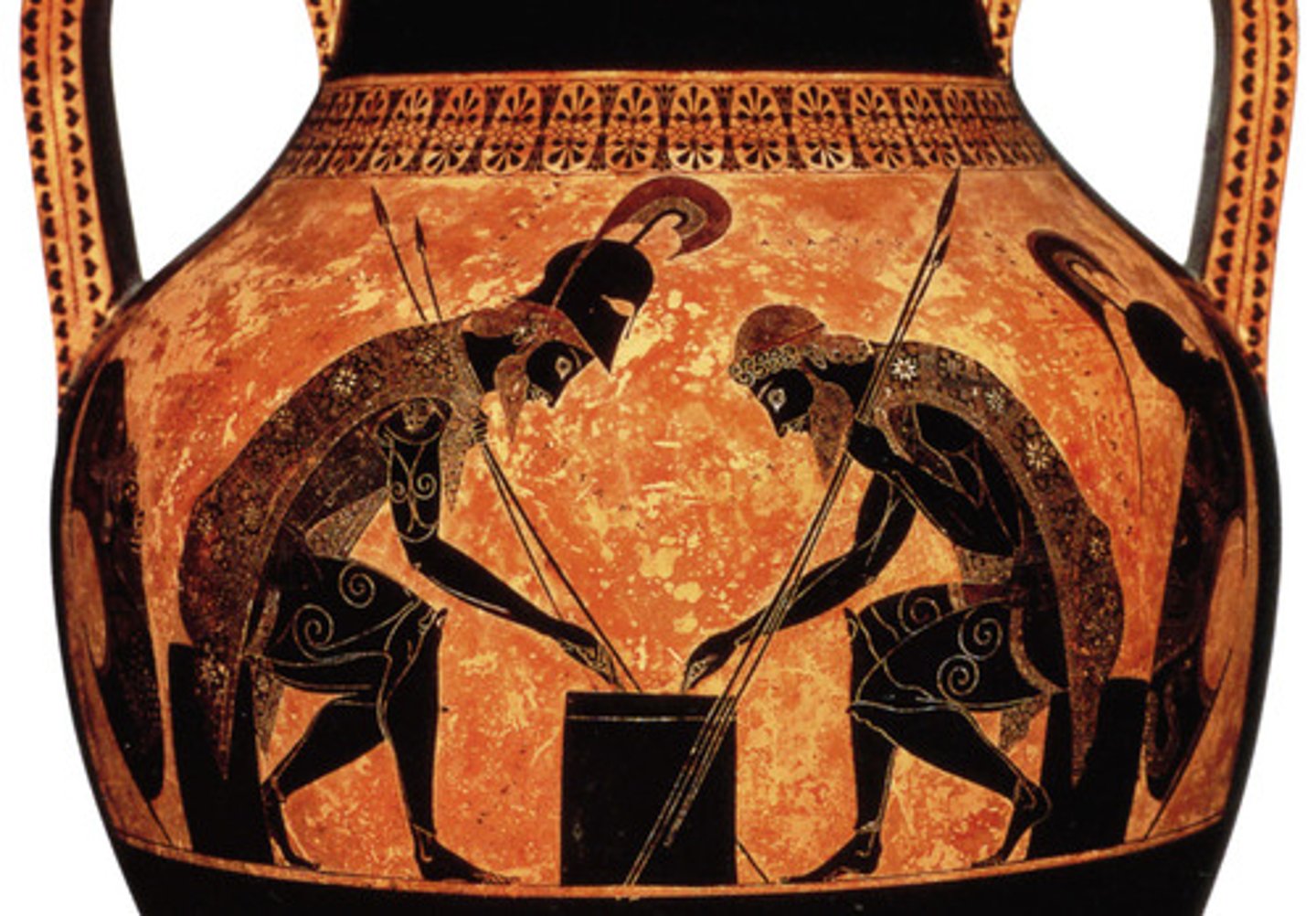
Black-figure pottery

- A Greek pottery style with black silhouetted figures on a red-orange clay background

- Developed in Corinth and perfected in Athens from the 7th-5th centuries BCE

- Artists used incised lines to add detail to the black figures

- Commonly depicted myths, athletics, symposia, and divine scenes

- Replaced by red-figure pottery around 530 BCE, which allowed more detail and naturalism
<p>- A Greek pottery style with black silhouetted figures on a red-orange clay background</p><p>- Developed in Corinth and perfected in Athens from the 7th-5th centuries BCE</p><p>- Artists used incised lines to add detail to the black figures</p><p>- Commonly depicted myths, athletics, symposia, and divine scenes</p><p>- Replaced by red-figure pottery around 530 BCE, which allowed more detail and naturalism</p>
3
New cards

Conical cups

- Simple, thin-walled drinking vessels found in enormous quantities at Minoan sites on Crete

- Mass-produced quickly on a wheel with minimal finishing, suggesting disposable use

- Found at palace sites, peak sanctuaries, and everyday settlements

- Their abundance suggests use in communal feasting or religious rituals

- Key evidence for understanding Minoan social and ceremonial gatherings

4
New cards

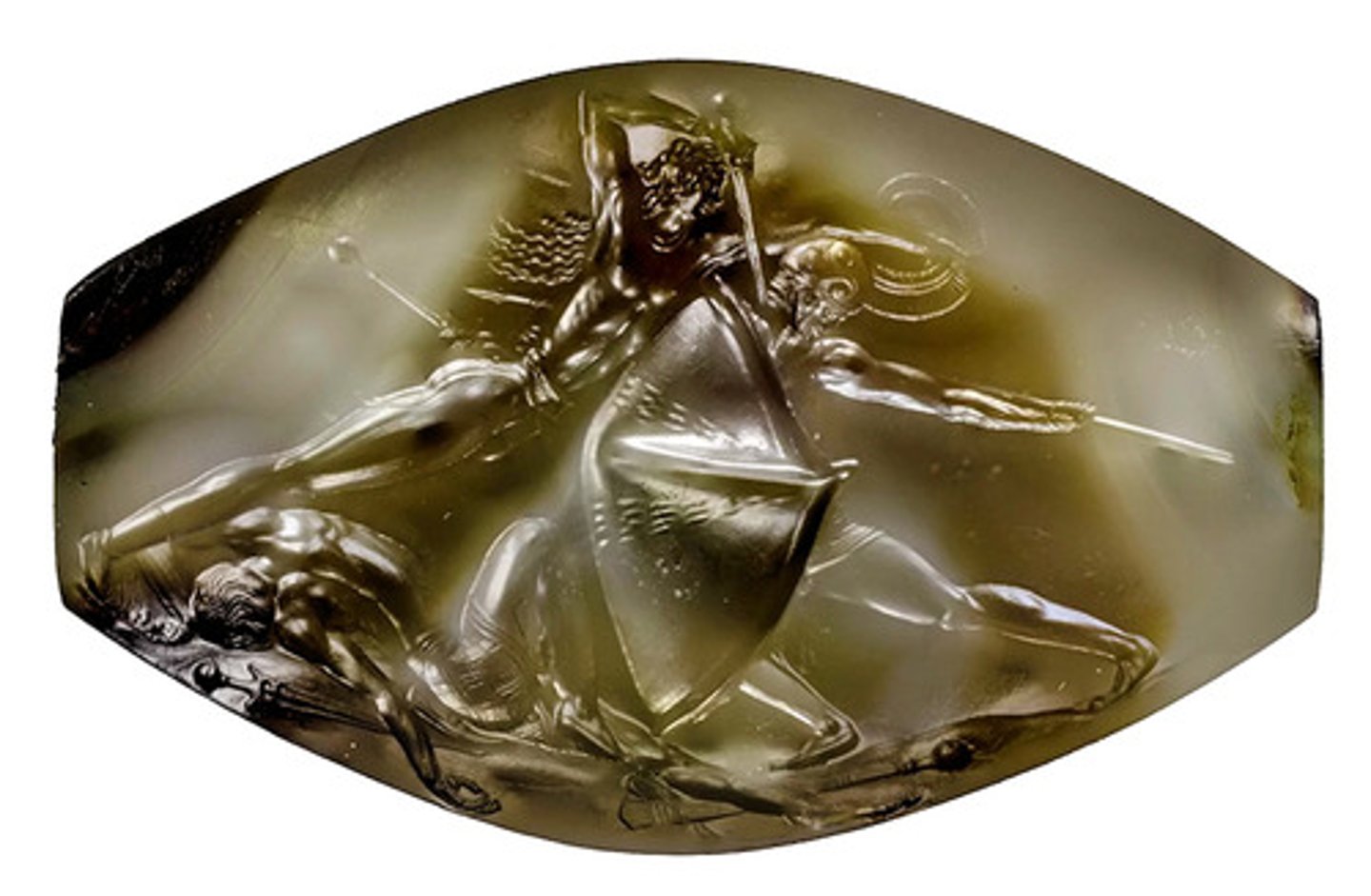
Griffin Warrior Tomb

- A wealthy warrior burial discovered at Pylos, Greece in 2015, dating to c. 1500 BCE

- Contained over 1,400 objects including gold rings, carved ivory, bronze weapons, and a mirror

- The gold rings depict Minoan religious imagery, showing strong Minoan-Mycenaean cultural contact

- Belonged to an early Mycenaean elite warrior at a moment when Mycenaean culture was forming

- One of the most significant Bronze Age Greek discoveries in decades
<p>- A wealthy warrior burial discovered at Pylos, Greece in 2015, dating to c. 1500 BCE</p><p>- Contained over 1,400 objects including gold rings, carved ivory, bronze weapons, and a mirror</p><p>- The gold rings depict Minoan religious imagery, showing strong Minoan-Mycenaean cultural contact</p><p>- Belonged to an early Mycenaean elite warrior at a moment when Mycenaean culture was forming</p><p>- One of the most significant Bronze Age Greek discoveries in decades</p>
5
New cards

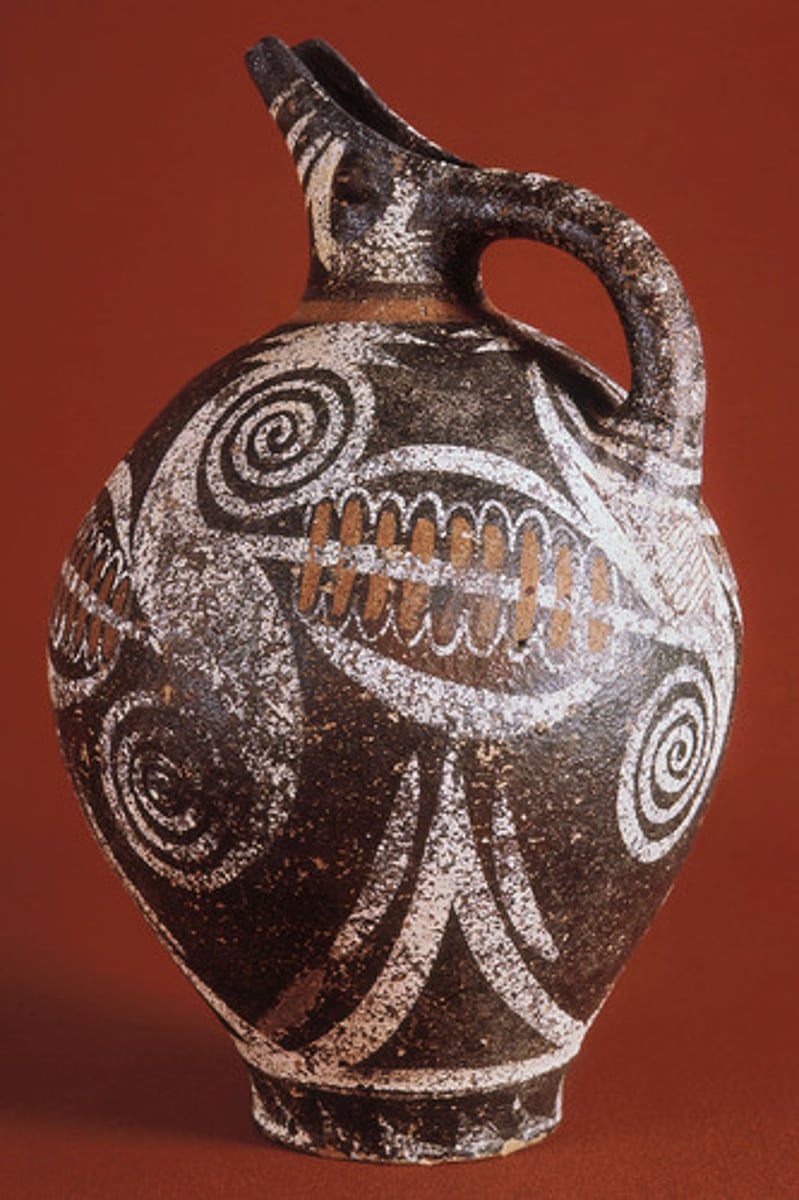
Kamares ware

- A distinctive Minoan pottery style from the Middle Bronze Age (c. 2000-1700 BCE)

- Named after Kamares Cave on Crete where it was first found

- Characterized by dark backgrounds with vivid white, red, and orange painted designs

- Some of the finest pottery from the ancient Aegean — thin-walled and expertly crafted

- Found across the eastern Mediterranean, indicating Minoan trade networks
<p>- A distinctive Minoan pottery style from the Middle Bronze Age (c. 2000-1700 BCE)</p><p>- Named after Kamares Cave on Crete where it was first found</p><p>- Characterized by dark backgrounds with vivid white, red, and orange painted designs</p><p>- Some of the finest pottery from the ancient Aegean — thin-walled and expertly crafted</p><p>- Found across the eastern Mediterranean, indicating Minoan trade networks</p>
6
New cards

Minoan Wall Painting

- Brightly colored frescoes painted on plastered walls of Minoan palaces and elite homes

- Subjects include nature scenes (flowers, dolphins, monkeys), bull-leaping, and processions

- Painted in a lively, dynamic style with a strong sense of movement

- Provide crucial evidence for Minoan religion, ritual, and social life

- The 'Bull-Leaping Fresco' from Knossos is among the most famous example
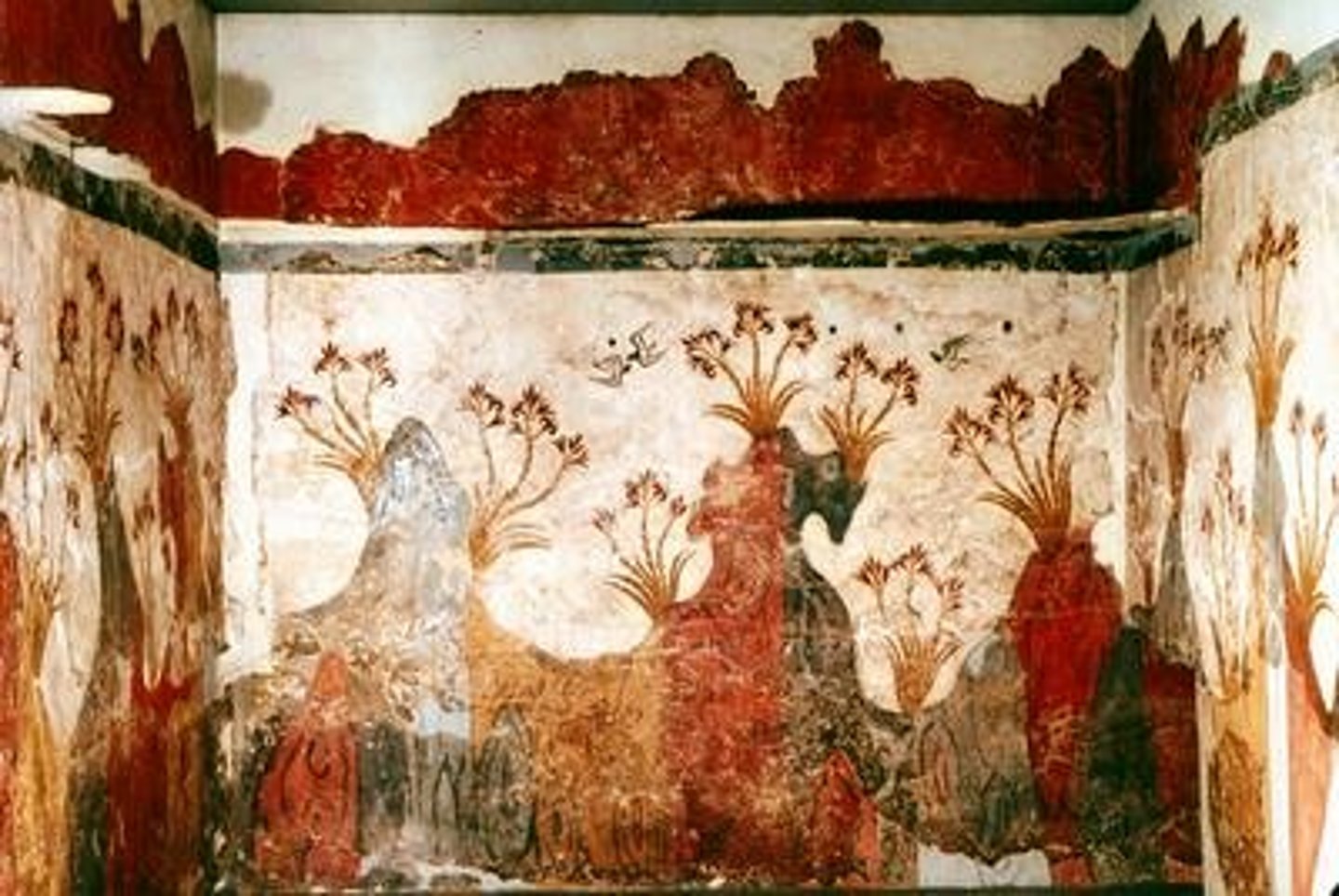
<p>- Brightly colored frescoes painted on plastered walls of Minoan palaces and elite homes</p><p>- Subjects include nature scenes (flowers, dolphins, monkeys), bull-leaping, and processions</p><p>- Painted in a lively, dynamic style with a strong sense of movement</p><p>- Provide crucial evidence for Minoan religion, ritual, and social life</p><p>- The 'Bull-Leaping Fresco' from Knossos is among the most famous example</p>
7
New cards

Models of the Tomb of Meketre

- A collection of painted wooden models found in the tomb of Egyptian official Meketre (c. 2000 BCE)

- Include miniature scenes of granaries, bakeries, breweries, cattle herds, weaving, and boats

- Intended to magically supply the deceased with food and services in the afterlife

- Discovered in a sealed chamber at Deir el-Bahri, near Luxor, in 1920

- One of the finest surviving examples of Egyptian funerary art, now in the Metropolitan Museum of Ar
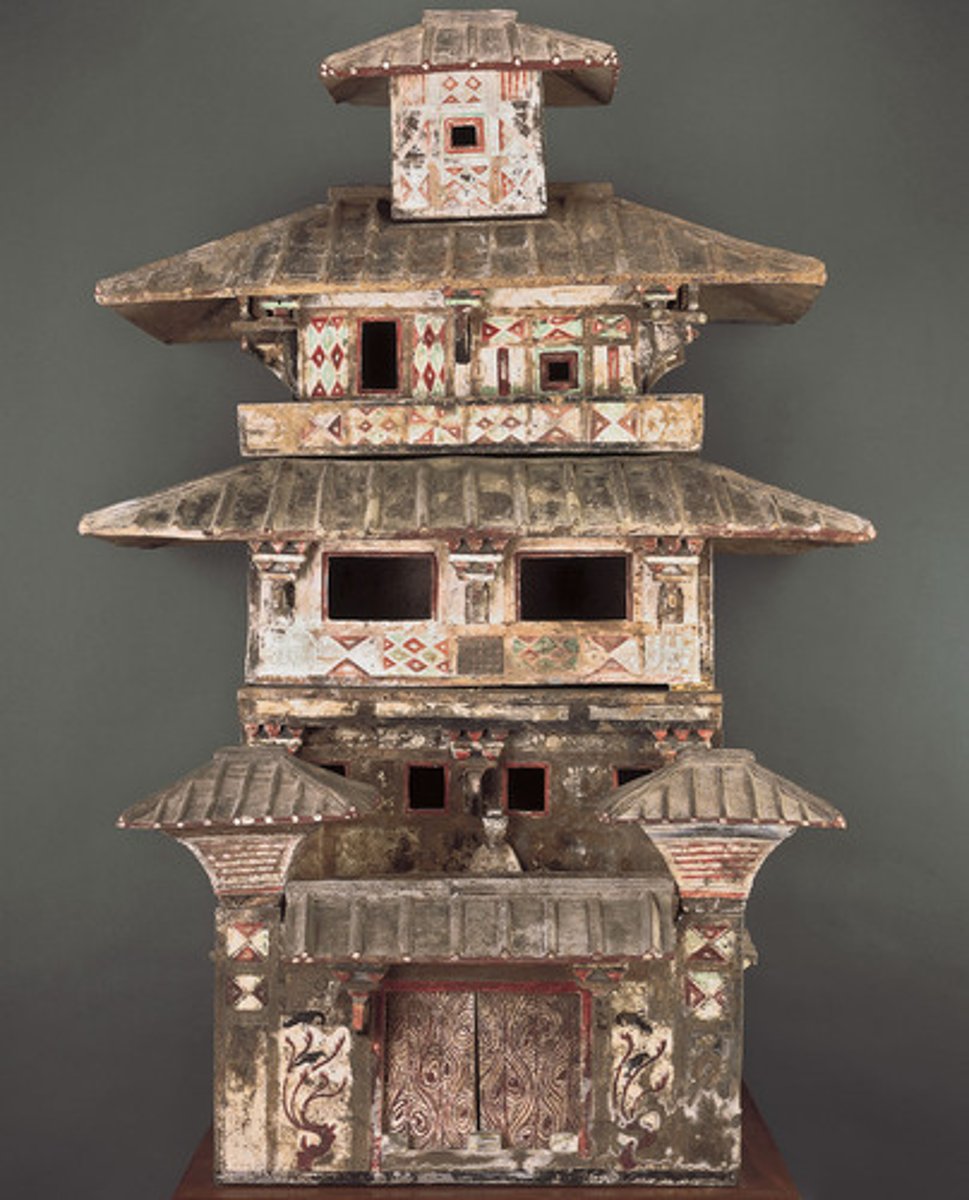
<p>- A collection of painted wooden models found in the tomb of Egyptian official Meketre (c. 2000 BCE)</p><p>- Include miniature scenes of granaries, bakeries, breweries, cattle herds, weaving, and boats</p><p>- Intended to magically supply the deceased with food and services in the afterlife</p><p>- Discovered in a sealed chamber at Deir el-Bahri, near Luxor, in 1920</p><p>- One of the finest surviving examples of Egyptian funerary art, now in the Metropolitan Museum of Ar</p>
8
New cards

Narmer Palette

- A carved ceremonial stone palette from c. 3100 BCE, depicting the unification of Egypt

- Shows Pharaoh Narmer wearing both the White Crown (Upper Egypt) and Red Crown (Lower Egypt)

- One of the earliest historical documents in the world, using proto-hieroglyphic symbols

- Follows Egyptian artistic conventions: figures shown in hierarchical scale, heads in profile

- Considered foundational for understanding early Egyptian kingship ideology
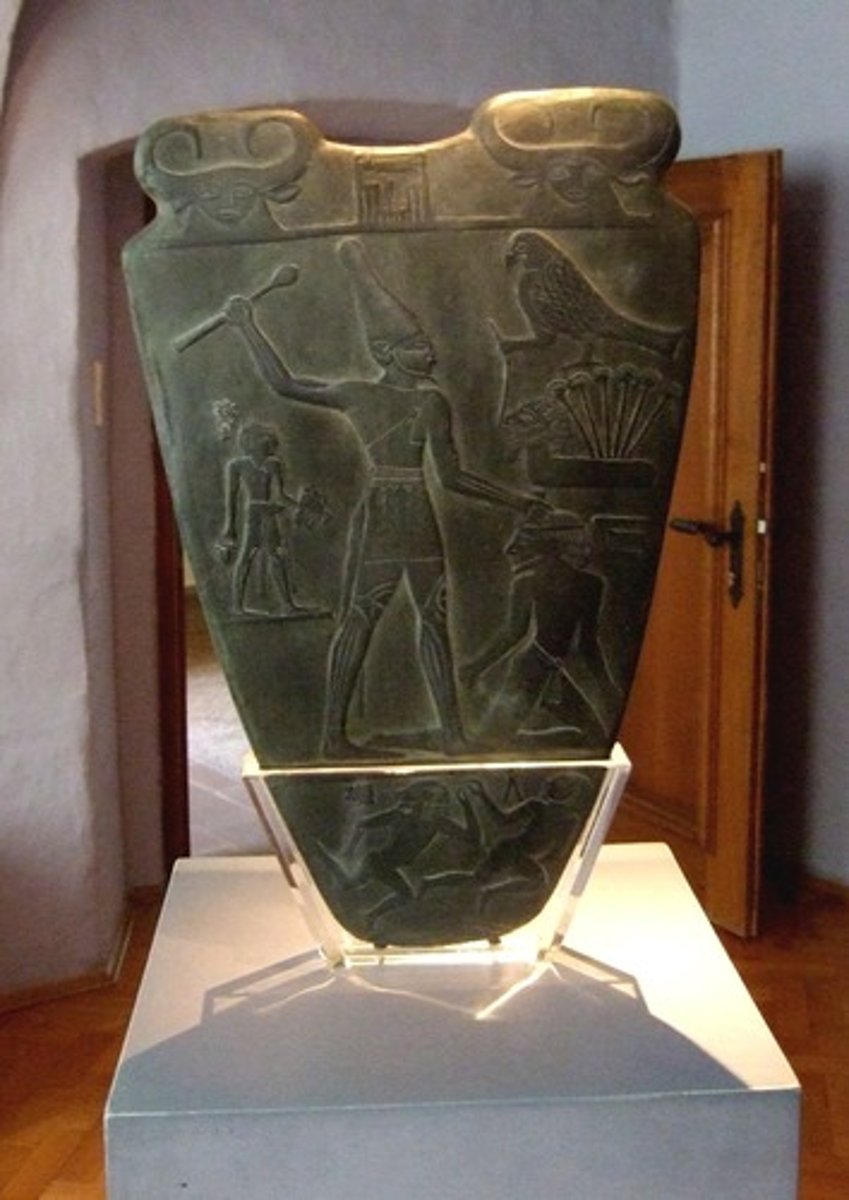
<p>- A carved ceremonial stone palette from c. 3100 BCE, depicting the unification of Egypt</p><p>- Shows Pharaoh Narmer wearing both the White Crown (Upper Egypt) and Red Crown (Lower Egypt)</p><p>- One of the earliest historical documents in the world, using proto-hieroglyphic symbols</p><p>- Follows Egyptian artistic conventions: figures shown in hierarchical scale, heads in profile</p><p>- Considered foundational for understanding early Egyptian kingship ideology</p>
9
New cards

Peak Sanctuary

- Minoan open-air sacred sites built on mountain peaks across Crete and the Aegean islands

- Worshippers left votive offerings including clay figurines of humans, animals, and body parts

- Likely served as places to communicate with deities overseeing agriculture and healing

- Visible from surrounding settlements, suggesting a communal and landscape-based religion

- Over 25 peak sanctuaries have been identified on Crete alone
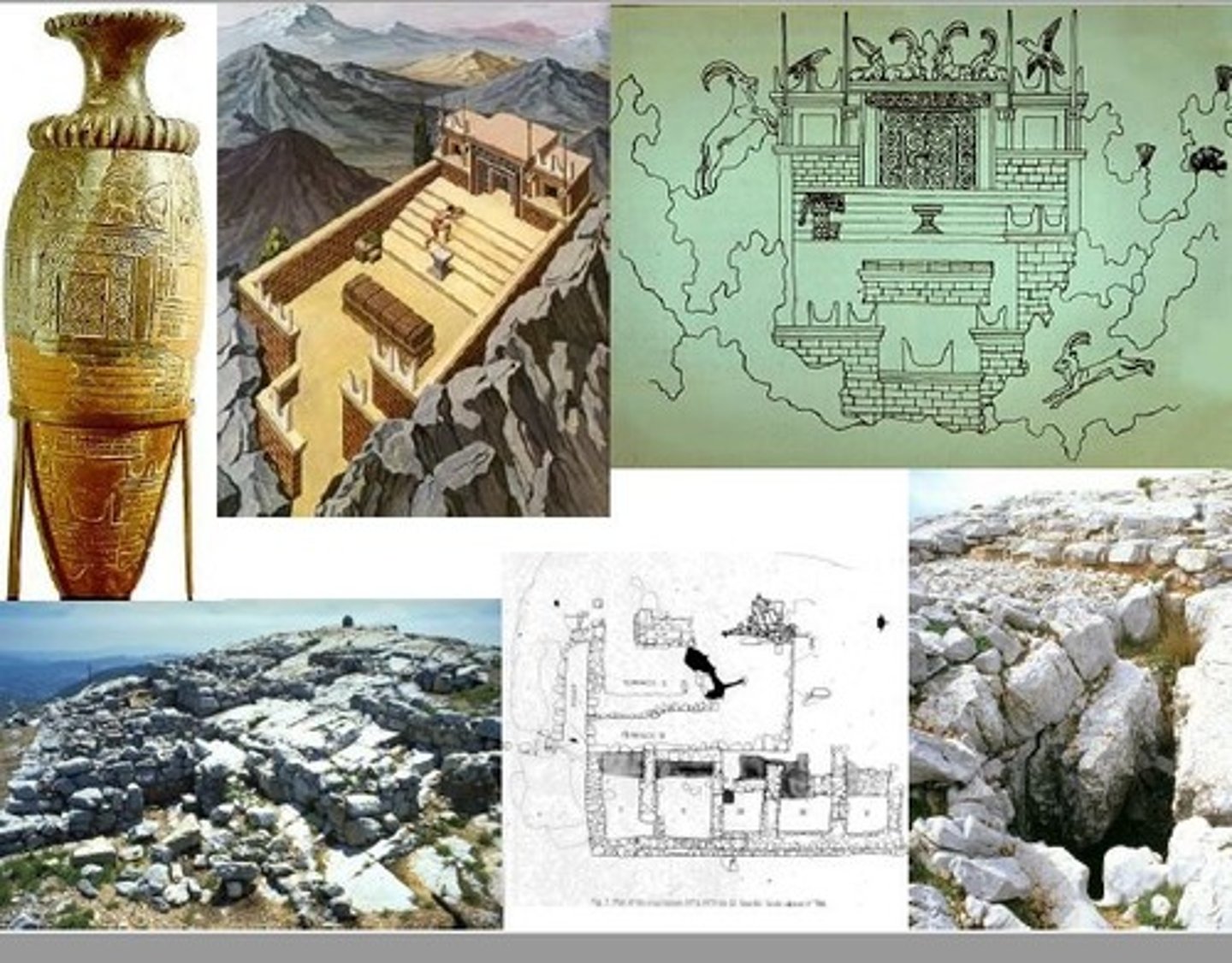
<p>- Minoan open-air sacred sites built on mountain peaks across Crete and the Aegean islands</p><p>- Worshippers left votive offerings including clay figurines of humans, animals, and body parts</p><p>- Likely served as places to communicate with deities overseeing agriculture and healing</p><p>- Visible from surrounding settlements, suggesting a communal and landscape-based religion</p><p>- Over 25 peak sanctuaries have been identified on Crete alone</p>
10
New cards

Pithos

- Large ceramic storage jars used throughout the ancient Aegean, Near East, and Mediterranean

- Could be 1-2 meters tall and hold hundreds of liters of oil, grain, wine, or other goods

- Found in large numbers in Minoan palace storerooms, indicating centralized economic control

- Made using coil-building technique and often decorated with rope-pattern reliefs

- Crucial evidence for understanding ancient economies and redistribution systems
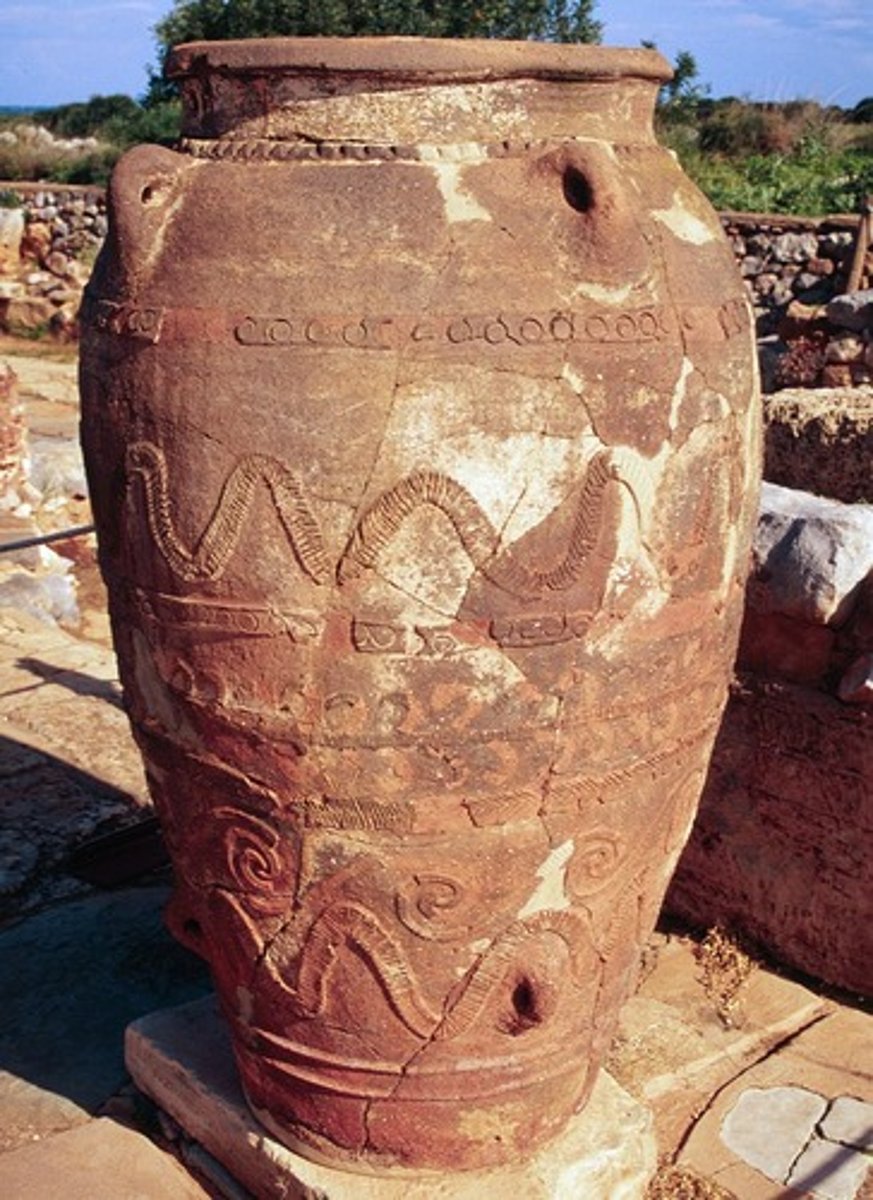
<p>- Large ceramic storage jars used throughout the ancient Aegean, Near East, and Mediterranean</p><p>- Could be 1-2 meters tall and hold hundreds of liters of oil, grain, wine, or other goods</p><p>- Found in large numbers in Minoan palace storerooms, indicating centralized economic control</p><p>- Made using coil-building technique and often decorated with rope-pattern reliefs</p><p>- Crucial evidence for understanding ancient economies and redistribution systems</p>
11
New cards

Pompeiian graffiti

- Thousands of inscriptions scratched or painted on walls throughout Pompeii

- Include political campaign ads, love declarations, insults, prices, and schedules

- Written in Latin by people of all social classes, including women, freedmen, and slaves

- Provide unparalleled insight into everyday Roman literacy, humor, and social life

- Among the most direct surviving voices of ordinary people from the ancient world

12
New cards

Pompeiian wall painting

- Elaborate frescoes decorating the walls of Pompeian homes and public buildings

- Classified into four styles based on subject and technique (architectural illusions, myths, landscapes)

- Subjects include gods, myths, erotic scenes, still lifes, and trompe-l'oeil architecture

- Preserved by Vesuvius's ash — the best-surviving examples of Roman decorative painting

- Offer evidence of wealth, artistic taste, and Roman pictorial conventions
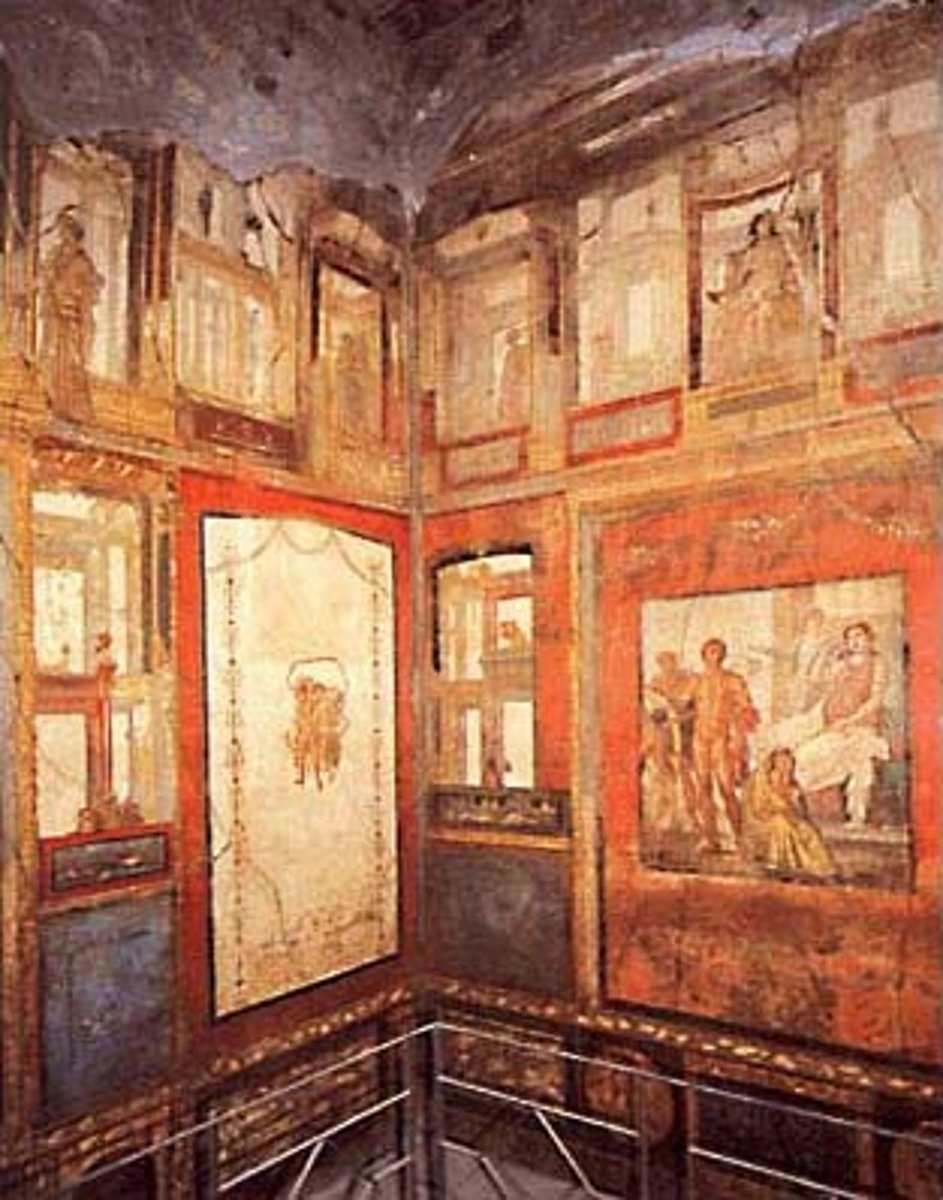
<p>- Elaborate frescoes decorating the walls of Pompeian homes and public buildings</p><p>- Classified into four styles based on subject and technique (architectural illusions, myths, landscapes)</p><p>- Subjects include gods, myths, erotic scenes, still lifes, and trompe-l'oeil architecture</p><p>- Preserved by Vesuvius's ash — the best-surviving examples of Roman decorative painting</p><p>- Offer evidence of wealth, artistic taste, and Roman pictorial conventions</p>
13
New cards

Red-figure pottery

- A Greek pottery style where figures are left in the reddish clay color against a black background

- Invented in Athens around 530 BCE, replacing black-figure technique

- Allowed painters to draw internal details with a brush, enabling more naturalistic figures

- Depicted myths, athletics, symposia, and daily life with great anatomical detail

- Dominated Greek pottery production until the 3rd century BCE
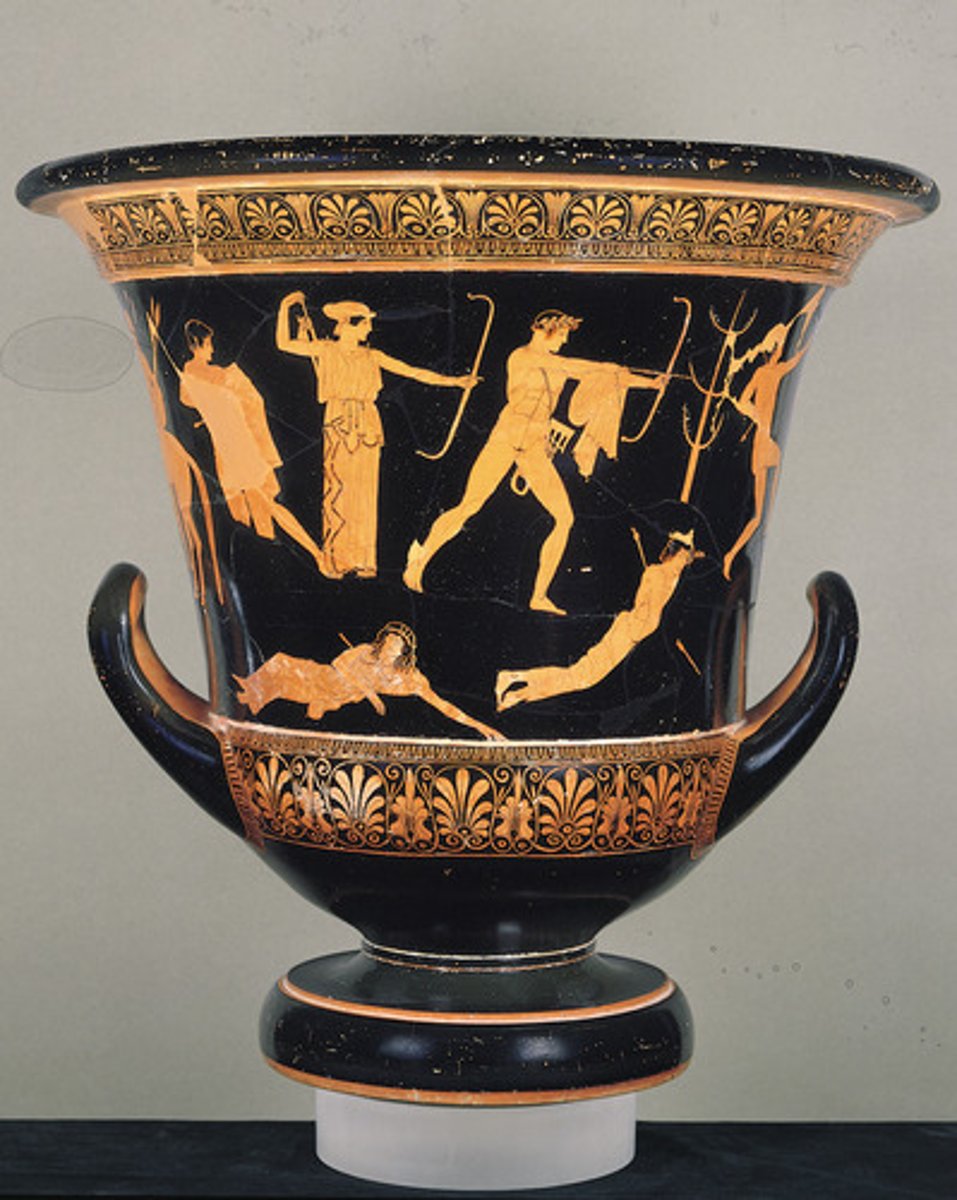
<p>- A Greek pottery style where figures are left in the reddish clay color against a black background</p><p>- Invented in Athens around 530 BCE, replacing black-figure technique</p><p>- Allowed painters to draw internal details with a brush, enabling more naturalistic figures</p><p>- Depicted myths, athletics, symposia, and daily life with great anatomical detail</p><p>- Dominated Greek pottery production until the 3rd century BCE</p>
14
New cards

Shang bronzes

- Elaborate bronze vessels produced by the Shang dynasty (c. 1600-1046 BCE) for ancestor worship rituals

- Made using sophisticated piece-mold casting unique to China, not lost-wax casting

- Shapes include food vessels (ding tripods), wine vessels, and bells, each with specific ritual uses

- Decorated with zoomorphic taotie masks and abstract animal motifs

- Quantity in tombs signaled elite status; among the finest ancient bronzes in the world
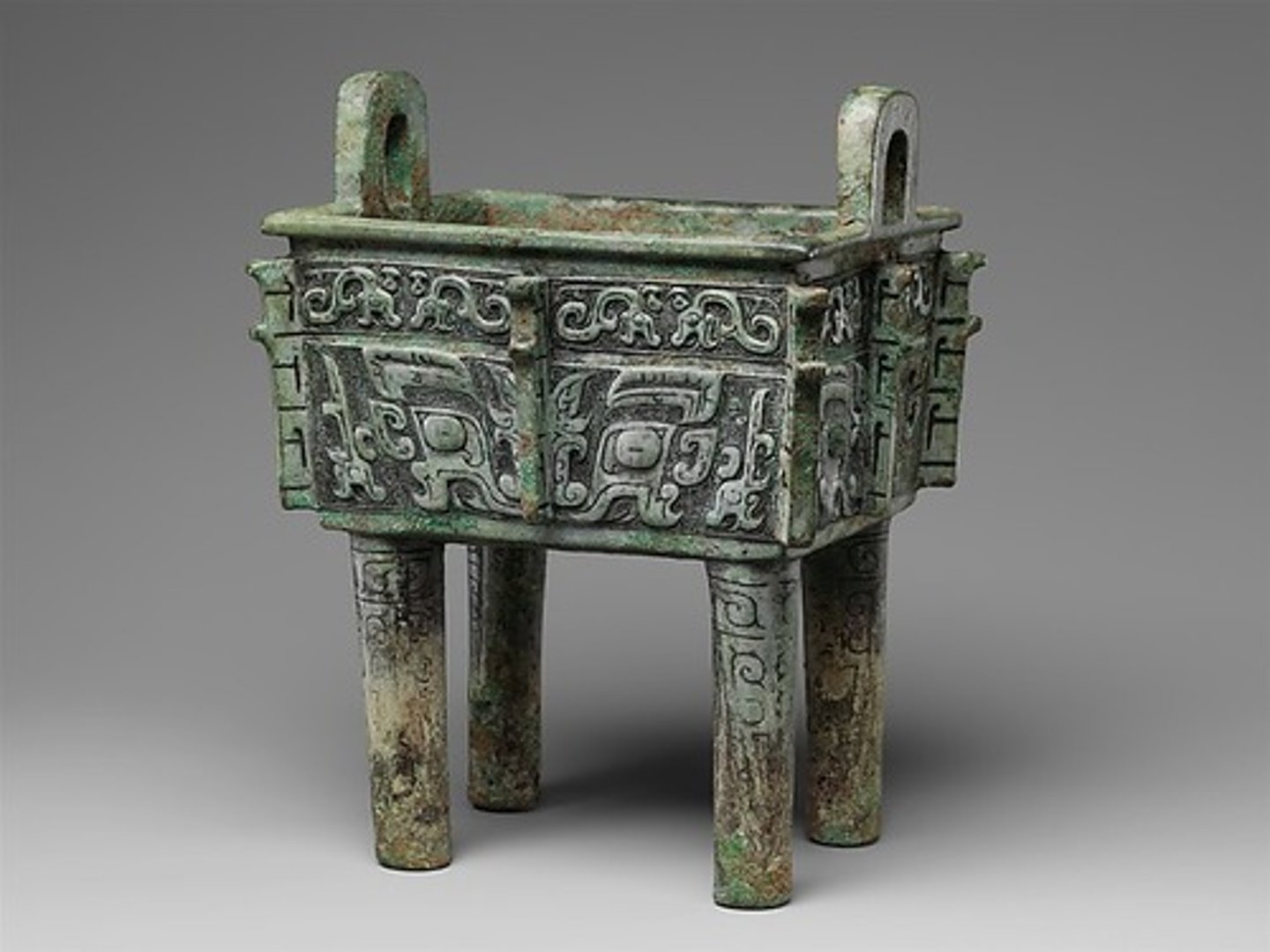
<p>- Elaborate bronze vessels produced by the Shang dynasty (c. 1600-1046 BCE) for ancestor worship rituals</p><p>- Made using sophisticated piece-mold casting unique to China, not lost-wax casting</p><p>- Shapes include food vessels (ding tripods), wine vessels, and bells, each with specific ritual uses</p><p>- Decorated with zoomorphic taotie masks and abstract animal motifs</p><p>- Quantity in tombs signaled elite status; among the finest ancient bronzes in the world</p>
15
New cards

Terracotta Warriors

- An army of over 8,000 life-sized clay soldiers buried with Emperor Qin Shi Huang (d. 210 BCE)

- Each figure is unique, with individual faces, hairstyles, and rank-specific details

- Arranged in military formation in underground pits near the emperor's tomb at Xi'an

- Originally painted in bright colors, now faded after exposure to air

- Discovered in 1974 by farmers digging a well — one of the greatest archaeological finds of the 20th century
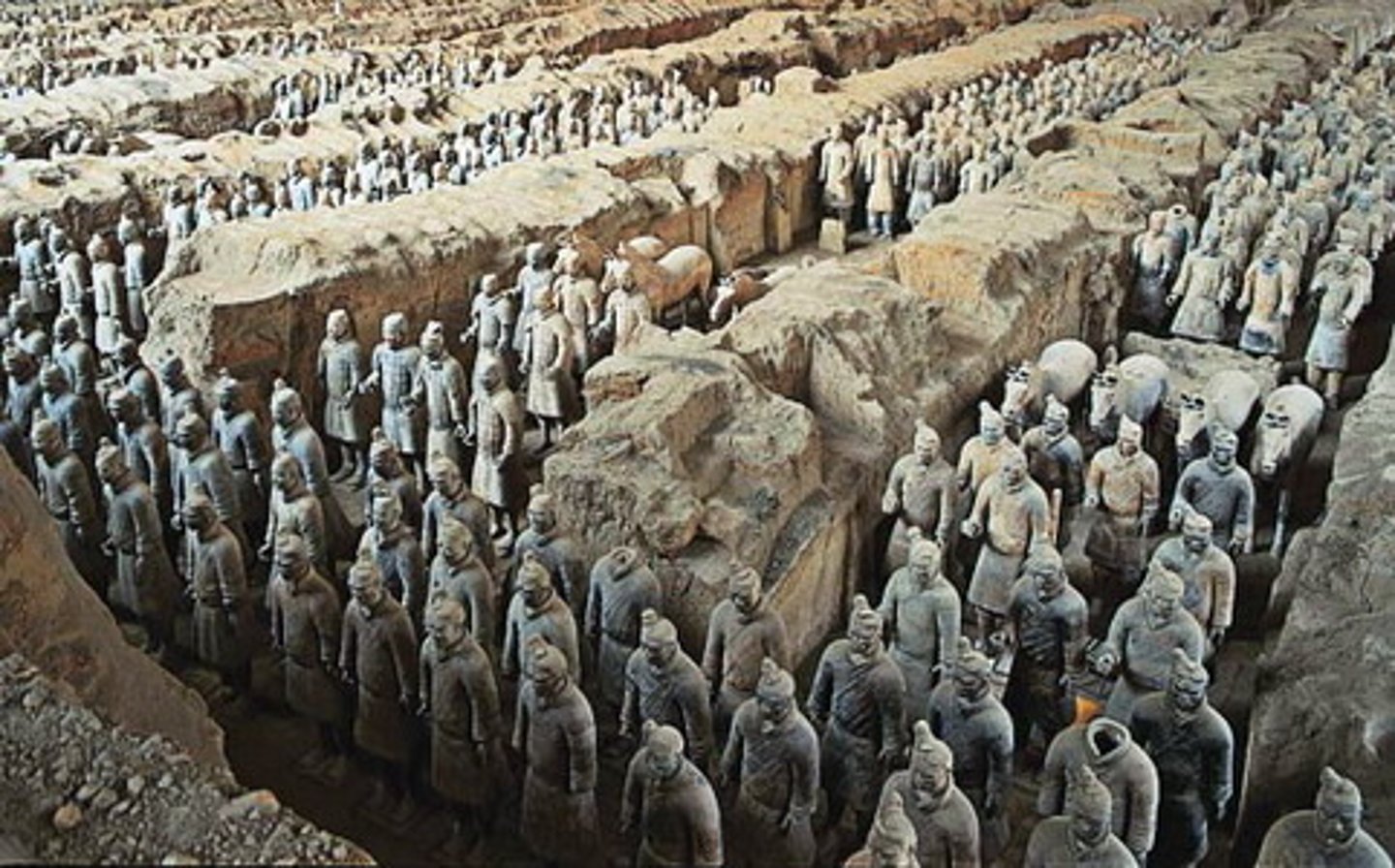
<p>- An army of over 8,000 life-sized clay soldiers buried with Emperor Qin Shi Huang (d. 210 BCE)</p><p>- Each figure is unique, with individual faces, hairstyles, and rank-specific details</p><p>- Arranged in military formation in underground pits near the emperor's tomb at Xi'an</p><p>- Originally painted in bright colors, now faded after exposure to air</p><p>- Discovered in 1974 by farmers digging a well — one of the greatest archaeological finds of the 20th century</p>
16
New cards

Tomb of Rekhmire

- The elaborately painted tomb of Rekhmire, Vizier of Egypt under Thutmose III (c. 1450 BCE)

- Wall paintings depict the duties of the vizier, tax collection, workshops, and foreign tribute

- Tribute scenes show delegations from Nubia, Punt, Crete, and Syria bringing exotic goods

- Provides exceptional detail about New Kingdom Egyptian administration, trade, and craft production

- Located in the Theban Necropolis (Luxor) on the west bank of the Nile
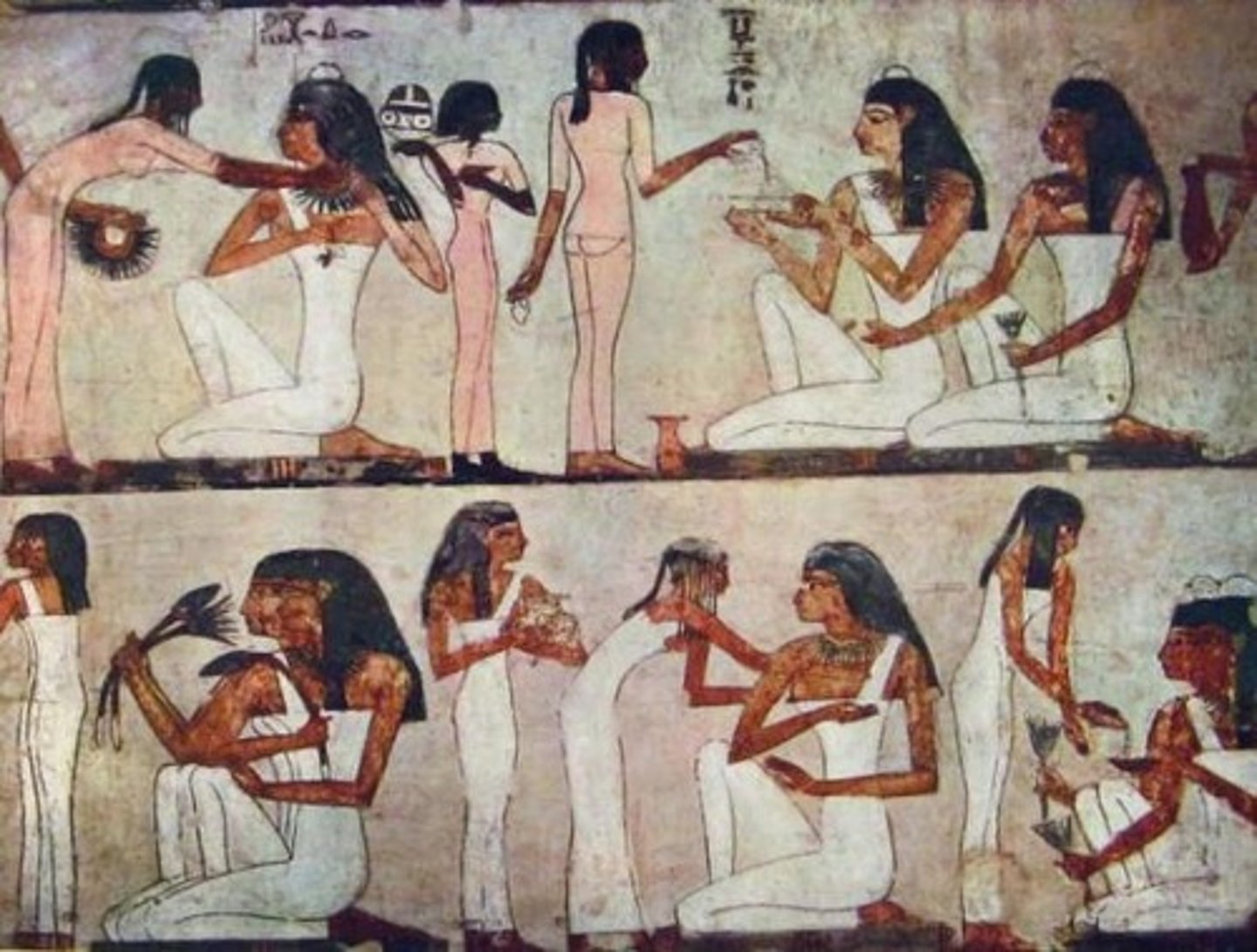
<p>- The elaborately painted tomb of Rekhmire, Vizier of Egypt under Thutmose III (c. 1450 BCE)</p><p>- Wall paintings depict the duties of the vizier, tax collection, workshops, and foreign tribute</p><p>- Tribute scenes show delegations from Nubia, Punt, Crete, and Syria bringing exotic goods</p><p>- Provides exceptional detail about New Kingdom Egyptian administration, trade, and craft production</p><p>- Located in the Theban Necropolis (Luxor) on the west bank of the Nile</p>
17
New cards

Tomb of Tutankhamun

- The nearly intact royal tomb of boy pharaoh Tutankhamun (d. c. 1323 BCE), discovered by Howard Carter in 1922

- Located in the Valley of the Kings and contained over 5,000 artifacts including a solid gold inner coffin

- The famous gold death mask is one of the most iconic objects in world archaeology

- Tutankhamun died young (~18-19 years old) and his tomb may have been hastily prepared

- Its discovery was a global sensation and sparked renewed popular interest in Egyptology
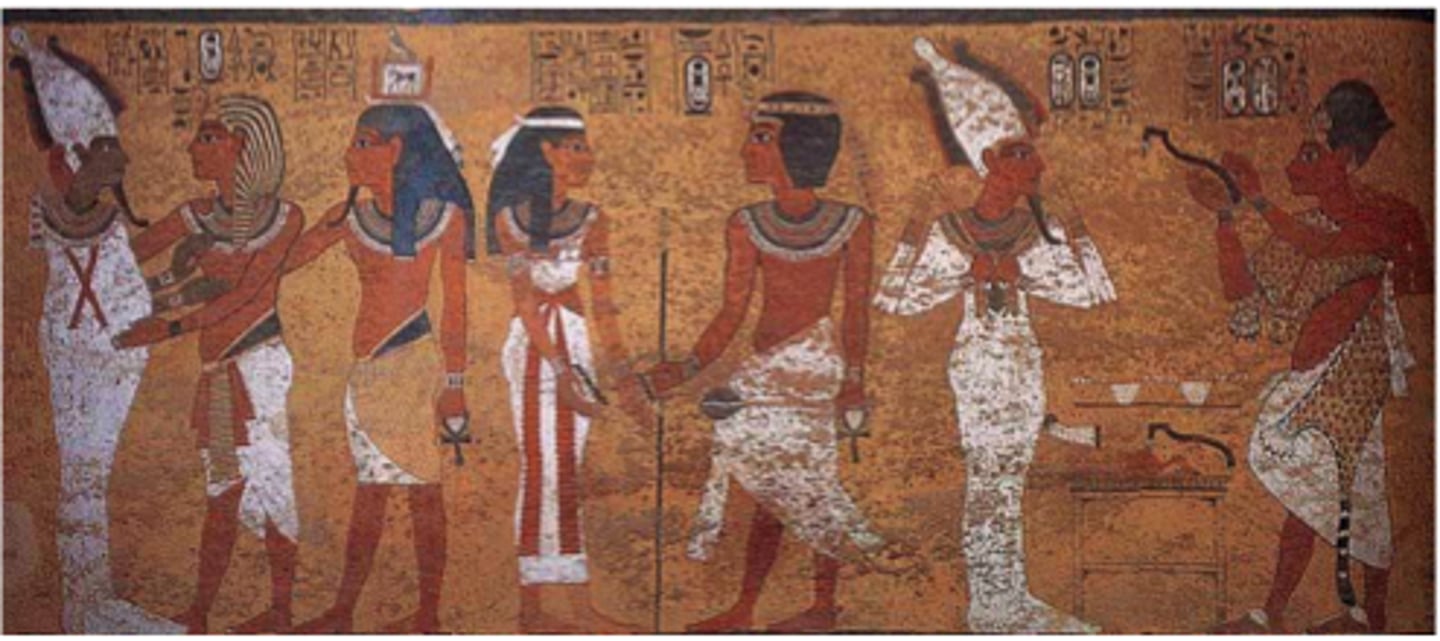
<p>- The nearly intact royal tomb of boy pharaoh Tutankhamun (d. c. 1323 BCE), discovered by Howard Carter in 1922</p><p>- Located in the Valley of the Kings and contained over 5,000 artifacts including a solid gold inner coffin</p><p>- The famous gold death mask is one of the most iconic objects in world archaeology</p><p>- Tutankhamun died young (~18-19 years old) and his tomb may have been hastily prepared</p><p>- Its discovery was a global sensation and sparked renewed popular interest in Egyptology</p>
18
New cards

Uluburun

- A Late Bronze Age shipwreck discovered off the coast of Turkey near Uluburun, dating to c. 1300 BCE

- Cargo included copper and tin ingots, ebony, ivory, glass, amber, scarabs, and luxury goods

- Provides the clearest evidence of long-distance Bronze Age Mediterranean trade networks

- The ship was likely Canaanite; passengers carried objects from at least 7 distinct cultures

- Excavated 1984-1994 by the Institute of Nautical Archaeology in over 22,000 dives
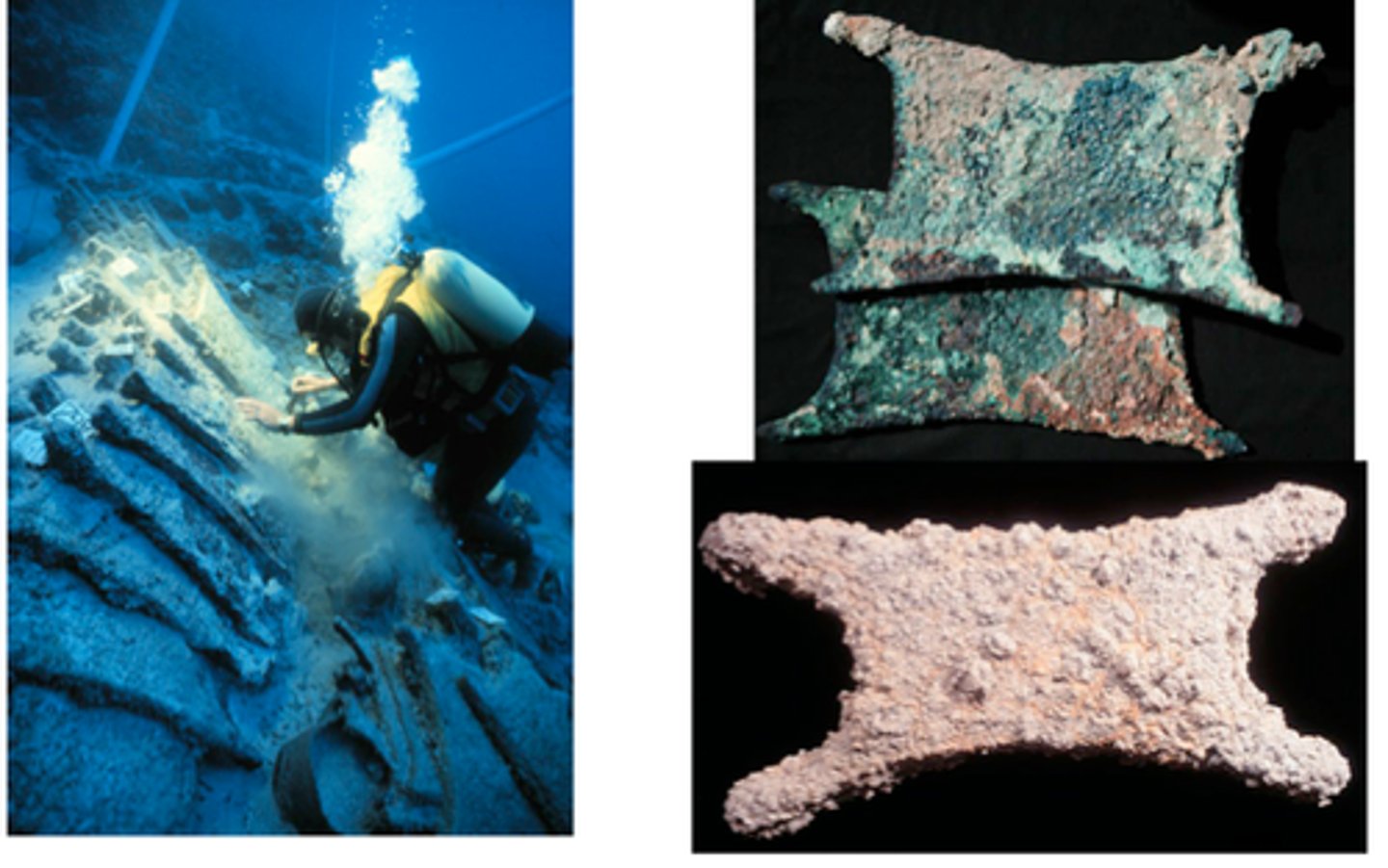
<p>- A Late Bronze Age shipwreck discovered off the coast of Turkey near Uluburun, dating to c. 1300 BCE</p><p>- Cargo included copper and tin ingots, ebony, ivory, glass, amber, scarabs, and luxury goods</p><p>- Provides the clearest evidence of long-distance Bronze Age Mediterranean trade networks</p><p>- The ship was likely Canaanite; passengers carried objects from at least 7 distinct cultures</p><p>- Excavated 1984-1994 by the Institute of Nautical Archaeology in over 22,000 dives</p>
19
New cards

Acropolis

- A fortified hilltop ('high city') in Athens, used as a citadel and religious sanctuary

- Construction of the main monuments dates to the 5th century BCE under Pericles

- Houses the Parthenon, Erechtheion, and Propylaea

- Served as both a place of worship and a symbol of Athenian civic pride

- Still one of the best-preserved examples of Classical Greek architecture
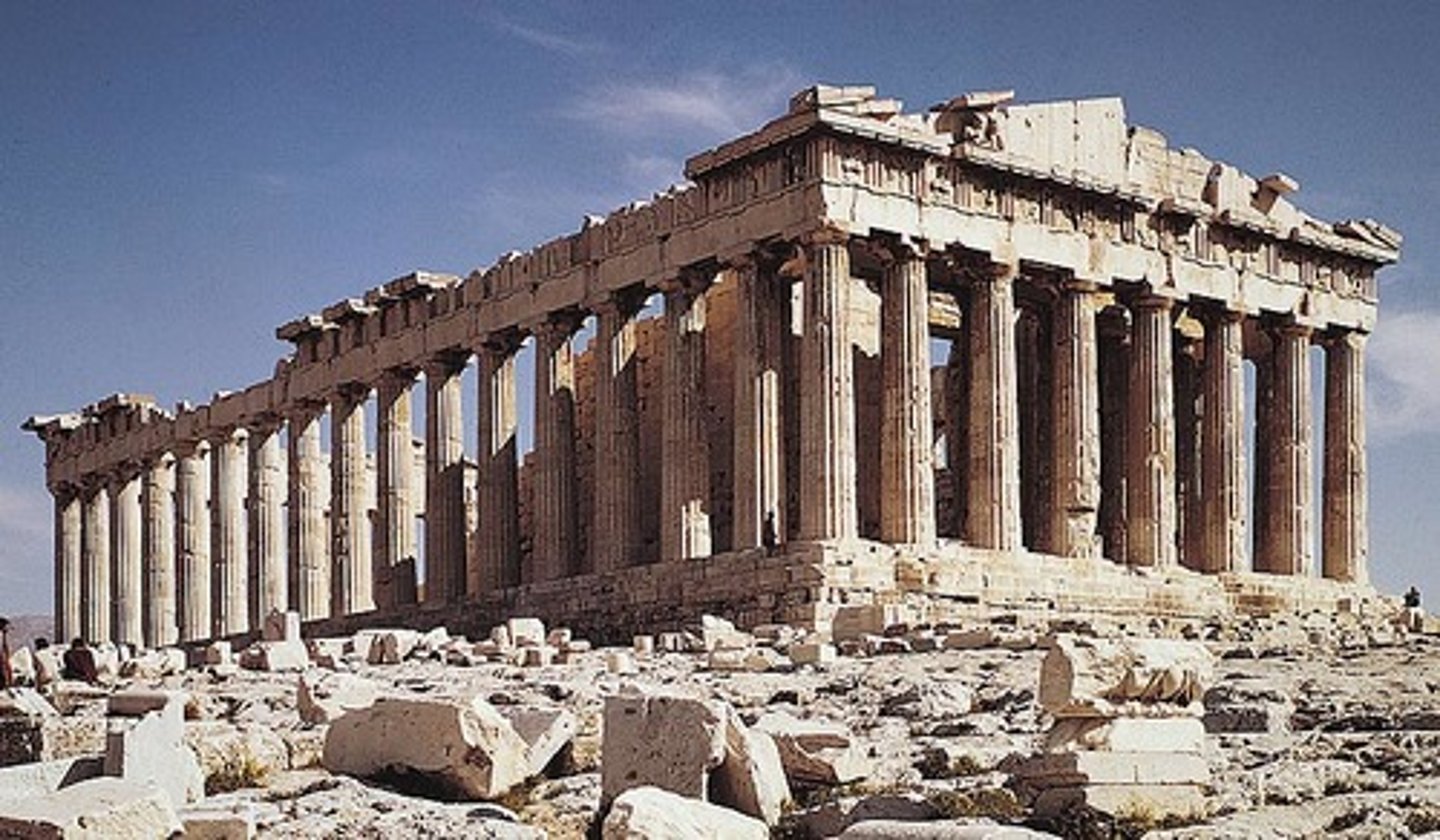
<p>- A fortified hilltop ('high city') in Athens, used as a citadel and religious sanctuary</p><p>- Construction of the main monuments dates to the 5th century BCE under Pericles</p><p>- Houses the Parthenon, Erechtheion, and Propylaea</p><p>- Served as both a place of worship and a symbol of Athenian civic pride</p><p>- Still one of the best-preserved examples of Classical Greek architecture</p>
20
New cards

Agora

- The central public space of a Greek city, used for commerce, politics, and socializing

- Athens' Agora featured temples, law courts, administrative buildings, and market stalls

- Philosophers like Socrates taught and debated here

- Archaeological excavations have uncovered pottery, coins, inscriptions, and administrative records

- Reflects the democratic, civic nature of Greek urban life
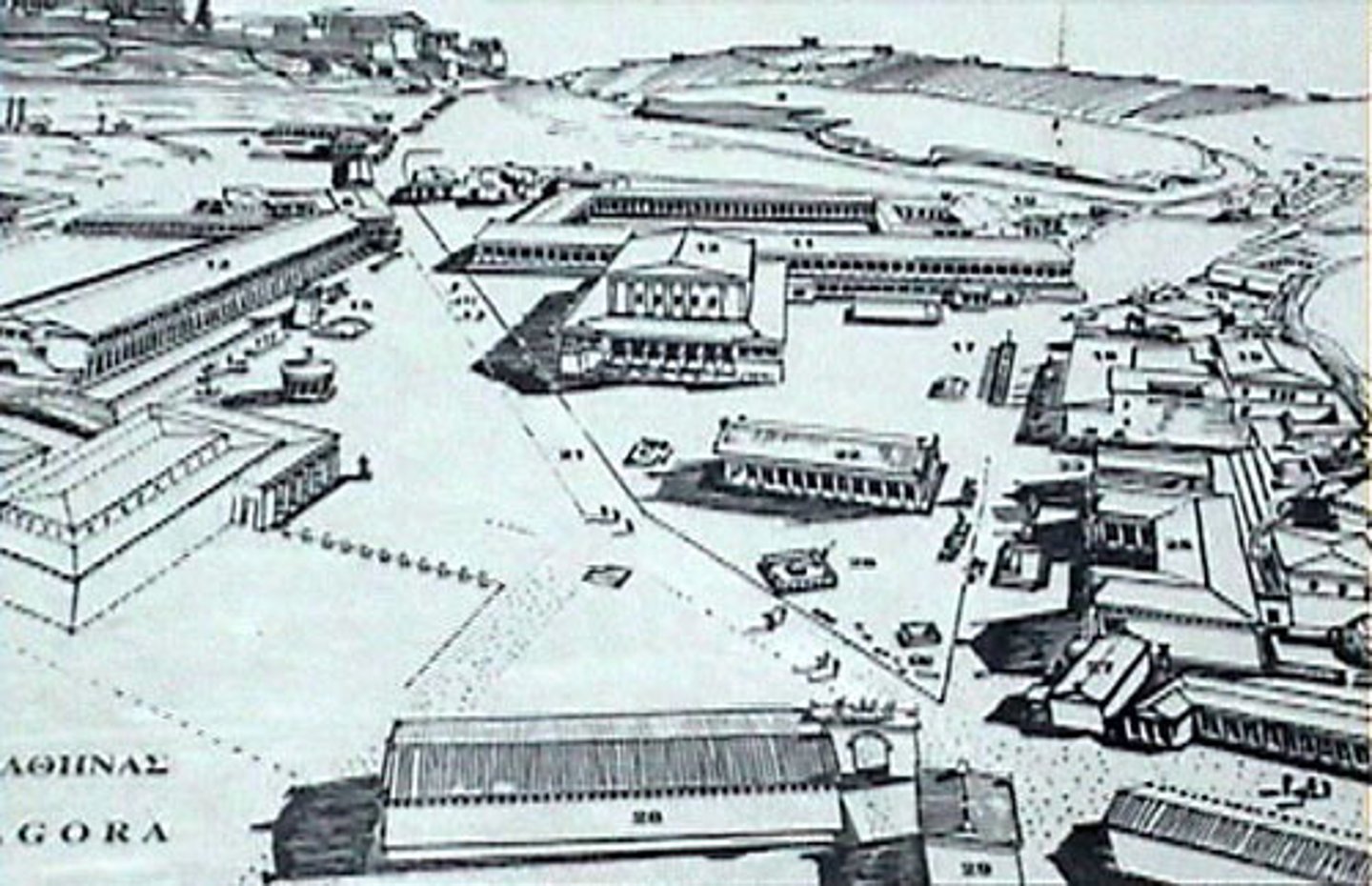
<p>- The central public space of a Greek city, used for commerce, politics, and socializing</p><p>- Athens' Agora featured temples, law courts, administrative buildings, and market stalls</p><p>- Philosophers like Socrates taught and debated here</p><p>- Archaeological excavations have uncovered pottery, coins, inscriptions, and administrative records</p><p>- Reflects the democratic, civic nature of Greek urban life</p>
21
New cards

Amphitheater

- An oval or elliptical open-air venue used in the Roman world for gladiatorial combat and spectacles

- The Colosseum in Rome (completed 80 CE) is the most famous example, seating ~50,000

- Built with arched stone construction using concrete and travertine

- Reflects Roman values of public entertainment and imperial display

- Pompeii's amphitheater (c. 70 BCE) is one of the oldest surviving examples
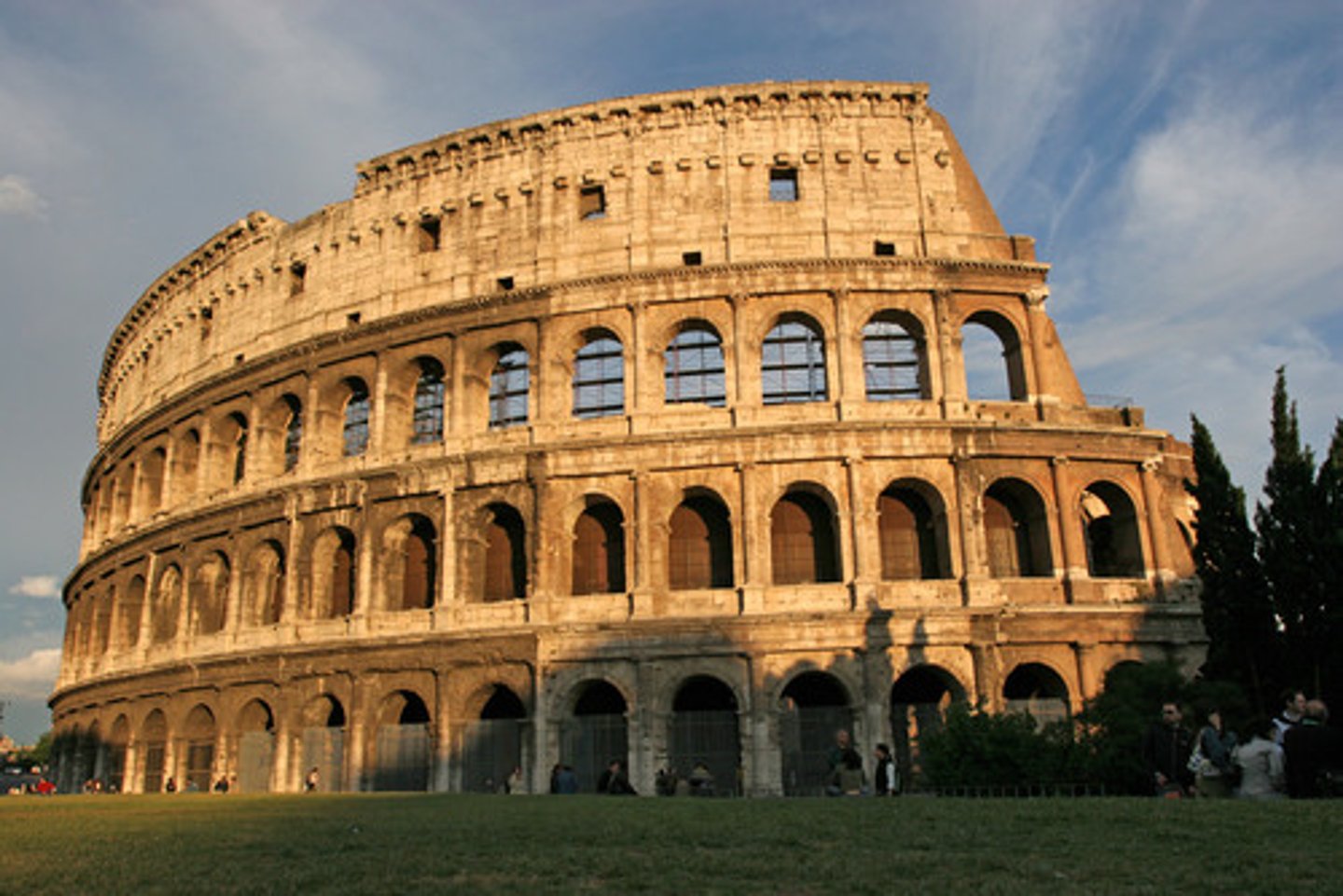
<p>- An oval or elliptical open-air venue used in the Roman world for gladiatorial combat and spectacles</p><p>- The Colosseum in Rome (completed 80 CE) is the most famous example, seating ~50,000</p><p>- Built with arched stone construction using concrete and travertine</p><p>- Reflects Roman values of public entertainment and imperial display</p><p>- Pompeii's amphitheater (c. 70 BCE) is one of the oldest surviving examples</p>
22
New cards

Djoser's Stepped Pyramid complex

- Built for Pharaoh Djoser at Saqqara around 2650 BCE by architect Imhotep

- The first monumental stone structure in Egypt — a revolutionary architectural achievement

- Consists of six mastaba-like steps rising to ~60 meters

- Surrounded by a large walled funerary complex with temples and dummy buildings

- Marked the beginning of Egypt's pyramid-building tradition
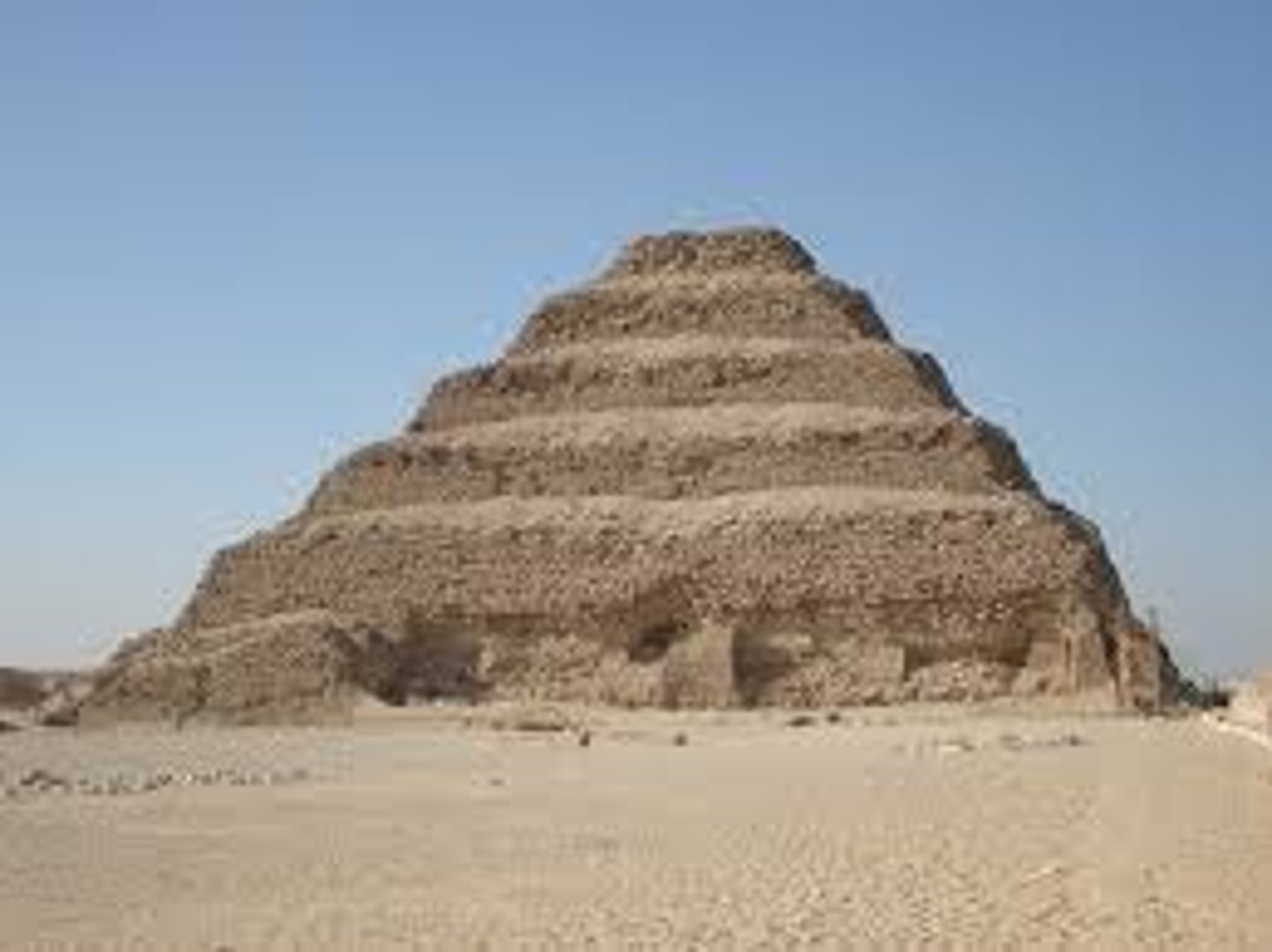
<p>- Built for Pharaoh Djoser at Saqqara around 2650 BCE by architect Imhotep</p><p>- The first monumental stone structure in Egypt — a revolutionary architectural achievement</p><p>- Consists of six mastaba-like steps rising to ~60 meters</p><p>- Surrounded by a large walled funerary complex with temples and dummy buildings</p><p>- Marked the beginning of Egypt's pyramid-building tradition</p>
23
New cards

Forum

- The central public space of a Roman city, equivalent to the Greek agora

- Rome's Forum Romanum was the political, religious, and commercial heart of the city

- Featured temples, basilicas (law courts), and the rostra (speaker's platform)

- Smaller forums were built in every Roman city throughout the empire

- Pompeii's Forum was paved with marble and flanked by temples and civic buildings
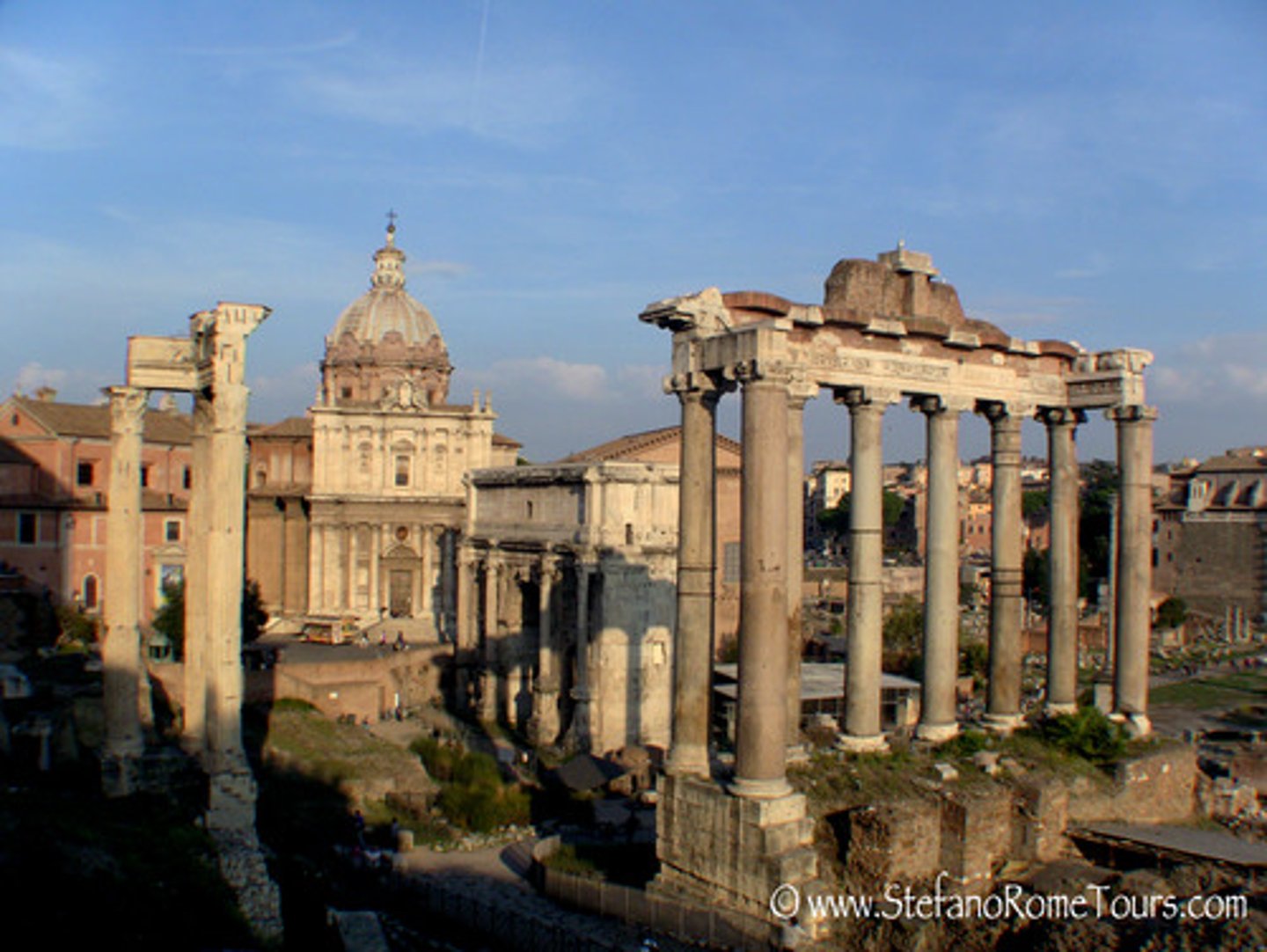
<p>- The central public space of a Roman city, equivalent to the Greek agora</p><p>- Rome's Forum Romanum was the political, religious, and commercial heart of the city</p><p>- Featured temples, basilicas (law courts), and the rostra (speaker's platform)</p><p>- Smaller forums were built in every Roman city throughout the empire</p><p>- Pompeii's Forum was paved with marble and flanked by temples and civic buildings</p>
24
New cards

Giza Pyramids

- Three large pyramids built for pharaohs Khufu, Khafre, and Menkaure (c. 2560-2510 BCE)

- The Great Pyramid of Khufu is one of the Seven Wonders of the Ancient World

- Built with millions of limestone and granite blocks, some weighing up to 80 tons

- Complex includes causeways, valley temples, and subsidiary pyramids for queens

- Built by organized, well-fed workers — not slaves, per Heit-el-Ghurab excavations
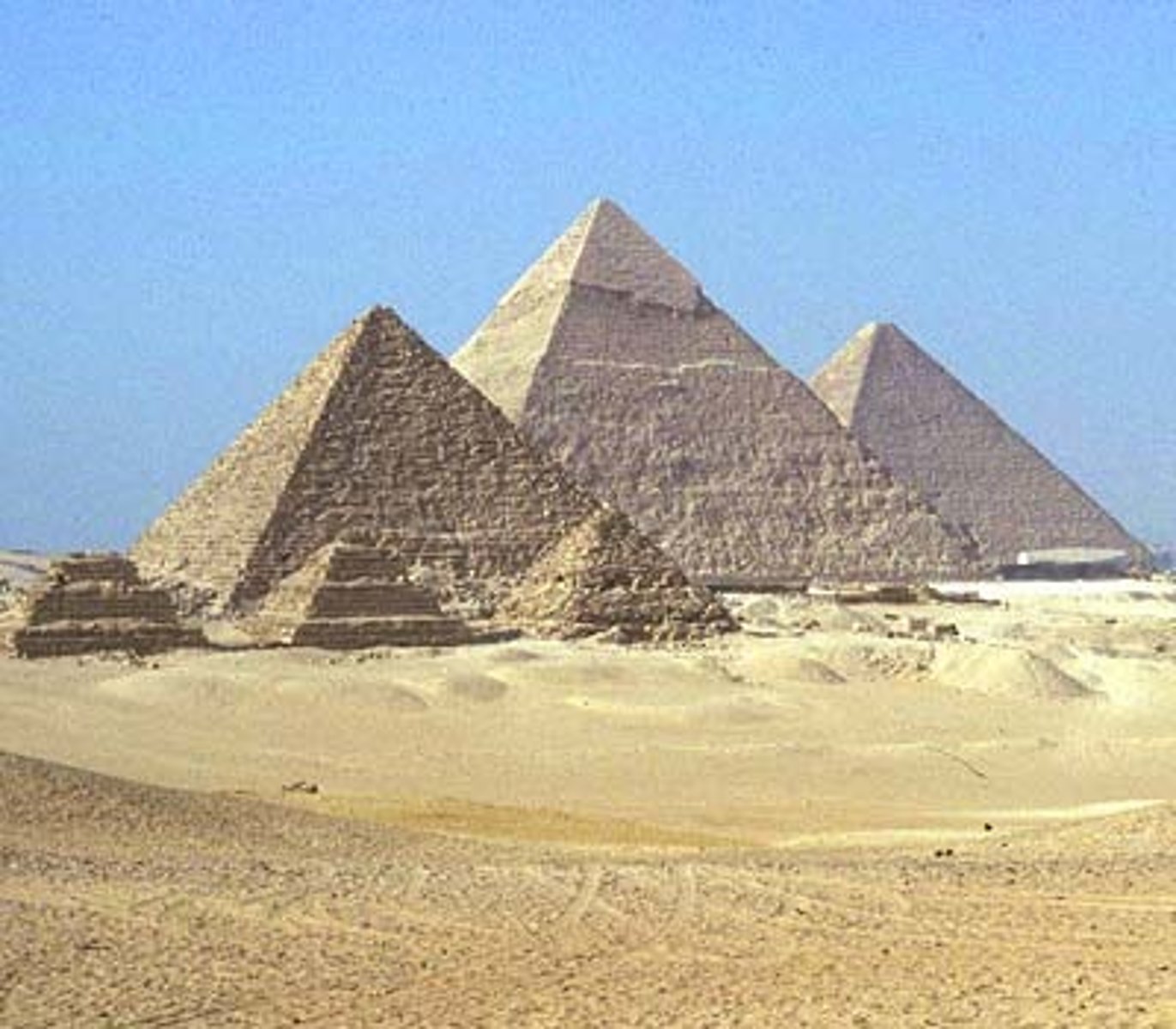
<p>- Three large pyramids built for pharaohs Khufu, Khafre, and Menkaure (c. 2560-2510 BCE)</p><p>- The Great Pyramid of Khufu is one of the Seven Wonders of the Ancient World</p><p>- Built with millions of limestone and granite blocks, some weighing up to 80 tons</p><p>- Complex includes causeways, valley temples, and subsidiary pyramids for queens</p><p>- Built by organized, well-fed workers — not slaves, per Heit-el-Ghurab excavations</p>
25
New cards

Giza Sphinx

- A colossal limestone statue with the body of a lion and head of pharaoh Khafre

- Carved around 2500 BCE directly from the bedrock at Giza

- Stands ~73 meters long and ~20 meters tall — the largest monolithic statue in the world

- Associated with the sun god Ra-Horakhty; may have served as guardian of the necropolis

- Heavily eroded; parts like the nose were damaged in post-ancient periods
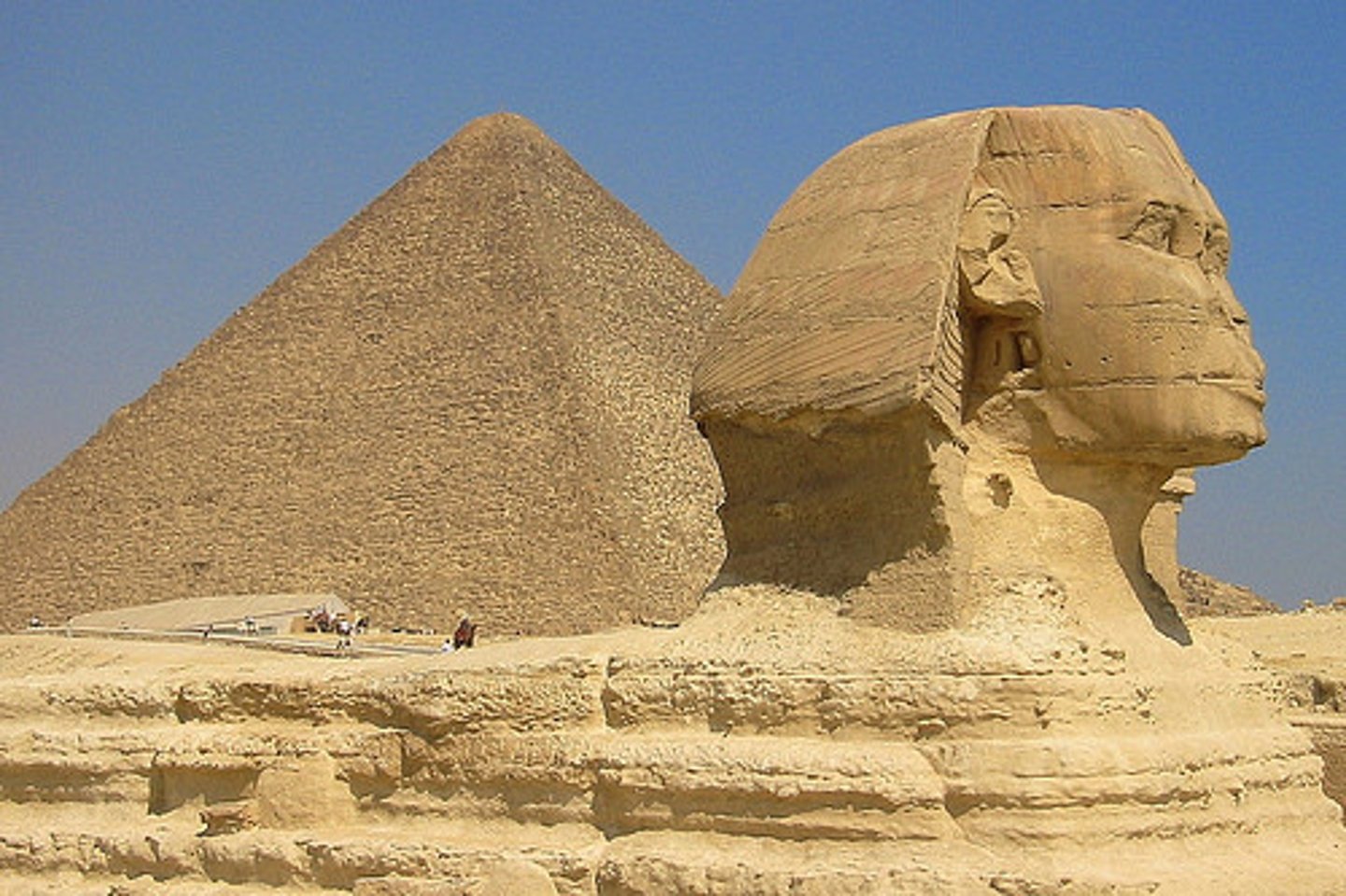
<p>- A colossal limestone statue with the body of a lion and head of pharaoh Khafre</p><p>- Carved around 2500 BCE directly from the bedrock at Giza</p><p>- Stands ~73 meters long and ~20 meters tall — the largest monolithic statue in the world</p><p>- Associated with the sun god Ra-Horakhty; may have served as guardian of the necropolis</p><p>- Heavily eroded; parts like the nose were damaged in post-ancient periods</p>
26
New cards

Greek Temples

- Rectangular stone structures built to house the statue of a deity

- Featured colonnades of columns in Doric, Ionic, or Corinthian orders

- The interior (cella/naos) held the cult statue; worship occurred outside

- Decorated with sculpted friezes, pediments, and painted metopes

- Examples include the Parthenon (Athens) and the Temple of Zeus (Olympia)
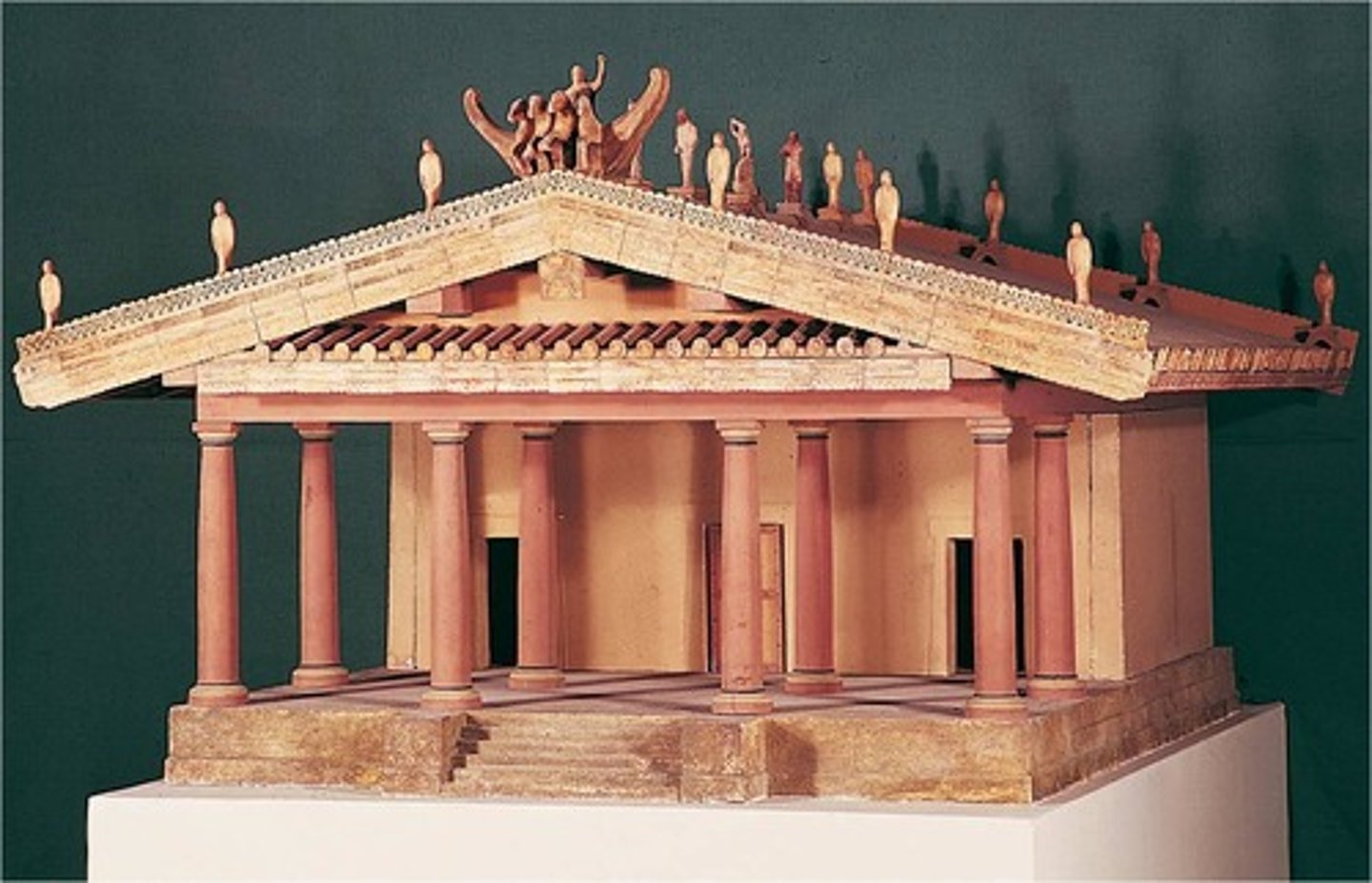
<p>- Rectangular stone structures built to house the statue of a deity</p><p>- Featured colonnades of columns in Doric, Ionic, or Corinthian orders</p><p>- The interior (cella/naos) held the cult statue; worship occurred outside</p><p>- Decorated with sculpted friezes, pediments, and painted metopes</p><p>- Examples include the Parthenon (Athens) and the Temple of Zeus (Olympia)</p>
27
New cards

Greek Theaters

- Semicircular open-air performance spaces carved into hillsides for natural acoustics

- Consisted of the orchestra (performance area), theatron (seating), and skene (stage building)

- Used for tragedies, comedies, and religious festivals honoring Dionysus

- The Theater of Epidaurus (c. 350 BCE) is the best-preserved, seating 14,000

- Drama was a civic and religious activity attended by much of the citizen population
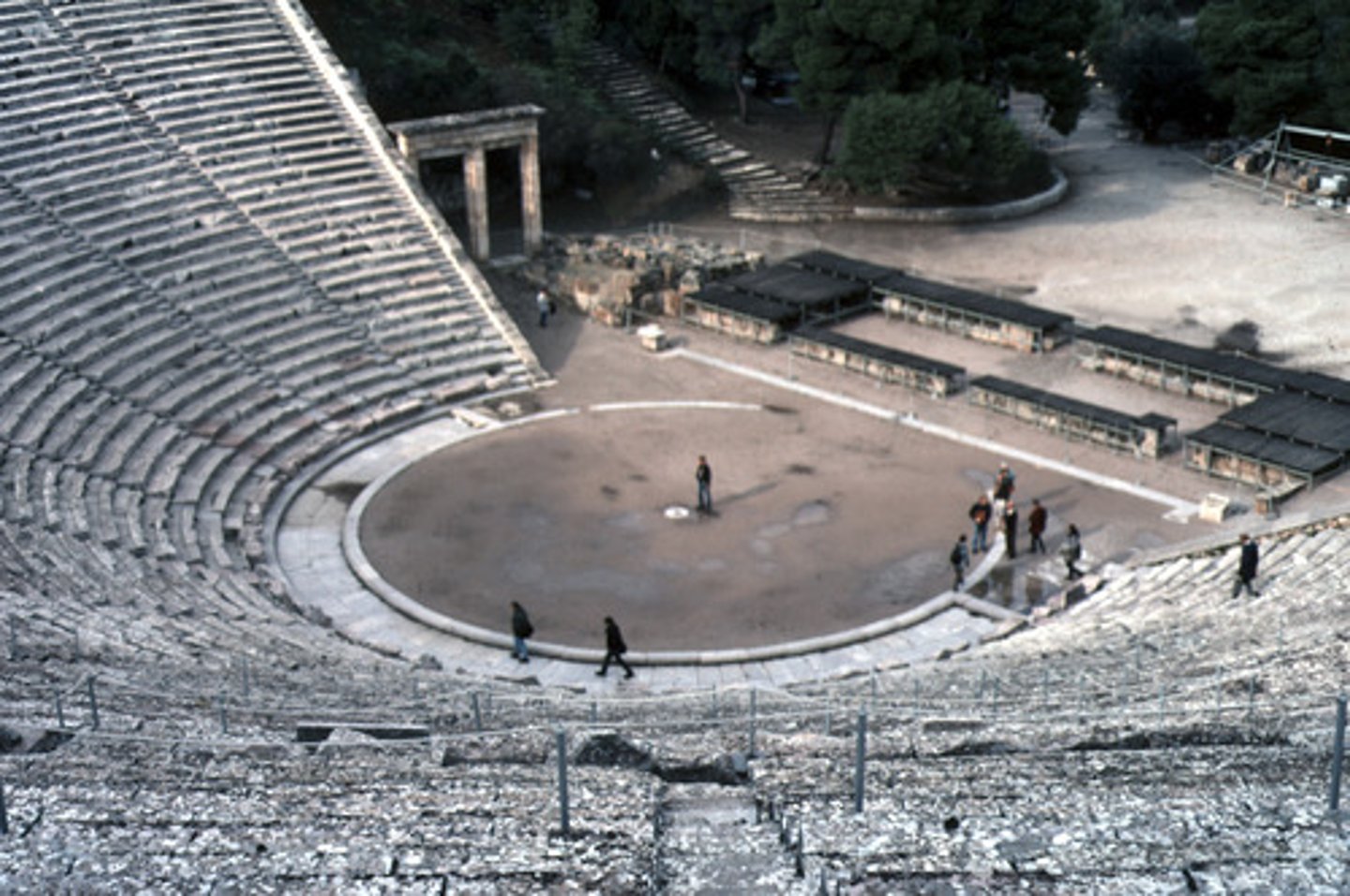
<p>- Semicircular open-air performance spaces carved into hillsides for natural acoustics</p><p>- Consisted of the orchestra (performance area), theatron (seating), and skene (stage building)</p><p>- Used for tragedies, comedies, and religious festivals honoring Dionysus</p><p>- The Theater of Epidaurus (c. 350 BCE) is the best-preserved, seating 14,000</p><p>- Drama was a civic and religious activity attended by much of the citizen population</p>
28
New cards

Minoan Palaces

- Large multi-story administrative and ceremonial complexes on Crete (e.g., Knossos, Phaistos)

- Organized around a large central courtyard, with storerooms, workshops, and shrines

- Functioned as economic redistribution centers controlling the flow of goods

- Decorated with vivid frescoes depicting nature, bull-leaping, and religious ceremonies

- Destroyed and rebuilt multiple times — possible link to the legend of the Labyrinth
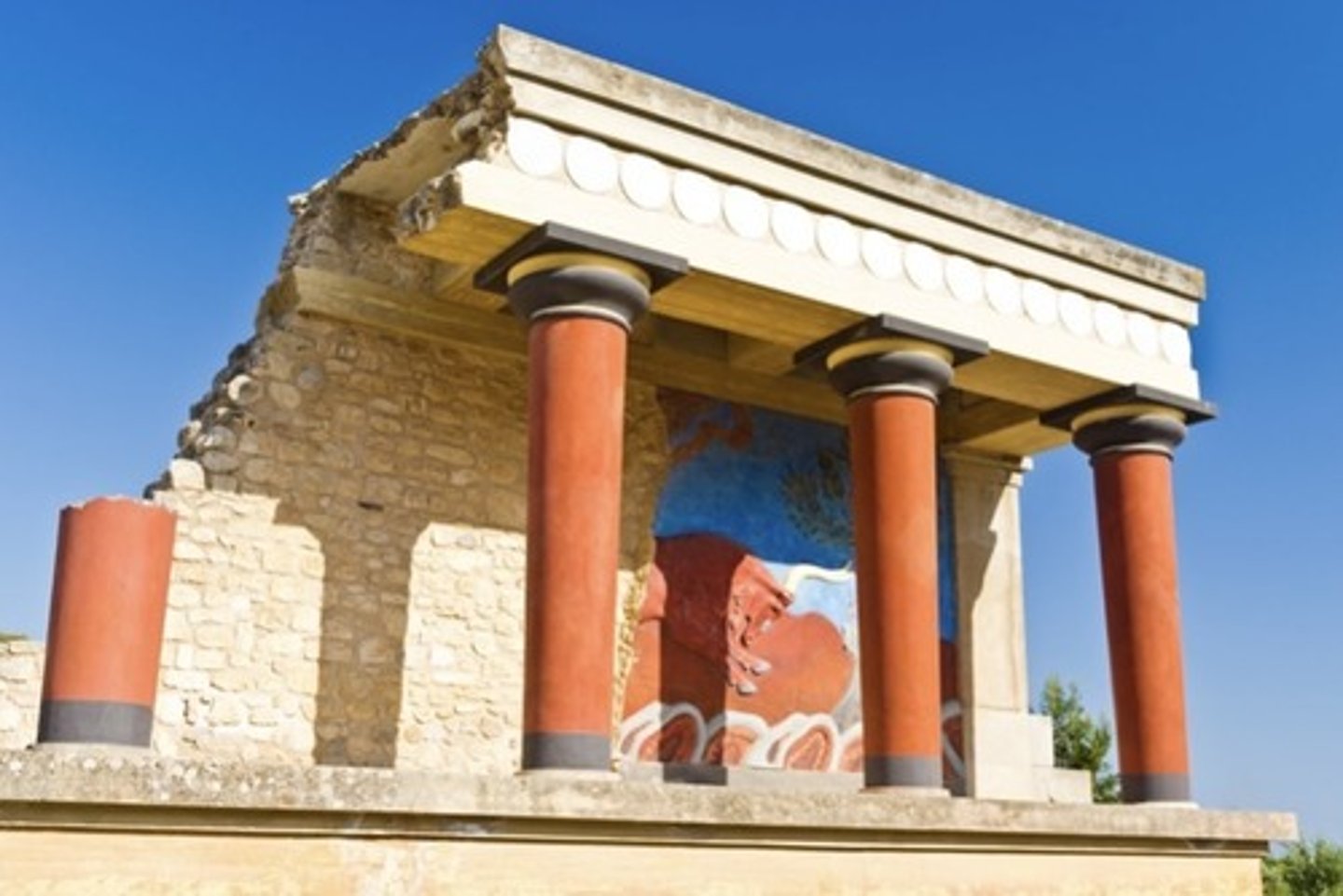
<p>- Large multi-story administrative and ceremonial complexes on Crete (e.g., Knossos, Phaistos)</p><p>- Organized around a large central courtyard, with storerooms, workshops, and shrines</p><p>- Functioned as economic redistribution centers controlling the flow of goods</p><p>- Decorated with vivid frescoes depicting nature, bull-leaping, and religious ceremonies</p><p>- Destroyed and rebuilt multiple times — possible link to the legend of the Labyrinth</p>
29
New cards

Parthenon

- A Doric temple on the Athenian Acropolis dedicated to Athena, built 447-432 BCE

- Designed by architects Ictinus and Callicrates under sculptor Pheidias

- Housed a colossal ivory and gold statue of Athena (now lost)

- Its sculpted friezes depicted the Panathenaic procession and mythological battles

- Considered the pinnacle of Classical Greek architecture and symbol of Athenian democracy
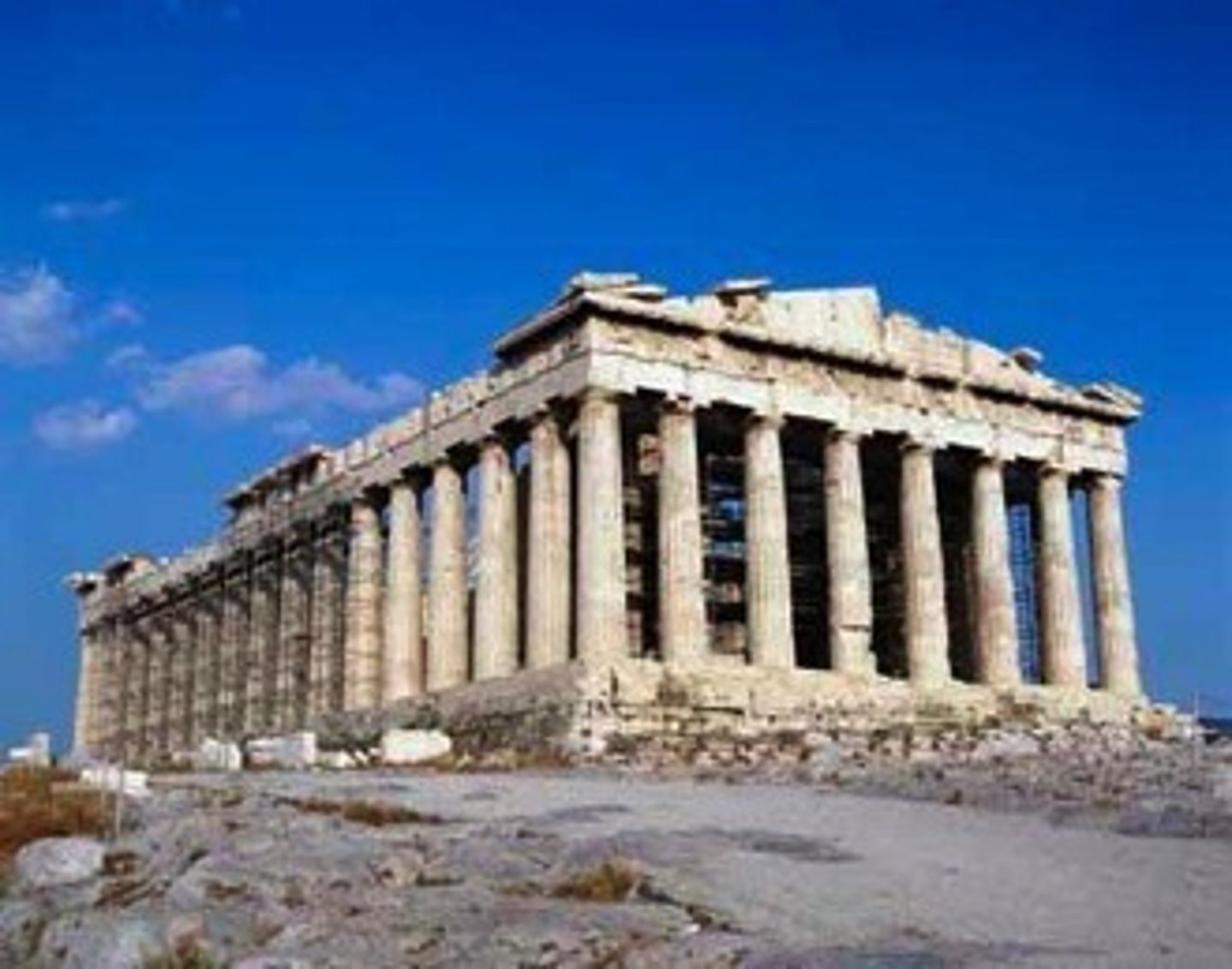
<p>- A Doric temple on the Athenian Acropolis dedicated to Athena, built 447-432 BCE</p><p>- Designed by architects Ictinus and Callicrates under sculptor Pheidias</p><p>- Housed a colossal ivory and gold statue of Athena (now lost)</p><p>- Its sculpted friezes depicted the Panathenaic procession and mythological battles</p><p>- Considered the pinnacle of Classical Greek architecture and symbol of Athenian democracy</p>
30
New cards

Roman baths

- Public bathing complexes (thermae) central to Roman social and civic life

- Rooms followed a sequence: apodyterium (changing), frigidarium (cold), tepidarium (warm), caldarium (hot)

- Often also included gymnasiums, libraries, shops, and gardens

- Heated by an underfloor hypocaust system circulating hot air

- Served all social classes and were gathering places for exercise and socializing
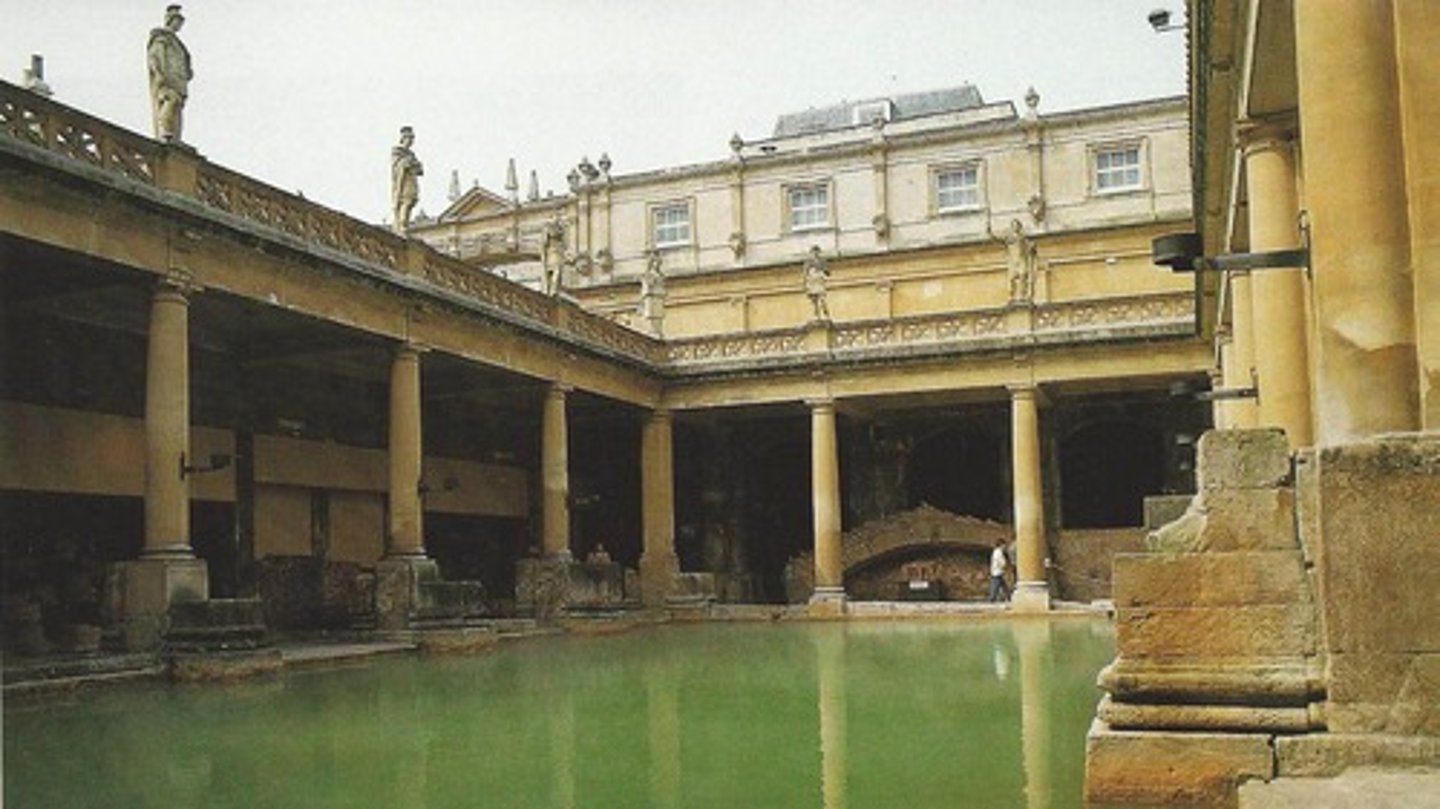
<p>- Public bathing complexes (thermae) central to Roman social and civic life</p><p>- Rooms followed a sequence: apodyterium (changing), frigidarium (cold), tepidarium (warm), caldarium (hot)</p><p>- Often also included gymnasiums, libraries, shops, and gardens</p><p>- Heated by an underfloor hypocaust system circulating hot air</p><p>- Served all social classes and were gathering places for exercise and socializing</p>
31
New cards

Three pyramids of Sneferu

- Pharaoh Sneferu (c. 2613-2589 BCE) built three major pyramids: Meidum, Bent, and Red

- Each reflects experimental refinements moving from step to true smooth-sided pyramid

- The Bent Pyramid has a distinctive angled shape due to a mid-construction slope change

- The Red Pyramid is considered the first fully successful true pyramid

- Sneferu's pyramids collectively pioneered pyramid architecture for his son Khufu
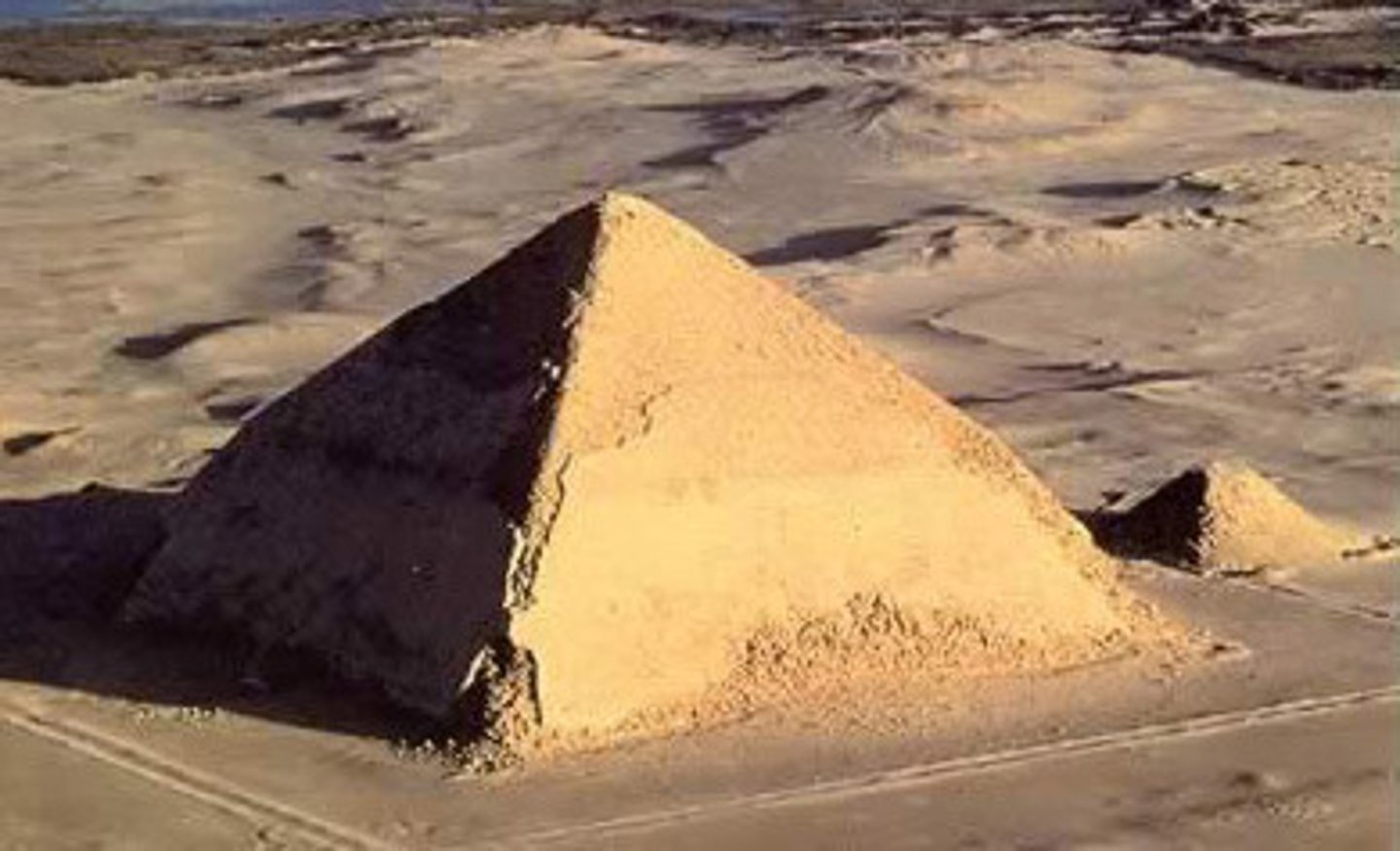
<p>- Pharaoh Sneferu (c. 2613-2589 BCE) built three major pyramids: Meidum, Bent, and Red</p><p>- Each reflects experimental refinements moving from step to true smooth-sided pyramid</p><p>- The Bent Pyramid has a distinctive angled shape due to a mid-construction slope change</p><p>- The Red Pyramid is considered the first fully successful true pyramid</p><p>- Sneferu's pyramids collectively pioneered pyramid architecture for his son Khufu</p>

Explore top notes

note
Unit 1 Health
Updated 454d ago
0.0(0)
note
Design and Tech - Electricity
Updated 1583d ago
0.0(0)
note
The Hate U Give
Updated 1255d ago
0.0(0)
note
Chapter 2: States
Updated 1093d ago
0.0(0)
note
Glaciation
Updated 580d ago
0.0(0)
note
The Geography of Food and Health
Updated 107d ago
0.0(0)
note
unit 7 study guide
Updated 415d ago
0.0(0)
note
Unit 1 Health
Updated 454d ago
0.0(0)
note
Design and Tech - Electricity
Updated 1583d ago
0.0(0)
note
The Hate U Give
Updated 1255d ago
0.0(0)
note
Chapter 2: States
Updated 1093d ago
0.0(0)
note
Glaciation
Updated 580d ago
0.0(0)
note
The Geography of Food and Health
Updated 107d ago
0.0(0)
note
unit 7 study guide
Updated 415d ago
0.0(0)

Explore top flashcards

flashcards
TEST no10 CAPITALS
126
Updated 24d ago
0.0(0)
flashcards
AP Human Geography Unit 4b
40
Updated 365d ago
0.0(0)
flashcards
Professionalism and Ethics
25
Updated 919d ago
0.0(0)
flashcards
exam 2 - id
48
Updated 171d ago
0.0(0)
flashcards
Les Français et les loisirs
37
Updated 956d ago
0.0(0)
flashcards
A. [Practice Questions] Part 1
111
Updated 123d ago
0.0(0)
flashcards
Ch. 8 "The Civil War"
45
Updated 419d ago
0.0(0)
flashcards
TEST no10 CAPITALS
126
Updated 24d ago
0.0(0)
flashcards
AP Human Geography Unit 4b
40
Updated 365d ago
0.0(0)
flashcards
Professionalism and Ethics
25
Updated 919d ago
0.0(0)
flashcards
exam 2 - id
48
Updated 171d ago
0.0(0)
flashcards
Les Français et les loisirs
37
Updated 956d ago
0.0(0)
flashcards
A. [Practice Questions] Part 1
111
Updated 123d ago
0.0(0)
flashcards
Ch. 8 "The Civil War"
45
Updated 419d ago
0.0(0)



