Unit One Airplane and Aerodynamics
 Call Kai
 Learn
Learn Practice Test
 Spaced Repetition
 Match
Match Flashcards
 Knowt Play
1/49

There's no tags or description
Looks like no tags are added yet.
Name | Mastery | Learn | Test | Matching | Spaced | Call with Kai |
|---|
No analytics yet
Send a link to your students to track their progress
50 Terms
1. What is one purpose of wing flaps?
To enable the pilot to make steeper approaches to a landing without increasing the airspeed.
To relieve the pilot of maintaining continuous pressure on the controls.
To decrease wing area to vary the lift:
To enable the pilot to make steeper approaches to a landing without increasing the airspeed.
2. One of the main functions of flaps during approach and landing is to
A. decrease the angle of descent without increasing the airspeed.
B. permit a touchdown at a higher indicated airspeed.
C. increase the angle of descent without increasing the airspeed.
increase the angle of descent without increasing the airspeed.
3. What is the purpose of the rudder on an airplane?
To control yaw.
To control overbanking tendency.
To control roll.
To control yaw
4. Which is not a primary flight control surface?
Flaps.
Stabilator.
Ailerons.
Flaps
5. The elevator controls movement around which axis?
Longitudinal.
Lateral.
Vertical.
Lateral
6. Which statement is true concerning primary fight controls?
A. The effectiveness of each control surface increases with speed because there is more airflow over them.
B. Only when all three primary flight controls move in sequence do the airflow and pressure distribution change over and around the airfoil.
C. Primary flight controls include ailerons, rudder, elevator, and trim systems.
The effectiveness of each control surface increases with speed because there is more airflow over them.
7. Which of the following is true concerning flaps?
A. Flaps are attached to the leading edge of the wing and are used to increase wing lift.
B. Flaps allow an increase in the angle of descent without increasing airspeed.
C. Flaps are high drag devices deployed from the wings to reduce lift.
Flaps allow an increase in the angle of descent without increasing airspeed.
8. Which device is a secondary flight control?
Spoilers.
Ailerons.
Stabilators.
Spoilers
9. Trim systems are designed to do what?
A. They relieve the pilot of the need to maintain constant pressure on the flight controls.
B. They are used during approach and landing to increase wing lift.
C. They move in the opposite direction from one another to control roll.
They relieve the pilot of the need to maintain constant pressure on the flight controls.
10. The four forces acting on an airplane in flight are
lift, weight, thrust, and drag.
lift, weight, gravity, and thrust.
lift, gravity, power, and friction.
lift, weight, thrust, and drag.
11. When are the four forces that act on an airplane in equilibrium?
During unaccelerated level flight.
When the aircraft is accelerating.
When the aircraft is at rest on the ground.
During unaccelerated level flight.
12. What is the relationship of lift, drag, thrust, and weight when the airplane is in straight-and-level flight?
Lift equals weight and thrust equals drag.
Lift, drag, and weight equal thrust.
Lift and weight equal thrust and drag.
Lift equals weight and thrust equals drag.
13. Which statement relates to Bernoulli's principle?
For every action, there is an equal and opposite reaction.
An additional upward force is generated as the lower surface of the airfoil deflects air downward.
Air traveling faster over the curved upper surface of an airfoil causes lower pressure on the top surface.
Air traveling faster over the curved upper surface of an airfoil causes lower pressure on the top surface.
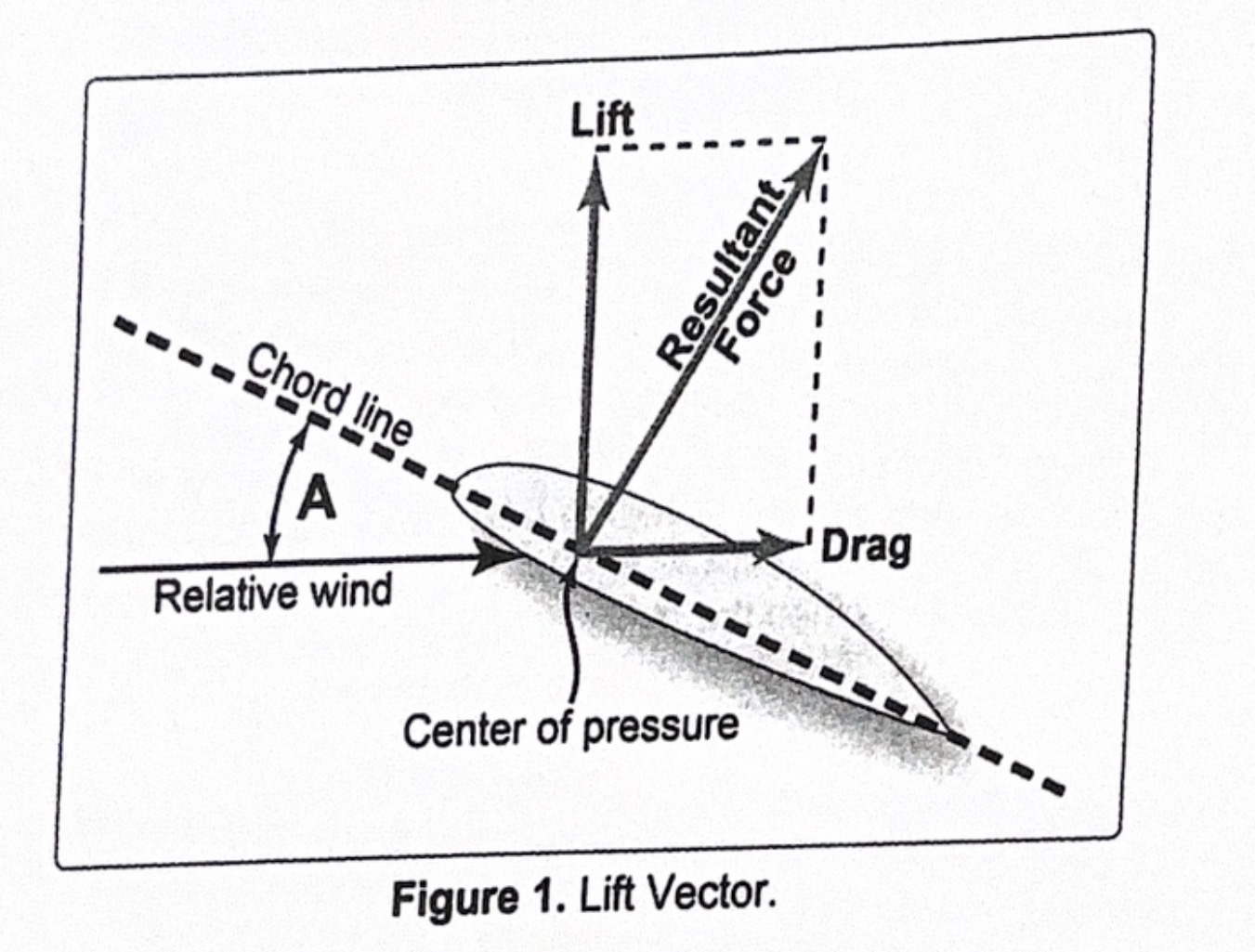
14. (Refer to Figure 1 below.) The acute angle A is the angle of
incidence.
attack.
dihedral.
Attack
15. The term "angle of attack" is defined as the angle between the
chord line of the wing and the relative wind.
airplane's longitudinal axis and that of the air striking the airfoil.
airplane's center line and the relative wind.
chord line of the wing and the relative wind.
16. The angle between the chord line of an airfoil and the relative wind is known as the angle of
A. lift.
B. attack.
C. incidence.
Attack
17. The angle of attack at which an airplane wing stalls will
increase if the CG is moved forward.
change with an increase in gross weight.
remain the same regardless of gross weight.
remain the same regardless of gross weight.
18. As altitude increases, the indicated airspeed at which a given airplane stalls in a particular configuration will
A. decrease as the true airspeed decreases.
B. decrease as the true airspeed increases.
C. remain the same regardless of altitude.
remain the same regardless of altitude.
19. In what flight condition must an aircraft be placed in order to spin?
Partially stalled with one wing low.
In a steep diving spiral.
Stalled.
Stalled
20. During a spin to the left, which wing(s) is/are stalled?
Both wings are stalled.
Neither wing is stalled.
Only the left wing is stalled.
Both wings are stalled.
21. What is ground effect?
A. The result of the interference of the surface of the Earth with the airflow patterns about an airplane.
B. The result of an alteration in airflow patterns increasing induced drag about the wings of an airplane.
C. The result of the disruption of the airflow patterns about the wings of an airplane to the point where the wings will no longer support the airplane in flight.
The result of the interference of the surface of the Earth with the airflow patterns about an airplane.
22. Floating caused by the phenomenon of ground effect will be most realized during an approach to land when at
less than the length of the wingspan above the surface.
twice the length of the wingspan above the surface.
a higher-than-normal angle of attack.
less than the length of the wingspan above the surface.
23. What must a pilot be aware of as a result of ground effect?
A. Wingtip vortices increase creating wake turbulence problems for arriving and departing aircraft.
B. Induced drag decreases; therefore, any excess speed at the point of flare may cause considerable floating.
C. A full stall landing will require less up elevator deflection than would a full stall when done free of ground effect.
Induced drag decreases; therefore, any excess speed at the point of flare may cause considerable floating.
24. An aircraft leaving ground effect during takeoff will
experience a reduction in ground friction and require a slight power reduction.
experience an increase in induced drag and a decrease in performance.
require a lower angle of attack to maintain the same lift coefficient.
experience an increase in induced drag and a decrease in performance.
25. Ground effect is most likely to result in which
problem?
Settling to the surface abruptly during landing.
Becoming airborne before reaching recommended takeoff speed.
Inability to get airborne even though airspeed is sufficient for normal takeoff needs.
Becoming airborne before reaching recommended takeoff speed.
6. What force makes an airplane turn?
A. The horizontal component of lift.
B. The vertical component of lift.
C. Centrifugal force.
The horizontal component of lift.
27. What determines the longitudinal stability of an airplane?
The location of the CG with respect to the center of lift.
The effectiveness of the horizontal stabilizer, rudder, and rudder trim tab.
The relationship of thrust and lift to weight and drag.
The location of the CG with respect to the center of lift.
28. An airplane said to be inherently stable will
be difficult to stall.
require less effort to control.
not spin.
require less effort to control.
29. Changes in the center of pressure of a wing affect the aircraft's
lift/drag ratio.
lifting capacity.
aerodynamic balance and controllability.
aerodynamic balance and controllability.
30. An airplane has been loaded in such a manner that the CG is located aft of the aft CG limit. One undesirable flight characteristic a pilot might experience with this airplane would be
a longer takeoff run.
difficulty in recovering from a stalled condition.
stalling at higher-than-normal airspeed.
difficulty in recovering from a stalled condition.
31. What causes an airplane (except a T-tail) to pitch nosedown when power is reduced and controls are not adjusted?
A. The CG shifts forward when thrust and drag are reduced.
B. The downwash on the elevators from the propeller slipstream is reduced and elevator effectiveness is reduced.
C. When thrust is reduced to less than weight, lift is also reduced and the wings can no longer support the weight.
The downwash on the elevators from the propeller slipstream is reduced and elevator effectiveness is reduced.
32. What is the effect of advancing the throttle in fight?
A. Both aircraft groundspeed and angle of attack will increase.
B. Airspeed will remain relatively constant but the aircraft will climb.
C. The aircraft will accelerate, which will cause a turn to the right.
Both aircraft groundspeed and angle of attack will increase.
33. Loading an airplane to the most aft CG will cause the airplane to be
A. less stable at all speeds.
B. less stable at slow speeds, but more stable at high speeds.
C. less stable at high speeds, but more stable at low speeds.
less stable at all speeds.
34. An airplane loaded with the Center of Gravity
(CG) rear of the aft CG limit could
make it easier to recover from stalls and spins.
make it more difficult to flare for landing.
increase the likelihood of inadvertent overstress.
increase the likelihood of inadvertent overstress.
35 In what fight condition are torque effects more pronounced in a single-engine airplane?
Low airspeed, high power, high angle of attack.
Low airspeed, low power, low angle of attack.
High airspeed, high power, high angle of attack.
Low airspeed, high power, high angle of attack.
36. The left turning tendency of an airplane caused by P-factor is the result of the
A. clockwise rotation of the engine and the propeller turning the airplane counterclockwise.
B. propeller blade descending on the right, producing more thrust than the ascending blade on the lent.
C. gyroscopic forces applied to the rotating propeller blades acting 90° in advance of the point the force was applied.
propeller blade descending on the right, producing more thrust than the ascending blade on the lent.
37. When does P-factor cause the airplane to yaw to the left?
When at low angles of attack.
When at high angles of attack.
When at high airspeeds.
When at high angles of attack.
38. The left turning tendency of an airplane caused by P-factor is the result of the
clockwise rotation of the engine and the propeller turning the airplane counterclockwise.
propeller blade descending on the right, producing more thrust than the ascending blade on the left.
gyroscopic forces applied to the rotating propeller blades acting 90° in advance of the point the force was applied.
propeller blade descending on the right, producing more thrust than the ascending blade on the left.
Which of the following is not a left-turning tendency at high power during takeoff?
Spiraling slipstream.
Gyroscopic precession in a conventional gear
"tail dragger."Gyroscopic precession in a tricycle gear airplane.
Gyroscopic precession in a tricycle gear airplane.

40. (Refer to Figure 2 below.) If an airplane weighs 3,300 pounds, what approximate weight would the airplane structure be required to support during a 30° banked turn while maintaining altitude?
1,200 pounds.
3,100 pounds.
3,960 pounds.
3,960 pounds.

41. (Refer to Figure 2 below.) If an airplane weighs 2,300 pounds, what approximate weight would the airplane structure be required to support during a 60° banked turn while maintaining altitude?
2,300 pounds.
3,400 pounds.
4,600 pounds.
4,600 pounds.

42. (Refer to Figure 2 below.) If an airplane weighs 4,500 pounds, what approximate weight would the airplane structure be required to support during a 45° banked turn while maintaining altitude?
4,500 pounds.
6,750 pounds.
7,200 pounds.
6,750 pounds.
43. Which basic flight maneuver increases the load factor on an airplane as compared to straight-and-Jevel flight?
Climbs.
Tums.
Stalls.
Tums
44. The amount of excess load that can be imposed on the wing of an airplane depends upon the
position of the CG.
speed of the airplane.
abruptness at which the load is applied.
speed of the airplane.
45. During an approach to a stall, an increased load factor will cause the aircraft to
stall at a higher airspeed.
have a tendency to spin.
be more difficult to control.
stall at a higher airspeed.
46. Structural damage or failure is more likely to occur in smooth air at speeds above
VNO.
VA.
VNE
VNE
47. Limit load factor is the ratio of
angle of attack to stall speed.
angle of attack to power-on configuration-specific stall speed.
maximum sustainable load to the gross weight of the airplane.
maximum sustainable load to the gross weight of the airplane.
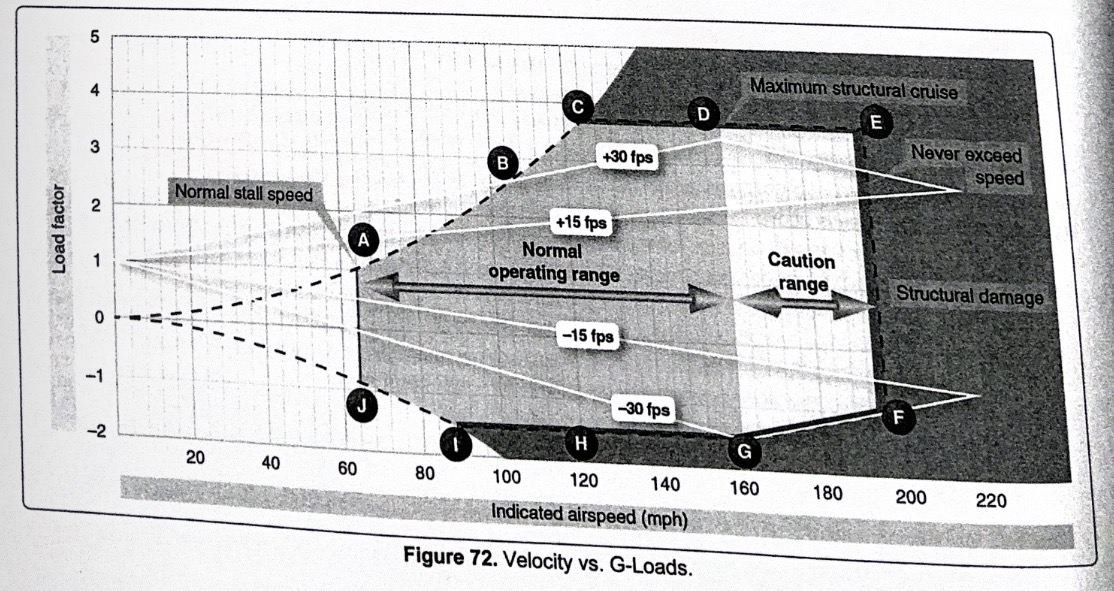
48. (Refer to Figure 72 below.) A positive load factor of 2 at 80mph would cause the airplane to
A. stall.
B. break apart.
C. operate normally, as it is within the normal operating range.
Stall
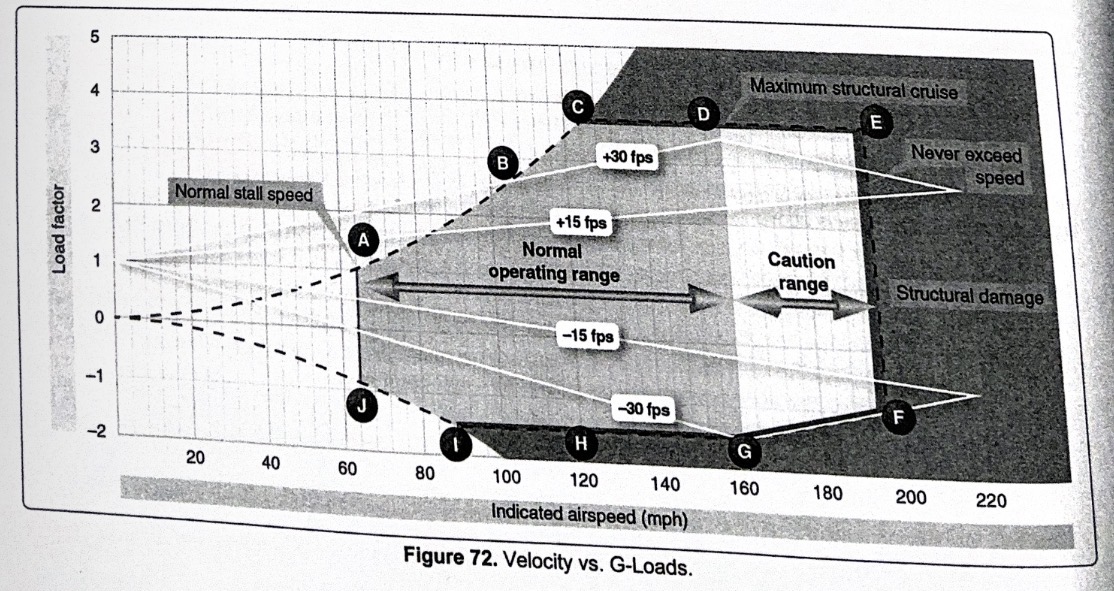
49.(Refer to Figure 72 below) What load factor would be created if positive 15 feet per second gusts were encountered at 120 mph?
A. 2.8
B. 3.0
C. 2.0
2.0
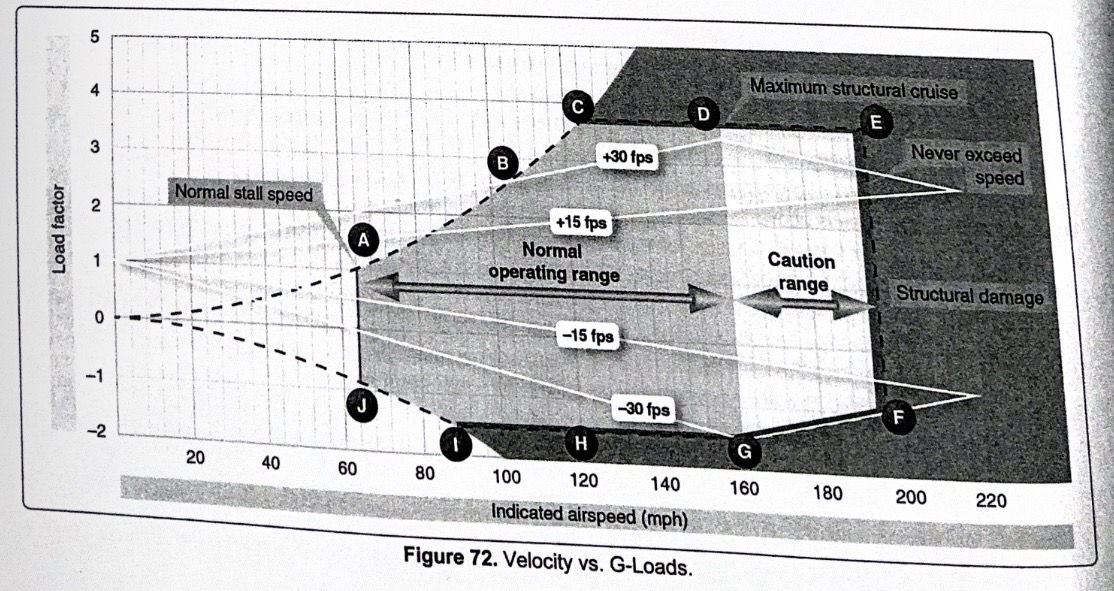
50.(Refer to Figure 72 below.) The airspeed indicated by points A and J is
maximum structural cruising speed.
normal stall speed.
maneuvering speed.
normal stall speed.

