Volatile Oils: Overview, Extraction Methods
 Studied by 1 person
 Call Kai
 Learn
Learn Practice Test
 Spaced Repetition
 Match
Match Flashcards
 Knowt Play
1/86

There's no tags or description
Looks like no tags are added yet.
Name | Mastery | Learn | Test | Matching | Spaced | Call with Kai |
|---|
No analytics yet
Send a link to your students to track their progress
87 Terms
Essential oils
Ethereal oils
Olea aethereal
Essences
Volatile Oils are also known as
Colorless
Freely soluble in ether and chloroform; fairly soluble in alcohol; Insoluble in water.
Lighter than water
Characteristic odor
High refractive index
Optically active
Do not leave permanent grease spot on paper(Determines if volatile/fixed oil)
Characteristics of Volatile Oils
Volatile Oil
Volatile Oil or Fixed Oil?
Can be distilled from their natural sources
Fixed Oil
Volatile Oil or Fixed Oil?
They oxidized and become rancid
Fixed Oil
Volatile Oil or Fixed Oil?
Composed mainly of glyceryl esters of fatty acids
Volatile Oil
Volatile Oil or Fixed Oil?
Do not consists of glyceryl esters of fatty acids
Volatile Oil
Volatile Oil or Fixed Oil?
Cannot be saponified with alkali
Volatile Oil
Volatile Oil or Fixed Oil?
Do not become rancid but instead oxidize and resinify upon exposure to light and air
Fixed Oil
Volatile Oil or Fixed Oil?
Cannot be distilled without decomposition
Fixed Oil
Volatile Oil or Fixed Oil?
Leaves a permanent spot/strain on paper
Fixed oil
Volatile Oil or Fixed Oil
Can be saponified
Volatile Oil
Volatile Oil or Fixed Oil?
Do not leave a permanent spot on paper
Glandular hairs or Trichomes
Specialized Secretory Structures
Lamiaceae (mint family)
Modified parenchymal cells
Specialized Secretory Structures
Piperaceae (Pepper family)
Oil tubes/ Vittae
Specialized Secretory Structures
Umbelliferae/Apiaceae (dillweed family)
Lysigenous or Schizogenous passages
Specialized Secretory Structures
Pinaceae (Pine family) / Rutaceae (Citrus family)
All tissue of plant
Conifers
Petals
Rose
Bark and leaves
Cinnamon
Petal and rind
Orange
Extraction by distillation
Extraction by Scarcification
Extraction by Non-volatile solvent
Extraction by Volatile Solvent
Extraction by Enzymatic hydrolysis
Method of obtaining volatile oils
Water distillation
Water and steam distillation
Direct steam distillation
Destructive distillation
Extraction by distillation
Lard
Olive oil
Examples of non-volatile solvent
Extraction by distillation: Water distillation
plant material that is dried and not subject to injury by boiling (eg. turpentine oil)
Extraction by distillation: Water and Steam Distillation
for dried or fresh substances that may be injured by boiling (eg. clove oil, cinnamon)
fresh plant drugs (eg. peppermint, spearmint)
Extraction by distillation: Steam Distillation
empyreumatic oils (heat w/o air access)
Extraction by distillation: Destructive Distillation
Incineration
Destructive distillation involves?
pinaceae/cupressaceae (conifern family)
In Destructive Distillation, the wood of ______ is used to make charcoal
Aq layer containing wood nafta
other layer?
In Destructive distillation, the condensed matter is separated into two layers:
Sponge process
Ecuelle Method
Extraction by Scarcification
Extraction by Scarcification: Sponge process
Softening
Expression
Collection and Separation
Controlled environment: Dark room
Extraction by Scarcification: Ecuelle Method
Puncturing
Washing
Centrifugation
Ecuelle picquer
Extraction by Scarcification: Ecuelle Method is aka
Eceulle picquer
method of obtaining citrus oils
puncture rind not the fruit
Enfleurage
Maceration
Spraying
Extraction by Non-Volatile Solvent
Extraction by Non-Volatile Solvent: Enfleurage
Preparation: A thin layer of odorless, bland fixed oil or fat is spread onto glass plates.
Absorption: Flower petals are placed on the fat for a few hours to allow the fat to absorb their fragrance.
Repetition: Old petals are repeatedly removed and replaced with fresh ones to saturate the fat with the oil.
Recovery: The final volatile oil is then extracted from the perfumed fat using alcohol
Extraction by Non-Volatile Solvent: Maceration
Heating: The lard or oil is heated over a water bath.
Stirring: Flowers are added to the hot fat and the mixture is stirred continuously.
Replacement: Exhausted flowers are removed and pressed to return any absorbed fluid to the fat. This is repeated with fresh flowers until the solvent reaches the desired strength.
Recovery: Finally, alcohol is used to extract the volatile oil from the perfumed fat
Extraction by Non-Volatile Solvent: Spraying
Air Circulation: Warm air is sprayed through a column of flowers to pick up their fragrance.
Absorption: Oil or melted fat is then sprayed over this fragrance-laden air, which absorbs and dissolves the perfume.
Alcohol Extraction: Finally, the collected oil or fat is extracted with alcohol to recover the volatile oil.
Extraction by Volatile Solvent
Volatile oils from flowers are extracted by using the solvent light petroleum and is distilled at low temperature leaving behind the volatile oil
light petroleum
Extraction by Volatile Solvent: Volatile oils from flowers are extracted by using the solvent ____ and is distilled at low temperature leaving behind the volatile oil
Petroleum ether
Benzene
Extraction by Volatile Solvent: Other solvents used
Extraction by Enzymatic Hydrolysis
Obtained by enzymatic hydrolysis of glycosides
Black Mustard
Which is more volatile Black mustard or White mustard
Allyl isothiocyante
Extraction by Enzymatic Hydrolysis: Sinigrin upon hydrolysis yields what
Acrinyl isothiocyanate
Extraction by Enzymatic Hydrolysis: Sinalbin upon hydrolysis yields what
Myrosin
Extraction by Enzymatic Hydrolysis: Sinigrin and Sinalbin are facilitated by an enzyme called
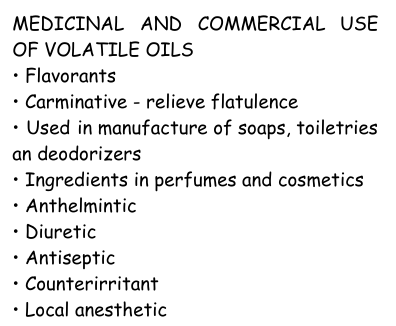
Medicinal and Commercial Use of Volatile oils (Read)
Most volatile
Leave the skin rapidly
Fabrication of Perfumes: Top notes
Intermediate volatility and tenacity
Fabrication of Perfumes: Middle Notes
Low volatility and high tenacity
Provide staying power for perfumes
Fabrication of Perfumes: Base Notes
Lemon
Anise
Lavender
Tope Notes examples
Thyme
Rose
Neroli
Middle Notes example
Vanillin
Musk
Civet
Ambergris
Base notes examples
Musk
preputial follicles
Dried secretion from the ____ of the male musk deer of Asia
Civet
A glandular secretion appearing in an outwardly discharging pocket underneath the posterior appendages of both male and female civet cats
Ambergris
A pathologic product formed in the stomach of the sperm whale when it is feeding on squid or cuttlefish (vomit of sperm whale) -> most expensive perfume!
Ambergris
Most expensive ingredient in perfume
Eleoptene
Stearoptene
Volatile oils consist of:
Eleoptene
hydrocarbon portion of the oil (liquid)
Stearoptene
oxidized hydrocarbon portion of the oil (solid)
Low temperature: crystallize stearoptenes
Fractional distillation
Fractional crystallization from poor solvents
Chromatography
Removal by chemical reaction = NaCO3, HCL, NaOH
Ways to separate V.O components
NaCO3
HCl
NaOH
Volatile Oil components can be separated by the removal of chemical action, give me 3 compounds.
Terpene derivatives (Terpenoids)
Aromatic compounds (Phenylpropanoids)
Chemistry of Volatile Oils
Terpene derivatives
formed via acetate mevalonic acid pathway
Aromatic compounds (phenylpropanoids)
Formed via shikimic-acid phenylpropanoid route
Shikimic-acid phenylpropanoid route
Aromatic compounds (Phenylpropanoids) are formed via what route
Acetate mevalonic acid pathway
Terpene derivatives (Terpenoids) form via what pathways
Terpenes
Natural products whose structure may be divided into isoprene units
(C5H8)n.
Most natural terpenoid hydrocarbons have the general formula ____ They can be classified on the basis of number of carbon atoms present in the structure.
Acyclic Terpenoids
Structure of Terpenoids: They contain an open structure
Monocyclic Terpenoids
Structure of Terpenoids: They contain one ring in the structure
Bicyclic Terpenoids
Structure of Terpenoids: They contain two rings in the structure
Tricyclic Terpenoids
Structure of Terpenoids: They contain three rings in the structure
Tetracyclic Terpenoids
Structure of Terpenoids: They contain four rings in the structure
Bonus
Bonus
Monoterpenoids
Sesquiterpenoids
Diterpenoids
Sesterpenoids
Triterpenoids
Tetraterpenoids
Polyterpenoids
Classification of Terpenoids
10
2
Monoterpenoids
Number of carbon atoms:
Value of N:
15
3
Sesquiterpenoids
Number of carbon atoms:
Value of N:
20
4
Diterpenoids
Number of carbon atoms:
Value of N:
25
5
Sesterpenoids
Number of carbon atoms:
Value of N:
30
6
Triterpenoids
Number of carbon atoms:
Value of N:
40
8
Tetraterpenoids
Number of carbon atoms:
Value of N:
>40
>8
Polyterpenoids
Number of carbon atoms:
Value of N:
Phenylpropanoids
It is a chemistry of volatile oils found in phenols or phenolic ether volatile oils
C6
C3
Phenylpropanoids contain the __ phenyl ring with an attached _ propane side chain
Cinnamic acid
Para-hydroxycinnamic
para-coumaric acid
Precursor of Phenylpropanoids
 Note
Note  Flashcards (36)