25- Nervous and Synaptic Transmission
 Call Kai
 Learn
Learn Practice Test
 Spaced Repetition
 Match
Match Flashcards
 Knowt Play
1/48

There's no tags or description
Looks like no tags are added yet.
Name | Mastery | Learn | Test | Matching | Spaced | Call with Kai |
|---|
No analytics yet
Send a link to your students to track their progress
49 Terms
What is a neurone (nerve cell)?
A specialised cell adapted to carrying nerve impulses quickly from 1 part of the body to another. They are adapted to serve this function in different ways
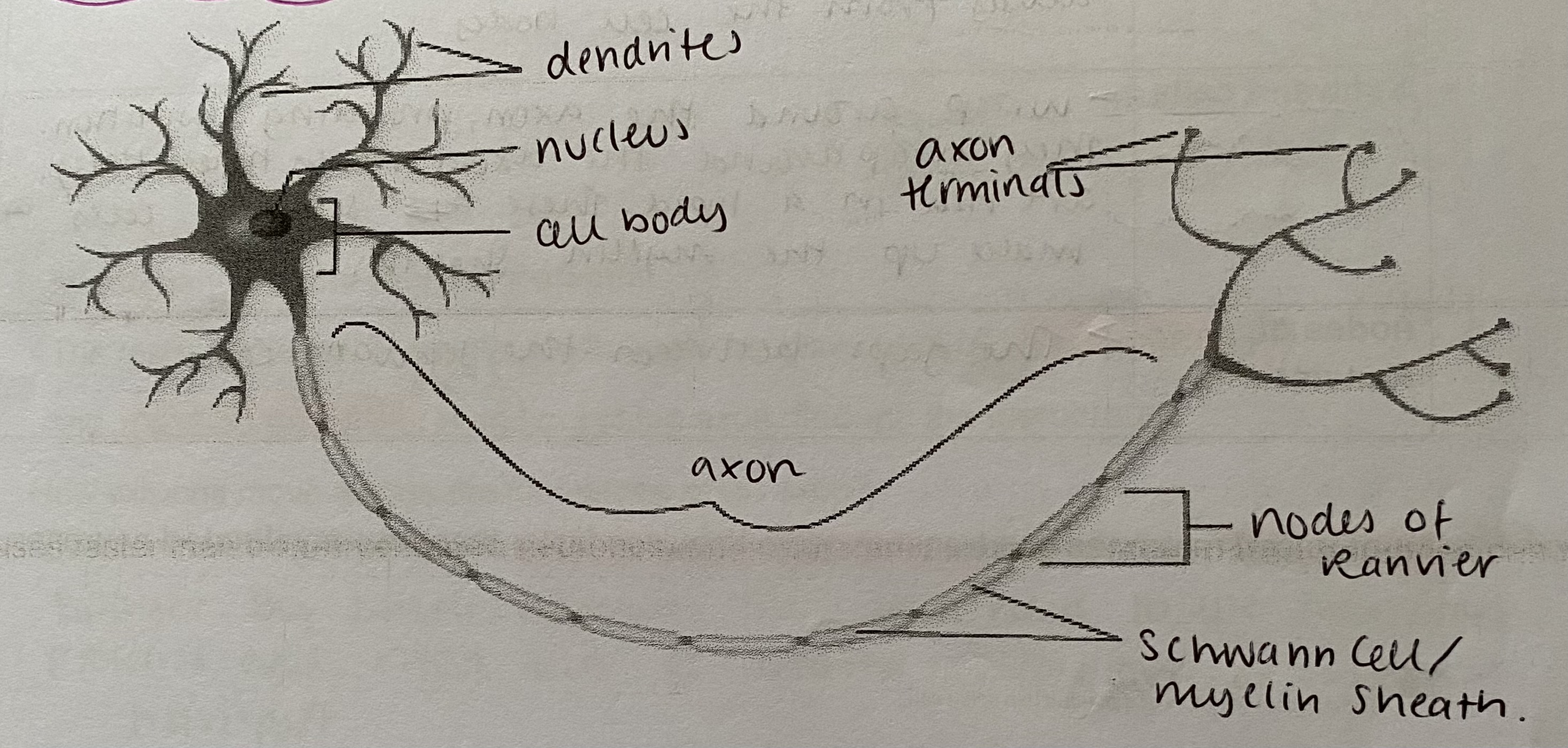
What are the parts of a typical motor neurone?
Dendrites
Nucleus
Cell body
Axon
Axon terminals
Nodes of Ranvier
Schwann cells/ myelin sheath
What is a schwann cell?
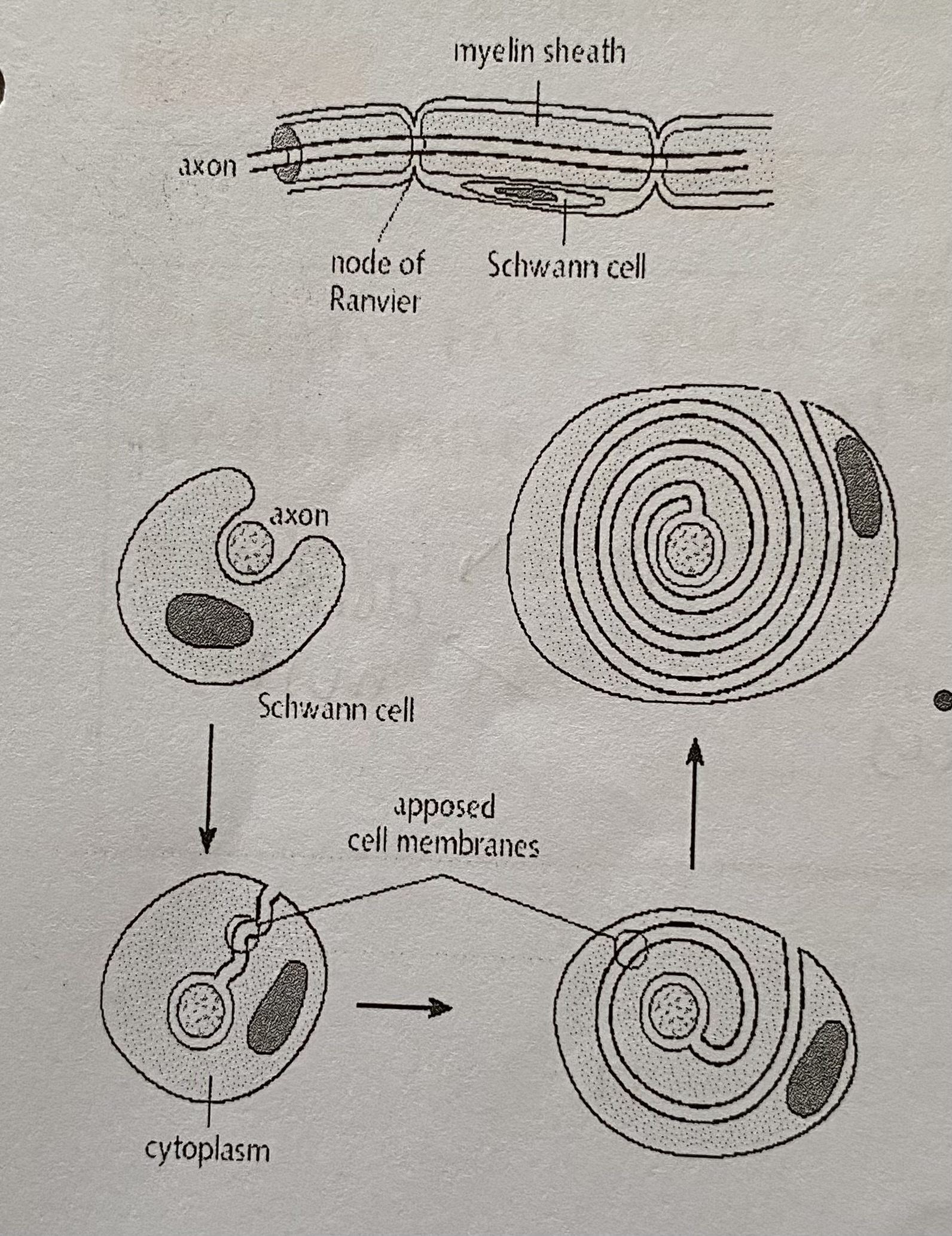
They create the myelin sheath
What is the function of the cell body in a typical motor neurone?
Contain typical cell organelles including large amounts of rough endoplasmic reticulum and mitochondria
What is the function of the dendrites in a typical motor neurone?
Carry nerve impulses to cell body
What is the function of the axon in a typical motor neurone?
A long fibre which carries impulses away from the cell body
What is the function of the schwann cells in a typical motor neurone?
Wrap around the axon, providing insulation. They wrap around the axon many times, they are rich in lipids. These schwann cells make up the myelin sheath
What is the function of the nodes of Ranvier in a typical motor neurone?
The gaps between the schwann cells
Why are myelinated neurones better than non-myelinated neurones?
Can transmit nerve impulses faster
What is a nerve impulse?
A temporary reversal of the electrical potential difference across the axon membrane. This reversal is between 2 states: the resting potential and the action potential
What happens during resting potential?
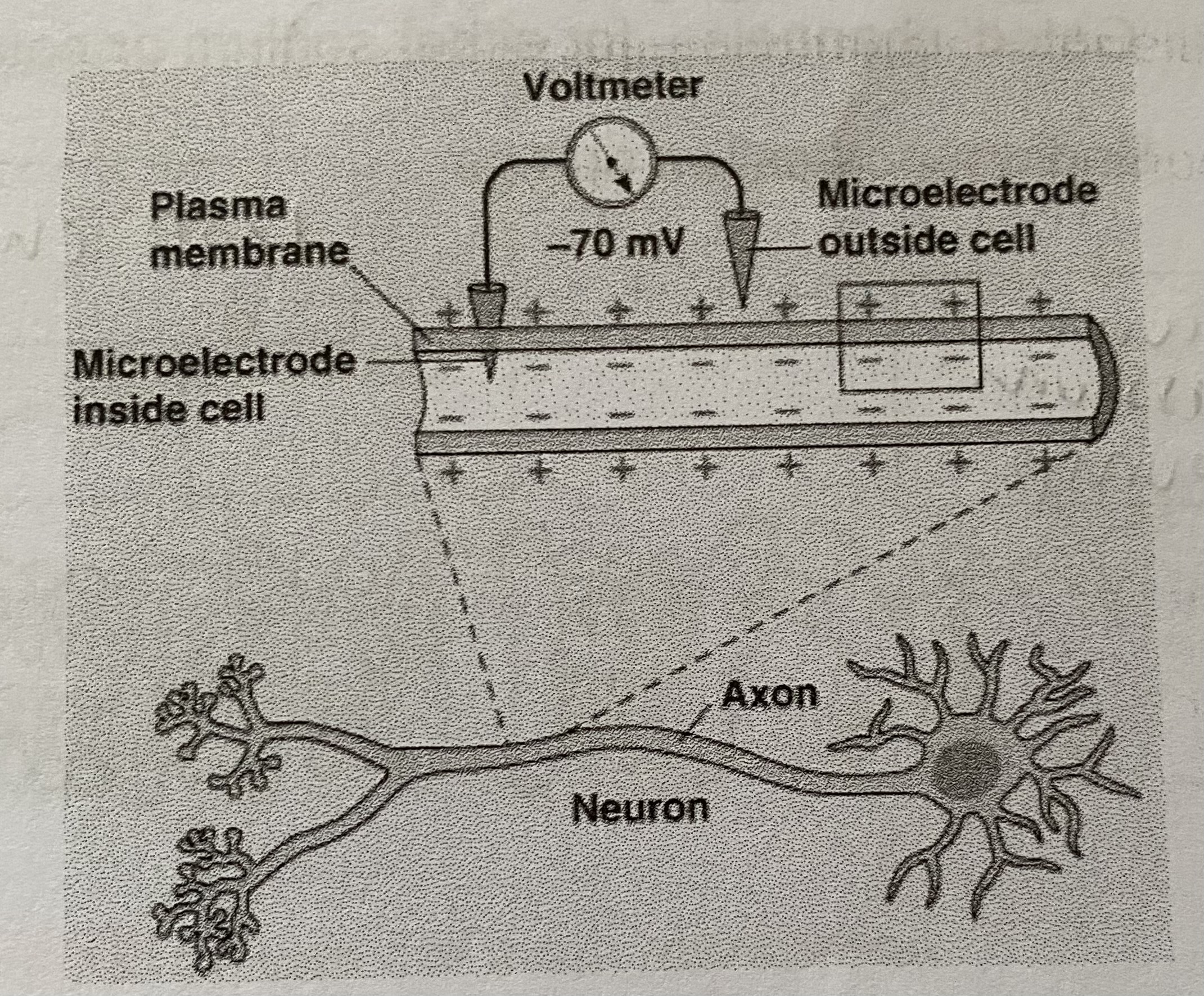
The electrical potential difference is -65mV to -70mV
The inside of the axon is more negative than the tissue fluid outside it
How is resting potential maintained?
Through movement of sodium ions and potassium ions in and out of the axon, through the membrane
How will ions move across the membrane of an axon?
Ions are charged and therefore cannot cross the phospholipid bilayer by simple diffusion. They will need to use transport proteins and move via facilitated diffusion or active transport
What are the similarities and differences of facilitated diffusion and active transport?
SIMILARITIES:
Both take place through membrane proteins
Both involve movement of charged/ polar molecules
DIFFERENCES:
AT required ATP→ FD is passive
AT against a conc gradient→ FD down a conc gradient
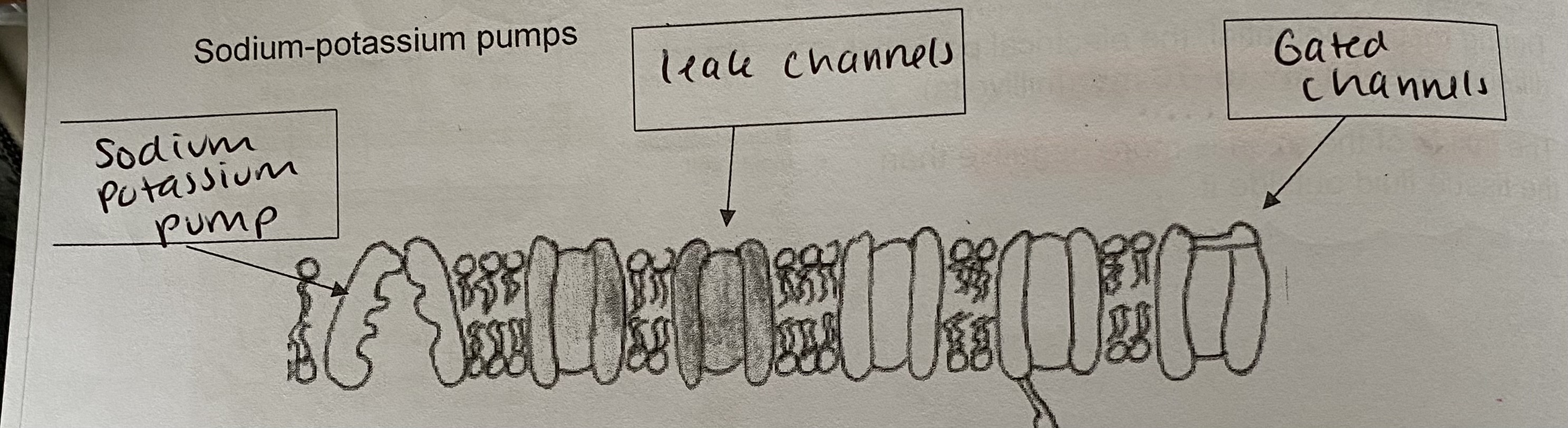
Tell me about the phospholipid bilayer of the axon
Embedded with intrinsic proteins
Leak channels- for Na+ or K+ ions
Gated channels- for Na+ or K+ ions
Sodium- potassium pumps
How is a resting potential established?
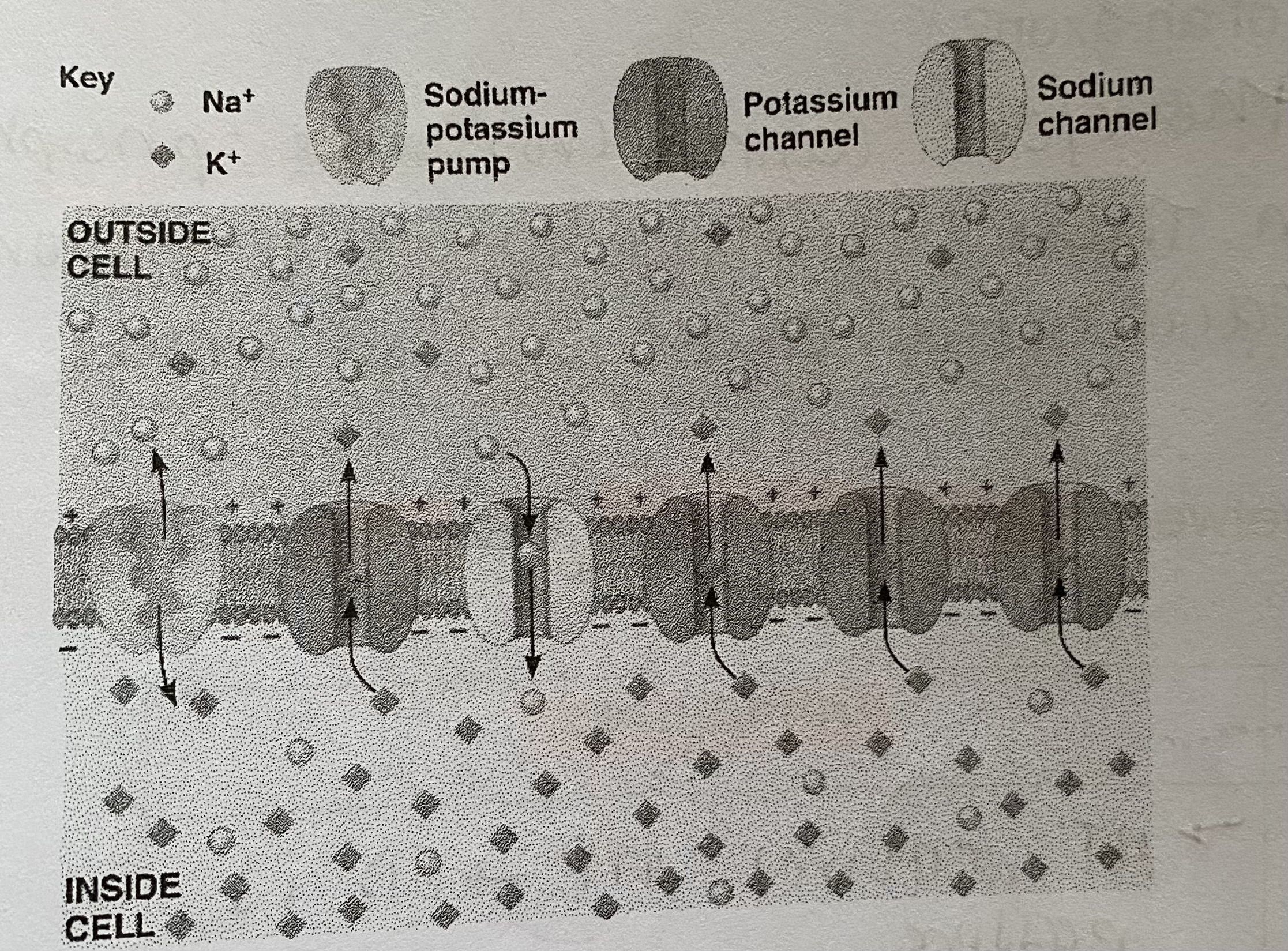
Active transport of 3 Na+ out of the axon and 2K+ into the axon by sodium-potassium pumps
Resulting in more K+ inside the axon than out (and more Na+ outside than in)
The membrane is more permeable to K+ ions that Na+ ins
K+ ions therefore diffuse back out faster than Na+ ions diffuse back in
Leading to a pd of -65mV inside compared to out
Membrane is said to be polarised
What is an action potential?
A stimulus can cause temporary reversal of the charges across the axon membrane. The axon is known as being depolarised. If the axon is depolarised enough, it can result in the generation of an action potential
Once an action potential is generated it moves along like a mexican wave
What are the stages which cause an action potential?
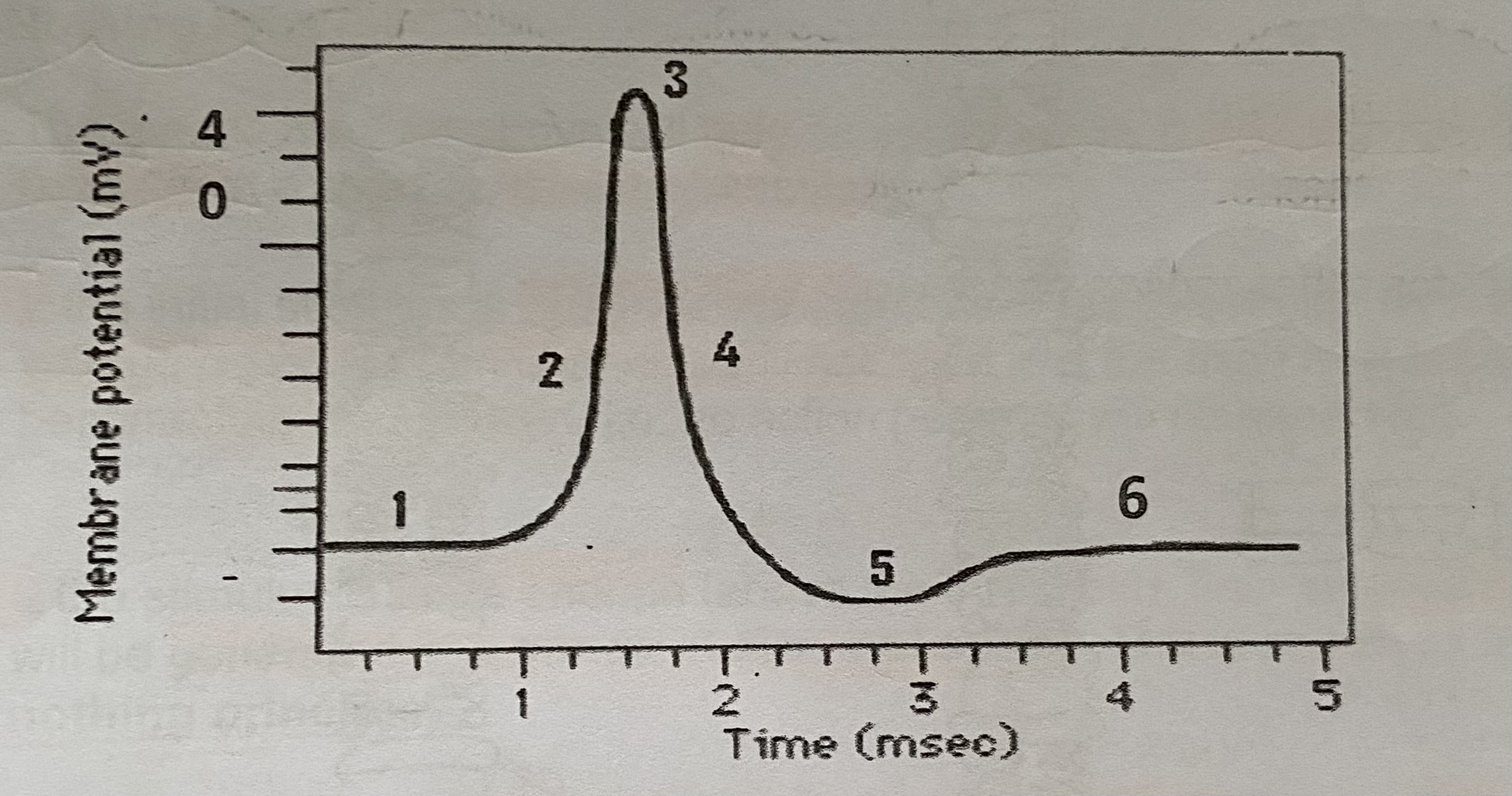
Resting potential
A stimulus causes the gated Na+ ion channels to open, making membrane more permeable to Na+ ions. Na+ ions rapidly diffuse into axon, causing depolarisation
Gated K+ ion channels open (axon’s permeability to K+ ions increases) and K+ ions diffuse rapidly out of the axon(repolarisation)
So many K+ ions diffuse out of the axon that they cause a more negative pd than normal, dropping the axon interior down to about -90mV. This is known as hyperpolarisation and causes the refractory period
Gated K+ ion channels close and the sodium-potassium pump restores conc gradients for Na+ and K+. This returns the resting potential of the axon to -65mV. The resting permeability of the axon is restored
> The whole process lasts 2-3 milliseconds
What is the all or nothing principle?
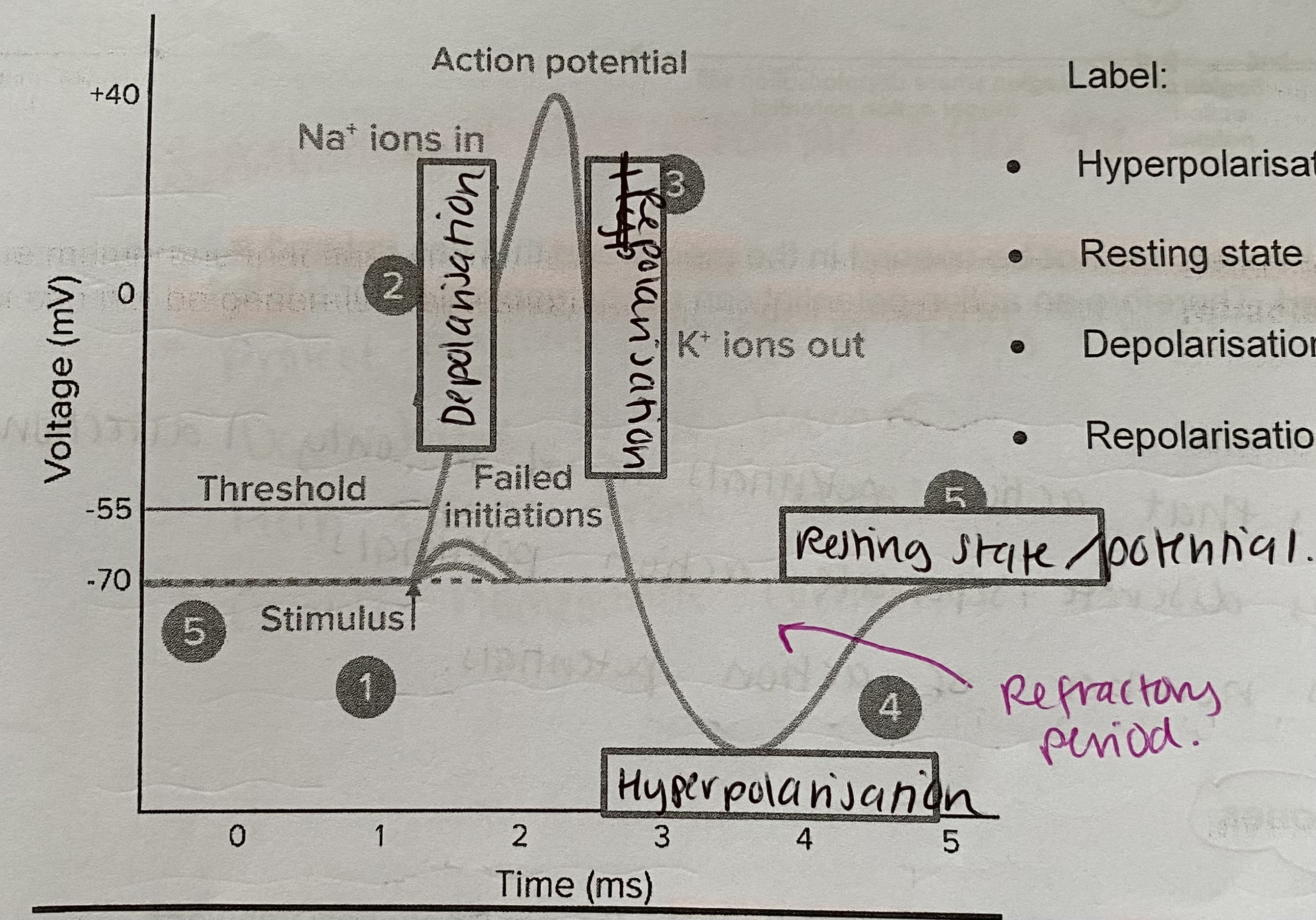
Events mentioned before will only be set into motion if initial stimulus is larger than a specific threshold value
If stimulus isn’t large enough (below threshold), then the voltage-gated Na+ channels will not open and the axon membrane will not become fully depolarised
If stimulus is large enough (above threshold), then an action potential will be generated at a constant size and speed. This is the all or nothing principle
Increasing the initial stimulus will not produce a larger or faster action potential. It will increase the frequency of action potentials
What is a refractory period?
After an action potential has occurred, there is a short period of time where that area of the axon membrane is recovering from its own depolarisation
What are the passages of action potentials like in non-myelinated neurones?
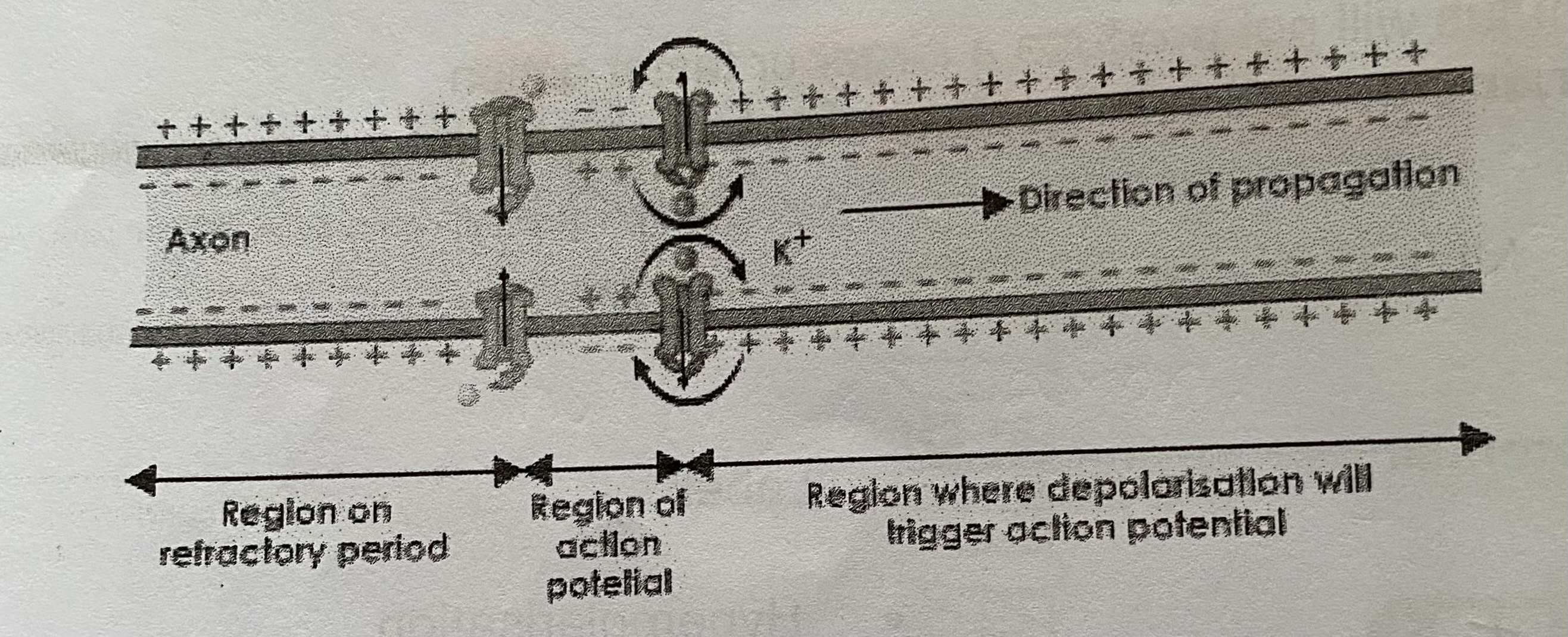
When an action potential occurs, some of the Na+ ions that enter the axon diffuse sideways. This causes gated Na+ ion channels in the next region to open and Na+ ions to diffuse in. This causes a wave of depolarisation to travel along the neurone
Passage of action potential is relatively slow (1ms^-1)
Gated Na+ channels cannot be opened in the membrane that has entered a refractory period. Therefore an action potential can not be generated for a short period of time
Why is it important that gated Na+ channels cannot be opened in a membrane that has entered a refractory period?
Ensures that action potentials travel in only 1 direction
Produces discrete, separate action potentials
Limits number of action potentials
What are the passages of action potentials like in myelinated neurones?
Depolarisation can only occur at the nodes of Ranvier (gaps between the schwann cells). This means the impulse jumps from node to node
This type of conduction is known as saltatory conduction and greatly increases the speed of an impulse (reaching speeds of up to 120 ms^-1)
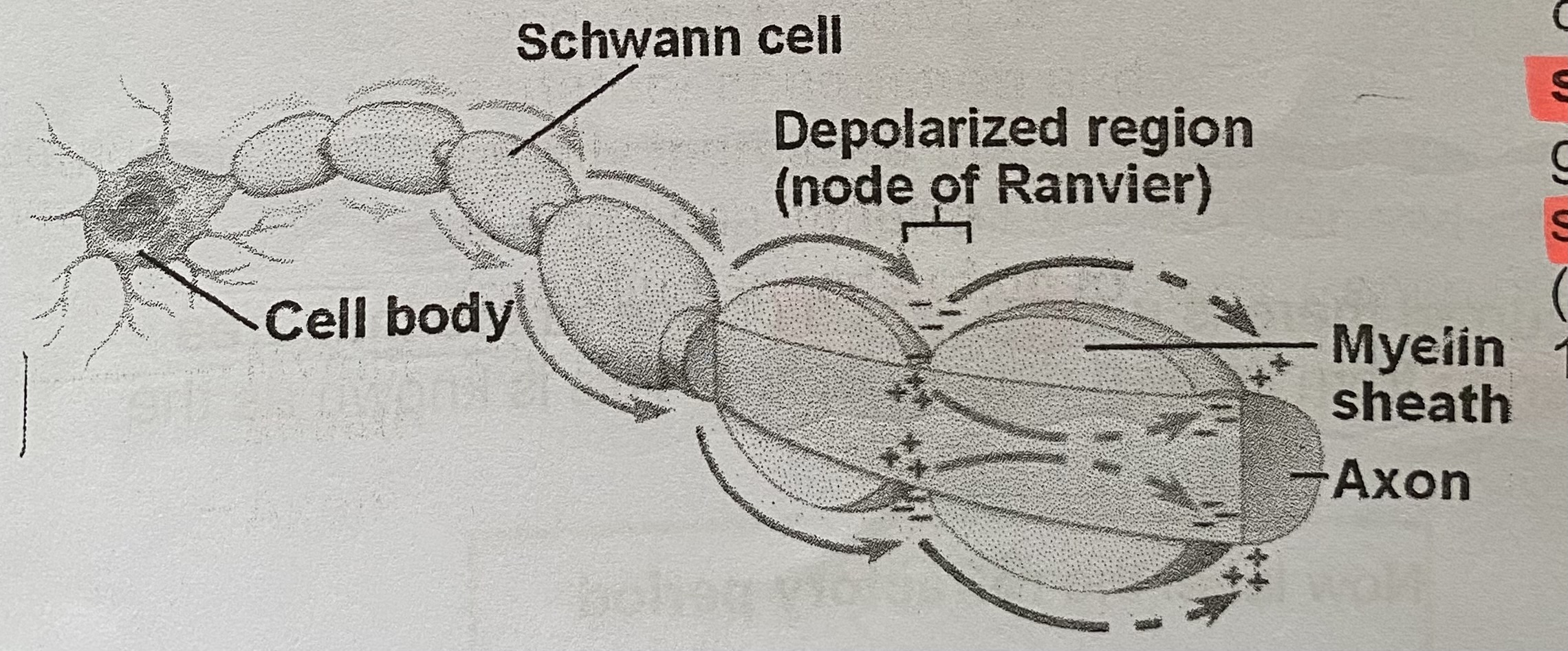
What are the factors affecting speed of conductance of passage of action potentials?
Myelination and saltatory conduction
Axon diameter
Temperature
Explain how myelination and saltatory conduction affects speed of conductance
Action potentials do not need to be generated along the entire length of the axon- just at the nodes of Ranvier so this increases the speed of conduction
Explain how axon diameter affects speed of conductance
A wider diameter increases speed because there is less resistance to flow of ions and less leakage of ions (the potential difference is more stable)
Explain how temperature affects speed of conductance
A higher temp increases speed as:
ions diffuse faster
enzymes involved in respiration work faster therefore there is more ATP for active transport
What are the advantages of a simple reflex arc?
Rapid
Protect against damage to body tissues
Don’t have to be learnt
Help escape from predators
Enable homeostatic control
What is a synapse?
A gap between the axon of one neurone and a dendrite of another. Action potentials cannot pass from 1 neurone to another so is transmitted as neurotransmitters that diffuse across the synapse
What is the structure of the synapse?
Synapses allow impulses to travel in 1 direction, divide impulses between neurones, or merge impulses onto a single neurone
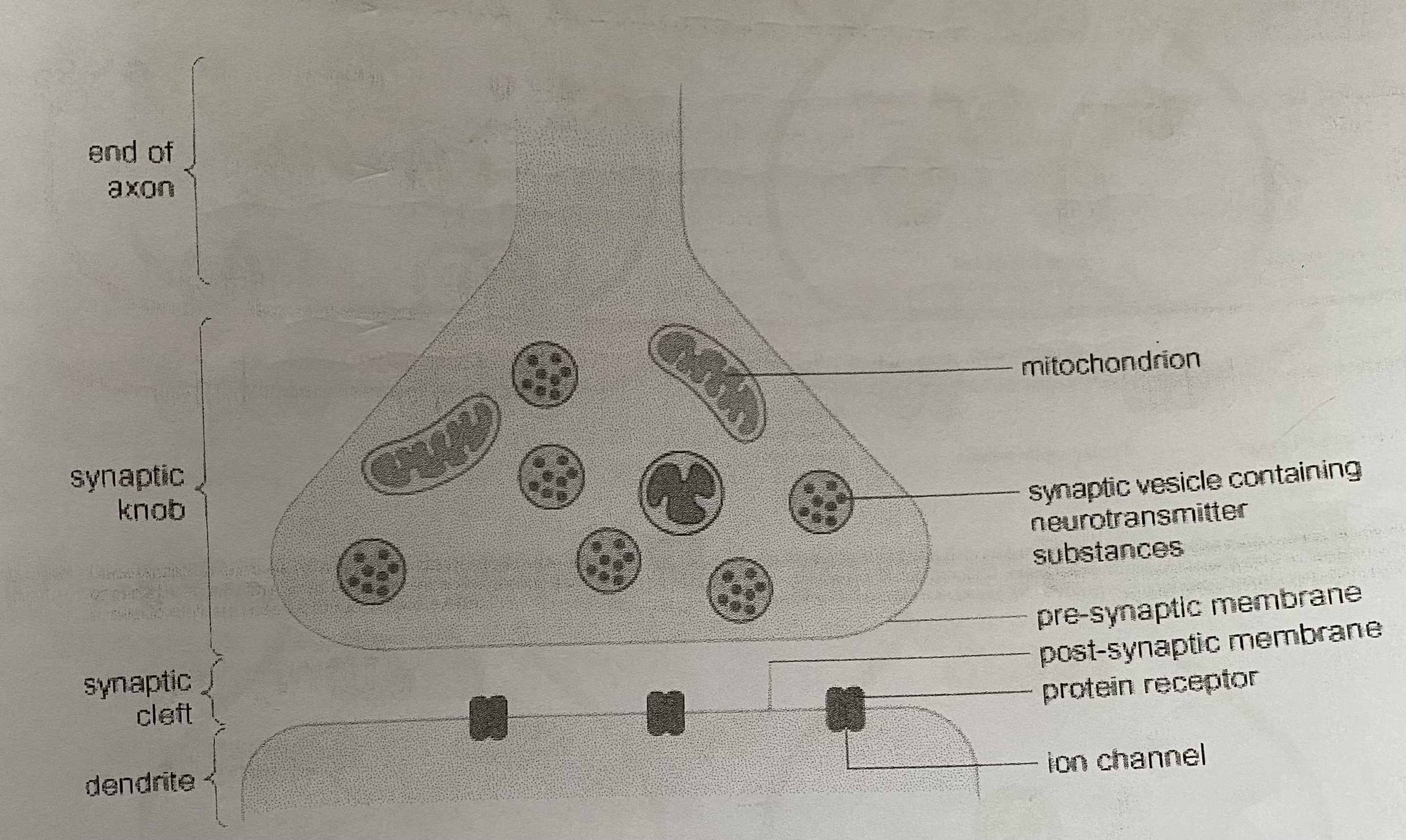
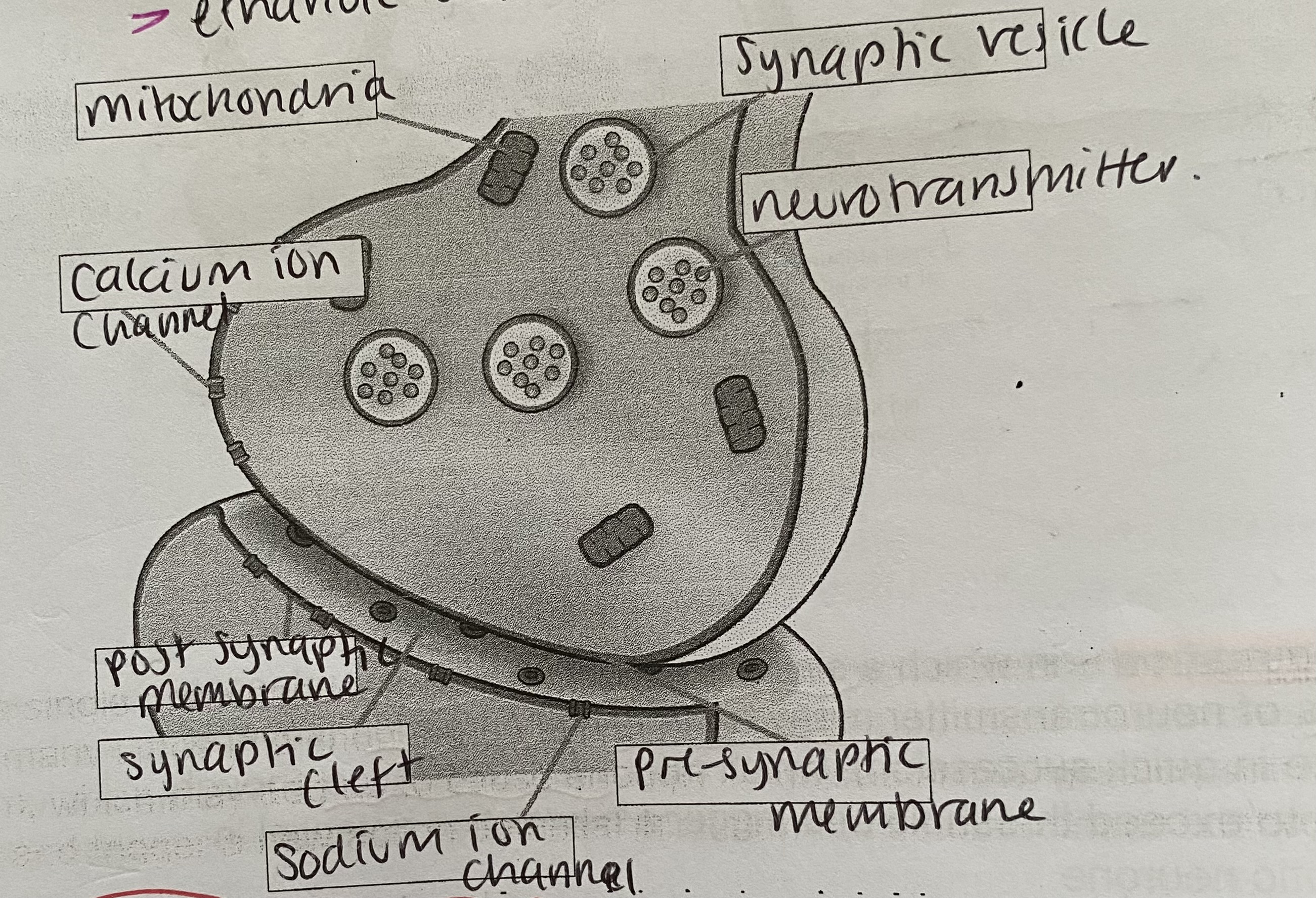
Individual neurones do not touch- they are separated from each other by a gap called the synaptic cleft. The neurone which releases the transmitter is called the presynaptic neurone. The end of the axon swells to form the synaptic knob- the knob contains many mitochondria
Once manufactured, the transmitter is stored in synaptic vesicles which when stimulated will fuse with the presynaptic membrane and release the neurotransmitter into the cleft. Once there, it will diffuse across the postsynaptic neurone which has specific receptor molecules to bind to the transmitter
What is the neurotransmitter called in a cholinergic synapse?
Acetylcholine (ACh)- made of ethanoic acid and choline
What is a neuromuscular junction?
A synapse between a motor neurone and a muscle. The post-synaptic membrane is the sarcolemma of the muscle
Describe the process of transmission across a synapse
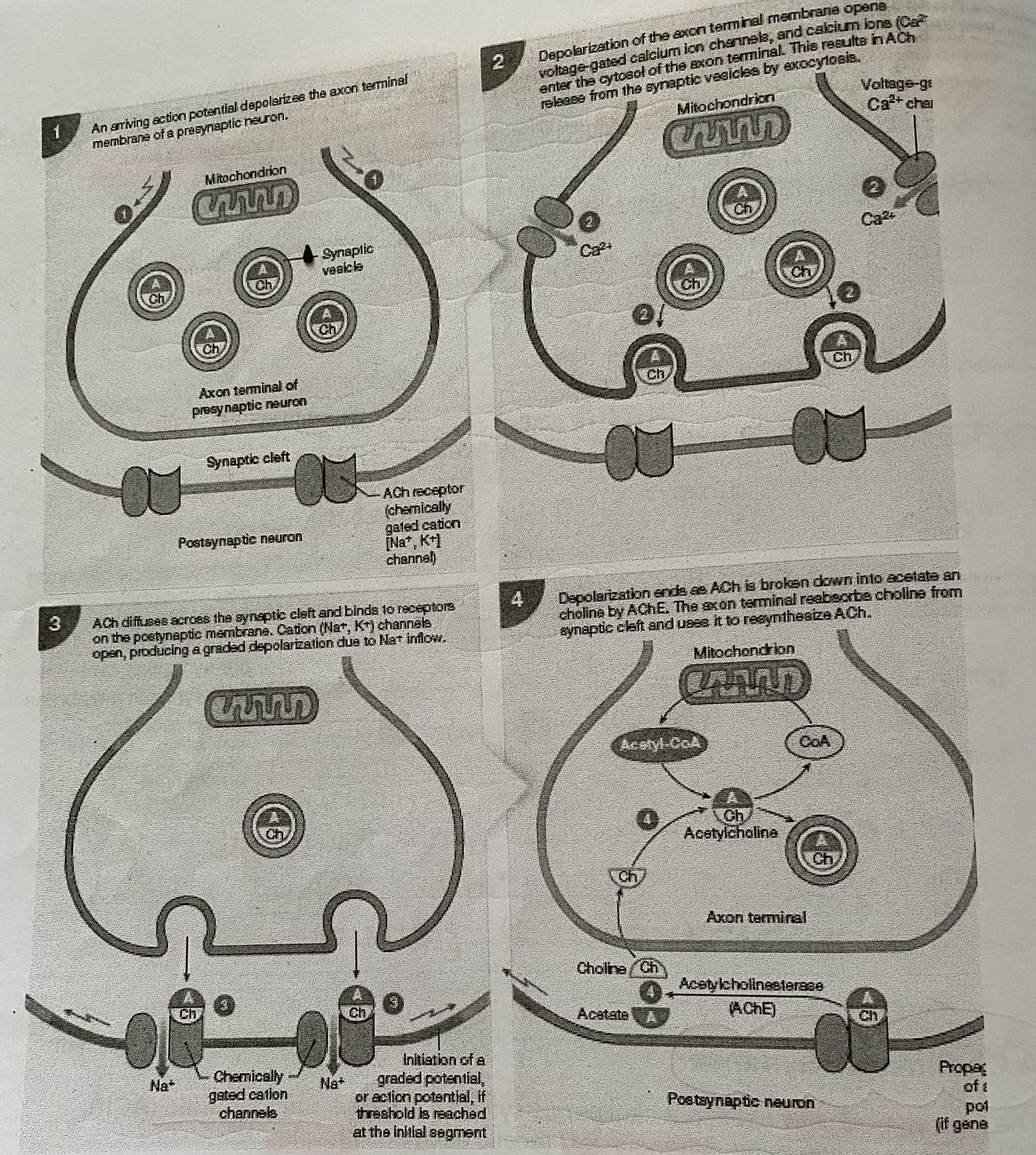
Arrival of an action potential at the synaptic membrane opens calcium ion channels in the membrane which allows calcium ions to diffuse in
Influx of calcium ions causes synaptic vesicles to fuse with the presynaptic membrane and release ACh by exocytosis into the synaptic cleft
ACh diffuses across the synaptic cleft and binds to receptors on the Na+ ion channels in the postsynaptic membrane
This causes the Na+ ion channels to open and Na+ ions diffuse rapidly into the postsynaptic cell, causing depolarisation. If the threshold is reached, an action potential will be initiated
To prevent the initiation of more action potentials in the postsynaptic membrane, by the continues presence of ACh, an enzyme, acetylcholinesterase, hydrolyses ACh
The products diffuse back across the cleft and can be reabsorbed into the presynaptic neurone. ACh is reformed and repackaged into vesicles
> When this occurs at a neuromuscular junction, the postsynaptic neurone is replaced by a muscle. When neurotransmitters cross the synaptic cleft and bind to receptors the muscle contracts
Explain why the presynaptic knob contains many mitochondria
Energy from ATP is required to generate neurotransmitter (also acetyl CoA produced in mitochondrial matrix during link reaction can be used to make more ACh, by providing an acetyl group)
What are the products from the hydrolysis of ACh by acetylcholinesterase?
Ethanoic acid and choline
What do synapses allow?
A single impulse from 1 neurone to be transmitted to several others, allowing a number of simultaneous responses
Multiple impulses may be combined to form a single response
What are the features of the synapse?
Unidirectionality
Summation
Inhibition
Explain the feature unidirectionality of synapses
Synapses can only pass impulses in 1 direction, the transmitter is only released by the presynaptic knob and receptors are found only on the postsynaptic cell membrane
Explain the feature summation of synapses
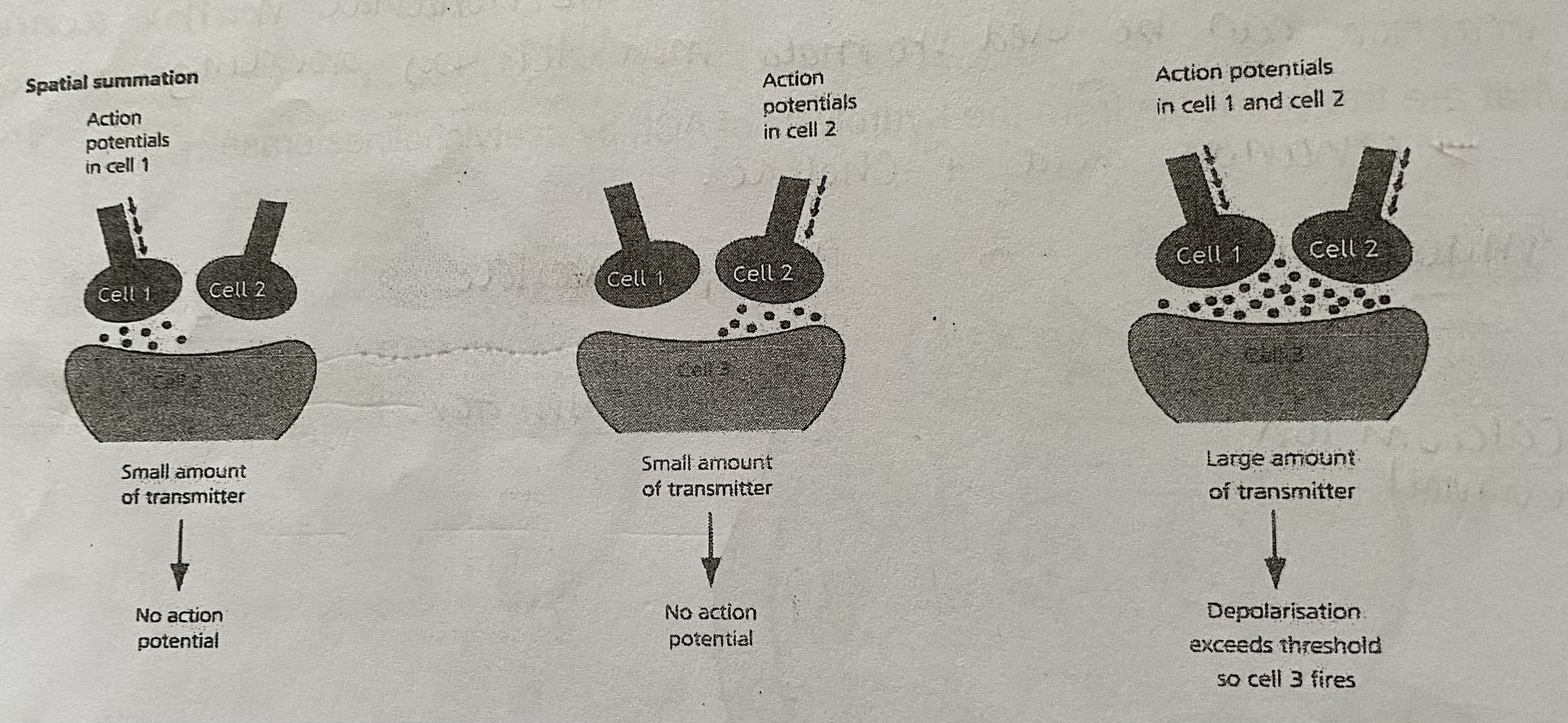
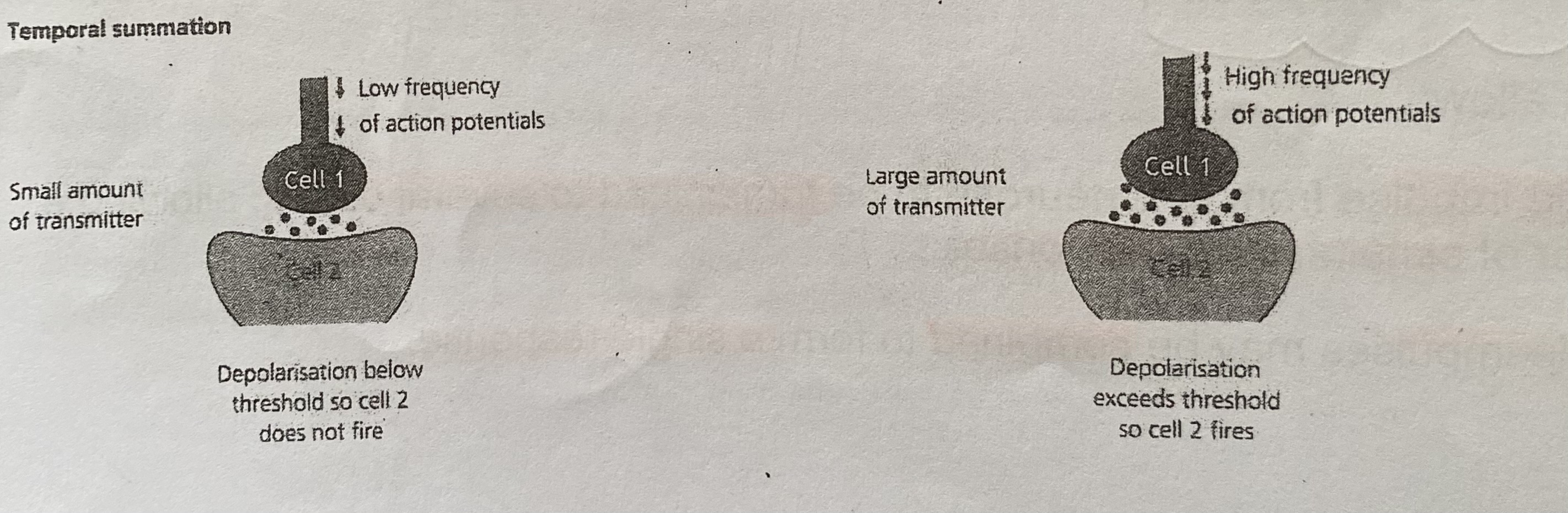
Low frequency impulses often don’t release enough neurotransmitter to generate an action potential in the postsynaptic neurone. The effect of different impulses can be combined by a process called summation to build up enough transmitter to generate an action potential (2 types- spatial and temporal)
What is spatial summation?
In which a number of different presynaptic neurones together release enough transmitter at the same time to cause enough depolarisation to exceed the threshold of the post-synaptic neurone and trigger an action potential
What is temporal summation?
In which a single presynaptic neurone releases small amounts of neurotransmitter many times in a short period (several impulses arrive in quick succession), which may add up to cause enough depolarisation to exceed threshold and trigger a new action potential in the post synaptic neurone
Explain the feature inhibition of synapses
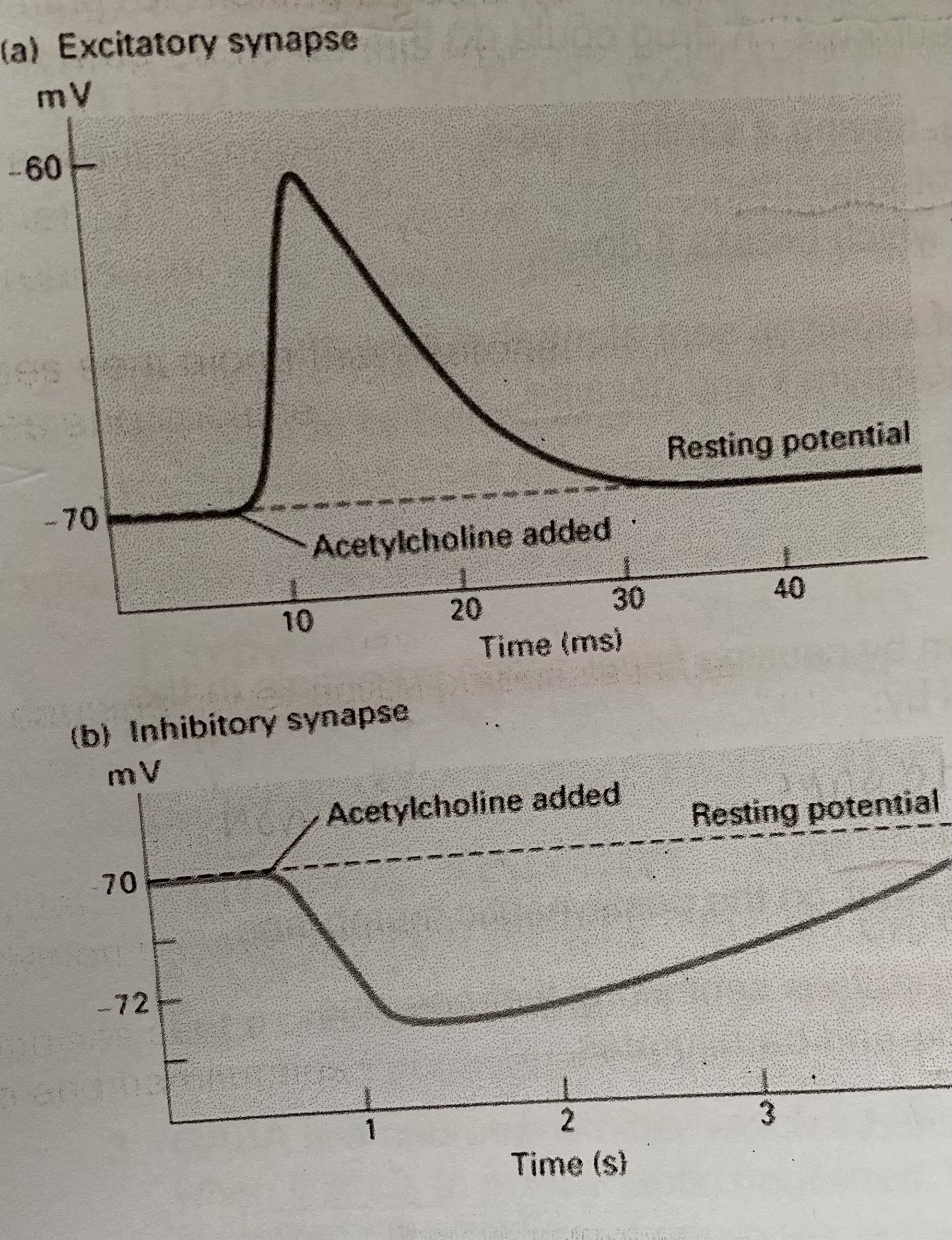
On the postsynaptic membrane of some neurones there are cholride ion channels which can be opened when activated by a certain neurotransmitter. This causes chloride ions to flood into the postsynaptic knob and make it more negative than it normally is at rest (hyperpolarisation). This is turn makes it less likely that the membrane can depolarise and so a new action potential cannot be generated. They are known as inhibitory synapses
Synapses and neurotransmitters that cause deplarisation of the postsynaptic membrane are called excitatory. Many neurones have both inhibitory and excitatory synapses
What is the effect of drugs which stimulate the nervous system?
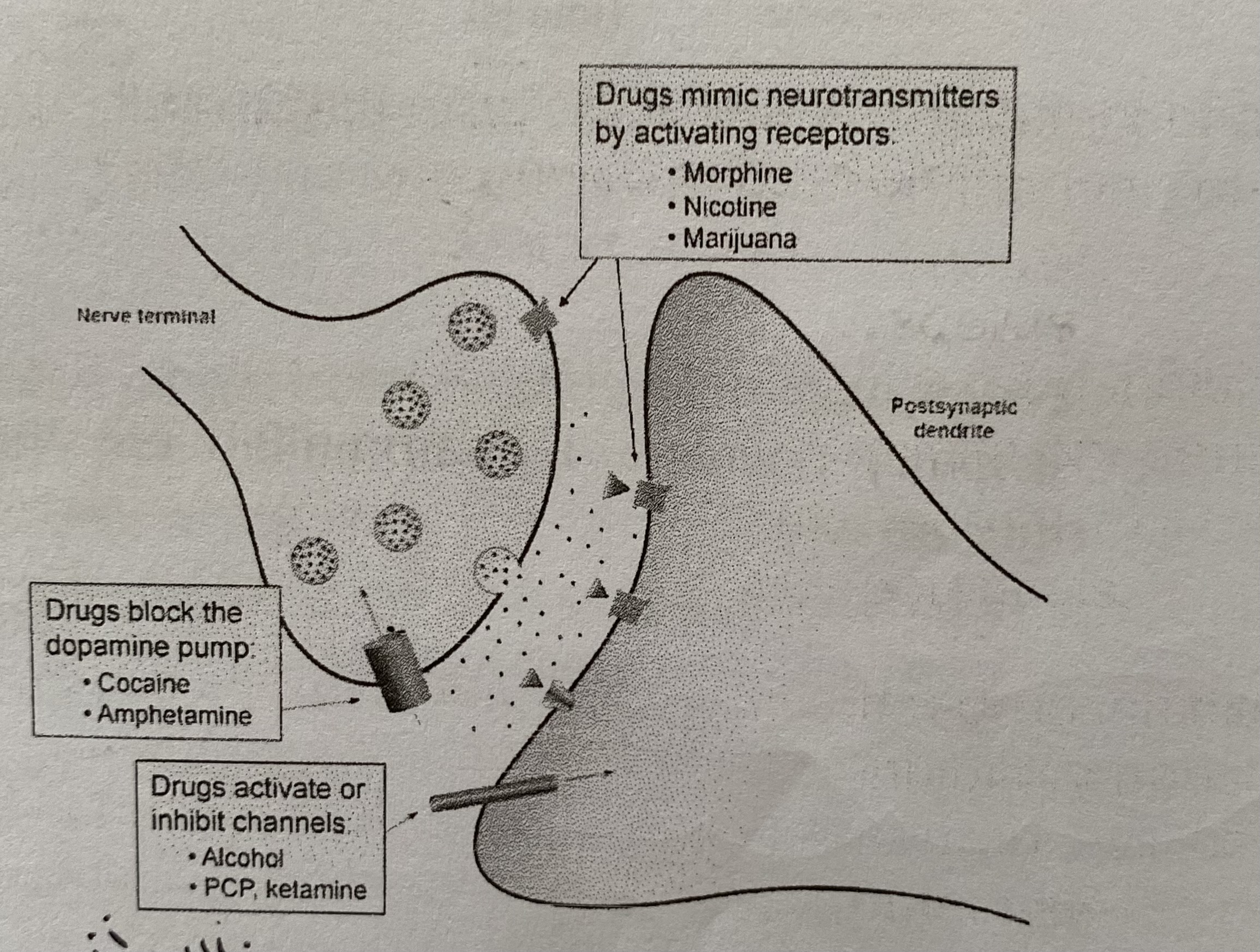
They create/ make it easier to create action potentials in postsynaptic neurones. A drug could do this by:
mimicking the neurotransmitter e.g. having the same shape
causing the release of excess neurotransmitter
reducing the activity of the enzyme which breaks it down
This causes an increase in the number of impulses sent along that neurone e.g. caffeine, nicotine and cocaine
What is the effect of drugs which inhibit the nervous system?
They cause fewer action potentials in the postsynaptic neurone. A drug could do this by:
inhibiting the release of the neurotransmitter
blocking the receptors for neurotransmitter on the postsynaptic neurone
This causes a reduction in the number of impulses sent along that neurone e.g. alcohol, cannabits and ketamine
What does the effect of a drug depend on?
Type of neurotransmitter and synapse
If a drug inhibits release of an excitatory transmitter, the postsynaptic neurone will be less likely to fire action potentials
If a drug inhibits release of inhibitory transmitter, the postsynaptic neurone will be more likely to fire action potentials
ADD QUESTION 5cii FROM EQ PACK
Nicotine is a similar shape to acetylcholine.
> Explain the effect nicotine would have on the nervous system
Nicotine will bind to ACh receptors in the postsynaptic membrane, opening sodium channels and allowing sodium ions to diffuse into the postsynaptic neurone, initiating action potentials. More impulses will be generated in CNS- excitatory effect
Atropine is found in the flower Atropa belladonna, otherwise known as Deadly Nightshade or Belladonna. It has a similar shape to ACh and binds to its receptors, but doesn’t allow the passage of sodium through the channels
> Explain what effect atropine would have on the muscle at a neurotransmitter junction
Atropine will bind to ACh receptors in postsynaptic membrane but will not cause the sodium channels to open. It will effectively block the receptor and prevent ACh from binding. Therefore depolarisation will not occur and action potentials will not be generated in the muscle cell membrane. This prevents muscles from contracting, causing paralysis
GABA is a neurotransmitter which inhibits the formation of action potentials when it binds to postsynaptic neurones. Epilepsy can be the result if an increase in the activity of neurones in the brain due to insufficient GABA. An enzyme breaks down GABA on the postsynaptic membrane. A drug called Vigabatrin has a molecular structure similar to GABA and is used to treat epilepsy
> Suggest a way in which Vigabatrin might be effective in treating epilepsy
The molecular structure of vugabatrin is similar to GABA so it may act as a competitive inhibitor for the active site of the enzyme which breaks down GABA. Therefore less GABA is hydrolysed and more of it is available to inhibit formation of action potentials
OR
Vigabatrin might bind to GABA receptors on the postsynaptic neurone and mimic its action, thereby inhibiting initiation of action potentials

