Ecology Exam #1

0.0(0)
studied byStudied by 2 people
call kaiCall Kai
learnLearn
examPractice Test
spaced repetitionSpaced Repetition
heart puzzleMatch
flashcardsFlashcards
GameKnowt Play
Card Sorting

1/223

encourage image

There's no tags or description

Looks like no tags are added yet.

Last updated 11:46 AM on 9/26/23
Name
Mastery
Learn
Test
Matching
Spaced
Call with Kai

No analytics yet

Send a link to your students to track their progress

224 Terms

1
New cards
Ecology
The study of ecological systems- how they work, and how they affect each other.
2
New cards
Environmental science (what ecology isn’t)
A broader, interdisciplinary field, incorporating ecology, chemistry, physics, geology, and sometimes even sociology and policy.
3
New cards
Environmentalism (what ecology isn’t)
A philosophy geared toward environmental \n protection and long-term survival of humanity on \n earth. Sometimes grassroots or confrontational.
4
New cards
Scenario: Is it ecology, environmentalism, or environmental science.

\
How does an invasive species affect the numbers and types of species in a forest?
Ecology (how does one thing change the other)
5
New cards
Ecological system
Biological entities that have their own internal processes and interact with their external surroundings.
6
New cards
Individual
* A living being—the most fundamental unit of ecology.
* Although smaller units in biology exist—for example, an organ, a cell, or a macromolecule—none of them has a separate life in the environment.
* Every individual has a membrane, or other covering, across which it exchanges energy and materials with its environment.
7
New cards
Is a cell, DNA, or amoeba an individual?
Amoeba
8
New cards

Individuals have… (requirements)

  • Membrane/outer covering

  • Transforms/moves energy, alters resources

  • Something that cannot be further divided without it ceasing to be whatever it is an instance of (Aristotle)...?

  • Propagate itself…?

9
New cards
Species
Historically defined as a group of organisms that naturally interbreed with each other and produce fertile offspring. Current research demonstrates that no single definition can be applied to all organisms.
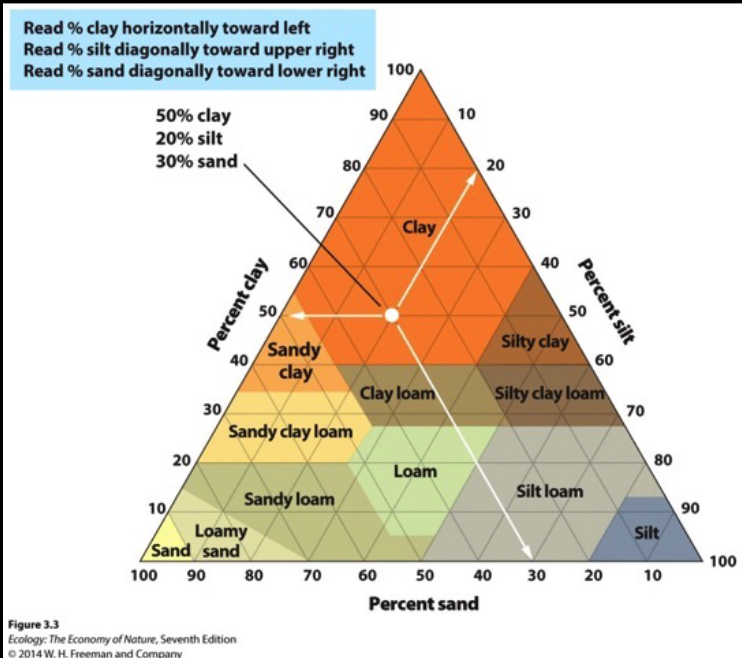
10
New cards
Horizontal gene transfer
* Bacteria can transfer bits of their DNA to other bacteria that are not closely related.
* Makes it difficult to group bacteria into distinct species.
11
New cards
Population
* Individuals of the same species living in a particular area.
* For example, we might talk about a population of catfish living in a pond, a population of wolves living in Canada, or a population of tubeworms living near a hydrothermal vent on the ocean floor.
* The boundaries that determine a population can be natural, for example, where a continent meets the ocean. Alternatively, a population might be defined by other criteria such as a political boundary.
12
New cards
Five distinct properties of populations, ways to measure them (not exhibited by individuals)
* Geographic range: distribution, is the extent of land or water within which a population lives.
* Abundance: the total number of individuals.
* Density: is the number of individuals per unit area.
* Composition: makeup in terms of age, sex, and genetics.

\
* Change in size: population change
* Example: pika population change
* super adapted to cold temp, can easily overheat, climate change will decrease their population.
13
New cards
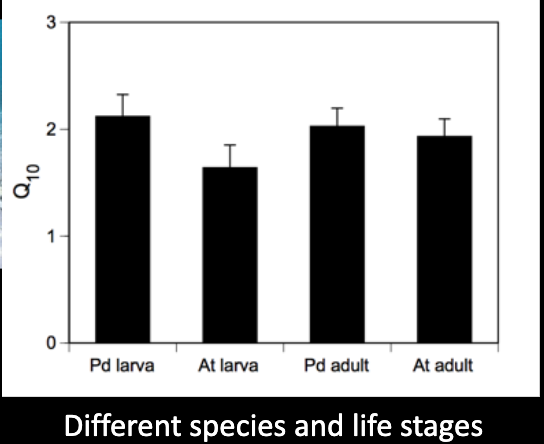
Community
* All populations of various species living together in a particular area that interact or could potentially interact.
* Boundaries are not always rigid- could cover large or small areas.
14
New cards
Ecosystem
One or more communities of living organisms interacting with their nonliving physical and chemical environments, which include water, air, temperature, sunlight, and nutrients.
15
New cards
What to focus on in an ecosystem
* *Focus on the movement of energy and matter between physical and biological components of the ecosystem*.
* Most energy that flows through ecosystems originates with sunlight and eventually escapes Earth as radiated heat.
16
New cards
Most common elements that organisms use
* Carbon, oxygen, hydrogen, nitrogen, and phosphorus.
* These elements comprise a major portion of the most important compounds for living organisms, including water, carbohydrates, proteins, and DNA.
17
New cards
Biosphere
* All the ecosystems on Earth
* All transformations of the biosphere are internal, with two exceptions: the energy that enters from the Sun, and the energy that is lost to space. The biosphere holds practically all materials that it has ever had, and retains whatever waste materials we generate.

\
* Distant ecosystems are linked together by exchanges of wind and water and by the movement of organisms.
* Climate, wind patterns, large matter energy circled globally
18
New cards
Apparent digestive efficiency
Relative proportion of energy absorbed by gut.
19
New cards
Production efficiency
Relative proportion of ingested energy used for growth.
20
New cards
Individual approach
* An approach to ecology that emphasizes the way in which an individual’s morphology, physiology, and behavior enable it to survive in its environment.
* Ecologists who use the individual approach are often interested in adaptations.
21
New cards
Community approach
* Understands the diversity and interactions of organisms living together in the same place.
* Interactions of organisms living in the same place.
* Predation, parasitism, herivaory, mutualism, ect.
22
New cards
Type of interaction: Predation/parasitoid
\+, -
23
New cards
Type of interaction: Parasitism
\+, -
24
New cards
Type of interaction: Herbivory
\+, -
25
New cards
Type of interaction: Competition
\-, -
26
New cards
Type of interaction: Mutualism
\+, +
27
New cards
Type of interaction: Commensalism
\+, 0
28
New cards
Ecosystem approach
An approach to ecology that emphasizes the storage and transfer of energy and matter, including the various chemical elements essential to life.
29
New cards
Biosphere approach
An approach to ecology concerned with the largest scale in the hierarchy of ecological systems, including movements of air and water—and the energy and chemical elements they contain—over Earth’s surface.
30
New cards
Dynamic steady state
* When gains and losses are in balance, ecological systems are unchanged.
* Example: inputs, level, outputs
* Input: food. Level: individual. Output: energy expended, waste
* Input: births, immigration. Level: population. Output: deaths, emigration
31
New cards
Proximate hypotheses
Address the cause of immediate changes in individual phenotypes or ecological interactions. (HOW AND WHAT)
32
New cards
Ultimate hypotheses
Address the fitness costs and benefits of a response (EVOLUTIONARY REASONS… THE WHY!)
33
New cards

Which of these represent an ultimate hypotheses for why these people have good abs?

a. People with good abs do 1000 sit-ups at the gym 5 days a week \n

b. People with good abs are have more sexual partners passing on their good abs gene to the next generation

c. People with good abs do activities that cause their muscle \n fibers are split resulting in a larger abdominal muscle fibers.

34
New cards
Testing hypotheses in Ecology: Manipulative experiments
* Where a hypothesis is tested by altering a factor hypothesized to be the cause of a phenomenon.

\
* Treatment: the factor that we want to manipulate in a study.
* Control: a treatment that includes all aspects of an experiment except the factor of interest.
35
New cards
Testing hypotheses in Ecology: Manipulative experiments, experimental unit
* The object to which we apply a manipulation
* Experimental units may be natural (e.g., lakes) or artificial \n (e.g., microcosms), and may vary in size by several orders of magnitude.
36
New cards
Testing hypotheses in Ecology: Manipulative experiments, replication
The number of experimental units per treatment
37
New cards
Testing hypotheses in Ecology: Manipulative experiments, randomization
A requirement for manipulation experiments; every experimental unit must have an equal chance of being \n assigned to a particular treatment.
38
New cards
Alternative types of experiments: Natural experiments
An approach to hypothesis testing that relies on natural variation in the environment to test a hypothesis.
39
New cards
Alternative types of experiments: Mathematical models
* Representations of a system with a set of equations that correspond to hypothesized relationships among the system’s components.
* Ecologists often test mathematical models using natural or manipulative experiments.
40
New cards
Natural selection
A change in the frequency of genes in a population through differential survival and reproduction of individuals that possess certain phenotypes.
41
New cards
Fitness
The survival and reproduction of an individual.
42
New cards
Adaptations
* Characteristics of an individual’s morphology, physiology, and behavior that enable it to survive in an environment.
* Responses to environmental challenges.
43
New cards
Environmental challenges are the agents that cause (blank) for adaptations.
selection
44
New cards
Water (4 things)

1. Water has 3 states and a high specific heat: the energy \n required to raise water temperature by 1°C.
2. Water at different states varies in density
3. Water has a high viscosity
4. Water contains dissolved compounds
45
New cards
High specific heat of water
Important that water has a high specific heat, if it didn't we wouldn't be able to use it.
46
New cards
Density of water
* Water is at its highest density at 4°C.
* Above and below 4°C, the density of water decreases
* Differential density
47
New cards
Differential density of water
Prevents water bodies from freezing solid during the winter
48
New cards
Adaptations to water density
* Some body tissues are more dense than water, some are less dense. Organisms have developed many adaptation to cope with their tendencies to sink or float.
* Example: swim bladder muscles relax, gets bigger, fish gets lighter, floats up
49
New cards
Viscosity
\n The thickness of a fluid that causes objects to encounter \n resistance as they move through it.
50
New cards
Adaptations to water viscosity
Most aquatic animals have a streamlined body shape that reduces water resistance to enable the animal to move faster in water, like a dolphin.
51
New cards
Water dissolves inorganic nutrients
* Water is polar → water attracts charged ions which causes many substances to dissolve.
52
New cards
Water is a powerful solvent that is able to dissolve many substances, which makes them (blank).
accessible to organisms
53
New cards
Homeostasis
An organism’s ability to maintain constant internal \n conditions in the face of a varying external environment.
54
New cards
Salt balance: Solutes
Dissolved substances in water
55
New cards
Salt balance: Semipermeable membranes
Membranes that allow only particular molecules to pass through, reduces free movement of solutes.
56
New cards
Salt balance: Osmosis
Movement of water across a semipermeable membrane
57
New cards
Salt balance: Osmoregulation
Mechanisms organisms use to maintain a proper solute balance.
58
New cards
Salt balance: Hyperosmotic
Tissue solute concentrations are higher than surrounding water.
59
New cards
Salt balance: Hypoosmotic
Tissue solute concentrations are lower than surrounding water.
60
New cards
Are freshwater fish hyperosmotic or hypoosmotic?
Hyperosmotic because freshwater fish want to hold in ions. Opposite for saltwater fish, because their gills are pumping out solutes
61
New cards

Loops of henle in whales

Adaptation for osmoregulation: allows whales to drink in saltwater without harm.

62
New cards

Salt balance: plants

  • Plants growing in salty environments also face major challenges of salt balance (e.g., root uptake of water).

63
New cards

Some mangrove species on coastal mudflats maintain high concentrations of organic solutes in their roots to increase osmotic potential (the force with which a solution attracts water)

Makes roots super hyperoosmotic, adaptation for osmoregulation

64
New cards
Water and salt balance in animals: All organisms must (blank) or (blank) solutes to maintain the proper concentrations of water and solutes.
acquire or remove
65
New cards
Water and salt balance in animals: Animals acquire (blank) in the water and food they consume. Water intake and urine excretion eliminate excess (blank).
ions, salts
66
New cards
Water and salt balance in animals: when water is scarce, animals exhibit numerous adaptations
Rat: behavioral adaptation, hunts at night

Beavers, humans, and rats: have comparative loops of henle

\
Beavers don't have long loops of henle because they are surrounded by water all the time. It would be a waste of energy.
67
New cards
Nitrogen
Metabolic waste product, can form toxic ammonia
68
New cards
Terrestrial animals rarely have enough water to excrete (blank) safely.
Ammonia, NH3
69
New cards
What’s in soil?
* Sand, silt, and clay, in addition to decomposing \n organic material.
* Sand > 0.05 mm diameter
* Silt = 0.002 – 0.05 diameter
* Clay < 0.002 diameter
70
New cards
How to read soil composition on the chart
71
New cards
What makes good soil: which holds more water?

Silt or clay
Clay, surface area is what water adheres to
72
New cards
What makes good soil: which holds more tightly to water?

Silt or clay
* Clay
* Clay holds more water against the pull of gravity
* Clay is not the best soil either though because it is super tightly holding to the water, plants can’t get at it
73
New cards
What makes a good soil: Matric potential
* Potential energy generated by the attractive forces between water and soil.
* Soil has matric potentional, roots have even stronger matric potential which pulls water through.
74
New cards
What makes a good soil: field capacity
The maximum amount of water held by soil against the force \n of gravity.
75
New cards
Root adaptations to access (blank) and (blank) in soil.
water and nutrients
76
New cards
How to remain at homeostasis (and not at equilibrium with soil): Two root adaptations

1. Semipermeable membranes
2. Active transport of solutes
77
New cards
Cohesion
* The mutual attraction of water molecules; allows water to move up through empty remains of xylem cells. (also, adhesion)
* But... Cohesion (beginning with root pressure forcing water into xylem) can only raise water to \~20 m... trees can be much taller!
78
New cards
Transpiration
The process by which leaves can generate water potential as water evaporates from the surfaces of leaf cells → creates tension!!
79
New cards
Cohesion tension theory: root hair
* Water moves into the root by osmosis, and then into the xylem.
* Tension pulls the water upward in the xylem of the root.
80
New cards
Cohesion tension theory: stem
* Water molecules form a cohesive column in the xylem.
* Tension pulls the water upward in the xylem of the stem.
81
New cards
Cohesion tension theory: leaf
* Tension pulls the water column up and out in the xylem of the leaf veins.
* Water evaporates from the mesophyll cells and diffuses out of the stoma.
82
New cards
Cohesion-tension theory (summary)
* Low water potential from transpiration → tension that draws water up through the xylem against gravity and the high osmotic potential of root cells.
* Or simply..
* the mechanism of water movement from \n roots to leaves due to water cohesion and water tension.
83
New cards
Stomata
Small openings on leaf surfaces that are points of entry \n for CO2 and exit points for water vapor; bordered by guard cells that open and close each stoma.
84
New cards
When soil is at its wilting point, why do plants wilt?
* Water potential in soil is too low for roots to draw out water from soil
* Too little water taken up to replace lost from leaves
* Stomata close, but then plants lose tension to help draw water up and out of soil.
85
New cards
Water balance in plants: rubisco
Needed for photosynthesis, rubisco takes oxygen
86
New cards
Water balance in plants: C3 plants
* Get rid of O2 by keeping stomata open to prevent photorespiration.
* Lose a LOT of water this way, too.
87
New cards
Water balance in plants: C4 plants
* Uses PEP carboxylase to help get CO2 to Rubisco. CO2 \n is concentrated in bundle sheath cells to improve efficiency.
* Down side: less photosynthesis, more energy/space used in process.
88
New cards
Water balance in plants: CAM plants
* Similar to C4 plants, but gas exchange happens at \n night, and no bundle sheath cells used. Lower water loss.
* Down side: slow photosynthesis, slow growth.
89
New cards
Heat and biological processes: heat causes biological molecules to change (blank).
shape
90
New cards
Heat and biological processes: heat accelerates chemical reactions by increasing (blank).
molecular movement
91
New cards
Heat and biological processes: The rate of most biological processes increases (blank) for each 10°C rise in temperature.
2 to 4 times
92
New cards
When things get hotter…
* Proteins and other biological molecules become less stable, may not function properly, and may denature (i.e., open up).
* Fats become fluid with heat, and stiff with cold.
93
New cards
Heat and biological processes: Q10 value
A ratio of a physiological process rate at one temperature \n to the rate of that process when the temperature is 10°C cooler.
94
New cards
Heat and biological processes: Q10 value example

Which is most affected by increasing temps?
Heat and biological processes: Q10 value example

Which is most affected by increasing temps?
Pd larva
95
New cards
Higher Q10 value means (blank) slope.
Steeper
96
New cards

Homeostasis

An organism’s ability to maintain constant internal conditions in the face of a varying external environment.

97
New cards

Organisms exchange heat by four processes

Radiation, evaporation, conduction, convection

98
New cards

Maintaining temperature: Negative feedback

The action of internal response mechanisms that restores a system to a desired state or set point, when the system deviates from that state.

99
New cards

Maintaining temperature (or not): Thermoregulation

The ability of an organism to control the temperature of its body

100
New cards

Maintaining temperature (or not): Animals exist on a continuum ______ → ______

thermoregulator → thermoconformer