Wood Manufacturing
 Call Kai
 Learn
Learn Practice Test
 Spaced Repetition
 Match
Match Flashcards
 Knowt Play
1/11

Earn XP
Description and Tags
Includes Manufacturing, build with wood, and normal and alterations lectures. Basically everything but properties and features. Starts on 6a slides
Name | Mastery | Learn | Test | Matching | Spaced | Call with Kai |
|---|
No analytics yet
Send a link to your students to track their progress
12 Terms
What is Normal Stresses during tree growth?
It is stress that originates from natural growth processes, and should not be confused with internal stresses that develop during the drying of or seasoning of timer.
Where is the formation of growth related stresses?
Initiated during the secondary cell wall development
Lignin deposition in S2 layer causes cells to contract longitudinally, produces tension along grain on the outside of the stem and compression on the inside of the stem
Associated with reaction wood.
What is the distribution of growth related stress?
Compression maximum at pith
Stresses are not even around the tree
Large between tree variation
Greater circumferential variation in leaning trees
Greater in rabidly growing young trees
How to decrease stresses in logs to be processed?
Sprinklers in log yards, time, saw techniques, log end scaling, log handling, manipulation through genetics and silviculture,
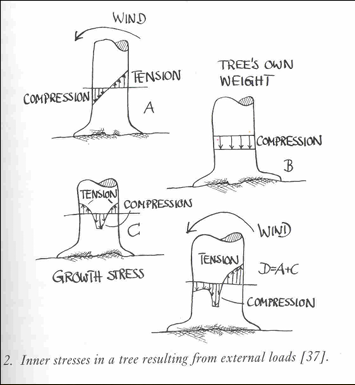
look at 6a - 6c for more notes on reaction wood, theres to many photos to upload here
What is the purpose of wood drying
To decrease moisture to a certain level, depending on the end use of the product.
What is veneer and plywood?
The conversion of logs into thin strips/sheets of wood that are generally less than 1/8th of an inch.
What are Composite products?
Using wood flakes, chips, or ground material to form a variety of end products.
Examples of engineered wood products and what they are
Glulam, LVL, LSL that uses waffers, strips, etc. to produce structural building products
Steps to producing lumber
Remove bark (mechanical ring barker) to extend saw life.
Log is bucked to a length and send through a saw system, typically removing the first outer slabs (one flat face) and flitches (two parallel flat faces). Slabs, edgings and trim goes to a chipper for pulp and the flitches are sent to a re saw or to an edger. Lumber is trimmed to a specified length with an allowance for drying
Sorting for grading and drying
After a kiln charge the wood is planed, graded, re trimmed, grade marked and packaged
Two forms of breaking down logs into lumber?
Sawing (takes more time, produces less defects)
Quarter sawing (easiest and fastest)
Importance of drying and how to do it (7a2)
Important because dry limber weighs less (reduces shipping costs), controls shrinking, increases strength/thermal/electrical properties, finish coats/decay/fire retardant chemicals, gluing more effectively applied,

