7. genetic drift
 Call Kai
 Learn
Learn Practice Test
 Spaced Repetition
 Match
Match Flashcards
 Knowt Play
1/23

There's no tags or description
Looks like no tags are added yet.
Name | Mastery | Learn | Test | Matching | Spaced | Call with Kai |
|---|
No analytics yet
Send a link to your students to track their progress
24 Terms
define genetic drift
Its the change in the frequency of an existing allele in a population due to random chance, rather than selection (evolution at random).
Why is genetic drift important ?
Important bc it affects survival, reproduction, and inheritance, by affecting alleles in next generations
What is an opportunity genetic drift can influence?
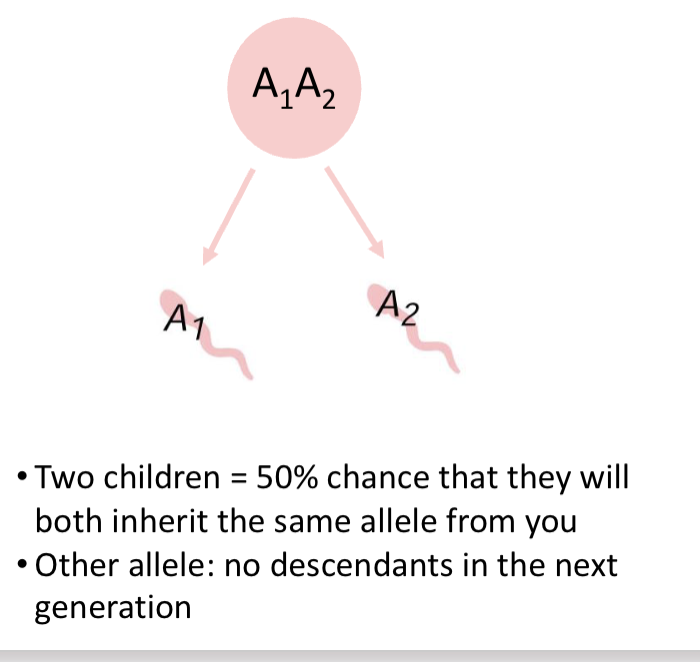
-can influence passing down alleles to offspring by random chance via segregation of chromosomes during meiosis.
→Ex) If a parent has the genotype A1A2 and has two children, there is a 50% chance that both children will inherit the same allele.
How does genetic drift correlate with small populations?
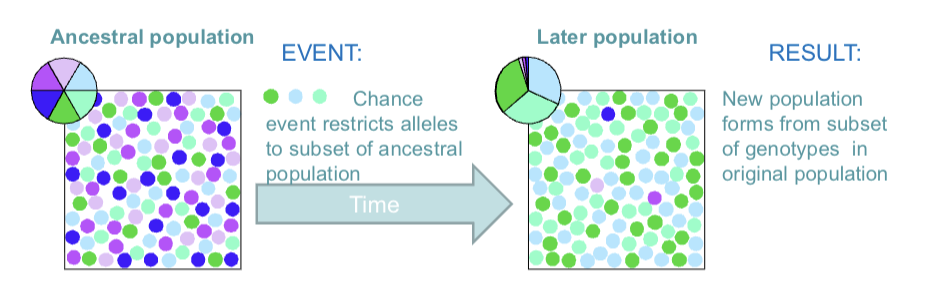
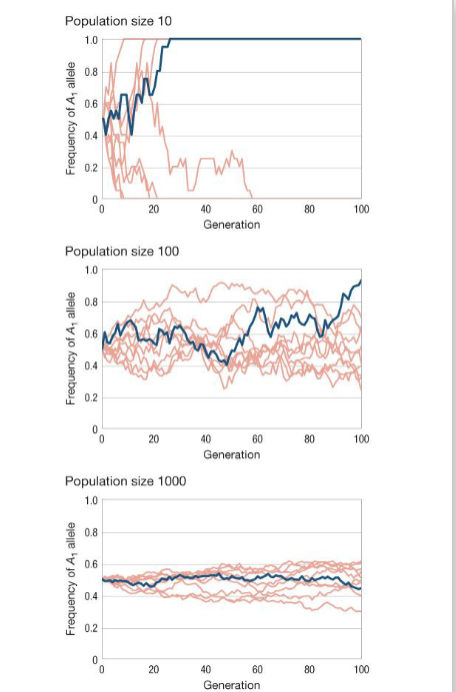
Genetic drift is strongest in small populations. As the smaller the sample, the larger the random fluctuations in allele frequencies.
→Genetic drift is driven by sampling error, which is the variability in allele frequencies because not all samples taken from the population have exactly the same allele frequencies as the population itself.
Why does sampling error diminish as sample size increases?
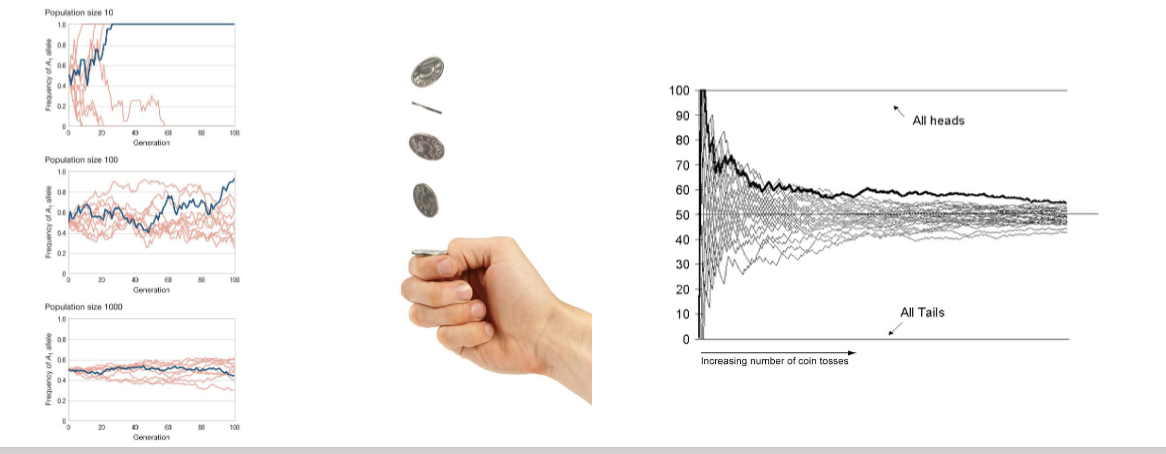
Bc of the basic laws of probability, outcomes become more consistent when averaged over a larger number of random events.
what are the Five Fundamental features of Genetic Drift (and extra)
drift is unbiased
random fluctuations are larger in smaller populations
genetic varation is lost
causes populations that are initially identical to become different
an allele can become fixed without selection
→extra: genetic drift is loss of heterozygosity
explain the 1st fundamental feature of genetic drift
-Drift is unbiased, bc an allele frequency is as likely to go up as to go down.
explain the 2nd fundamental feature of genetic drift
-Random fluctuations are larger in smaller populations, as smaller samples have a greater chance of random deviation from predicted results due to the basic laws of probability
→Outcomes become more consistent when averaging over a larger number of randoms events. This is caused by sampling error, the variability that arises because a small subset of reproducing individuals may not perfectly represent the genetic makeup of the entire ancestral population.
explain the 3rd fundamental feature of genetic drift
-Genetic variation is lost, as allele frequencies will fluctuate randomly up and down until reaching 0 (loss) or 1 (fixation). the direction of any single shift is determined by sampling error
→This loss is faster in smaller populations
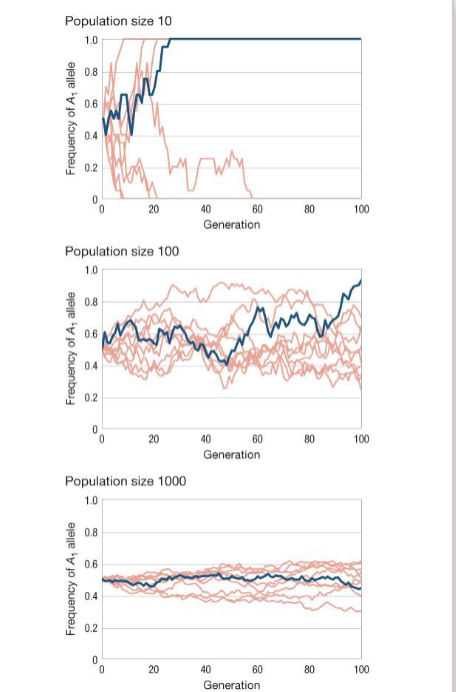
explain the 4th fundamental feature of genetic drift
-Populations that are initially identical become different from one another over time (divergence of populations)
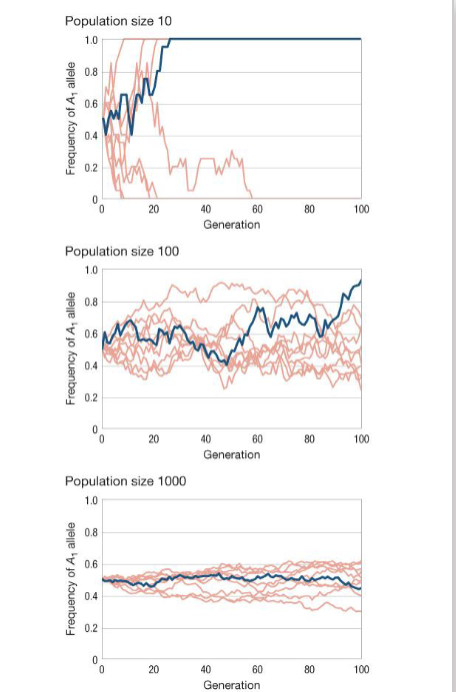
explain the 5th fundamental feature of genetic drift
-An allele can become fixed (1.0) purely by chance without any influence from natural selection.
→The probability that an allele will eventually become fixed is equal to its current frequency in the population.
→New mutation with no effect on fitness has a probability of 1/2N of ultimately becoming fixed
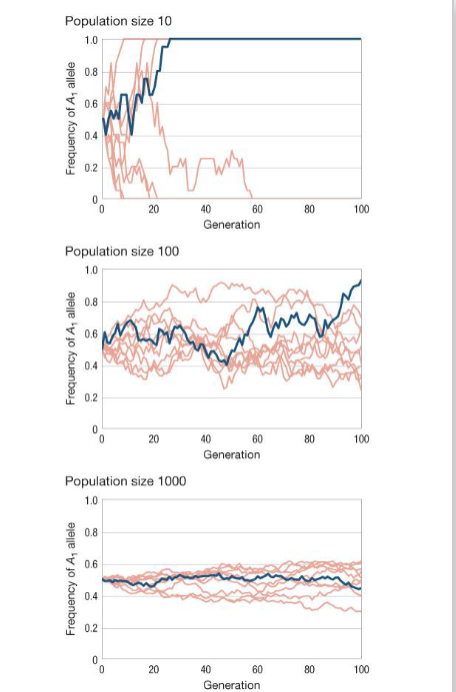
explain the 6th/extra fundamental feature of genetic drift
-There is a loss of heterozygosity, as drift doesnt cause large departures from Hardy-Weinberg equilibrium within a population
→Drift causes a deficit of heterozygotes when a set of diverging populations is considered as a whole
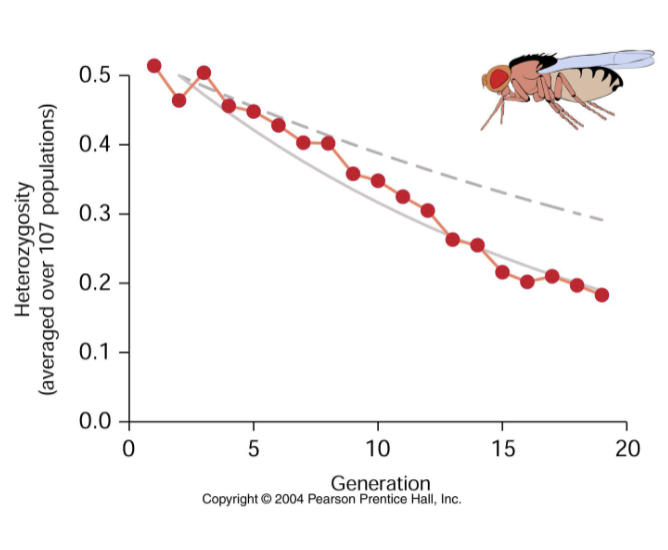
How do you measure the strength of genetic drift in any population?
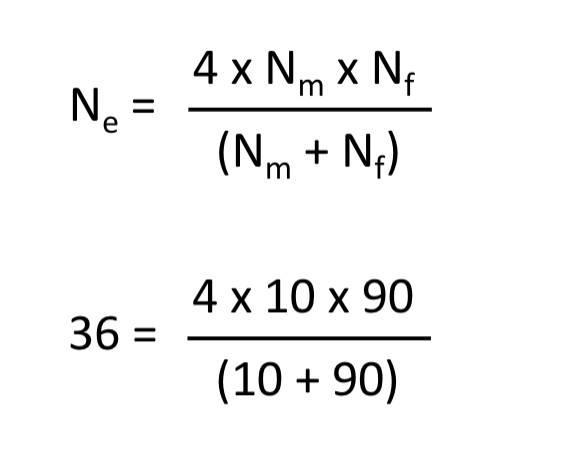
-Measure the strength of genetic drift by effective population size (Ne), which is the number of individuals that effectively participate in producing the next generation
Why is the breeding population less than total population?
-Some members are too old or young to reproduce, the sex ratio is different from 1:1, and there is variation in number of offspring produced by one sex
→ex) 1 boss man seal protects harem of females. so not many males reproduce
What is strength of genetic drift is inversely proportional to?
Strength of genetic drift is inversely proportional to Ne, smaller Ne results in stronger genetic drift.
→All individuals have equal chance of leaving offspring
What are the 3 categories of why drift is affected by fluctuations in population size
→The evolutionary history of many species includes times when the population was reduced to small numbers
The founder effect
The bottleneck effect
Genetic Variation within Species
what is the founder effect (isolated colonies)
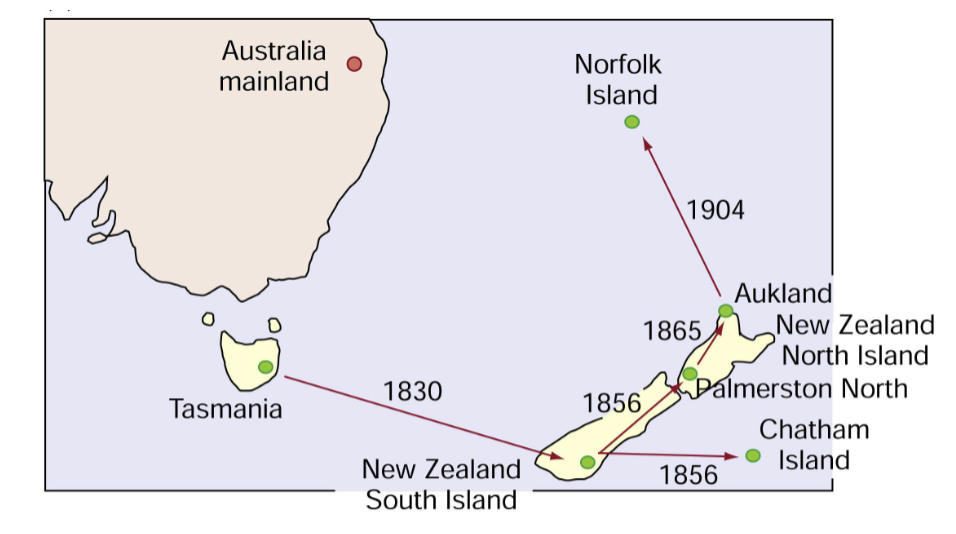
When small populations have just been founded, and the allele frequencies in the new population are likely to be different from source population
example of founder effect with silver eyes
→A small number of silver eyes leave a large population to establish a new one, and this new colony only has a tiny fraction of the original genetic diversity
explain the bottleneck effect (Natural disasters)
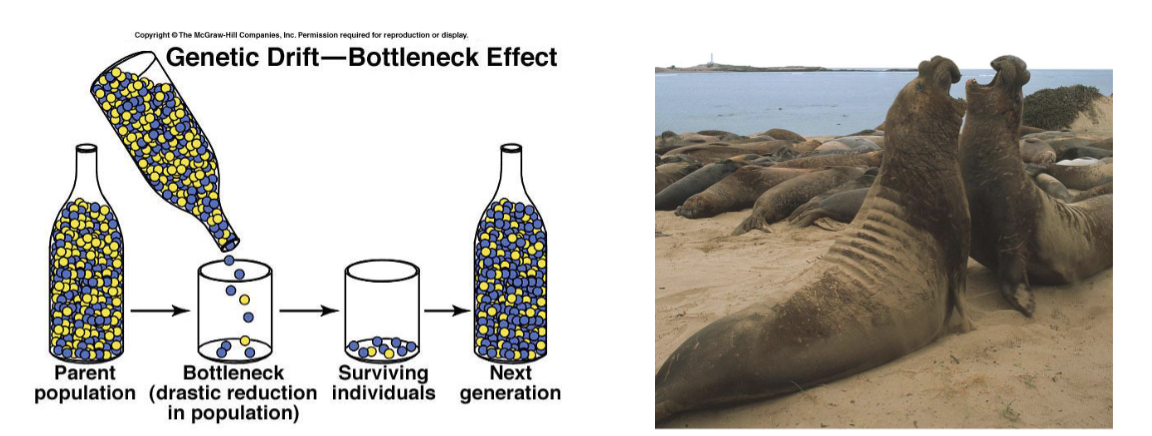
When population is decreased to a small number of individuals usually from natural disasters. Causing a reduction in allelic diversity and heterozygosity after bottleneck effect.
→There is an intense genetic drift with long-lasting impact on genetic variation and potentially negative impact on fitness
Explain the genetic variation within species (affects genetic drift)
-Genetic variation is high in regions between genes and within introns, while exons are less variable (especially at 1st and 2nd base of each codon)
-Loci polymorphism is spread unevenly across the genome, much of the polymorphism results from genetic drift acting on selectively neutral mutations
What is the interaction between mutation, selection and genetic drift, what would we expect?
-The deleterious alleles appear and are ELIMINATED by selection
-Neutral mutations appear and are FIXED/LOST by chance
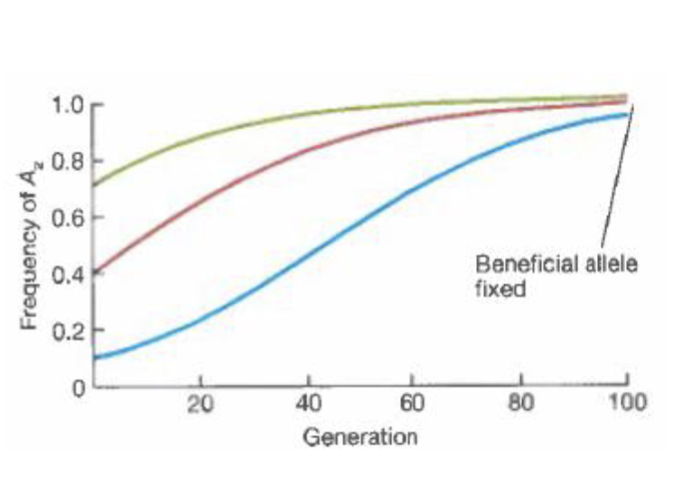
-Advantageous mutations appear and are RAPIDLY FIXED by selection
What can determine evolution?
What has weak drift, and what measures the strength of drift?
-Selection is much stronger than drift that effects of drift can be ignored, and drift can overwhelm selection.
-Large populatiosn have weak drift, which 1/Ne measures strength of drift
→If S>1/Ne: Selection determines evolution
→If S<1/Ne: Drift determines evolution
What can cause deleterious mutations and what are the effects?
-Populations with small Ne drift can cause deleterious mutations to spread to fixation, leading to fitness decline and contribute to extinction of small populations (known as inbreeding load)
What is an example of inbreeding load?
-An isolated population of Vipera berus had fewer than 40 individuals that were highly homozygous. The females had unusually small litters with deformed/still-born offspring.
→20 adult males were introudced from other populations that were left to interbreed for 4 years and then removed
Explore top notes

Explore top flashcards
