3.5 Labour Markets
 Call Kai
 Learn
Learn Practice Test
 Spaced Repetition
 Match
Match Flashcards
 Knowt Play
1/29

There's no tags or description
Looks like no tags are added yet.
Name | Mastery | Learn | Test | Matching | Spaced | Call with Kai |
|---|
No analytics yet
Send a link to your students to track their progress
30 Terms
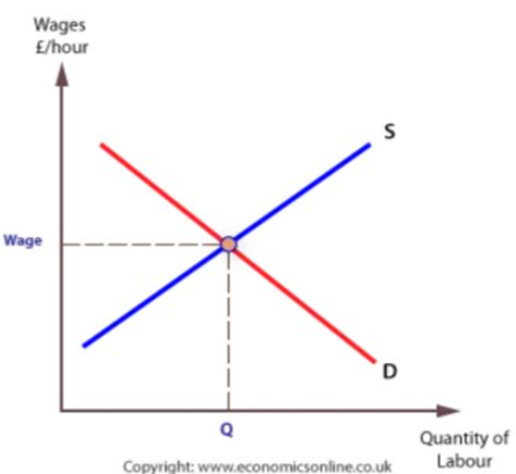
What does the demand for labour curve show
Quantity of labour that employers would wish to hire at each possible wage rate
How is demand for labour determined
By marginal revenue product (MRP), the extra revenue generated by an individual worker. The higher the MRP, the higher the demand for workers.
MRP Equation
MRP = Marginal output x price
or
The difference in total revenue
Define derived demand
It is derived from demand for the product the labour produces. Businesses only want the worker for as long as people are willing and able to buy the product
6 Factors influencing demand for labour
Wage rates
Demand for product
Prices of other FOP
Wages in other countries
Technology
Regulation
How do wage rates influence demand for labour
As wage rates increase, demand for labour contracts since the MRP of labour must be higher for it to be worthwhile employing more people, so less people are employed. it has the same influence on demand for labour as price has on demand for products
How does demand for product influence demand for labour
If there is no demand for a product, there is no demand for the labour.Firms wont employ people if the goods they make arent going to be sold and make profit. Increase in demand for product leads to an increase in demand for labour
How do prices of other factors of production influence demand for labour
if machinery and equipment become cheap, people will switch machinery for labout and therefore demand for labour will fall
How do wages in other countries influence demand for labour
if wages are lower in other countries and are relitively high in the UK, people will be employed in other countries as this ha lower costs for businesses. this means that demand in the UK is low
How does technology influence demand for labour
improvements in computers and tech means that many jobs have been lost with work being done by machines. Less demand for labour, but demand for labour in tech-based indistries is increasing
By 2040, about 47% of jobs could be lost to technology
How does regulation influence demand for labour
high regulation within the labour market is likely to discourage firms from hiring since it can be very costly and time-consuming so this will reduce demand for labour in these areas. As laws are passed some jobs dissapear, such as conductors, whilst others are made
Labour market diagram
What is Price Elasticity of Demand
The responsiveness of the quantity demanded of labour to the wage rate
4 Factors affecting PED of labour
PED of demand for the product
Proportion of wages to the total cost of production
Substitutes
Time
How does PED for the product affect PED of labour
if the good is elastic, then a rise i wages and a rise in prices for consumers will have a large impact on the quantity the business sells. This will mean busniesses will reduce the number of people it employs, in order to help it make profit
How does proportion of wages to the total cost of production affect PED of labour
if wages are a huge proportion of costs, then an increase in wages will increase costs massively and so there will be a large fall in demand for labour, hence elastic
How does substitutes affect PED of labour
Machinery and labour in other countries are substitutes, and this means the demand will be elastic if there are many. High skilled jobs tend to be more inelastic than low skilled jobs as the labour cannot be replaced easily
How does time affect PED of labour
in the LR, it is more elastic as machinery can be developed and jobs can be moved whilst in the SR firms have to employ workers and reduncancy payments can be expensive
what does the supply of labour curve show
ability and willingness of people to make themselves available to work at different wage rates
7 Factors influencing supply of labour
wages
population and distribution of age
non-monetary benefits
education/training/qualification
trade unions and barriers to entry
wages and conditions of other jobs
legislation
How do wages influence the supply of labour
It will lead to an increase in hours worker at first, but soon a decrease in hours will occur. Firms can increase the number of hours worked by its workforce in two ways: it can increase the number of hours, or recruit new workers. therefore although an increse in wage rates may not increase the number of hours worked by existing labour, it will increase the number of workers. this is because new workers may join from other industries or from being unemployed
How does population and distribution of age influence the supply of labour
a high population will mean there is a large supply of labour. the distribution of age is important as there needs to be many people in high working age to ensure there is loads of labour, migration plays a role in determining the workforce, since many migrants are of working age and come to the UK to work
How does non-monetary benefits influence the supply of labour
supply of labour will increase if there is high job satisfaction, for example in vocational jobs. some jobs are attractive because they are close by or in an area with good social life, such as London, require little commuting or near friends/family. Some jobs offer perks such as free private healthcare, which will increase supply
How does education/training/quaifications influence the supply of labour
more educated workers mean there is a higher supply of workers. this is particularly important for some indistries which require qualifications. occupations which require high level skills of education may suffer from lower supply of labour compared to low skilled jobs
How does trade unions and barriers to entry influence the supply of labour
trade unions may be able to restrict the supply of labour by introducing barriers to entry, for example you have to have a degree for teaching
How do wages and conditions of other jobs influence the supply of labour
if many jobs in a local area are considered to be unpleasant and offer low wages, then supply for alternatives will be higher
How does legislation influence the supply of labour
the government rules can affect supply of labour, for example school leaving age and retirement age
Market failure
the labour market should operate in the same way as any other. An increase in wages should attract labour to the industry and a fall in wages should mean labour leaves industry. However, labour is not a perfectly free market
Two types of immobility
Occupational: where workers find it difficult to move from one job to another because of a lack of transferable skills.
Geographical: where they find it difficult to move from one place to another due to the cost of movement, family etc.
How does immobility affect demand and supply of labour
Immobiliy can mean that there can be excess supply of labour in one area/occupation and excess demand in another. even if wages are higher where there is excess demand, people will be unable to leave where there is excess supply to get a job in that area/occupation because of immobility

