OB Exam III
 Call Kai
 Learn
Learn Practice Test
 Spaced Repetition
 Match
Match Flashcards
 Knowt Play
1/222

There's no tags or description
Looks like no tags are added yet.
Name | Mastery | Learn | Test | Matching | Spaced | Call with Kai |
|---|
No analytics yet
Send a link to your students to track their progress
223 Terms
List common suspicions for what causes labor to begin.
Stretching of the uterus
Amniotic fluid level
Shift from progesterone to estrogen dominance
Increased oxytocin sensitivity (oxytocin receptors increase = increases the sensitivity to oxytocin = uterus is more receptive to contractions)
Increased release of prostaglandins
List the signs that indicate labor is near.
Cervical changes “Ripening”
Lightening
Increased energy level (nesting)
Bloody show
Braxton Hicks “False Labor”
SROM
What is “Ripening”?
Ripening = cervical changes that indicate labor is near
Cervix must soften and stretch to allow dilation
—>Can occur over weeks or within hours
—>Prostaglandins and Relaxin starts releasing to relax the pelvis and soften the cervix
What is lightening?
A sign that labor is near
Lightening: Fetal presenting part engages into the pelvis
Before the presenting part was ballotable (floated around)
Once engaged, its in there
Resulting from lightening:
—>Improvement in breathing b/c the fetus is not pressing on the diaphragm as much
—>May have more frequent voiding because of more pressure on the bladder
—>More pelvic pressure, leg cramps, dependent edema, back discomfort, vaginal discharge
—>May happen a few weeks before or during labor
What is nesting?
A sign that labor is near
Nesting: Sudden increase in energy before labor begins
Prep for baby; setting up the nursery then rearranging it 5 times, folding and refolding baby clothes, packing bags for hospital, scrubbing the floor on hands & knees (not a bad thing), etc.
Usually occurs 24-48 hours before the onset of labor
Assumed to be caused by an increase in epinephrine release caused by a decrease in progesterone
What is bloody show?
A sign that labor is near
Bloody show: Mucus plug expels as the cervix softens, effaces, and dilates
Cervix has small capillaries that bleed as the cervix ripens and it mixes with mucus, aka “bloody show”
May happen as labor begins, and may happen later in labor
Mucus plug means NOTHING!
What are Braxton-Hicks contractions, what is are important nursing considerations of them, and what is their function, and describe what they feel like vs real contractions?
A sign that labor is near
Braxton-Hicks: “false labor” warm up contractions that encourage cervical ripening but aren’t true labor contractions’
Nursing Considerations of Braxton-Hicks:
A woman can be in early stages of labor for days, which is called prodromal labor
Women have true anxiety of going into the hospital thinking they’re in labor, but being sent home
—>Reassuring them that we are always here when she needs to be evaluated and educating on signs of true vs false labor may be helpful
—>Also reassure her that things are “warming up” for the birthday party and every annoying contraction, whether real or false is doing a job
Functions of Braxton-Hicks:
Moves the cervix from posterior to anterior in prep for labor
Description of Braxton Hicks vs Real Contractions
Tightening or pulling sensation at the top of the uterus and spread through low abdomen and groin
Braxton Hicks are short, irregular, annoying more than painful
Real contractions may be felt in the front or the back
What is SROM?
A sign that labor is near
SROM: Water breaks
What is PROM and PPROM, and what do these pose an increased risk of?
PROM: water breaking before labor begins
—>If this happens, labor usually begins within 24 hours
PPROM: preterm water breaking
—>Treatment may buy enough time to get betamethasone in but not always
Why can these be dangerous?
Amniotic fluid has some of mom's antibodies
Keeps baby cushioned
Amniotic sac protects against infection
Increased risk of cord prolapse if ROM before Lightening occurs
What maternal physiologic responses occur during labor?
HR increases by 10-20 bpm
Cardiac output increases 40-50%
BP increases during contractions
WBC’s increase to 25,000-30,000
RR increases and more oxygen is consumed due to increase in metabolism
Gastric motility and food absorption decrease, leading to N/V
Joints loosen due to Relaxin to allow for baby to pass through the pelvis
Blood glucose levels decrease due to stress of labor
What fetal physiologic responses occur during labor?
Periodic FHR accels and decels related to fetal movement, fundal pressure, and uterine contractions
Decrease in circulation and perfusion to the fetus due to uterine contractions
Decrease in fetal breathing movements
What could maternal hypotension during labor indicate? What does this lead to?
Hypotension of mom can be normal or a side effect of the epidural, but can indicate intrauterine hemorrhage
This leads to late and prolonged fetal heart rate decelerations
What could maternal tachycardia during labor indicate?
Maternal tachycardia can indicate hemorrhage
What might a maternal feeling of increased apprehension (“impending doom”) indicate?
Increased apprehension “impending doom” can be anxiety or signs of oxygen deprivation, hemorrhage, or other emergent situations
What could meconium fluid present in the amniotic fluid indicate?
Meconium fluid may indicate recent or prolonged fetal distress
What could fetal hyperactivity indicate during labor? What can this complication lead too?
Fetal hyperactivity may indicate signs of hypoxia and present as marked variability on fetal monitoring
Low oxygen perfusion leads to acidosis and may cause permanent neurological damage
What are the 4 P’s of labor?
Passage: Birth canal and pelvis
Passenger: Fetus and placenta
Powers: Contraction
Psyche
For the “passage” part of labor, what is involved?
Passage:
Fetal head is wider circumference than the rest of the body
The passage is soft tissue (ligaments, tendons, muscle, fascia) and the pelvis
Relaxin and estrogen relax connective tissues and allow the joints to become more flexible
Describe the gynecoid pelvis shape.
Gynecoid: Is most favorable for vaginal births because the inlet is round and has room for the baby to maneuver
Describe the android pelvis shape.
Android: Is funneled & heart-shaped
Vaginal birth is not very successful with this shape because baby cannot rotate effectively
Describe the anthropoid pelvis shape.
Anthropoid: Is common in men and most common in non-white women
Oval pelvic inlet and long sacrum
Vaginal birth is typically successful with this shape
Describe the platypelloid pelvis shape.
Platypelloid: Flat pelvis
Least common shape
Oblong pelvic inlet and prominent sacrum
Vaginal birth is not very successful with this shape
For the “passenger” part of labor, what is involved?
Passenger: The fetus and placenta
Fetal Attitude
Fetal Lie
Fetal Presentation
Fetal Position
Fetal Station
What should you know about the fetal head during the passenger part of labor.
Fetal Head
Suture lines/fontanelles of the fetal head allow the head to mold to fit through the pelvis and birth canal
Molding “cone head”: The bones overlap, which is important in helping the infant navigate through the pelvis. It resolves within a few days.
Engagement: Is the fetal head dropping and “locking” into the pelvis. This is prevented with malposition of the fetal presentation (so abnormal fetal station)
What should you know about the fetal attitude during the passenger part of labor.
Preferred: Chin to chest with back rounded so smallest diameter of head fits into the pelvis
What should you know about the fetal lie during the passenger part of labor.
Fetal Lie: Long axis of fetus and how it correlates to the long axis of the mother
Longitudinal: up & down in line with maternal spine
Transverse: laying side-ways
What is fetal presentation during the passenger part of labor? List the types of fetal presentation.
Fetal presentation: Body part that can be felt in/near the pelvis
Types
Cephalic
Frank breech
Complete breech
Single footling
Double footling
What is fetal position during the passenger part of labor? What is the most preferred position?
Fetal position: Which position of the maternal pelvis is the fetal occiput facing
LOA most preferable presenting position for labor, followed by ROA
What is fetal station during the passenger part of labor?
Fetal Station: How high or low baby is in the pelvis
Engagement:
The fetus is engaged in the pelvis when the presenting part is at 0 station
Negative is high, which means it’s harder to reach baby through the birth canal
Positive is low, which means it’s much easier to reach baby; +3 & +4 is visible at the opening of the vagina, also called crowning
Describe cephalic fetal presentation
Types: Vertex, military, face, shoulder
Full flexion is chin to chest (vertex presentation) MOST preferred
Moderate flexion is looking straight ahead (military presentation)
Poor flexion, also called partial or complete extension is head hyperextended (face or brow presentation)
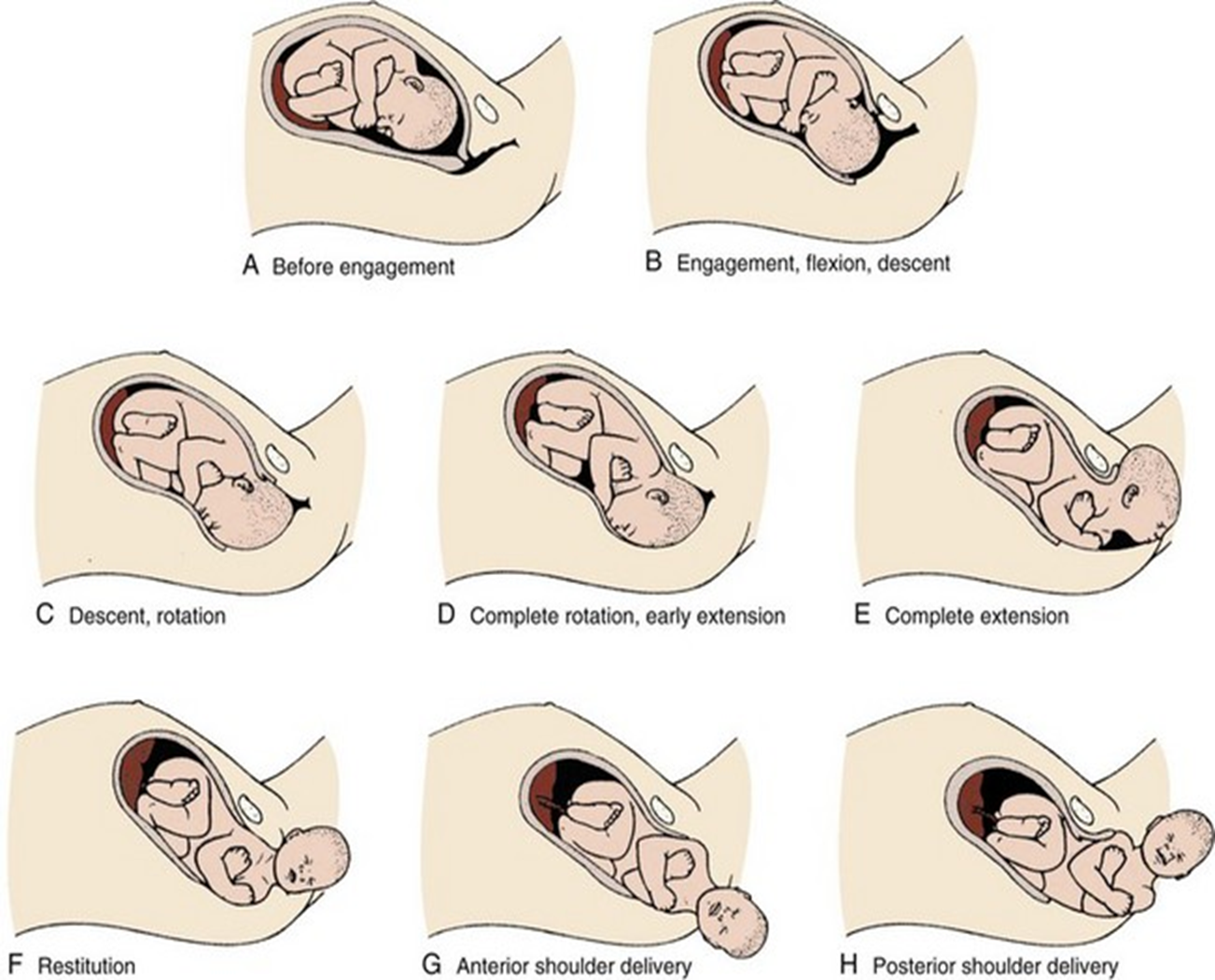
List the cardinal movements of labor
Engagement
Descent
Flexion
Internal Rotation
Extension
External Rotation (Restitution)
Expulsion
What is the “power” part of labor, and how do we monitor it?
Power of labor = uterine contractions
External: TOCO or MONICA
Internal: IUPC
Palpation: mild, moderate, strong
Regarding uterine contractions, how are they described?
Frequency: how often
Duration: how long
Intensity: how strong
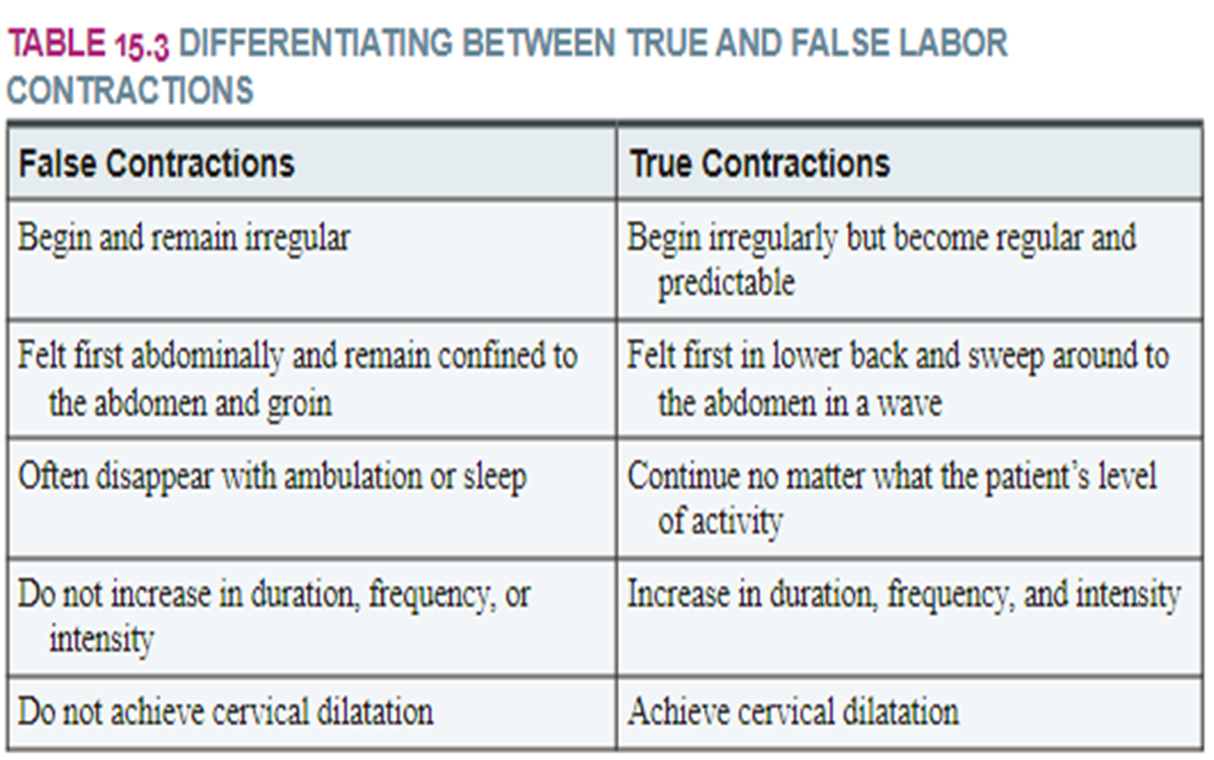
Differentiate false and true contractions.
What is the job of contractions during labor? Why is this important?
The job of contractions is to push the baby downward and apply pressure to the cervix, allowing it to open and the baby to move through the birth canal
An effective contraction pattern is very important for labor progression
How are vaginal exams performed during labor? What is measured?
Vaginal exams are performed using a sterile glove and water-soluble jelly
We measure 3 things:
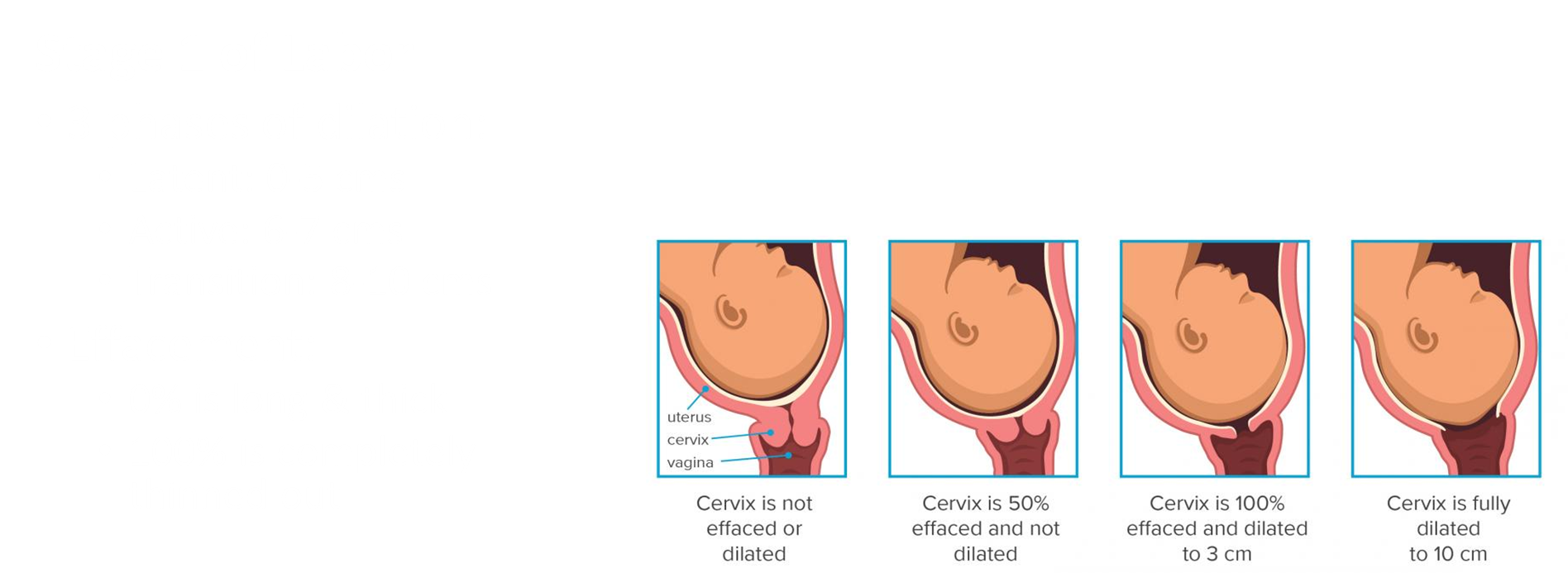
Dilation: Opening or enlargement of the external cervical os
Effacement: Thinning of the cervix
Fetal Station: Location of presenting part in relation to the ischial spines
What are the 3 phases of dilation during stage 1 of labor?
Latent: 0-5 cms
Active: 6-7 cms
Transition: 8-10 cms

How is effacement during stage 1 of labor described?
0% is long & thick
100% is completely thinned out
What should be reviewed/completed by the nurse during stage 1 of labor?
Review records to identify risks and potential complications
Review birth plan
IV and consents for admission, lab work
Identify psychosocial needs
—>Religious, cultural needs, support system, etc.
Vaginal exams to determine labor progression
Interpret fetal monitor strips to identify reassuring or nonreassuring status
Educate patients on each step of the process; good communication skills!
Pain management & comfort measures
—>Repositioning helps with pain relief and aids baby in navigating the pelvis
—>Breathing techniques
Chart, chart, chart! OB is one of the most libelous fields of nursing
What should the nurse assess to get a read on fetal health during labor and birth?
Analysis of amniotic fluid
Analysis of the FHR
Umbilical cord analysis
What should the nurse assess regarding an analysis of amniotic fluid during labor and birth?
Use the Acronym COAT: COAT: Color, Odor, Amount, Time
Color
Green: meconium
—>Could be from transient hypoxia, prolonged pregnancy, cord compression, intrauterine growth restriction (IUGR), maternal hypertension, diabetes, or chorioamnionitis
—>Watch for meconium aspiration syndrome
Odor
Cloudy or foul-smelling indicates infection
Amount
Small or large amount leaking
Time
We want to know what time
Longer ROM=higher risk of infection (chorioamnionitis)
When the water breaks:
The nurse should immediately assess FHR for signs of distress
Possible SVE
—>Limit SVE’s with ROM due to increased risk of infection
Clean patient up

What should the nurse assess regarding an analysis of FHR during labor and birth?
Monitoring can reduce the risk to fetus by identifying ominous signs of distress
—>Controversial topic
—>Monitor variability, accelarations/decelerations
Doppler, External, Internal,
Continuous vs Intermittent
What should the nurse assess regarding an analysis of the umbilical cord during labor and birth?
Analyze: Cord pH and Blood type/Coombs status
Cord pH
Acid-base analysis “cord gas” evaluates hypoxemia and acidosis
—>Norm pH range is 7.14-7.4
Fetal acidosis may lead to deficits, including cerebral palsy & seizures
Blood type/Coombs status
Perform infant blood typing when mom is O or any negative blood type
—>Rh incompatibility
—>ABO incompatibility
Perform Coombs done to determine if baby has developed antibodies from exposure to mom’s blood in utero
—>Indicates a higher risk for hyperbilirubinemia (jaundice) or anemia
What should be discussed regarding a patient’s birth plan?
Delivering location
Educational classes
Comfort measures/Pain management
Interventions
Infant care
When discussing a patient’s birth plan, what are the possible delivery locations?
Home birth
Hospital
Birth center
When discussing a patient’s birth plan, what educational classes are available?
Coping skills
Educates on pain management options
Changes the body goes through during pregnancy and labor
Educates patients so they can make a more informed decision and know their options during birth and labor
Educates on what to expect postpartum and with infant care
Breastfeeding support
When discussing a patient’s birth plan, what comfort measures should be discussed?
Pharmacologic vs Nonpharmacologic
Support system
—>Partner, family/friends, doula
When discussing a patient’s birth plan, what interventions should be discussed?
Interventions: Discuss with patient, and they will need to consent or decline
Induction of labor
Augmentation of labor
Artificial rupture of membranes
Forceps/Vacuum
When discussing a patient’s birth plan, what should be discussed regarding infant care?
Breast vs Bottle
Circumcision
Skin to skin
Declining medications
What pharmacological comfort measures are available for labor?
Epidural
Spinal (c-section)
General (only if unable to place spinal)
Opioids
Pudendal Block
Nitrous Oxide
What non-pharmacological comfort measures are available for labor?
TENS unit
Acupuncture/Acupressure/Reflexology
Hot/Cold therapy
Aromatherapy
Hydrotherapy
Hypnobirthing
Guided Imagery
Focal Point
Breathing Techniques
Positioning
Therapeutic touch/Massage/Effleurage
What factors cause pain in labor?
Physiological
Contractions, dilation, birth
Emotional
Fetal position
—>Occiput posterior “sunny-side up” babies tend to cause back labor
What emotional factors can influence pain perception during labor?
Previous birth experiences can affect fear and anxiety, which can increase pain intensity
Having a good support person present throughout the childbirth process reduces the need for pain relief and helps with coping skills
Temperament affects pain management
Trust in healthcare team is beneficial, too; makes the patient feel more at ease
—>ALWAYS communicate with your patients!!!
What are special considerations of labor for obese patients?
Obese patients are harder to position, harder to get epidural/spinal anesthesia due to body habitus
What are special considerations of labor for substance addicted patients?
Those with addictions will become more anxious and less capable of coping as their craving hits
What are special cultural considerations of labor for obese patients?
Culture plays a part in coping, acceptance of pharmacologic options, comfort with using male providers, and specific birth practices
List risks for the use of epidurals and spinals (used for c-sections) during labor.
Swift drop in BP
Numbing too high, leading to respiratory depression
Spinal headache
Nausea/Vomiting
Allergic reaction
What is a last resort for pain management during labor? Why?
General anesthesia is an absolute last resort
Crosses over and depresses infant
Aspiration of vomit and stomach contents
Intubation
What should the nurse promote during labor?
Promote movement
Promote regular voiding
How can movement help during labor? List examples of movements that can aid labor.
Changing positions during labor can shift the pelvic diameter and allow baby to navigate it better
Example Movements:
Squatting
Hands & knees
Standing/Dancing
Side-lying
Peanut ball
Birth ball
Birth bar
Spinning Babies
What does the mother’s psychological state affect?
Self-confidence
Self-esteem
View of life
Relationships
Other children
How can a negative psych state affect a woman’s pregnancy? How can this be managed?
Anxiety and fear can decrease a woman’s ability to cope with pain and can inhibit uterine blood flow and placental perfusion
Empower patient to be involved in her care
List factors that promote a positive birth experience for the patient
Clear information about the procedure (vaginal birth, C/S, etc.)
Support
Sense of accomplishment
Trust in caregivers
Positive reaction to the pregnancy
Personal control over breathing
Preparation for the childbirth experience
What is the 2nd stage of labor?
It’s GO time
Dilated 10cms until birth
What is nursing care for the 2nd stage of labor focused on? List nursing interventions for this stage.
Focus:
Nursing care during this phase is focusing on supporting the woman and her support person
Nursing Interventions:
Clear communication, laboring down, guidance with pushing and positions for pushing
Monitor for Tears: Rated 1st-4th
Episiotomy
Continue fetal and maternal monitoring
Continue efforts to support mother with pain and anxiety
Prepare for birth and newborn support
What is the 3rd stage of labor? What occurs during this stage? What hormones control this stage of labor and how?
3rd stage of labor: Birth to delivery of the placenta
Strong uterine contractions continue
Placenta begins detaching from the uterine wall and is expelled
Signs of detachment include a change in the uterine shape to globular ovoid and a sudden gush of dark blood
May require manual extraction
3 Hormones:
Oxytocin: Contractions
Endorphins: happy, excited
Adrenaline: increases during pushing and decreases after delivery
What does nursing care of the 3rd stage of labor focus on?
Nursing care includes:
Focusing on documenting birth
Time of placental delivery
Monitoring postpartum bleeding
What is the 4th stage of labor? List nursing care for this stage
4th Stage: Postpartum period, including mother bonding with baby
Nursing Care:
Assist with breastfeeding/bonding
Monitor VS of mother and infant
Monitor blood loss of mother/for signs of postpartum hemorrhage
Fundal rubs on schedule
Administering Oxytocin, Cytotec, Methergine, Hemabate, etc. to control PP bleeding
Ice packs to the perineum
Warm blankets for shivering from adrenaline decreasing
Clean up post-delivery
Define bradycardia in FHR monitoring.
A sustained FHR less than 110 bpm for greater than 10 minutes
Define tachycardia in FHR monitoring.
A sustained FHR greater than 160 bpm for greater than 10 minutes
Define baseline in FHR monitoring.
The average FHR during a 10-minute segment, excluding periodic or episodic changes
Define variability in FHR monitoring.
The beat-to-beat fluctuations in the FHR
Define an acceleration in FHR monitoring.
Abrupt increase in FHR, onset to peak <30 sec, <2 min duration
Define an early deceleration in FHR monitoring.
Gradual decrease beginning with contraction and ending with contraction
Define a variable deceleration in FHR monitoring.
Abrupt decrease >15 bpm with abrupt return to baseline
Define a late deceleration in FHR monitoring.
Gradual decrease starting after contraction begins and returning after contraction ends
A nursing instructor is teaching about non-pharmacological techniques used for pain relief in labor. What are some techniques that the nurse would include in the teaching?
Some techniques to use for relief of pain during labor besides medications are relaxation, controlled breathing, effleurage, focusing, and imagery
The nurse is caring for a client in early labor with 3 cm cervical dilation. Which statement will the nurse use when teaching the client consciously controlled breathing during contractions at this stage of labor?
“Take slow, deep, full breaths.”
A nurse is discussing the benefits of childbirth education courses to a client who recently learned that they are pregnant. What are generally accepted as benefits of such classes?
Preparation courses can increase satisfaction, reduce the amount of reported pain, decrease risky behaviors such as smoking, and increase feelings of control during childbirth
It is documented that by attendance in discussion of breastfeeding, the proportion of new parents who breastfeed can be increased
The nurse is leading a prenatal education class for a group of pregnant clients in the third trimester. What should the nurse include in this education?
Third-trimester classes are primarily focused on preparation for labor and birth
Signs of labor, pain management in labor, and warning signs of complications in late pregnancy are all important education topics
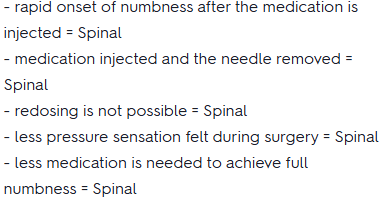
Regional anesthesia is usually administered in advance of a cesarean birth. List the characteristics of spinal anesthesia.
Regional anesthesia is usually administered in advance of a cesarean birth. List the characteristics of epidural anesthesia.
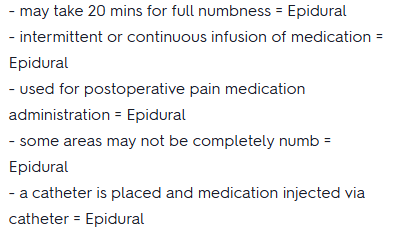
What anesthesia has the highest risk of aspiration pneumonia (when you inhale food, stomach acid, or saliva into your lungs, causing pneumonia)?
General anesthesia
During a cesarean birth, the surgeon can use either a classical or a low transverse incision to enter the uterus and deliver the baby. Identify the characteristics of a classical incision.
Higher incidence of uterine rupture
Less blood loss
During a cesarean birth, the surgeon can use either a classical or a low transverse incision to enter the uterus and deliver the baby. Identify the characteristics of a low transverse incision.
Potential for bladder injury
Better healing of the uterine incision
What are the indications for a cesarean birth for a patient with spontaneous onset of labor at full-term gestation?
Fetal distress and failed descent
Which side effects are commonly associated with epidural anesthesia?
Nausea
Shivering
SOB
During a cesarean birth, the circulating nurse is responsible for the instrument count. When is the instrument count performed?
1) As soon as skin closure is initiated
2) Prior to the skin incision
3) When closure of the peritoneum is initiated.
What are the reasons for early ambulation following a cesarean birth?
1) To promote passage of flatus
2) To promote lung expansion
3) To prevent blood clots
Which type of uterine incision has the lowest risk for rupture during a trial of labor in a subsequent pregnancy?
Low transverse
A cesarean birth is scheduled or planned in situations where labor and vaginal birth are contraindicated. Which conditions are contraindications to labor and a vaginal birth?
Active genital herpes
Complete placenta previa
There are four stages of labor: dilation, birth, placental, and recovery. The first stage is the longest and is divided into the latent and active phases.
Identify characteristics associated with the latent phase of labor.
Mother is talkative
Mother prefers to ambulate or sit
Mother is an active participant in care
The intensity of contractions is mild to moderate
There are four stages of labor: dilation, birth, placental, and recovery. The first stage is the longest and is divided into the latent and active phases.
Identify characteristics associated with the active phase of labor.
Mother turns inward
Mother may prefer to lie down
Mother experiences feelings of less control
Mother prefers a quiet environment
What interventions are beneficial in the plan of care for patients anticipating a vaginal birth?
Continuous support during labor and birth
Delayed pushing in the second stage of labor
Universal screening for GBS at 35-37 weeks' gestation
Delayed admission to the hospital until the active phase of labor
List the cardinal movements of labor in the order in which they occur.
1) Engagement
2) Descent
3) Flexion
4) Internal rotation
5) Extension
6) Restitution
7)Expulsion
What is the correct technique to determine the strength of the contractions?
Palpate the uterine fundus during a contraction, noting the degree of firmness
How is the frequency of contractions determined?
The time from the beginning of one contraction until the beginning of the next contraction
The nurse teaches the patient to take a deep breath with each contraction and hold it for a count of 10, exhale, and repeat 3 to 4 times with each contraction. The nurse has taught the patient which pushing method?
Closed glottis pushing
During the third stage of labor, when is oxytocin administered?
After delivery of the placenta
What is the criterion for a prolonged third stage of labor?
Greater than 30 min

