PSY110 Gillis Test 3
 Call Kai
 Learn
Learn Practice Test
 Spaced Repetition
 Match
Match Flashcards
 Knowt Play
1/169

There's no tags or description
Looks like no tags are added yet.
Name | Mastery | Learn | Test | Matching | Spaced | Call with Kai |
|---|
No analytics yet
Send a link to your students to track their progress
170 Terms
Original Sin
In the middle ages, the goal of childrearing was salvation
Tabula Rasa
John Locke Renaissance: belief was child was not born with sin, parents must shape their behavior. (tabula rasa=blank tablet)
Innate Goodness
• 18th cen: Jean Jacques Rosseau believed that babies were born naturally good.
• Innate goodness = Nobel Savage
Nature vs. Nurture
Controversy over whether individual differences are the result of genetic endowment (nature) or the consequence of learning (nurture)
Continuity vs. Discontinuity
Controversy over whether children have a gradual developmental life (continuous), or if they develop in distinct stages (discontinuous)? • butterfly (discontinuous) and tree (continuous) example
When psychologists view development as qualitatively different from stage to stage, they refer to the change as being _____.
discontinuous
Cross-sectional research design
Groups of subjects of different ages are assessed and compared one point in time
The cross-sectional study method gives an accurate view of ________ but its main disadvantage is that it ________.
individuals at one point in time; doesn't examine developmental change.
Longitudinal research design
• Evaluates behavior in the same group of people at several points in time to assess what kinds of changes occur over the long term.
• what kinds of changes occur over the long term
Which research design evaluates the behavior of the same group of people at several points over a long time period?
Longitudinal research design
Fluid intelligence
• the ability to learn new things
• perceive and draw inferences, conceptualize, and solve problems; abstract tests; peaks at 20 or 30 and then drops off after
(John Horn)
Crystallized intelligence
• results from accumulated knowledge, education, experience, and cultural background; measured by tests of intelligence; increases with age
• the ability to apply previous learning to new situations (John Horn)
Flaws in cross sectional research
Its findings might not reflect developmental differences or changes in environment or if there's a 3rd factor at play
Flaws in longitudinal research
Large investment of time, shrinking sample due to death or moving away, environmental factors in the interim time.
3 stages of prenatal development
Zygote, Embro, Fetus
Zygote
0-2 weeks, small number of microscopic cells (fertilized egg, clump of cells)
embryo
2-8 weeks
fetus
2-9 months
Teratogens
an agent that might cause a birth defect
Some of the most potent teratogens
Alcohol, Vitamin A , Thalidoemide,
Alcohol (Fetal Alcohol syndrome)
when a woman drinks while pregnant, the baby can develop this, which may lead to mental retardation, or in a more mild form, some facial deformities.
Vitamin A
in large doses, can negatively affect baby - result in a hairlip
Thalidomide
babies born as a result of mothers taking thalidomide sleeping pills were born without limbs
Advantages of Breastfeeding
1) establishes bond between mother & child
2) Ideal nutrition
3) Breastfed babies have fewer diseases
Social Attachment
the strong bond between that forms between the baby and the primary caregiver
The intense emotional tie that develops between an infant and mother is _____.
attachment
Freud's - Oral Gratification
• baby bonds to mother because of oral gratification, thinks everything is done based on the child's oral rewards, children are born in the oral stage; mother feeds baby
Harlow and Zimmerman's -
Contact Comfort
set up studies with baby monkeys with a wire "mother" with a milk bottle in its chest and another soft monkey figure "mother". Monkey bonded with wire mother by day for food and bonded with soft mother by night for warmth and comfort.
In Harlow's experiments, infant rhesus monkeys showed preference for surrogate mothers _____.
that were made of cloth
Konrad Lorenz - Imprinting
• biologist who was studying geese, bonded with geese like a mother. when eggs hatch, they follow the first thing that moves.
• Labeled the phenomenon where newly hatched ducklings begin to follow the first moving they see and see it as their mother
• Critical time to imprint on a mother
Mary Ainsworth's Strange Situation Test
o Bring a kid into a room and there is a stranger and the mom says I'm leaving you and they see how the kid reacts when the mom leaves them alone with the stranger and then they see how the kid reacts when the mom comes back in the room.
Securely attached child
knows they can trust mommy, doesn't want her to leave, fuss when she's gone, but interacts with stranger and is happy when she comes back
Insecurely attached child
might not even notice when mother leaves, "she always leaves", resistance to stranger, shuts down around mother when she returns
• Insecure attachment: Avoidant- unphased when the mom comes a goes and will interact with the stranger regardless, Resistant, Ambivalent - get very distressed when the mom leaves
Freud's 5 Stages of Psychosexual Development
Oral, Anal, Phallic, Latency, Genital (O.A.Ph.L.G)
Oral Fixation
(0-2) sucking, chewing, biting
Anal Retentive
( 2-3)
OCD
Harsh Toilet training
Phallic
(3-7) Oedipus Complex
• (Penis Envy)
Latency
(7- Puberty)
Genital
○ adult sexuality usually happens when one is about 12, 13; sexual maturity
Piaget's 4 terms
-Assimilation
-Accommodation
-Schemas
-Egocentrism
Assimilation
• to take new information and incorporate them to our existing ideas
• If the new information just fits into your mental framework file system then you just put it in your folder. New info fits with pre-existing schemas.
Accommodation
• If it doesn't fit with what you already know, you change your schema and file new information into new way of organization
• ex; Mother daughter walking in park. Daughter says look a bird. Mommy says yes it is a bird.. that is a blue bird. (Assimilated). Next time daughter sees big butterfly and says look a birdie! Mother says no honey that is a butterfly! Now kid is like okay bird is bigger and flies straighter (Accomadation)
According to Piaget, a mental structure involved in acquiring or organizing knowledge is called _____.
Schemas
Schemas
• mental framework
• conceptual frameworks that individuals use to make sense out of stored information... mental structures we form to assimilate and organize processed info
Egocentricism
- self-centeredness, inability to perceive the world from any perspective other than one's own
- We think universe revolves around us. We think God is just interested in us.
Piaget's 4 Stages of cognitive development
- Sensorimotor
- Preoperational
- Concrete operational
- Formal operations
Sensorimotor
- (0-2): infants learn about the world through their senses and actions
- Object Permanence
- Seeing, walking, talking.
Object permanence (part of sensorimotor)
Realization that objects continue to exist even when they are not immediately in view. (key aspect of sensorimotor stage)
Piaget's ________ stage is characterized by language, spotty logic, and egocentrism.
preoperational
Preoperational
(2-7 years) Symbolic reasoning:
- a child begins to acquire the ability to use symbols to represent people, objects, and events. Child still cannot reason logically
- understanding language, numbers & symbols
- Grammar, Math, Musical Systems, verbal
- ex. Also, there is a picture of mountains with a cross and then they match what they see with a picture and then they ask the child what the opposite side of the mountain looks like and if they don't know it and think it's what they're seeing on their side then they are...
Concrete Operational
- (7-12): Mental manipulation of real objects
-Ex. of researcher asking a kid if cups of water are equal (they are) and then pours one into a taller glass and says which one is bigger and then if they are at this stage then the child will know it is still equal.

A seven-year-old generally can express the correct answer when given Piaget's water glass test because he or she understands _____.
conservation
Conservation (Concrete Operational)
The understanding that changing something's form does not necessarily change its essential character
Formal operational
- (12 & older): Children become able to think hypothetically, abstractly
- abstract reasoning becomes prominent; acquire the ability to make complex deductions and solve problems by systematically testing hypothetical solutions
Ex: Honor, justice, patriotism, love
Erik Erikson 8 stages of of Psychosocial Development
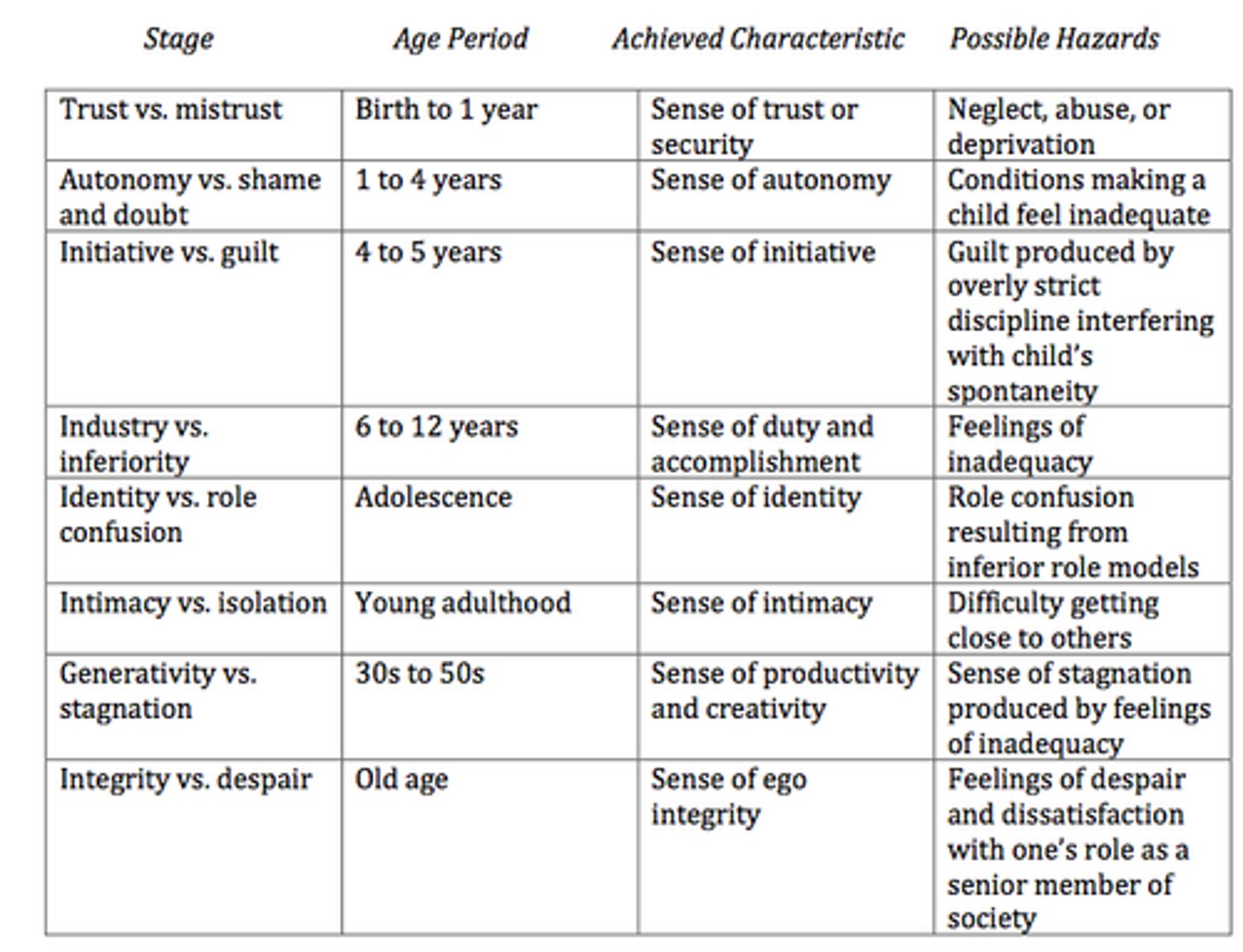
Erik Erikson - Trust vs Mistrust
• 0-2 Basic concept of trust taught to a child
• Establish a secure bond with the mother and a bond to the primary care giver.
Erik Erikson - Autonomy vs. Shame and Doubt
(2-4) Toddler:
- Toilet Training, Being able to walk on their own (autonomy) and they learn to say no (autonomy). Kids take pleasure in not doing what parents tell them to do (autonomy)
- parents should encourage good side and have independence
- encouragement = independence, overprotective = doubtful, hesitant
Terrible Two's (Autonomy vs. Shame and Doubt )
- When kids begin to think on their own. Children are sitting on high chair and they knock something off the table and then after picking it up the child will do it again. This is because they have joy in being able to make loud noises and making chaos. We want them to have their own mind and thoughts. BUT they only want autonomy to a point!!!
Erik Erikson - Initiative vs guilt
(3-5) Early School
- Children taking the initiative to strike out on their own, and the potential guilt they will feel if the behavior disappoints their parents
- What would make a child think they're a loser? If they are not learning as fast and they're not as intelligence or they may have a learning disability. May have a sense of guilt because of this.
Erik Erikson - Industry vs inferiority
(6-12) Middle School
children compare achievements to others - if it's positive, they have sense of achievement or industry, if negative, feelings of inferiority
- Ex; Little girls want to help so there comes a time when the little child will want to go out themselves with the dad and go hunting or weaving and this is a sense of industry. No parents would force the child to do anything. Nowadays this is through grades. We want kids to want to learn. Sometimes bad grades can actually demotivate you instead. We don't want kids to feel inferiority
Erik Erikson - Identity vs Role confusion
(12-22) Adolescence
- Major task is to secure a stable identity. if unable to do this, there's sense of role confusion
- Identity is figuring out who you are. Adolescence is actually getting longer and longer.
Erik Erikson - Intimacy vs isolation
(22-34) Early Adult
- Ability to experience open and supportive relationships without fear of losing your identity.
- young adulthood. Either able to have a strong intimate relationship with others, or feeling a sense of isolation, reluctant to establish close ties with others
Erik Erikson - Generatively vs stagnation
(34-60) Middle Adult
- Getting involved with future generations of your own family. Getting involved with youth programs, teaching, getting involved with cousins, nephews, and nieces. You can make the world a better place for other people.
- Stagnation is when you focus on your self. Give to stuff for other people to homie.
- the main task is to determine purpose in life and to focus on achieving high aims. Success in this will result in happiness, failure at this will result in feeling self-centered and stagnated
Erik Erikson - Ego Integrity vs Despair
(60 & up) Late Adult
Older years of life. Extensive reflection on past life - those who reflect on a lifetime of purpose will find ego integrity, those who look back on lifetime of lack of purpose will develop a strong sense of despair.
- Integrity is when you look forward positively, or you look back and say damn I had a great life.
- Despair is when you look back on your life and you say I had a bad life.
Kohlberg's 3 stages of moral development
- preconventional
- conventional
- postconventional
Preconventional
Punishment and reward: 4 - 10 yrs old
children learn right from wrong because of how parents treat them based on their behavior
- a period during which moral judgments are based largely on expectation of rewards or punishment
Conventional
(Rules and Laws) early adolescence: children are conscious of rules established in their homes by parents ("mommy told me not to" ) mentality
Post conventional
(Internal Code): Consulting an internal moral code. 25% reach this level of moral reasoning
Elizabeth Kubbler-Ross's 5 Stages of Death, Dying & Grief
- Denial
- Anger
- Bargaining
- Depression
- Acceptance
D.A.B.D.A
Denial
- When we ignore the fact that we are going to die eventually
Anger
- If like your doctor says you're going to die soon then you get angry. "Why me?!?!?"
Bargaining
- Make a deal with God and basically you're like if you get me past this cure than I'll go with the church or do some sort of church or religious thing
Depression
- no hope

Acceptance
- You have had a good life and you finally understand that this is real and it happens.
The Old Storm and Stress View of Adolescence
- Adolescence is a difficult period in our lives; teenagers typically turn to drugs and alcohol as a result
- Adults just aim to guide through this period of storm and stress and hope that the child becomes normal through the end of it.
Haidt's New Theory Of Development
When Morality opposes Justice: Conservatives have moral intuitions that Liberals my not recognize
Social Psychology
scientific study of the interactions between 2 or more people
Attitude
- any learned relatively enduring predisposition to respond in consistently favorable or unfavorable ways to certain people, groups, ideas, or situations
- belief or opinion about anything
ABC Model
Attitude with 3 components: to be a valid meaningful attitude If it does not have these components then it is a pseudo-attitude
Affective Component
(mood) you can have positive affect or negative affect
Behavioral Component
The affect will predict your behavior. Indicated ones behavior
(You like apples)
Cognitive Component
- Must be a matching thought to the behavior
- You must know that you have that attitude.
- Conscious awareness of one's attitude
Ex. You know that you like the apple
Persuasion
Trying to change someone's beliefs and attitudes
The Yale Approach
a credible speaker is more believable, authoritative;
Source/Speaker -> Message -> Target/Audience
Source/Speaker
Ability to persuade is based on credibility, attractiveness, similarity
Forewarning
if you tell someone they will be persuaded, they will become close minded
Message - 1-Sided, 2-Sided
If the audience is initially in favor of the message, a 1-sided argument works better
If the audience is initially opposed to the message a, 2-sided argument works better
Target/Audience
- Gender
- Knowledge
- Forewarning
- Inoculation
Inoculation
Providing a weakened form of arguments and then refuting them with good evidence.
Gender
Originally thought that women were more easily persuaded than men - this has been disproven as there is a 3rd factor: knowledge
Knowledge
Women ran studies on men and found that if it is about an issue that one is passionate or knowledgeable about, they are not easily persuaded
Cognitive Dissonance
The Theory that people experience psychological discomfort or dissonance whenever cognition and behaviors are in conflict.
ex. imagine that you have always considered yourself a supporter of abortion, but you find yourself protesting when you discover a close friend is considering an abortion. There is a discrepancy between what you believe and the way you perceive yourself acting; and if you become aware of it, you will experience...
Leon Festinger - 1$ / 20$ study
- The less is more Study
- 1 group in experiment was told part 1 of the experiment (a very boring task) would earn them $1, other group was told part would earn them $20. First group believed the task was more interesting than the second found it.
Relation between Cognitive Dissonance and 1$ / 20$ study
attitude goes against your behavior -> Cognitive Dissonance -> 1. Change attitude 2. Change Behavior 3. Seek Justification
Three ways to reduce Cognative Dissonance
1. Perceived Power, trustworthiness
2. Power
3. Attractiveness
Attributional Theory
We tend to attribute people's behavior either to internal causes or to external causes
2x2 of Attributional Theory
We observe others' behaviors in a correlation of stable/unstable and internal/external
Causal Attribution (2x2 of Attributional Theory)
- Stable Internal - If the girl is smart and stuff
- Stable External - Easy Test. It'll be an easy test always.
- Unstable internal - She put in a lot of effort to get an A in this test.
- Unstable External - If you get lucky on the test
Fundamental Attributional Error
when someone does something we don't like, we tend to use overuse internal attributions (attributing it to them)
Example of Fundamental Attributional Error
a friend complains that she has just failed a test, do you attribute her poor performance to a tricky test or a lack of adequate prep time (both situational causes), or are you more inclined to assume she is not very well bright (dispositional cause)?

