Lecture 2-3 -- Fish Biology: Diversity, Anatomy, and Physiology
 Studied by 0 people
 Call Kai
 Learn
Learn Practice Test
 Spaced Repetition
 Match
Match Flashcards
 Knowt Play
1/66

There's no tags or description
Looks like no tags are added yet.
Name | Mastery | Learn | Test | Matching | Spaced | Call with Kai |
|---|
No analytics yet
Send a link to your students to track their progress
67 Terms
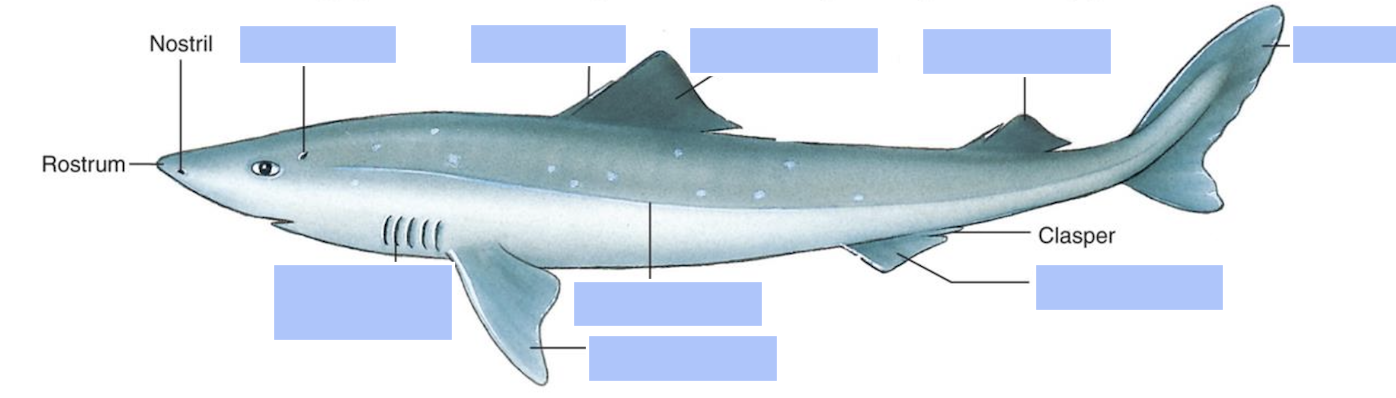
Name all the anatomical features of the fish shown in this picture
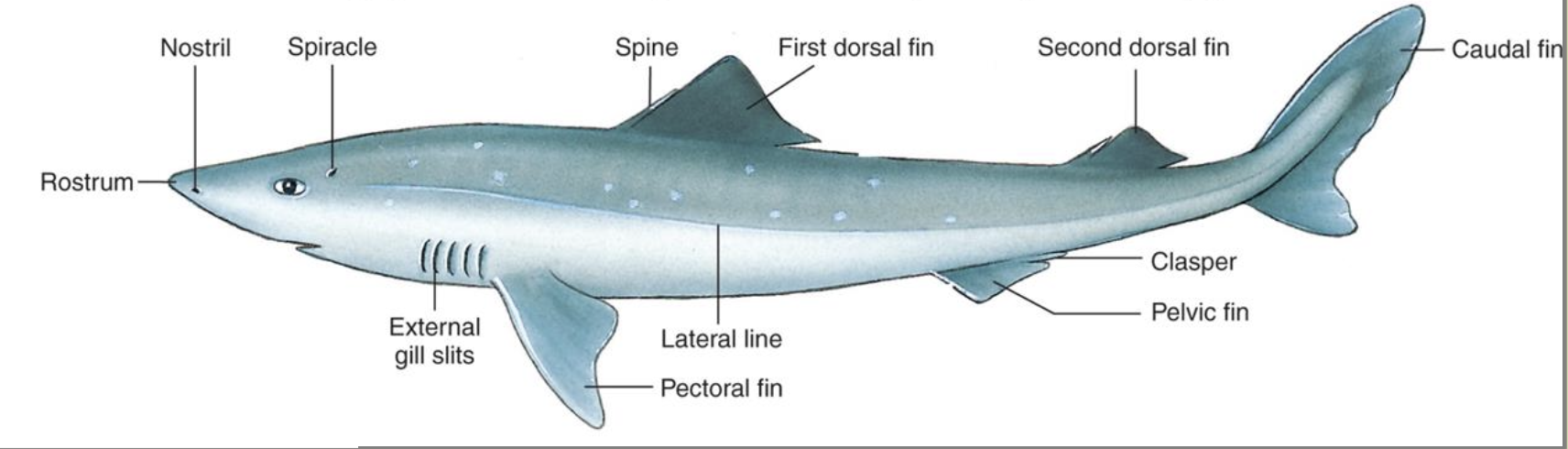
Which fins are unpaired fins in fish?
The caudal fin and dorsal fin (some species also have an anal fin)
P.S. Anal fin is located behind the pelvic fin
What is the main function of dorsal, caudal and anal fin?
Help prevent the fish from rolling
How many sets of paired fins do fish have? What are they?
Two sets of paired
Pectoral and pelvic fin
What is the role of the pectoral fins in cartilaginous fishes?
They act as hydrofoils, providing lift as they have no swim bladder
What special structure is found on the pelvic fins of male cartilaginous fish? What is its function?
Claspers
Function as intromittent organs for internal fertilisation
What is a spiracle?
A spiracle is a remnant of an ancestral anterior gill slit found in some cartilaginous fishes
What is the function of the spiracle in these fish?
Many cartilaginous fish live on seabed and burry themselves in sediment for protection -> They draws water in through the spiracle to prevent sand from entering
Where does the lateral line run on a fish’s body?
Along the sides of the body, with branches around the head, especially the mouth and jaw
What is the lateral line made of?
Neuromast cells embedded in a canal beneath the skin and connects to the surface through tiny pores
What is the function of the lateral line organ in fish?
Acts as a mechanoreceptor that detects minute water pressure changes → Give information about in the surrounding water and head region + help control predation
How does the lateral line detect water movement?
Water movement enters through pores → Presses against the cupula → Bends the sensory hair cells in the neuromast → Generates a signal → Hair cells send signals to nerve fibres → Transmit impulses to the central nervous system
What are the Ampullae of Lorenzini?
Gel-filled canals that lead to pores on the skin that concentrated around the mouth and head region
What is the function of the Ampullae of Lorenzini?
Detect electrical signals in the environment e.g. heartbeat of a buried flatfish hidden under sand
Which ear structures do fish NOT have?
NO outer ear, inner ear bones (malleus, incus, stapes), or a cochlea
What sensory structures do fish have instead of a typical ear?
Semi-circular canals
What is the main function of semi-circular canals in fish?
Act as organs of balance
How many semi-circular canals are present in jawed vertebrates? What movements does each of them detect?
Three
Up–down movement; Side-to-side movement; Tilting (rotational) movement
How many semi-circular canals are found in hagfishes?
1
How many semi-circular canals are found in lampreys?
1 or 2
Why are the pectoral fins of ray-finned fish smaller than those cartilaginous fishes ?
Ray-finned fish have a swim bladder, which provides buoyancy
Cartilaginous fishes have no swim bladder → They need larger pectoral pins to act as buoyancy organ
What is the main function of pectoral fins in ray-finned fish?
Responsible for precise manoeuvring and even swimming backwards in some species
What is the swim bladder? Where is the swim bladder located?
A gas-filled organ that provides buoyancy
Located high above the centre of gravity
How many chambers are in a ray-finned fish heart?
One atrium and one ventricle = No separation into left and right sides
Describe the pathway of blood circulation in ray-finned fish.
Deoxygenated blood returns via the anterior and posterior cardinal veins → sinus → atrium → ventricle → four branchial arches → gills (gas exchange occurs) → oxygenated blood is sent to the head and body via a large artery.
How is the stomach structured in ray-finned fish?
Divided into a cardiac part and a pyloric part
What are pyloric caeca? What is the function of pyloric caeca?
Small finger-like pouches near the stomach–intestine junction
Their exact function is unknown, but they may secrete digestive enzymes
What is a key skeletal feature of lobe-finned fishes?
Have unique supportive elements in the skeleton of the girdles and limbs
E.g. African lungfish and South American lungfishes
→ They live in muddy environments → They do not support their body weight against gravity and instead wriggle through mud → Lead to secondary reduction of body-lifting structures
What does “facultative air breather” mean? Which lungfish is a facultative air breather?
Facultative air breather = A fish that can breathe air when needed but can also obtain enough oxygen from water
Example: Australian lungfish.
They usually live in streams and rivers that have a lot of oxygen in them -> Only when they have to swim fast to escape a predator, they increase blood oxygen concentration by breathing air with their lungs
What does “obligate air breather” mean? Which lungfish is a obligate air breather?
Obligatory air breather = A fish that must breathe air to survive
Example: African and South American lungfishes
Their gills are greatly reduced, so they rely mainly on lungs for oxygen
How does water compare to air in terms of physical properties?
Water has higher density, viscosity, and specific heat capacity than air
Based on the physical properties of water, what special features do for water-breathing animals have?
High energetic costs of ventilation
Water is dense and viscous → Moving it in and out of respiratory surfaces requires more energy
Difficult to retain body heat
Water has high specific heat capacity + Constantly removes heat as it flows over the gills = Continuously heat loss to surrounding water
How does oxygen availability in water compare to air? Why?
Oxygen has low solubility in water → Air equilibrated water contains 20-30 times less oxygen than an equal volume of air
How do fish compensate for low oxygen levels in water?
Higher ventilation rates
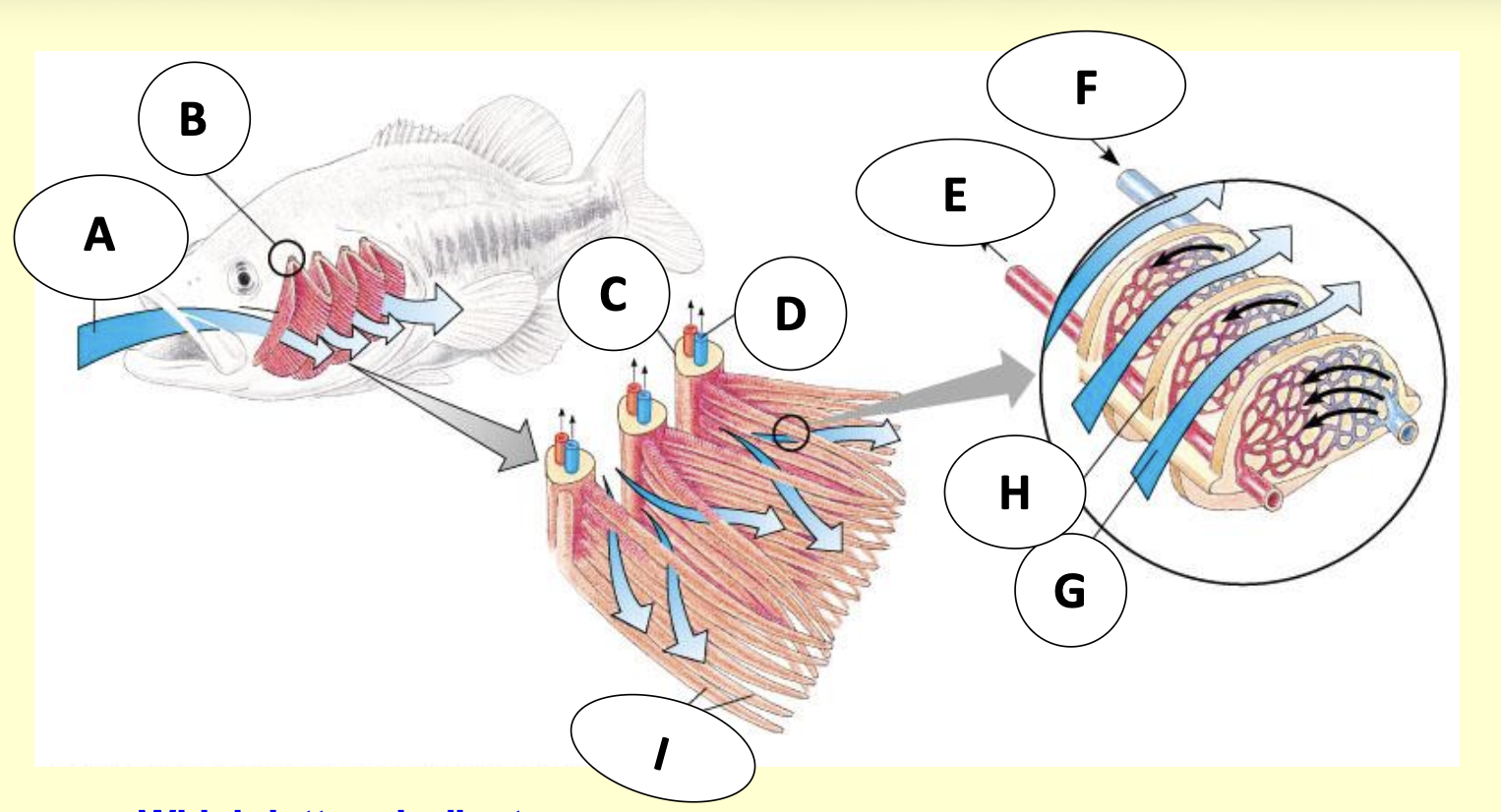
Describe the structure of the gills shown in the picture
B + C: Gill arch
D, F: Deoxygenated blood
E: Oxygenated blood
A, G: Direction of water flow
H: Gill lamella
I: Gill filament
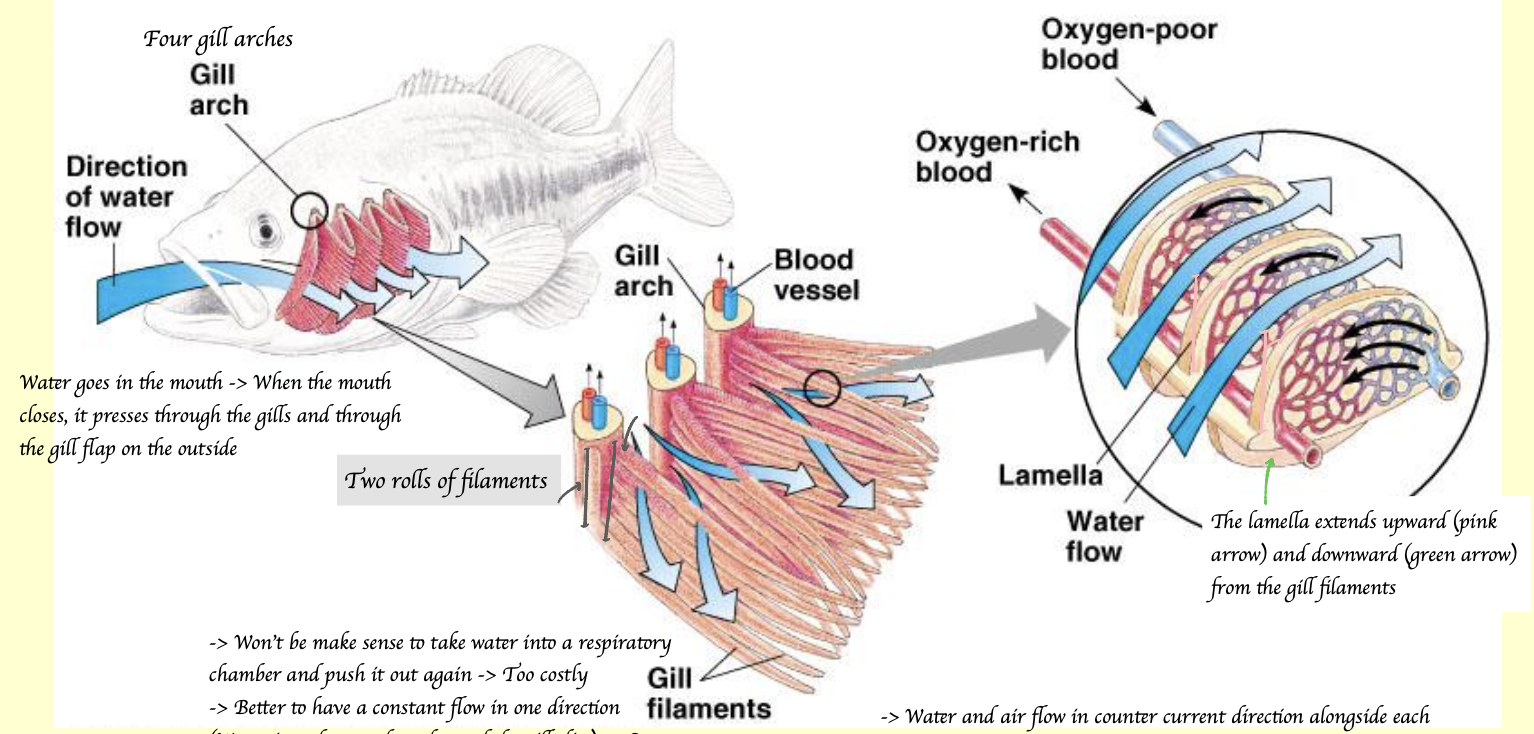
How many gill slits do cartilaginous fish have?
Five gill slits, separating four internal gill arches
How many gill arches are present on each side of a fish? What is the structure of a gill arch?
Four gill arches
Each arch has two rows of filaments
Each filament contains hundreds of lamellae on both side (Upwards and downwards)
How does water flow over the gills?
Unidirectional flow
Saves energy and ATP and reduces oxygen demand because pumping water in and out is energetically costly due to the high density, viscosity, and high specific heat capacity of water
Why are lamellae efficient for gas exchange?
Thin and are filled with capillaries
Large surface area
Thin lamellae with short diffusion distance for respiratory gases
How does counter-current flow work in fish gills?
Water and blood flow in opposite directions across lamellae
Maximise oxygen uptake into the blood
What colour is fish gill when it is fully oxygenated?
Red
What happens to the gills shortly after a fish dies?
Become dark
What colour do the gills turn if the fish has been dead for longer? Why?
Brown
Because the haemoglobin becomes oxidised
What is “trust” in fish movement?
Force that moves the fish forwards, which are generated by the side-to-side movement of tail or truck
What is “yaw” in fish movement?
When a swimming animal moves its tail side-to-side, it generates trust behind its centre of gravity, which creates a rotational effect around the vertical axis, allowing the fish to change direction while swimming
E.g. When the tail beats to the right, the head swings slight in the opposite direction (left)
What is “pitch” in fish movement?
Up and down movement of the body
Often seen in dolphins but not much in fish
What is “roll” in fish movement?
Rotation of the body around its longitudinal axis
Which fins help control roll in fish?
Unpaired fins such as dorsal and anal fins
What is “gravity” in fish movement?
Force that pushes the fish down
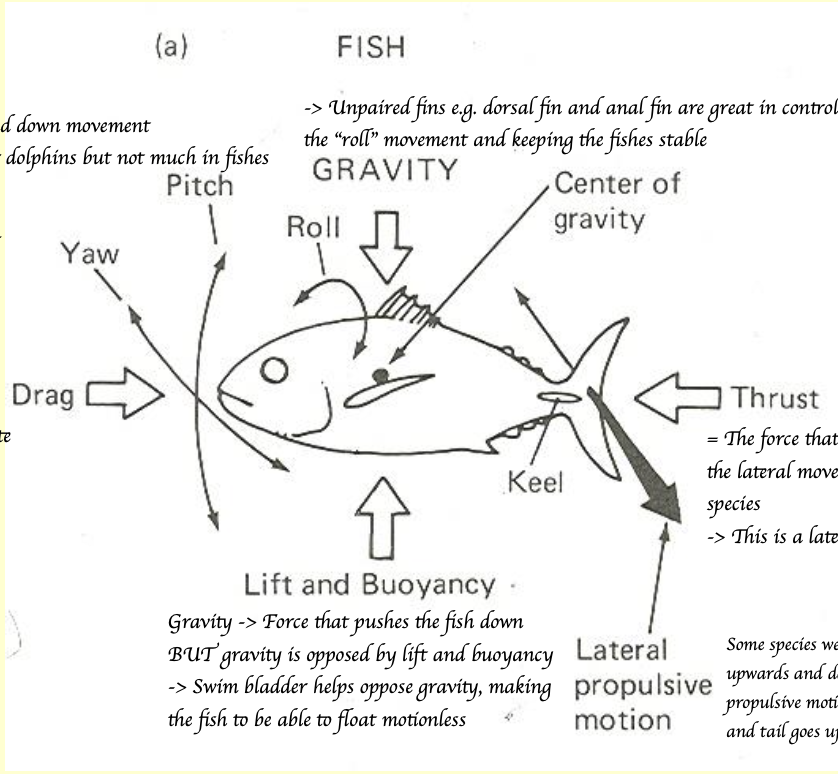
What helps counteract gravity of the fish?
Swim bladder
Explain the differences between different types of swimming.
Undulatory
Most of the trunk or body moves in waves
Oscillatory
Mainly the tail fin moves back and forth
Intermediate
Mainly fins with minimal body movement
Which types of fish have a well developed tail fin? Why?
Tuna and mako sharks
They live in open water without obstacles → Need speed for continuous cruising and efficient hunting → Use oscillatory side-to-side movement of the tail fin to propel themselves
Which fish are examples of using undulatory swimming? Why?
Eels and dogfish
Less energetically efficient BUT allow them to move in complex habitats
Which fish swim halfway between undulatory and oscillatory swimming?
Knifefish, triggerfish, trunkfish
How do they perform this type of swimming?
By using their dorsal, anal and pectoral fins with minimal trunk movement
What are the advantages of this swimming types?
Allow precise hovering, manoeuvring and backward swimming
How do fish primarily excrete nitrogenous waste?
Directly excreting NH3 ammonia into the water through gill
Why do fish excrete nitrogenous waste as NH₃, instead of as urea or uric acid like mammals and birds?
NH₃ can be lost directly across gill membranes** without ATP expenditure
Besides nitrogenous waste, what are other major roles of gills?
Iron balance and osmotic regulation
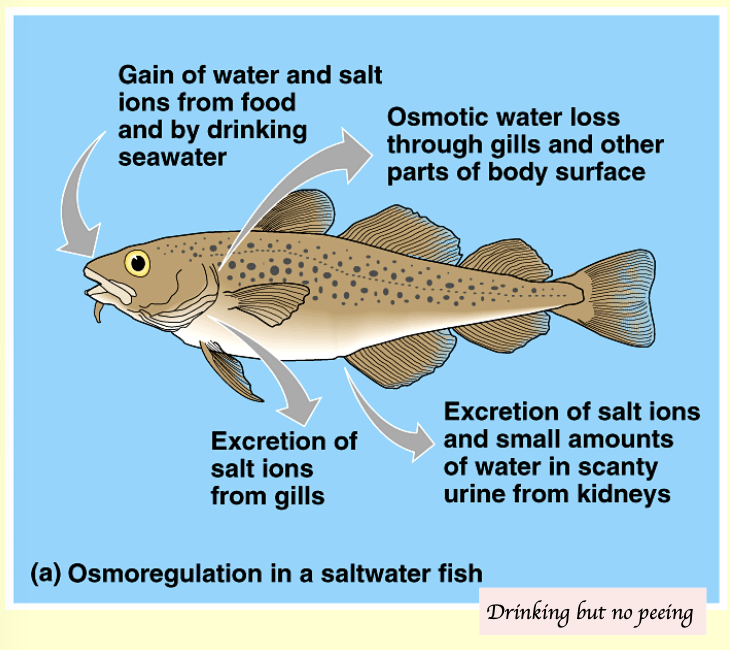
How do saltwater fish maintain osmoregulation?
Saltwater fish live in hypertonic environment → Risk of dehydration → Conserve water + Excrete salts
Gain water and salt ions from food and by drinking seawater
Excrete salt ions from gills
Excrete salt ions and a small amount of water in scanty urine from the kidney
Lose water osmotically through gills and body surface
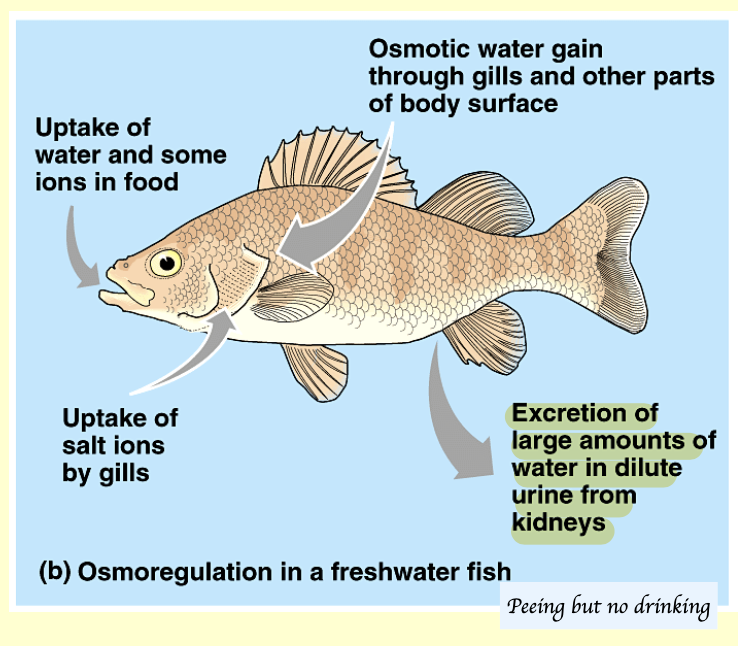
How do freshwater fish maintain osmoregulation?
Freshwater fish live in a hypotonic environment → Risk of water gain → Excrete excess water + retain salt
Take up water and ions in food
Take up salt ions via gills
Gain water osmotically through gills and body surface
Excrete large amounts of dilute urine from the kidney
Are fishes ectothermic or endothermic?
Ectothermic
Why is endothermy limited in fish?
High gill ventilation rates
Blood temperature equilibrates with water
High heat capacity of water
Difficult to retain body heat
Some fishes are evolved as partial endothermy because of climate heating. Which fish show partial endothermy?
Tunas and some sharks
How do these fishes retain heat?
They use counter-current vascular heat exchangers
Oxygenated blood from the gills flows along the cutaneous side into the muscles
Arterial blood entering the muscles is positioned close to venous blood leaving the muscles
Heat transfers from warm venous blood to cooler arterial blood → Retain heat inside the body
= Venous blood leaving working muscles pre-warms incoming cold arterial blood from gills
What are the benefits of counter-current heat exchangers system in those fishes?
Retaining heat in the muscles allow more efficient and powerful contractions → Improves swimming speed → More effective predator
Enhances visual processing and brain function → Improve hunting ability
What are the special features of the fish circulatory system?
Single loop circulation
Undivided, two chambers heart (No separation between left and right)
Low pressure circulatory system
Because of the high density of water, blood is weightless in water → Blood can still reach targeted organs despite low pressure
No blood ”pooling” in lower appendages = Blood does not accumulate or get trapped in the lower parts of the body
Water supports the body due to its high density = Gravity only has little effect on blood flow
 Note
Note  Flashcards (127)