Classic Evidence: Watson and Rayner
 Call Kai
 Learn
Learn Practice Test
 Spaced Repetition
 Match
Match Flashcards
 Knowt Play
1/99

There's no tags or description
Looks like no tags are added yet.
Name | Mastery | Learn | Test | Matching | Spaced | Call with Kai |
|---|
No analytics yet
Send a link to your students to track their progress
100 Terms
What are the three key components of aversion therapy?
1. A negative stimulus is paired with a desired behavior. 2. The goal is to create an aversion to the behavior. 3. Repeated exposure to the negative stimulus reinforces the aversion.
How does the assumption of classical conditioning link to aversion therapy?
It assumes that behaviors can be conditioned through the association of a neutral stimulus with an aversive stimulus, leading to a conditioned response of avoidance.
What is one ethical issue associated with aversion therapy?
The potential for psychological harm to the individual, as it may cause distress or trauma.
What was the primary research question of Watson and Rayner's study?
Can fear of a previously neutral stimulus be conditioned by presenting it simultaneously with an established negative stimulus?
What is stimulus generalization in the context of classical conditioning?
The same response is caused or elicited by stimuli that are similar to the conditioned stimulus.
What is stimulus discrimination in classical conditioning?
The response only occurs to a very narrow range of specific stimuli, distinguishing between similar stimuli.
What was the participant in Watson and Rayner's study known as?
Little Albert.
What was the methodology used by Watson and Rayner in their study?
A controlled observation where they filmed the reactions of Little Albert to various stimuli.
What was the age of Little Albert when the testing began?
11 months old.
What was the primary finding of Watson and Rayner's study regarding Little Albert's reactions?
Little Albert developed a fear response to the white rat after the loud noise was paired with its presentation.
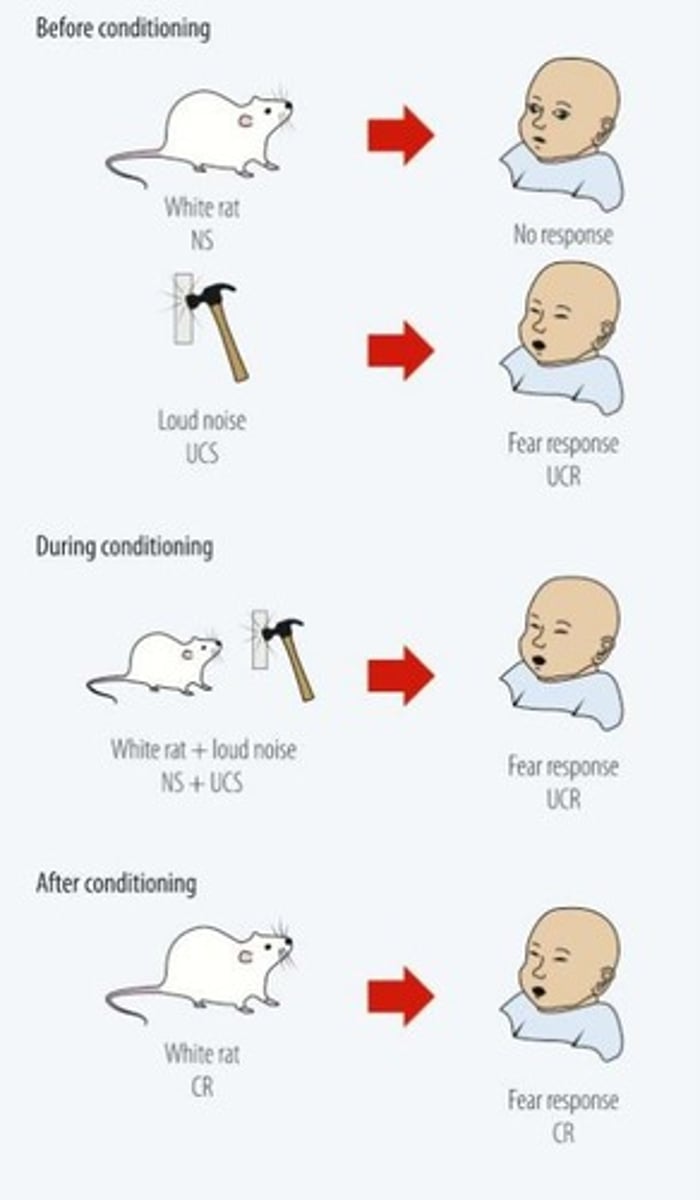
What was the procedure followed in the first controlled observation of Little Albert?
A white rat was presented to Albert, and a metal bar was struck behind him to create a loud noise.
What was the reaction of Little Albert when he first encountered the white rat?
He jumped and fell forward, showing signs of fear.
What did the findings of the study indicate about the effect of time on conditioning?
The conditioned fear response persisted over time, indicating that the emotional response did not diminish.
What was the significance of using a controlled observation in Watson and Rayner's study?
It allowed for systematic observation of Little Albert's reactions to various stimuli in a controlled environment.
What ethical considerations were raised by Watson and Rayner's study?
The potential psychological harm to Little Albert and the lack of informed consent.
What did Watson and Rayner aim to demonstrate through their study?
That emotional responses could be conditioned and unconditioned through classical conditioning techniques.
What were some of the stimuli used to test Little Albert's reactions?
A white rat, a dog, a monkey, a mask, cotton wool, and a burning newspaper.
How did Little Albert's fear response change during the study?
His fear response increased with repeated pairings of the rat and the loud noise.
What was the conclusion drawn from Watson and Rayner's study?
Fear can be conditioned in humans, and conditioned responses can generalize to similar stimuli.
What was the role of the loud noise in Watson and Rayner's experiment?
It served as the unconditioned stimulus that elicited a fear response when paired with the neutral stimulus (the rat).
What does the term 'conditioned emotional reactions' refer to?
Emotional responses that are learned through the process of classical conditioning.
What was the age of Little Albert when the study concluded?
1 year and 21 days.
What were the findings regarding Little Albert's reaction to the Santa Claus mask?
He reacted negatively, showing signs of fear and distress.
What was the impact of changing the location during the study?
It demonstrated that the conditioned fear response could still be elicited in a different environment.
What is the significance of the 'Little Albert Study' in psychology?
It provided foundational evidence for classical conditioning and its application to emotional responses.
What was the aim of Watson and Rayner's study?
To investigate whether a fear response could be conditioned.
What was the neutral stimulus in the study?
The white rat.
What was the unconditioned stimulus used in the study?
The loud bang.
How many sessions were conducted in the study?
Five sessions.
How would you best describe the methodology of the study?
Controlled observation.
What was Little Albert given in between each session?
Wooden blocks.
Name one object to which Albert's fear transferred.
Rabbit, dog, cotton wool balls, or Santa Claus mask.
How was the location changed during the study?
From a small dark room to a well-lit lecture room.
At what age did the observations of Little Albert begin?
At 11 months and 3 days.
What was observed about Albert's behavior when presented with the rat?
He showed withdrawal and fear responses.
What was Albert's reaction to the rabbit during the study?
He leaned away, whimpered, and cried.
What was Albert's reaction to the dog?
He turned away, whimpered, and cried.
What incidental finding was noted about Albert's behavior?
He often sucked his thumb for comfort, which blocked out his fear response.
What was the age of Little Albert during the fifth observation?
1 year and 21 days.
What was the response of Albert to the Santa Claus mask?
He withdrew, whimpered, and cried.
Describe Albert's reaction to the fur coat.
He withdrew, cried, and tried to push it away.
What did Albert do when the rat crawled on him?
He covered his eyes and leaned back.
What was the purpose of the joint presentations of the rat and the bar?
To condition Albert's fear response to the rat.
What was the effect of the loud bang on Albert's behavior?
It created a fear response when paired with the rat.
How did Albert react to the cotton wool?
He kicked it away and withdrew his hand but showed less fear compared to other stimuli.
What was the significance of the observations conducted at different ages?
To assess the development and persistence of conditioned fear responses.
What was the initial emotional state of Little Albert before the conditioning?
He showed no negative emotional response to the rat.
What did the study reveal about the generalization of fear?
Albert generalized his fear from the rat to other similar objects.
What was the reaction of Albert to the rabbit during the third observation?
He leaned away and whimpered but not as violently as before.
What was the reaction of Albert to the dog during the fourth observation?
He turned away, whimpered, and cried when the dog barked.
What was the age of Little Albert during the first observation session?
9 months old
What stimuli were presented to Little Albert during the first session?
Furry objects such as a white rat, a white bunny, Watson's beard, and wooden blocks.
What was the result of the first session with Little Albert?
He showed no fear towards the stimuli.
What method was used to create fear in Little Albert?
Joint stimulation of a loud noise when he reached for the rat.
At what age did Little Albert experience the conditioning process?
11 months and 3 days.
What was the purpose of the generalization step in the study?
To see if fear responses could be transferred to other objects.
What objects were used during the generalization phase?
Watson's hair, a dog, a rabbit, cotton wool, and a Santa mask.
How did the environment change during the study?
Little Albert was moved to a well-lit lecture room with other people present.
What was the effect of time on Little Albert's conditioned responses?
Responses persisted even after a week and transferred to other stimuli.
What did Watson and Rayner conclude about the removal of conditioned responses?
They believed the opportunity to remove the response was denied, and it likely persisted indefinitely.
What is stimulus generalization as observed in the study?
Fear response to the rat was generalized to other furry objects like a rabbit and a dog.
What did Watson and Rayner suggest about the persistence of conditioned responses?
They suggested that conditioned responses could modify personality throughout life.
What was the baseline condition in the study?
Testing Albert's initial response to various objects before conditioning.
How did Little Albert react when he was presented with the rat after conditioning?
He exhibited fear responses.
What did Watson and Rayner believe about Freud's explanation of Albert's fear?
They disagreed, suggesting a simpler behaviorist explanation instead.
What was the methodology used in the Little Albert study?
An observational study with controlled exposure to stimuli and joint stimulation.
What was the conclusion regarding the conditioning of a previously neutral stimulus?
Yes, a previously neutral stimulus can be conditioned by pairing it with an established negative stimulus.
What was Albert's mother's occupation?
The notes do not specify her occupation.
What was the main ethical concern regarding Little Albert's participation?
The lack of opportunity to remove the conditioned response.
What did the study reveal about emotional responses over time?
Conditioned responses can persist and may not diminish over time.
What was the final age of Little Albert during the last observation session?
12 months and 21 days.
What was the significance of the study in psychology?
It provided evidence for the conditioning of emotional responses and stimulus generalization.
What did Watson and Rayner hope to achieve if they had the opportunity to recondition Albert?
They would have attempted to recondition him by associating positive stimuli with the feared objects.
What was the main focus of Watson and Rayner's study?
To investigate whether fear can be conditioned in a child.
What was the name of the child involved in Watson and Rayner's study?
Little Albert
What type of therapy is associated with Watson and Rayner's findings?
Aversion therapy
What ethical issue did Little Albert experience during the study?
Psychological harm and distress.
What is one strength of the methodology used in Watson and Rayner's study?
High level of control over extraneous variables.
What was a significant limitation regarding the sample in Watson and Rayner's study?
The study only involved one participant, limiting generalizability.
What ethical guideline was breached regarding consent in Watson and Rayner's study?
Little Albert's right to withdraw was not respected.
What is one implication of Watson and Rayner's research for education?
Classical conditioning techniques can improve learning environments.
What does the Two-Process Theory propose regarding phobias?
Operant conditioning explains the maintenance of phobias formed by classical conditioning.
What is a limitation of classical conditioning in explaining phobias?
Not everyone who experiences a negative event develops a phobia.
What did Watson and Rayner use as a control condition in their study?
Building blocks.
How did Watson and Rayner ensure high levels of control during their study?
The study was conducted in a controlled environment and included baseline tests.
What is one ethical issue regarding confidentiality in Watson and Rayner's study?
The study did not adequately protect Little Albert's identity.
What is a potential scientific benefit of Watson and Rayner's study?
It demonstrated that phobias can be learned through classical conditioning.
What is one social implication of classical conditioning in parenting?
Parents can use conditioning techniques to shape children's behavior.
What did Watson and Rayner need to do to maintain Little Albert's fear response?
Periodically refresh the fear response as it began to weaken.
What is one ethical consideration regarding the distress caused to Little Albert?
Participants should leave an experiment in the same state they arrived.
What was the method used to observe Little Albert's reactions?
Controlled observation.
How does biological preparedness challenge Watson and Rayner's explanation of phobias?
It suggests that some phobias may be innate rather than learned through conditioning.
What is one strength of using controlled observations in psychological studies?
It limits the impact of extraneous variables on the findings.
What does the term 'ecological validity' refer to in the context of Watson and Rayner's study?
The extent to which findings can be generalized to real-world settings.
What was the main ethical concern regarding the treatment of Little Albert post-study?
Watson intended to remove the conditioned fear response, but Albert was removed before this could happen.
What is one way to improve the ethical considerations in psychological research?
Ensure participants have the right to withdraw at any time without repercussions.
What is a potential weakness of high control in experimental studies?
It may lead to low ecological validity.
What did Watson and Rayner conclude about Albert's fear of animals?
Albert developed a phobia of the rat and other animals due to the association with loud noises.
What is one way that classical conditioning can be applied in advertising?
Creating positive associations with products through pleasant stimuli.
What is the significance of the controlled environment in Watson and Rayner's study?
It allowed for the control of extraneous variables, enhancing the validity of the findings.

