BIO120 Final
 Studied by 0 people
 Call with Kai
 Learn
Learn Practice Test
 Spaced Repetition
 Match
Match Flashcards
 Knowt Play
1/732

There's no tags or description
Looks like no tags are added yet.
Name | Mastery | Learn | Test | Matching | Spaced | Call with Kai |
|---|
No study sessions yet.
733 Terms
Taxonomic (or morphological)
Based primarily on distinct morphological differences
Biological
Based on inter-fertility (cross-ability) among individuals
Ernst Mayr
Wrote the book Animal and Species Evolution, was convinced that the discontinuities of nature are not arbitrary, but an objective fact
Darwin only explained
how a single species changes over time
Darwin did not explain
how a species splits into two different species
speciation
formation of new species
species
A group of similar organisms that can breed and produce fertile offspring
biological species concept
An idea created by Ernst Mayr that a group of interbreeding natural populations that are reproductively isolated from other such groups
What are the two main modes of speciation
Allopatric and sympatric
allopatric
geographically separate
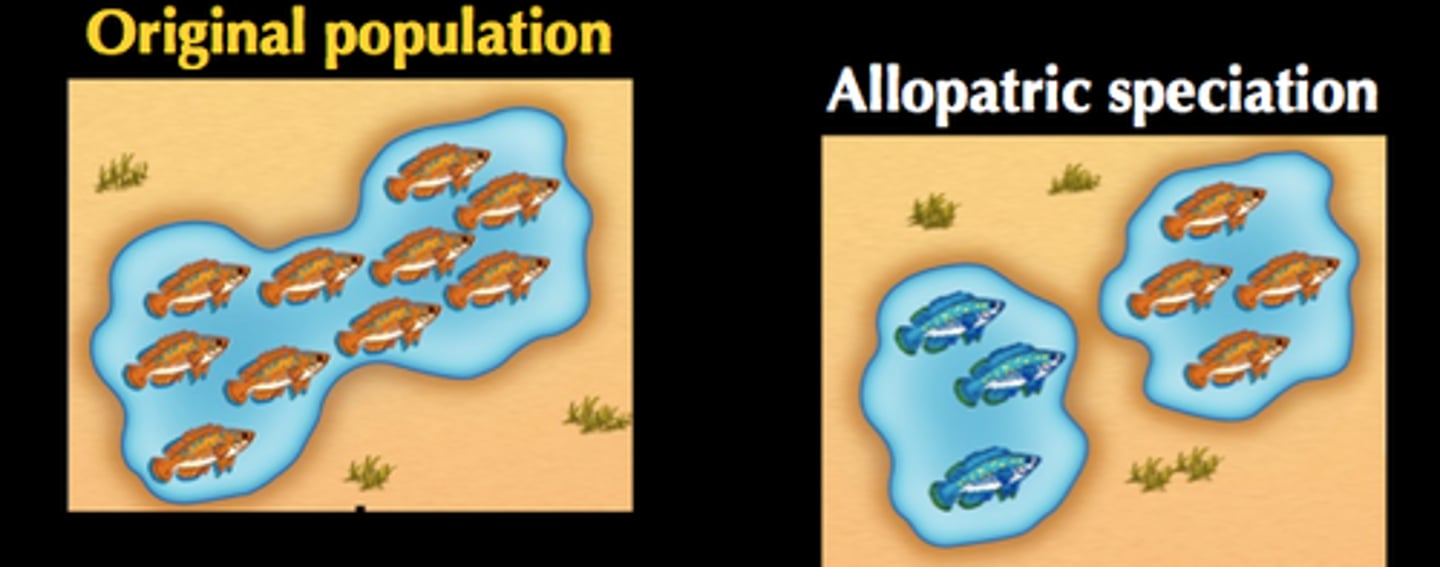
sympatric
geographically overlapping
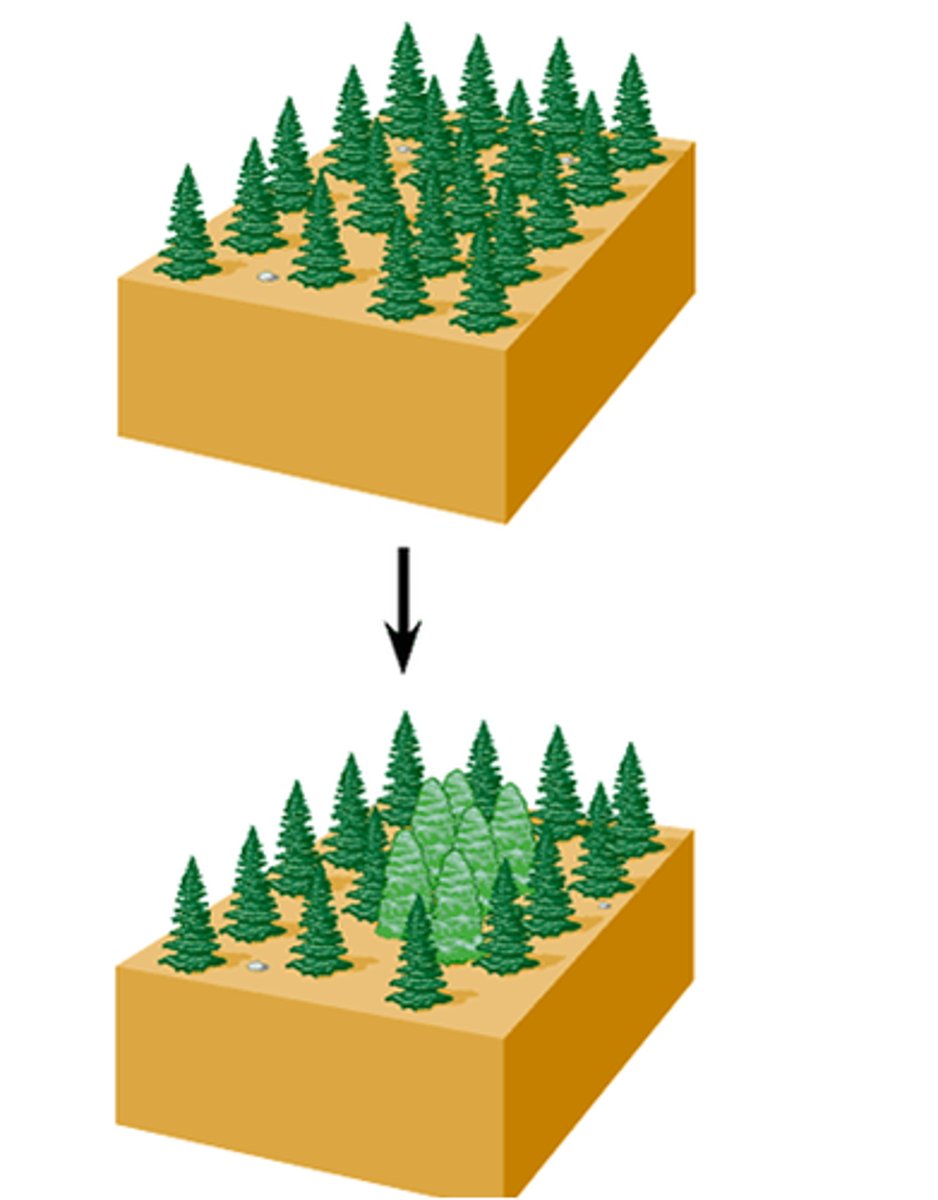
What causes reproductive isolation
finding a compatible mate mating & fertilization
development of zygote
adult growth & survival reproduction & fertility of offspring
reproductive isolation
separation of species or populations so that they cannot interbreed and produce fertile offspring
Premating isolation
Prevents zygote formation - mechanical/prevention of gamete fusion
Postmating isolation
prevents successful fertilization and development, even though mating may have occurred
Speciation involves
the evolution of reproductive isolation between populations
Douglas Schemske
Premating isolation in species of monkey flower:
pollinator preferences & altitude
Why are hybrids of monkey flower not seen in the field
because of elevational separation & pollinator preferences
the more _____________ pairs of flies are the more likely they are to be ______________
genetically differentiated, reproductively isolated
Genetic distance
measure of the degree of genetic differentiation between samples
an example of intrinsic postmating isolation
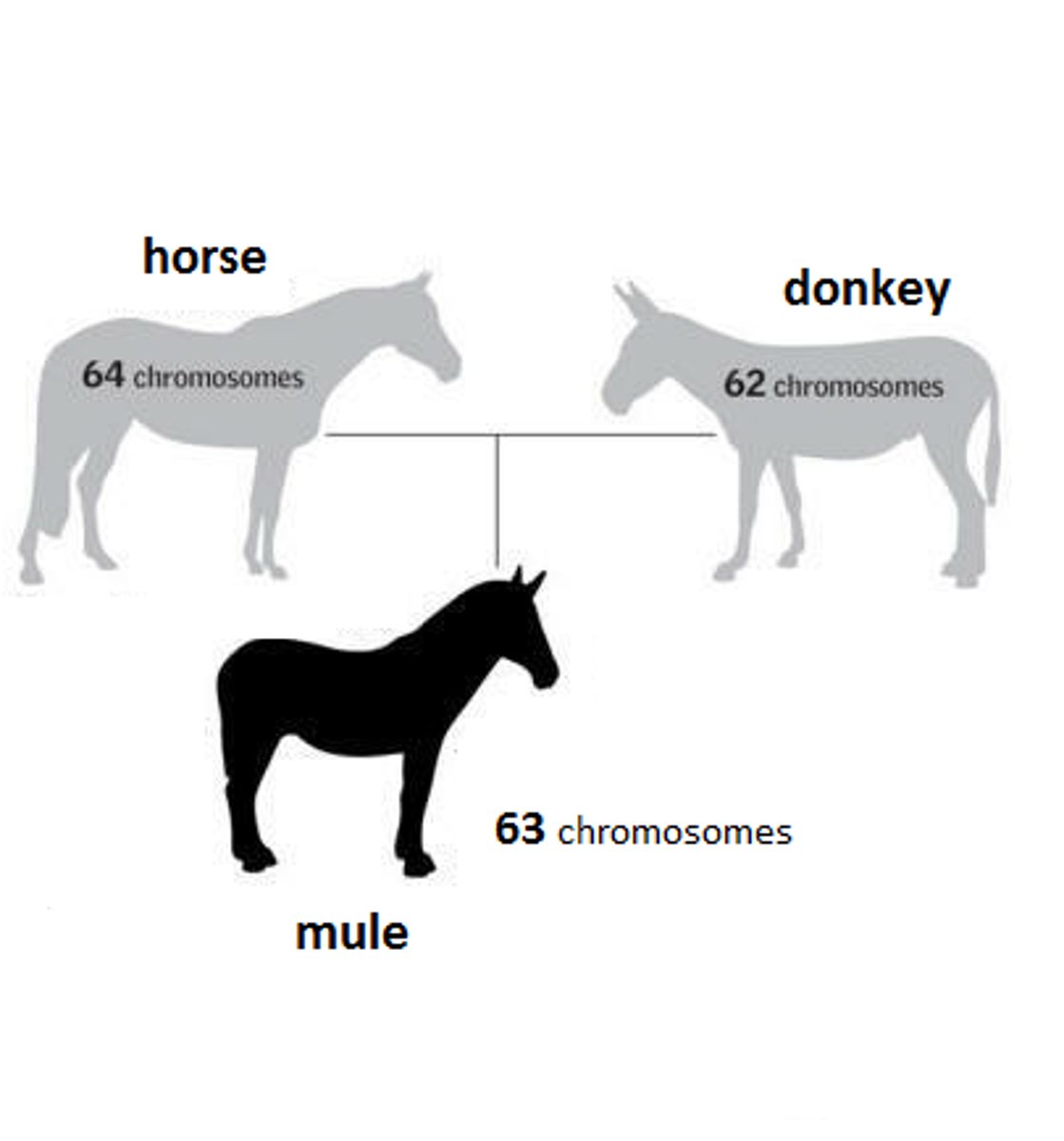
the mule
mule
sterile offspring of a male donkey and a female horse
Two types of crows in Europe: known as the Corvus corone and Corvus cornix are examples of __________
extrinsic postzygotic isolation due to poorly adapted hybrids
extrinsic postzygotic isolation
isolated by external means
intrinsic postmating isolation
although these animals see each other in their environment a lot, they are not able to effectively mate and produce fertile offspring
ecological speciation
evolution of reproductive barriers due to adaptation to divergent environments
speciation genes
genes that cause reproductive isolation and hence speciation
Stickleback study freshwater vs salt water
freshwater stickleback lost their body armour due to the lack of large fish and the salt water sticklebacks kept their body armour because of the vast amounts of fish
hybridization
The exchange of genes between species as a result of occasional inter-specific mating
Polyploidy
An organism, tissue, or cell with more than two complete sets of homologous chromosomes
autopolyploidy
An individual that has more than two chromosome sets that are all derived from a single species
allopolyploidy
polyploidy resulting from contribution of chromosomes from two or more species (most common type that arises from occasional hybridization between species)
Evolutionary significance of polyploidy
1. Polyploids reproductively isolated from their diploid parents hence a form of sympatric speciation
2. Polyploids exhibit novel phenotypes allowing exploitation of new habitats
3. Hybrid vigour evident due to heterozygosity, particularly in allopolyploids
4. Approximately half of all flowering plants are of polyploid origin including many crops plants & invasive species
Jerry Coyne
"When we understand the origin of reproductive
isolating factors, we understand the origin of species"
Dolph Schluter
Study on sticklebacks
reproductive isolating mechanisms
pre-mating isolation, post mating isolation
types of premating isolation
Geographical, ecological, temporal, behavioural, mechanical, prevention of gamete fusion
types of postmating isolation
Inviability, sterility, or abnormal development of hybrids
F2 breakdown
Carolus Linnaeus
"father" of taxonomy, binomial nomenclature, he came up with the hierarchical system of classification: kingdoms, phyla, classes, order, family, genus, species
What is the purpose of a biological classification?
Name is key to the literature on an organism (predictive power)
Enables interpretation of origins and evolutionary history
taxon
a named taxonomic unit at any level (plural=taxa)
What are the levels for taxonomy
kingdoms, phylums, class, order, family, genus, species
taxonomy
theory and practice of classification
Systematics
study of biodiversity and the evolutionary relationships among organisms
Phenetics
Classifying species based solely on overall resemblance (largely dead)
Cladistics
Classifying species on the basis of their phylogenetic relationships
Schools of Taxonomy: Philosophical wars of the 70s and the 80s
Philosophical wars of the 70s and the 80s between the study of phenetics and cladistics
Willi Henning
Created the phylogenetic tree. Provided a depiction of the evolutionary relationships among groups of organisms.
phylogenetic tree
A family tree that shows the evolutionary relationships thought to exist among groups of organisms
Monophyletic Group
a single ancestor that gives rise to all species in that taxon and no species in any other taxon
Non-monophyletic group
a taxon whose members are derived from two or more ancestral forms not common to all members
Ancestral trait
a trait shared with a common ancestor
Derived trait
a trait that differs from the ancestral trait in a lineage
Homology
similarity of traits due to shared ancestry
Homoplasy
similarity of traits as a result of convergent evolution
Convergent Evolution
Evolution of structures that resemble one another and perform similar functional roles due to the shared ecology of unrelated organisms
Why is molecular biology relevant to evolution and phylogeny reconstruction?
1. All life is related through branching descent
2. Common genetic code is evidence that all life is related
3. Evolutionary relationships among species are reflected in their DNA and their proteins
Inferring species relationships from nucleotide sequences
1. Genes or parts of a gene can be sequenced for different species
2. Species can be assessed for changes in the sequence of nucleotides
3. These changes can be used to construct relationships in a branching diagram (phylogeny)
phylogeny
Evolutionary history of a species or group of species.
Wayne and David Maddison
Tree of life web project
provides 10,000 webpages about biodiversity and phylogenetic relationships
Key innovations for phylogenies
1. Origin of a novel trait resulting in adaptive radiation
2. Carriers of the trait can exploit new resources or sets of habitats
3. Usually associated with rapid evolutionary diversification (e.g. adaptive radiations)
Key points on the Nature Paper on Columbines
16 fold variation in nectar spur length among species
7 independent pollinator shifts - 2 from bee to bird; 5 from bird to hawkmoth
Clear directionality in spur length evolution with no evidence of reversal to shorter spurs
Pollinator shifts associated with speciation events due to premating isolation
The optimal mating rate is lower...
for females than males
Therefore females...
tend to resist most mating attempts by males
Males have evolved...
grasping structures to overcome resistance
Females also evolve...
behaviours to aid in resisting
This antagonistic coevolution
has the potential to escalate like an arms race
What does an arms race predict?
escalation of armaments over evolutionary time
nectar spur evolution
there was a rapid burst of speciation with acquisition of nectar spur
nectar spur
pouch for storing nectar
Biological Invasions
The successful establishment of a species in a region not previously occupied followed by rapid range expansion
Native
An indigenous species that occurs wild in a given region
Alien
A species that has been introduced to a part of the world to which it is not native
Also referred to as adventive, exotic or simply introduced species
Negative environmental consequences of biological invasions
1) Disrupt ecological processes in natural plant and animal communities
2) Displace species leading to their extinction
3) Adverse effects on human health
4) Serious economic and social impacts through reduction of yields
Invasive species in the USA
1) Economic cost = $120 billion per year
2) 50,000 introduced species, number rising
3) 42% of threatened and endangered species at risk primarily due to alien invasives
enemy release hypothesis
A hypothesis that states when a new animal or plant enters a new habitat, their population increases dramatically as a result of no threat of predation against them
Invasive species thrive in disturbed sites
the more disturbance the more vulnerable to invasion
Common attributes of successful invasive species
1) Rapid development to reproduction
2) Uniparental reproduction
3) High reproductive output
4) Well-developed dispersal mechanisms
5) Broad ecological tolerance
6) High phenotypic plasticity
phenotypic plasticity
ability of a genotype to alter its phenotype in response to environmental change - important trait in unpredictable environments
How do some plants evolve to protect themselves from humans?
Weeds will evolve to protect themselves from humans by trying to mimic what rice plants look like
The Problem with Pesticides
Pesticides have caused many bugs that eat plants to evolve rapidly and become resistant to pesticides
Zebra Mussels
an invasive species that has caused a lot of problems in Ontario specifically clogging up water intake pipes as well as damaging local fishing industries, the females can produce up to 30,000-1000000 eggs per season, free swimming larvae easily dispersed in water. They have also been linked to avian botulism
Purple Loosestrife
1)Plants competitive with high phenotypic plasticity, produce millions of small, easily dispersed seeds with high viability,
2)Populations genetically diverse due to multiple introductions, outbreeding, and polyploidy; provides opportunities for evolution of local adaptation
Purple Loosestrife Flowering Time
Flowering Time correlated with latitudinal gradient of seasonality//Flowers farther north have adapted to the short growing season
cline
a gradual change in trait means over a geographical transect
The world's worst aquatic invaders
1) Water hyacinth
2) Kariba Weed
What do the worst aquatic invaders have in common
Native to South America, introduced by humans to Old World tropics, free-floating with prolific clonal propagation, populations genetically uniform and invasiveness due to high phenotypic plasticity NOT genetic diversity
Herbicide control causes pollution of aquatic habitats so biological control methods are used
Management of invasive species
1) mechanical e.g. hand weeding, machines
2) chemical - herbicides
3) ecological e.g. burning, flooding • biological control
Biological Control of Invaders
The planned introduction of natural enemies (e.g. predators, parasites, pathogens) to control unwanted populations of invaders in alien range
Which species is easier to control: asexual or sexual?
asexual species have a limited amount of genetic diversity since the offspring are clones of whatever the parent species was. For species to be a good biological invader, they have to have phenotypic plasticity and phenotypic plasticity requires changes in genotypes. Asexual species take longer to experience change and are thus easier controlled
The amount of genetic diversity determines...
whether resistance evolves in plant invader
Clonal species have ________ diversity than sexual species
less
Advantages of Biological Control of invasive species
1) Non-toxic to humans; if conducted carefully no serious environmental impacts
2) If successful the effects are permanent
3) Economically cheap ($1 for biological control vs. $5 for chemical control)
What is the main danger of using biological control of invasive species
Sloppy science creates new invasion
crop mimicry
when weeds mimic crops to avoid being picked by humans when they go through their crops to see if they are weeds or not
E.O. Wilson
biodiversity, expert in myrmecology (study of ants), early founder of biodiversity science
What are the two most important global environmental problems?
1) Global warming & climate change
2) Loss of biodiversity
Global environmental problems
Global Warming and climate change
Loss of Biodiversity
Environmental Pollution
Human Famine
Spread of infectious diseases
Human Population Growth
How will organisms respond to climate change?
1)Migrate to more favourable environmental conditions (=ecology)
2)Adapt to changing environmental conditions (=evolution)
3)Go locally (or globally) extinct (=evolution)
Climate change alters ____
phenology
 Note
Note  Flashcards (20)