Weps Midterm 2026
 Call Kai
 Learn
Learn Practice Test
 Spaced Repetition
 Match
Match Flashcards
 Knowt Play
1/15

There's no tags or description
Looks like no tags are added yet.
Name | Mastery | Learn | Test | Matching | Spaced | Call with Kai |
|---|
No analytics yet
Send a link to your students to track their progress
16 Terms
Fire Control
3 Phases
Detection
Tracking
Engagement
Detect to Engage - Phase 1
Detection
Detect
target, environment (noise)
Localize
speed, bearing, elevation, range, depth
Classify
number, size, ID, type
Detect to Engage - Phase 2
Tracking → fire control solution
generate continuous target data
feedback loop with localization
Detect to Engage - Phase 3
fire control solution → Engagement
weapon selection
launching, propulsion, guidance, control weapon
neutralization
fuzing
warhead
effects
Mechanical vs Electromagnetic Wave
Mechanical
requires a medium for propagation
ex. sonar
Electromagnetic
doesn’t require a medium for propagation
ex. RADAR, visible light, thermal radiation
4 Types of Wave Propagation
Reflection
specular (equal but opposite angle off smooth surface)
diffuse (waves strike uneven surface, reflect at many angles)
Refraction
not all EM wave is reflected, some refracted and bent into the other medium
angle determined by Snell’s law and the refractive index
Diffraction
EM waves diffract around objects (land mass, mountain top, slit, etc.)
can detect signals despite LOS limitations
Interference
constructive interference (two identical waves create one bigger wave)
destructive interference (two opposite waves cancel each other out)
Attenuation (definition and types)
Attenuation - EM signal loss
Spreading
energy distributed over an increasingly larger area
Absorption
energy dissipated into a medium
Scattering
energy bounces off suspended particles within a medium
note: attenuation increases as frequency increases
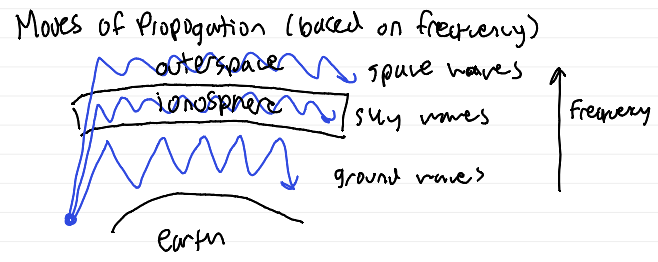
Modes of Wave Propagation
Ground Waves
follow curvature of the earth, form a duct between ground and ionosphere
lowest frequency
Sky Waves
bounce off ionosphere back to earth or travel in the ionosphere
medium frequency
Space Waves
penetrate ionosphere and travel through space
highest frequency
Beamforming and Directionality
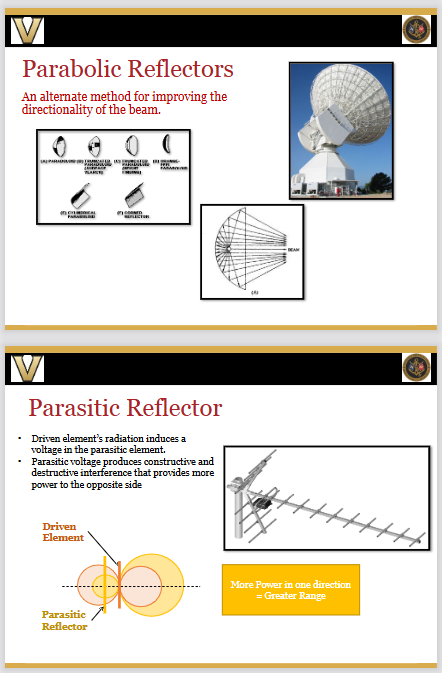
Directionality allows more efficient energy use
achieved by using reflectors
Two Reflector Types
Parabolic
reflective beamforming (energy bounces off a cone in one direction)
Parasitic
cancellation beamforming (driven element induces parasitic voltage which produces constructive and destructive interference which gives directionality)
Search vs Targeting Radar
Different Radar beamwidths
Search: wide beamwidth
looking to see if something is there
Targeting: narrow beamwidth
used for fire control (launching missiles)
MSA vs. ESA
MSA: mechanically steered array
have to physically move (slower)
require more power, slower response time
ESA: electronically steered array, aka Phased Array
uses ionized air/phase shift to create and send out a beam
instantaneous, less moving parts to break
increased flexibility
multi-target tracking
multi-mode ops (frequencies) - search or fire control
Continuous Wave Radar (CW)
CW
continuously transmits and receives
requires relative motion to determine target presence (either target or radar movement)
requires 2 antennas (one to transmit, one to receive)
uses a mixer to distinguish between transmitted and received frequencies
can only measure velocity, not distance
Basic Pulsed Radar
Pulsed
transmits short pulses followed by long rest periods where range is determined based on pulse return time
target is detectable while stationary or moving at same speed & bearing
requires only one antenna
Frequency Modulated Continuous Wave Radar
FMCW
frequency increases over time, time stamp created for transmitted signal → cycle repeats constantly
transmitted and received signal’s frequencies compared
difference in frequencies gives a time of travel, time of travel gives range
doppler gives velocity
commonly used as radar altimeters, short range proximity detectors
SAR and ISAR
SAR - synthetic aperture radar
radar on moving platform focuses on target of interest
system stores returns as platform moves and creates “synthetic aperture” image of target
advantages: large effective aperture, outstanding resolution
disadvantages: large storage capacity and computer power needed (not as relevant as technology advances)
ISAR - inverse SAR
if target has periodic motion (yaw, pitch, roll), then SAR image can be achieved without a moving radar
Guidance - Detect to Engage
Boost
from when weapon receives launch signal to when weapon is in stable flight toward target
Midcourse
inputs may be required to bring missile on course and stay there (longest phase in distance and time)
Terminal
high accuracy, fast response to target’s evasive maneuvers

