psych 1101 module 52 neurodevelopmental disorders
 Call Kai
 Learn
Learn Practice Test
 Spaced Repetition
 Match
Match Flashcards
 Knowt Play
1/24

There's no tags or description
Looks like no tags are added yet.
Name | Mastery | Learn | Test | Matching | Spaced | Call with Kai |
|---|
No analytics yet
Send a link to your students to track their progress
25 Terms
neurodevelopmental disorder
central nervous system abnormalities (usually in the brain) that start in childhood and alter thinking and behavior (as in intellectual limitations or a psychological disorder)
intellectual disability
a condition of limited mental ability, indicated by an intelligence test score of 70 or below and difficulty adapting to the demands of life. (Formerly referred to as mental retardation)
what age is intellectual disability apparent by
before age 18 with a known physical cause
example of intellectual disability is
Down syndrome
two criteria for intellectual disability is
the first is low intellectual functioning as reflected in a low intelligence test score. Guidelines specify test score performance that is in the lowest 3 percent of the general population, or about 70 or below
The second criterion is that the person must have difficulty adapting to the normal demands of independent living, as expressed in three areas, or skills that are conceptual, social, and practical
Intellectual disability like normal intelligence results from a combination of
genetic and environmental factors
autism spectrum disorder (ASD)
a disorder that appears in childhood and is marked by significant limitations in communication and social interaction, and by rigidly fixated interests and repetitive behaviors
ASD is now diagnosed
1 in 38 children in South Korea, 1 in 59 in the United States, 1 in 66 in Canada, and 1 in 100 in Britain
The increase in ASD diagnoses has been offset by a decrease in the number of children with a “cognitive disability” or “learning disability,” which suggests a relabeling of children’s disorders
symptom of ASD
Symptom is poor communication among brain regions that normally work together
from age 2 months on, children typically spend more and more time looking into others’ eyes
ASD people have
impaired theory of mind
they have difficulty inferring and remembering others’ thoughts and feelings, and appreciating
Relationships emotionally unsatisfied, get bullied, more likely to get depression (4 times)
About half of people with ASD experience a
“fair” or even “good” outcome
Aspergers
high function, normal intelligence but also accompanied by exceptional skill or talent in specific areas
utistic traits display a slightly better than average of
social psychological phenomena
ASD may lack the motivation and ability to
interact and communicate socially, and they tend to become distracted by irrelevant stimuli
Spectrum's more severe end struggle to use language
ASD diagnosed in about
three boys for every girl, girls are better at hiding it
Biological factors contribute to ASD like
prenatal environment
Genes matter to, ASD heritability was
near 80%
if one identical twin is diagnosed with ASD, the chances are
50 to 70 percent that the co-twin will be as well
no autism gene
400 identified
Mutations become more frequent with age, meaning that age 40 man having a kid is more likely to have autism
than a 30 year old man having a kid
ASD telltale signs
Several studies have revealed “underconnectivity”—fewer-than-normal fiber tracts connecting the front of the brain to the back
children as young as 3 months, EEG-recorded brain activity can foretell
ASD
When people with ASD watch another person’s hand movements, for example,
their brain displays less-than-normal mirroring activityc
childhood vaccinations do not contribute to
ASD
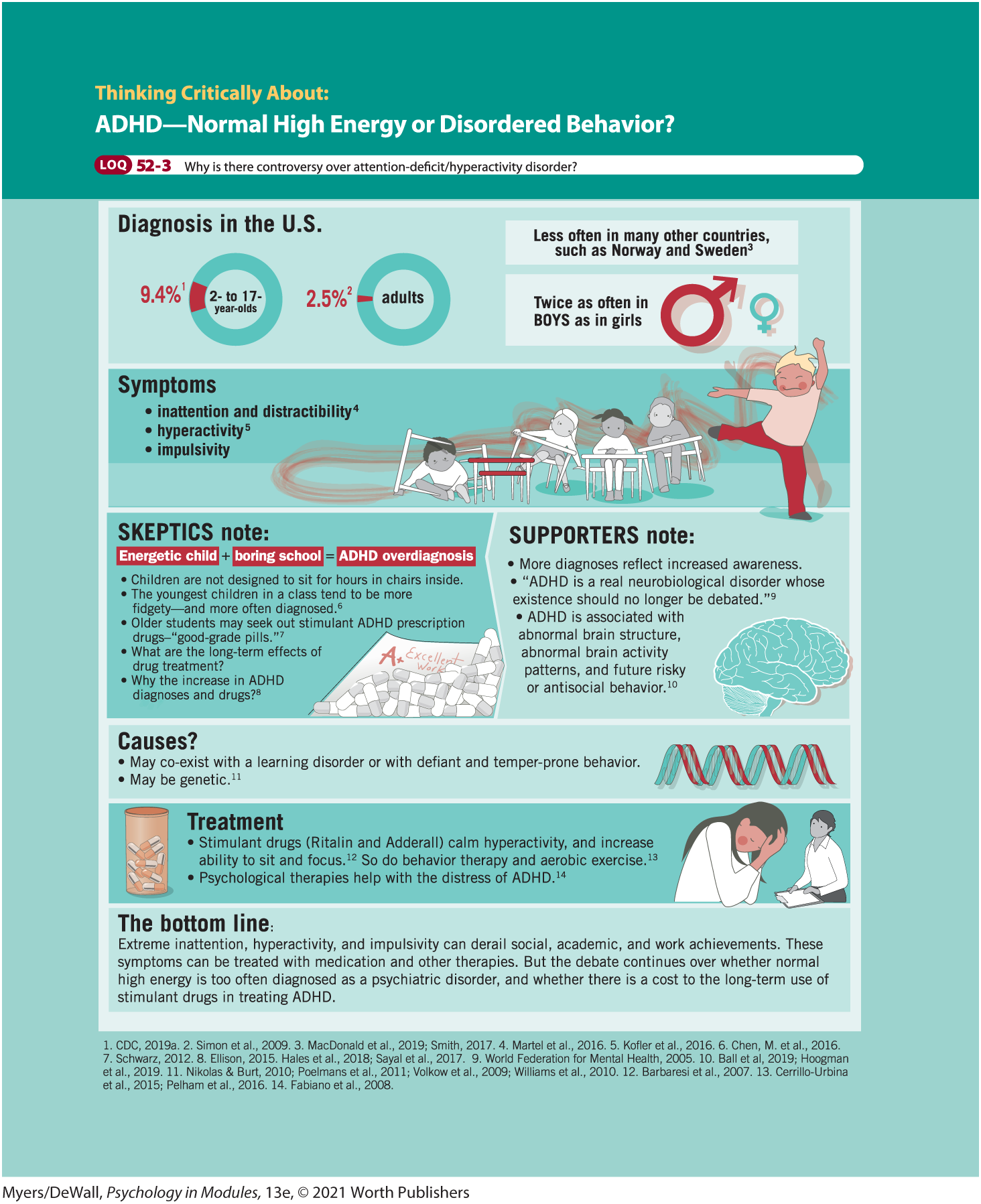
attention deficit/ hyperactivity disorder (ADHD)
a psychological disorder marked by extreme inattention and/or hyperactivity and impulsivity