Advanced Environmental Geology Exam 1
 Call Kai
 Learn
Learn Practice Test
 Spaced Repetition
 Match
Match Flashcards
 Knowt Play
1/78

There's no tags or description
Looks like no tags are added yet.
Name | Mastery | Learn | Test | Matching | Spaced | Call with Kai |
|---|
No analytics yet
Send a link to your students to track their progress
79 Terms
settlement
The process where soil settles via compaction and consolidation.
compaction
the loss of air
consolidation
the loss of water
3 Key Parts to Settlement
shrinking and swelling
slope failures
premeability issues
What makes up soil?
mineral matter, organic matter, water, and air
Types of soils
granular, cohesive, and organic
Types of granular soils
gravel (>2mm), sand (0.75-2mm), silt(0.005-0.075mm)
Types of cohesive soils
clays (<0.005mm)
Origins of granular soils
residual- physical weathering
transported- many! shallow marine sands, river sands & gravels, dune sands, etc
Origins of cohesive soils
residual- chemical weathering
transported- many! river floodplain deposits, glacial lake deposits, deep sea, etc
Origins of organic soils
plant matter cannot fully decay due to low O2 & waterlogging. This forms soils like peat.
Soil Classification Systems
AASHTO (American Association of State Highway and Transportation Officials) & USCS (Unified Soil Classification System)
USCS
coarse-grained soils, fine-grained soils, and organic soils. Gravel (G), sand (S), silt (M), clay (C), and organic (O). Poorly graded (P, Uniform), Well graded (W, diversified particle sizes). High plasticity (H) and Low plasticity (L). CONSIDER GRAIN SIZE & SORTING as well as behavior of soil in presence or absense of water (Atteburg limits)
Atterburg Limits
Liquid limit (LL) & Plastic limit (PL)
Liquid Limit
Water content (in weight %) at which soils behave as liquids
Plastic Limit
Water content att which the soil behaves as a plastic (play doh)
AASHTO
grain size and Atteburg limits needed.
Grain size is determined by
sieve analysis to create a histogram where weight % is plotted against grain size. Narrow peak means well sorted and broad peak means poorly sorted. You will get statistics such as Cu and Cc.
Cc
coefficent of curvature. D60/D10
Cu
coefficient of uniformity. (D30)2/(D10*D60)
Dx
diameter at which x% passes through the soil sieve. **You get this by looking at the graph**
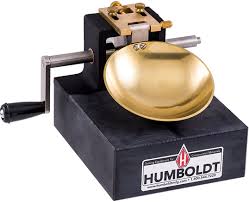
Liquid Limit Test
Make a mudpie in a bowl, then make a groove in the mudpie. Then, the bowl will bounce off a rubber base using a crank, and then see how many drops are required to fill the gap you created. Then, you know if you’re beyond the liquid limit or not, 25 drops just close.
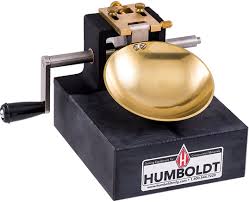
Plastic Limit Test
make “worms” out of clay, make a certain diamter→ if it breaks its too dry
Plasticity Index (PI)
LL-PL
Shear strength of soils
soil needs strength, or everything would be flat
angle of repose
Pour the soil out of a bucket, and the angle of the pile is the respected angle
Gravity’s effect on slopes
Gravity works to eliminate slopes TPED→ tectonics proposes, erosion disposes
Soil has strength
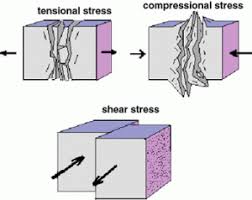
its ability to resist stress, of which there are 3 kinds: compressive, tensional, and shear
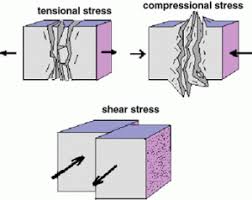
Compressive stress
forces act towards each other, compressing
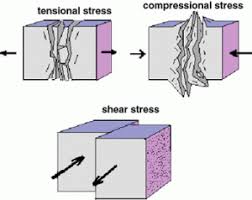
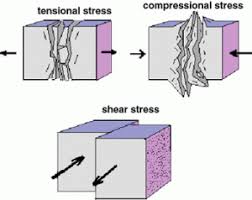
Tensional stress
forces act away from each other, tension.
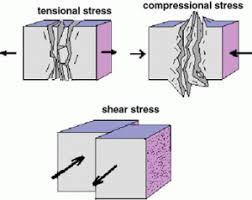
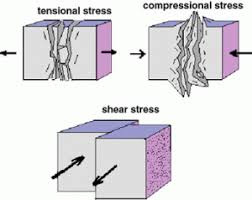
Shear Stress
forces act towards each other on two planes of material, allowing them to slide past each other, shearing.
Coulumbs Equation
Shear Strength = cohesion + NF * tangent angle of internal friction
Where course-grained soils get their strength
friction
Where fine-grained soils get their strength
mainly cohesion but some friction
Tests for shear strength
unconfined compression test, direct shear test, and triaxial compression test
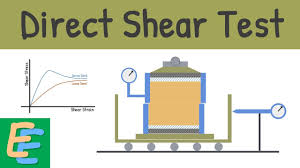
Direct Shear Test
plots shear strength vs normal force, granular soils start at the origin, and cohesive soils start with a higher y-value. The steeper the line, the more strength the soil gets from friction (angle of internal friction based off of the line)
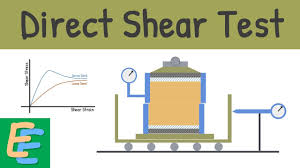
Objectives of Direct Shear Test
Determines shear strength at varying normal forces
gives you they-intercept
Advantages of Direct Shear Test
easy, fast, cheap
Disadvantage of Direct Shear Test
forces the failure plane to be horizontal
Factors affecting shear strength of granular soils
compactness, particle surface roughness, water (pwp→directly opposes NF)
Modified Coulumb’s Equation
Shear Strength = cohesion + (NF-PWP) tan angle of internal friction
Factors affecting shear strength of cohesive soils
type of clay mineral and water content
soil settlement
the vertical component of reduction in soil volume that occurs when a load is applied (results from compaction and consolidation)
increased compaction and consolidation, increase engineering qualities
decrease settlement potential and increase shear strength
Predicting Settlement Potential
SPT (standard penetration test (FIELD)), Consolidometer (meters of consolidation (LAB), Nuclear Densiometer (FIELD).
Reducing Settlement Potential
Proctor Compaction Test (LAB) is easy and cheap
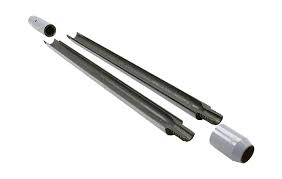
Standard Penetration Test (SPT) (FIELD)
Split Spoon Sampler→ pound into ground and see how much resistance. 140 lb hammer falls 30 inches to impact this device. Back of a drill rig: cable pulls the hammer up and lets it free-fall. # of drops or blows correlates to soil density. 3 trials and 6” at a time, the first 6” trial is thrown out, other two are kept.
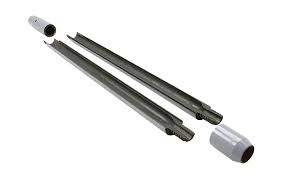
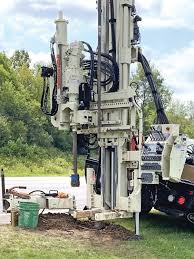
Hollow Stem Auger Drilling (FIELD)
5’ in length with flutes going around (auger), cuttings come off when you drill into the ground, and they pile at the top of the hole. You stop when at the required depth, then insert a solid rod with a split-spoon sampler down the pipe. You can then remove the core and perform the SPT via SSS.
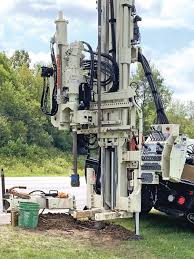
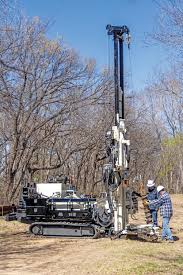
Geoprobe (FIELD)
An alternative to a truck-mounted rotary rig. It’s small and compact, maneuverable (track mounted), some can rotary drill, but more commonly they can do direct push without rotation. It includes a metal pipe with a plastic liner (pipe), which forces the sample into the plastic pipe. Commonly used for chemical spills and determines if the soil is poorly graded or well sorted.
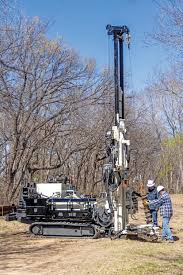
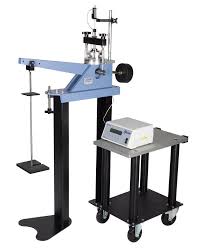
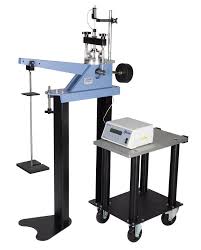
Consolidometer (LAB)
Clay soils don’t consolidate immediately; granular soils do. Clay gives up water in the pores of the deposit. This device is applied to wet clays. Clay is put into a hockey puck core, with porous stones above and below the sample. Water doesn’t compress, so it needs to go somewhere. This is inside a bigger tube so a load can be applied in a constant even force.
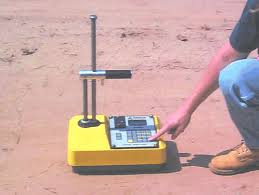
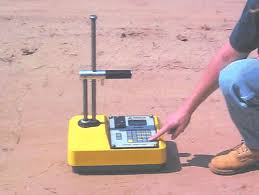
Nuclear Densiometer (FIELD)
Field test to determine soil density. Gamma radiation to measure soil density, before you put the box down, you hammer a tube into the ground ~18”. Move the ND over the hole, and the ND has a probe that you put in the hole. In the probe, theres a gamma radiation source. The ND has detectors to pick up the “signal” from the radiation. Gives you the density, and is not so much for natural soils & landscapes. Used primarily for road work, laying new roads to make sure the substrate is compressed well enough to lay the road down. Typically used by independent agencies or consulting companies. Troxler Nuclear Densiometer
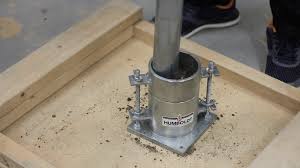
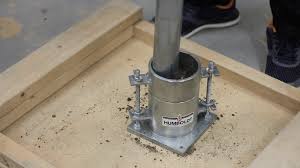
Proctor Compaction Test (LAB)
Determines optimum H2O content for compaction treatments. Example: Gravel from a dump truck + roller & vibration for compaction. (Presettlement) You need wet gravel, but not too much, because water reduces friction, but not enough to fill the pore space. Fill the cylinder just barely above the top. The piston is pushed down for a certain distance (# of drops) 5.5 lb hammer (25 drops per se), measure distance, put the sample in oven to determine dry density, you now have volume and mass (D=M*V), re-run trials to provide a compaction curve. The graph plots H2O content against dry density. GIVES YOU MAX DRY DENSITY and OPTIMUM H2O content for compaction treatments.
Water Weight
Ww = Wsoil(mcf -mci)
Clay Mineral
sheet or phyllosillicates
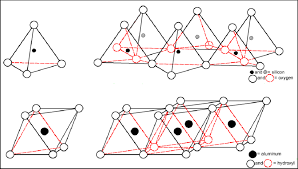
T Sheet
O and Si
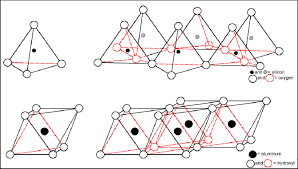
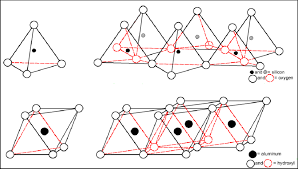
O Sheet
O, OH, Al, Mg, Fe, etc
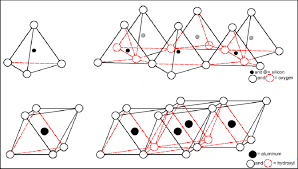
Clay minerals can stack as
TO or TOT, there are different metallic ions in the lattice (more common in TOT)
Adjacent TO sandwiches are held together
by hydrogen bonds
Adjacent TOT sandwiches are held together by
Van der Waals forces, theyre weak and water gets into the spaces
Each platy clay grain has a net negative charge via
Isomorphous substitution in oct. sheets (replacement of one atom by another of similar size in a crystal structure without disrupting or seriously changing the structure), unsatisfied ions on the crystal surface, pH (un)availability of H+ ions in the solution
Plasticity Index→swelling capacity
PI
0-10, low inherent swelling capacity
10-20, medium
20-35, high
>35, very high
Why is water attracted to clays?
hydrogen bonding to specific sites and general electrostatic attraction
Why do some clays swell more than others?
type of clay (TO vs TOT), geometry of the clay grain, and charge of cations in the lattice
Bentonite uses
drilling mud, plugging leaks, clumping cat litter, taconite pellets.
Why dont micas swell?
TOT clays with Al 3+ subs for Si +4
Identifying expansive soils
mineralogy via x-ray diffraction, consolidometer, free swell test, and PI (relate to chart)
Engineering Procedures for Preventing Swelling/Shrinking (clays)
Avoid them, remove them, control H2O content, and chemical stabilization (cation exchange)
Cation exchange
higher valence replace lower valence, for ions of the same charge, the smaller one is better absorbed
Lime injection
adding lime (CaO) to the soil where Ca +2 replaces the Na+
shear stress > shear strength
shear failure occurs
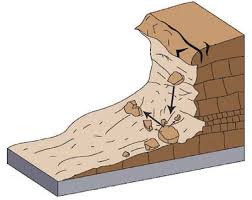
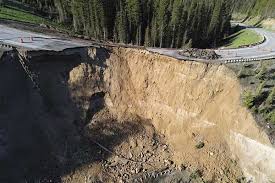
Rock Fall
A coherent mass that moves down (not in contact with the underlying failure plane) results in undercutting from differential weathering
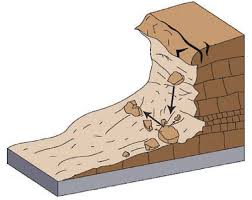
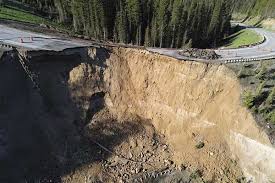
Soil Fall
A coherent mass that moves down (not in contact with the underlying failure plane) results in undercutting
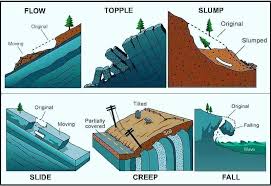
Rock Slide
A coherent mass moves over a predefined failure plane
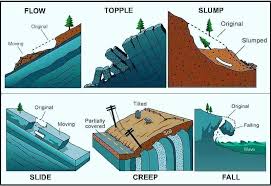
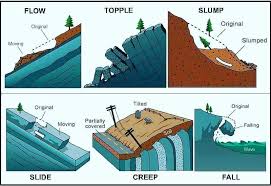
Soil Slide (Slump)
A block (slump block) of soil lacks a ready plane of weakness so you get a rotational aspect which leaves a crescentic scarp.
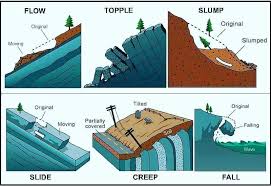
Combination failure
very common*, slump-flow is very typical. Flow can remove basal support and allow for a soil slump or vice versa
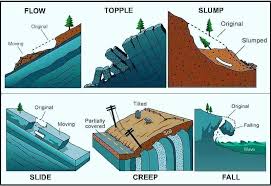
Earth flow
not confined to a channel moving downslope moving similar to a viscous fluid incoherent mass
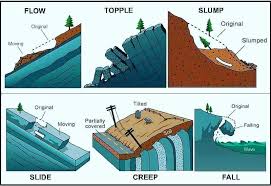
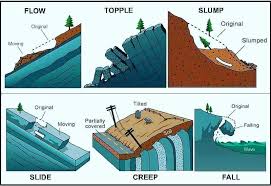
Mudflow
confined to a channel moving downslope, similar to a viscous fluid, moves quicker with soils mixed with water
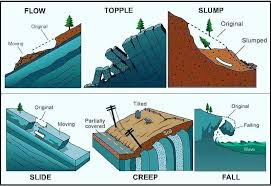
Creep
VERY SLOW and SNEAKY! very slow flow-downslope movement from many mechanisms, freeze-thaw can cause this, freeze causes crystals to go up and thaw causes crystals to go down. Along a slope gravity pulls materials down.

