Deviant Behav - Chapter 3
 Call Kai
 Learn
Learn Practice Test
 Spaced Repetition
 Match
Match Flashcards
 Knowt Play
1/20

There's no tags or description
Looks like no tags are added yet.
Name | Mastery | Learn | Test | Matching | Spaced | Call with Kai |
|---|
No analytics yet
Send a link to your students to track their progress
21 Terms
What is biological theory of deviance?
Biological theory proposes that an individual deviates from social norms largely because of their biological makeup. The theory primarily pertains to formal deviance, using biological reasons to explain criminality, although it can certainly extend to informal deviance
Limitation to Biological Theory
It does not tell us how deviance is socially constructed.
What is a Psychological Theory of Deviance?
• Psychologists believe that a set of personality traits distinguish deviants from non-deviants.
• Crime is a symptom of a “real” problem deep within the criminal’s personality.
• Much of adult behavior (deviant or nondeviant) is based on certain instinctive drives and on early childhood reactions to parents and siblings.
• Behavior disorders are explained by analyzing the individual’s unconscious mind.
Characteristics of an Authoritarian Personality
• Strong need for order and structure
• Highly critical of others and often find fault with them
• Superstitious and anti-intellectual
• Value obedience and respect above all else
• Destructive and cynical
Limitations to Psychological Theory
Personality traits may indeed explain individual acts of deviance, but social issues require a focus on social causes, social arrangements, and social conditions.
What is a Rational Choice Theory of Deviance?
• In rational choice theory, a choice is made to behave a certain way, to think a certain way, or to live a certain kind of lifestyle.
• A risk/reward calculation is made in which the criminal act becomes a rational choice.
Limitations to Rational Choice Theory
• Deviance is not always a choice.
• Deviant acts can be acceptable in some situations.
Which social factors of deviance are structural theories?
Anomie, Conflict, and Labeling Theory
Which social factors of deviance are process theories?
(Self) Control and Learning Theory
Anomie Theory of Deviance
Social structures put pressure on people to engage in deviant and criminal behavior.
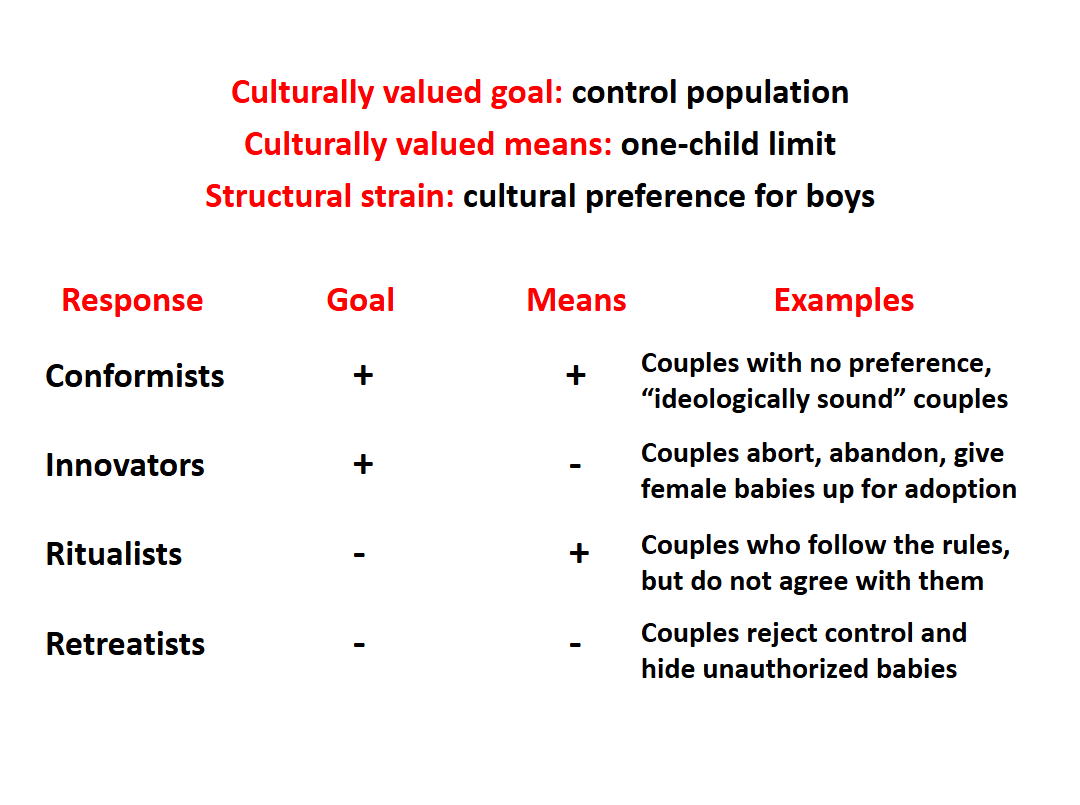
Limitations to Anomie Theory
• Does not explain how different times, places, and circumstances create different strains on people.
• There is a class bias
• Does not explain why wealthy and educated people would engage in illegal economic activities.
How Does Conflict Theory Explain Deviance?
• Deviance stems from the economic inequalities inherent in a capitalist system.
• Powerful groups create definitions of deviance to serve their own interests.
Limitation to Conflict Theory
It does not focus on processes of socialization - how people learn their culture, how people develop human capacities and acquire a unique personality and identity.
How Does Labeling Theory Explain Deviance?
• Deviant behavior is behavior that people so label.
• Primary deviance - casual and occasional acts that are not part of the individual’s self-concept.
• Secondary deviance – frequent acts that become part of the individual’s self-concept.
Limitation to Labeling Theory
Does not account for deviant behavior that goes undetected and thus unlabeled.
How Does Control Theory Explain Deviance?
• Low self-control adversely affects a person’s ability to accurately calculate the consequences of their actions.
• People with low self-control find it more difficult to resist criminality.
• With proper socialization, people will conform.
Four Elements of Social Bonding
• Attachment: affection, respect, socialization to group norms.
• Commitment: having a “greater stake” in conformity.
• Involvement: nondeviant, conventional activities.
• Belief: allegiance to dominant value system.
Limitations to Control Theory
• It does not explain adult criminality very well.
• It does not allow for delinquency by juveniles who are properly socialized, nor does it allow for conformity by juveniles who are not properly socialized.
Learning Theory of Deviance
• Deviance is learned by interacting with other people, just like all human behavior is learned.
• Whether behavior is deviant or conforming depends on differences (or differentials) in associations.
Differential Association
The best known learning theory. The idea that deviant behavior is learned through social interactions with intimate personal groups
Limitation of Learning Theory
It does not consider that people are perfectly capable of getting into trouble on their own.

