Midterm 1 Psy340
 Studied by 1 person
 Call Kai
 Learn
Learn Practice Test
 Spaced Repetition
 Match
Match Flashcards
 Knowt Play
1/105

There's no tags or description
Looks like no tags are added yet.
Name | Mastery | Learn | Test | Matching | Spaced | Call with Kai |
|---|
No analytics yet
Send a link to your students to track their progress
106 Terms
Correlational
Helps understand relationships
Easy to conduct (surveys)
You can’t infer cause and effect
Experimental
You’re able to see cause and effect
It’s precise
It is not real, and does not mimic real-life
You can only test one subject at a time
Suppression and rebound
show pictures
suppress picture (you do not think about it)
allowed to thunk freely
show facilitation (rebound) for picture-related information
Implicit associations
Our thoughts and beliefs
focuses on our hidden bias
biases of which we may be unaware of or unwilling to share
Implicit association test
IAT score calculation
“Consistent” pairing (SDSU/ Good and UCSD/ Bad) minus “inconsistent pairing (SDSU/ Bad and UCSD/ Good)
Negative score = bias against UCSD
Score of 0 = no bias
Positive score = bias against SDSU
Clark and Clark
Took a group of dolls to elementary schools
Used to collect responses from 253 black students
134 from the south
119 from the north
Shown 2 black and 2 white dolls
Asked 8 questions about the doll
preference (1-4)
Knowledge of racial differences (5-7)
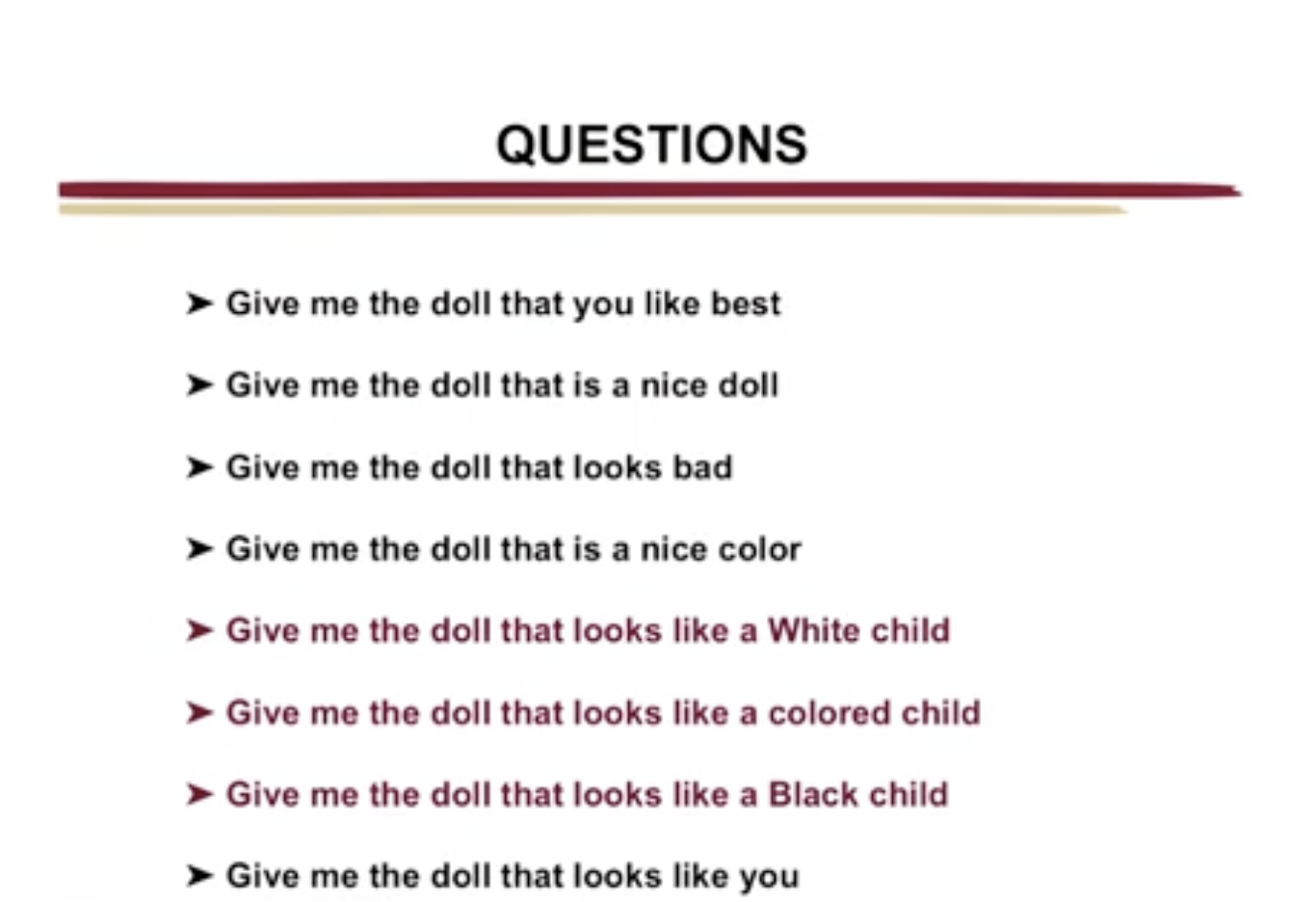
Clark and Clark findings
kids knew how to distinct the dolls
“colored” had a higher identification %
33% of kids gave the researcher a white doll despite being black
distancing themselves from their black identity because of preferential treatment (south and north)
helped overturn segregation
Darley and Latane
72 undergraduate students (59 female, 13 male)
Randomly assigned to a condition
2,3, or 6 participants (one victim)
Discussion on personal problems in college
A fictitious participant has a seizure
Could not speak to other participants or victim
Darley and Latane findings
2 (participant, victim) 85%, 52 seconds
3 (participant, victim, 1 other) 62%, 93 seconds
6 (participant, victim, 4 others) 31%, 166 seconds
when there’s more “others” they responds slower
Self concept are made up of
self-schemas
self-guides
what we know and believe about ourselves
Social desirability
worrying about how someone will view you
not an accurate representation of your schema
self presentation bias
the self that one presents to other people
Self-complexity (interdependent view of self)
less complex
One piece of daily life affects another aspect of your life
Self-complexity (independent view of self)
more complex
traits do not influence each other
“What happens in Vegas, stays in Vegas”
More complex self-construals
more independent, do what you want, not what your friends and family want
we strive for personal achievement
Less complex self-construals
more independent, more likely to do what your friends and family want (their beliefs matter)
we strive for the group and group achievement
Spotlight effect
the belief that others are paying more attention to our appearance and behavior than they really are
illusion transparency
the illusion that our concealed emotions leak out and can be easily read by others
3 types of self
actual self (who we are)
Ideal self (who we want to be)
Ought self (who we should be)
Actual-ideal discrepancy
promotion, focus, dejection/ sad emotions
Actual-ought discrepancy
prevention focus mindset, agitations/ disturbed emotion
social roles
the hats we wear
social identity
I am what I am
We gain self knowledge through
social roles
social identity
Social comparisons
success and failure
other’s judgments
We gain self “Mis-knowledge” through
explaining our behavior (misattribution)
Predicting our behavior
Predicting our feelings
Entitlement
I deserve an award, I deserve a prize
State self-esteem (Heatherton and Polivy)
Situation specific
Social
“I am concerned about the impression I am making right now.”
1-5 scale
Academic/ Intellectual
How you feel about yourself intelligence-wise
Appearance
Do I look good? How we appear to others
State self-esteem (Heatherton and Polivy) findings
Appearance should not affect your academic aspect, just the appearance itself
They are independent of each other
Trait (global) self-esteem scale (Rosenberg, 1965)
difference between Low self-esteem and High self-esteem
High self-esteem (HSE) is more clear and stable
They will respond quicker, they are more confident in their judgment
Low self-esteem (LSE)
when they feel threatened, they may feel bad for a while
Dangers of high self-esteem
unsafe sex
violence
gang membership
Example of unrealistic optimism
“I know I am going to get an A, so I do not put int he work”
High self-monitors
Managers, Politicians
Low self-monitors
better at research, detailed work
mundane realism
The degree to which an experiment is superficially similar to everyday situations
experimental realism
the degree to which an experiment absorbs and involves its participants
Will sometimes require deceiving people with a plausible cover story
⅓ of social psychological studies in the past decade involve deception
Heuristics
simple, efficient thinking strategies
Two sides of self-esteem
state versus trait self-esteem measures
state self-esteem (Heatherton & Polivy)
more situation specific
Trait (global) self-esteem scale (Rosenberg)
individual difference measure
assesses your general feelings of self worth
Better than average effect
we use social comparisons to see where we fall in relation to other people
Base rates (Kahneman and Tversky)
(ignoring prior probabilities)
we forget to consider the number of people in a population
Ignoring sample size
make sure you have a stable enough observation that does not change the mean value
Misconception of chance
coin toss
we have to be careful of when things are independent and dependent
Independent: does not matter what happened before
Regression to the mean
an extreme event is not the true level, you need multiple observations to get a true sense (think of David’s softball story)
Representativeness heuristic
Categorizations are based on the degree that resembles the category
the resemblance is often a good indicator of an exemplar-category relationship
EX: Einstein and Hawking can be but in the physicist, professor, smart person categories
Why we commit the representativeness heuristic
ignore base rates
ignoring sample size
regression to the mean
conjunction fallacy
something specific is now less likely
availability
accessibility
ease of retrieval
explaining the phenomena in terms of frequency, egocentric bias, salience
Bridge study (Dutton & Aron)
male participants, one female researcher
males on the scary bridge would call the female more
But features are not always diagnostic (Fischoff & BarHillel)
make judgements about people’s occupations
100 samples, 70 were engineers the others were different occupations
Is Frank an engineer or a lawyer?
He sounds like a lawyer but it is likely that he is an engineer
Availability heuristic
estimates of chance are biased by the ease of generating examples
But features are not always diagnostic (Fischoff & BarHillel) findings
people IGNORE base rate information
they have the base rate information at the very beginning of the session
Attribution theory
we may unconsciously apply this theory when we see someone shouting on public transport
we try to infer the cause of others’ behavior or our own behavior
we put ourselves in the best possible light
It is more self-serving to admit attractiveness rather than fear
Fritz Heider
did work on attribution theory
interested in how people explain other people’s behavior
We misattribute the source, by attributing it to the person himself, failing to consider the situation
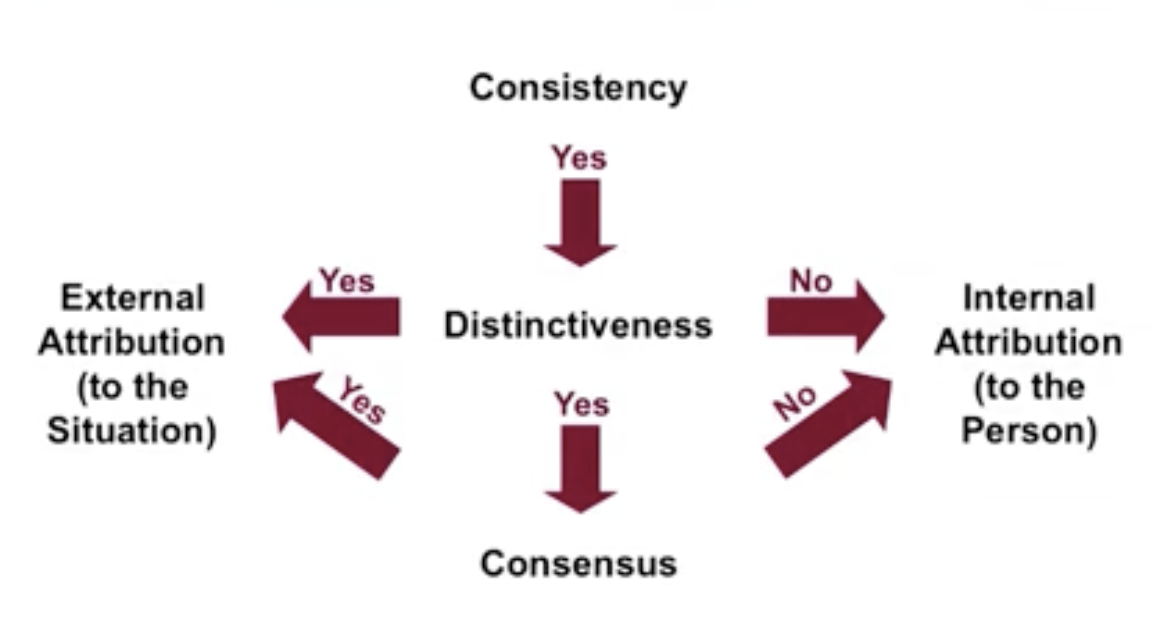
Rational explanation (Harold Kelly)
we use behavior information or consistency, distinctiveness, and consensus to make attributions
Bob can never fix his car in Auto Shop A, but in Autoshop B he is able to
something about A is making him not fix it
If he can’t fix it in auto shops A and B maybe he is a louse mechanic
If everyone in Auto A can’t fix cars, then there is an issue with the shop
If Bob is the only one unable to fix it in Auto Shop A he is the issue
Inferring traits (Jones and Davis) Less rational
we infer that behaviors correspond with peoples’ intentions and dispositions
a person who says something sarcastic, IS a sarcastic person
attribution is more likely to occur after unexpected behavior
behavior does not correspond to the situation
Fundamental Attribution Error (FAE)
We often discount the situation and simply focus on the person’s behavior, and we judge the person’s behavior as being caused by his/her internal state (discounting principle)
We enact our behaviors and we are focused on the
the situation, not our internal state
For the self, we want to maintain high self worth
For others, we want to feel better about ourselves
FAE in everyday life
the job that you are playing is the situation, you have to act a certain way
authority figures lead more, making others assume that they are smarter, leaders
Lapiere study
traveled for 2 months, with a Chinese couple (Chinese were discriminated against during this time frame)
In every single dining experience, they were able to eat peacefully
Lapiere wrote a letter to the restaurants/ hotels letting them know that he would be traveling with a Chinese couple (after he had already done it)
Many responded with No
What people say and what they do has no relation
Problems with attitudes
it is not directly measurable, only inferred (attitude= what you are willing to express to me)
they are expressions that are susceptible to situational or outside influences
Attitudes are
evaluative in nature
they are beliefs or thoughts (cognitions)
they are subjective
they are personal
Components of an attitude
affective and cognitive
Example
affective score =3
cognitive score =-1
Attitudes and social influence
it is minimal
we don’t always wanna share sensitive information, that may change responses
When attitude is strong
it is similar to self-schema attributes
self-interest
value relevance
Theory of attitude accessibility (Fazio, 1986)
to guide behavior toward an object attitudes must be affective (strong evaluative) and accessible (often automized)
Role-related behavior shapes your
thoughts
think of Stanford experiment
Foot in the door phenomenon
if you engage in some type of behavior, you’re likely to engage in it further down the line
Low ball techniques
often used with sales
I wan’t to get you excited about something, you start to think about that thing and start to form an attitude
Cognitive dissonance theory (Festinger)
We feel tension (dissonance) when 2 thoughts or beliefs (cognitions) are psychologically inconsistent
Attitude behavior match
attitude change because we are motivated to maintain self-consistency
Insufficient justification
when external reward is not enough
Attitude follows behavior
chosen versus compliance
can apply to more than one thing
accountability
inconsistency salient
Self-perception theory
how we see others can apply to how we see ourselves
When we have weak or unformed attitudes we often look to our own behaviors to discern our attitudes
Expressions and attitudes
Attitudes follow expression
mood follows expression
empathy and mimicry
we start to become like those we like
Overjustification
unnecessary and award or praise
turning play into work
Intrinsic
doing something because you love doing it, it is fun for you
Ohio State University: Richard Petty
there was more support from kids who shacked their heads up and down
Kenneth Savitsky and Thomas Gilovich
found that people overestimate the extent to ehich the internal states “leak out”
Self-concept
what we know and believe about ourselves
self-schema
beliefs about self that organize and guide processing of self-relevant information
individualism
the concept of giving priority to one’s own goals over group goals and defining one’s identity in terms of personal attributes rather than group identification
planning fallacy
the tendency to underestimate how long it will take to complete a task
impact bias
overestimating the enduring impact of emotion-causing events
we are prone to impact bias after negative events
self handicapping
protecting one’s self image with behaviors that create a handy excuse for later failure
false uniqueness effect
the tendency to underestimate the commonality of one’s. abilities and one’s desirable or successful behaviors
System 1
the intuitive, automatic, unconscious, and fast way of thinking (automatic processing)
System 2
the deliberate, controlled, conscious and slower way of thinking (controlled processing)
priming
activates particular associations in memory
embodied cognition
the mutual influence of bodily sensations on cognitive preferences and social judgments
Counterfactual thinking
imagining alternative scenarios and outcomes that might have happed, but did not happen
illusory correlation
perception of a relationship where none exists, or perception of a stronger relationship than actually exists
regression toward the average
the statistical tendency for extreme scores or extreme behavior to return toward their average
belief perseverance
persistence of one’s initial conceptions, such as when the basis for one’s belief is discredited but an explanation of why the belief might be true survives
misinformationn effect
incorporating “misinformation” into one’s memory of the event after witnessing an event and receiving misleading information about it
attribution theory
the theory of how people explain others’ behavior and what we infer from it
dispositional attribution
attributing behavior to the persons’s disposition and traits
situational attribution
attributing behavior to ones environemnt
spontaneous trait inference
an effortless, automatic inference of a trait after exposure to someone’s behavior
role
a set of norms that defines how people in a given social position ought to behave
self-presentation theory
for strategic reasons, we express attitudes that make us appear consistent
cognitive dissonance theory
assumes that to reduce discomfort, we justify our actions to ourselves
 Note
Note  Flashcards (24)