bio exam 3 - water & electrolyte balance in animals - chap 40
 Call Kai
 Learn
Learn Practice Test
 Spaced Repetition
 Match
Match Flashcards
 Knowt Play
1/74

There's no tags or description
Looks like no tags are added yet.
Name | Mastery | Learn | Test | Matching | Spaced | Call with Kai |
|---|
No analytics yet
Send a link to your students to track their progress
75 Terms
changed in ___ _______ are a fundamental process by which cells operate
ion concentration
diarrheal disease is the ___ leading cause of death in children 1-59 months
3rd
what is the most severe threat posed by dirrahea?
dehydration
a compound that dissociates into ions when dissolved in water
electrolyte
movement of water down its concentration gradient across a semipermeable membrane
osmosis
concentration of all solutes in solutionx
osmolarity
_____ plasma osmolarity can affect all other cells
blood
when the concentration of dissolved substances in a cell or tissue is abnormal (different from set points)
osmotic stress
main organs for ionoregulatory homeostasis in fish and crustaceans
fish drink seawater through mouth and lose water through ____ via osmosis (same answer to both)
gills
main organs for ionoregulatory homeostasis in insects
malpighian tubes
main organs for ionoregulatory homeostasis in mammals
kidneys
mitochondrion rich cells that actively pump ions in ionoregulatory organs of animals that maintain optimal osmotic, ionic, and acid-base levels
ionocytes
The urinary system:
_____ and removes unwanted fluids in the body
regulates ___ and _____ in blood
recycles, ion, solutes
intake of water needs to ____ excretion
equal
2 organs in the back of the upper abdominal cavity
kidneys
functions of the kidneys
control _____ ____ _____ production
maintain _____ balance
maintain ____ balance
control _____ volume
maintain blood __
activate ________ _
red blood cell, water, salt, blood, pH, vitamin D
blood descending aorta branches through the _____ ______ to the left and right kidney for filtration
renal arteries
how much liquid do your kidneys filter every day
200 quarts
outer region of the kidney
cortex
inner region of kidney
medulla
triangular shaped structures consisting of loops of tubules where urine is being made
renal pyramids
functional units of kidneys that concentrate urine and is composed of hollow tube of epithelial cells and blood vessels that supply the tube
nephron
_________ consist of: arterioles, capillaries, glomerular capsule, proximal and distal tubes and a collecting duct
nephrons
bundle of capillaries from which plasma fluid is released into the glomerural space
glomerulus
the pressure in the glomerulus is ____
high
the pressure in the glomerulus is high because the ________ ________ that feeds the glomerulus with blood is larger than the ________ ________ that drains the glomerulus
afferent arteriole, efferent arteriole
_______ means moving toward
afferent
______ means moving away
efferent
the forcing of liquid and solutes through the pores in glomerular capillaries by keeping blood cells in blood
glomerular filtration
water, ions, glucose, amino acids, urea, and creatine that remain in glomerular space after glomerular filtration
glomerular filtrate
area between vessels of the glomerulus and the glomerular capsule
glomerular space
cells surrounding the glomerulus that direct the glomerular filtrate into the tubules of the nephron
glomerular (bowman’s) capsule
tube of epithelial cells in nephron closest to the golmerular capsule that release fluid for the tubular reabsorption
proximal tubule
microvilli of the proximal tubule cells reabsorb all of the glomerular filtrate except the creatine, 50% of the urea, 1% of water and 1% of most ions (this prevents nutrient loss)
tubular reabsorption
______ means closer
proximal
_____ means distant
distal
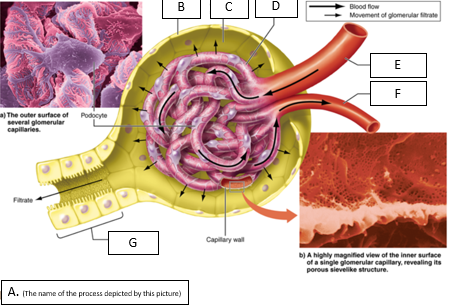
A
glomerular filtration
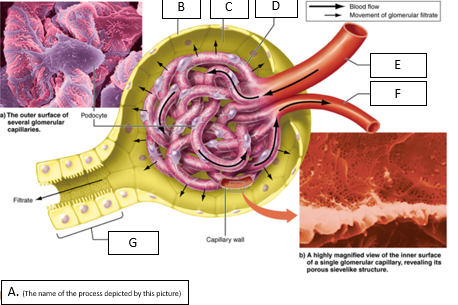
B
glomerular capsule
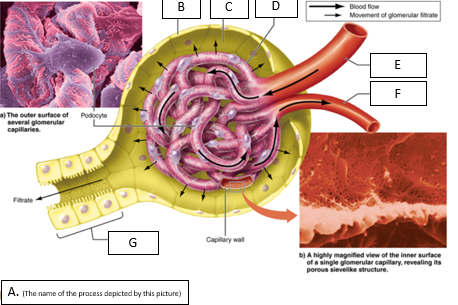
C
glomerular space
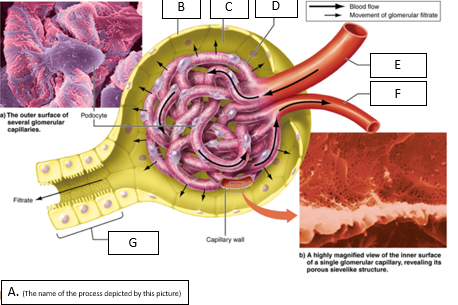
D
glomerulus
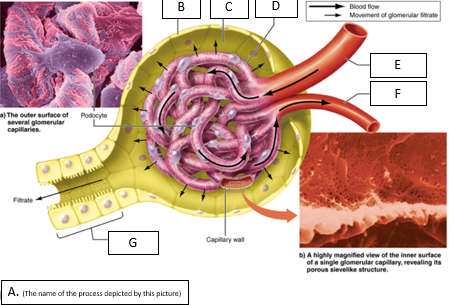
E
afferent arteriole
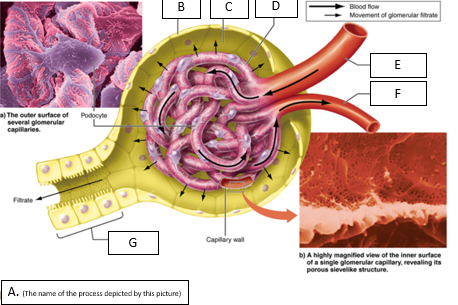
F
efferent arteriole
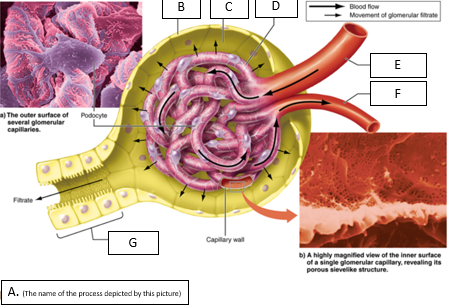
G
proximal tube
cell membrane protrusions that increase the surface area of a cell for increased diffusion
microvilli
transports 3 Na+ from inside epithelial cells in the proximal tubule to the interstitial fluid, and 2K+ from interstitial fluid into cell - step 1 of tubular reabsoprtion
Na+/K+ ATPase
extracellular fluid that is not enclosed in blood vessels or lymphatic vessels
interstitial fluid
step 2 of tubular reabsorption: decreased Na+ in the cell creates a Na+ gradient to drive ______ (or ions, glucose, amino acids, and vitamins, etc.) that selectively pump solutes from the filtrate into the epithelial cell
cotransporters
step 3 of tubular reabsorption: increased ions, glucose, and vitamins, etc. in the cells create a concentration gradient that allows them to pass through _______ _______ into the interstitial fluid and then into the blood
facilitative transporters
step 4 of tubular reabsorption: water follows the movement of solutes from the proximal tubule into the cell and then out of the cell and into blood vessels by osmosis through ______
aquaporins
u shaped loop in a nephron that extends into the renal pyramid that maintains an osmotic gradient that allows reabsorption of water from the collecting duct
loop henle
as fluid flows down the descending limb the water follows an osmotic gradient into the interstitial fluid surrounding the nephron
descending limb
the membrane in the descending limb is nearly ______ to solutes
impermeable
the membrane in the ascending limb is nearly _______ to water
impermeable
Na+ and Cl- ions follow the concentration gradient created by the previous loss of water
thin ascending limb
Na+ and Cl- ions are actively transported out of the nephron in the thicker ascending limb of the cortex
thick ascending limb
tube or cells in nephron where tubular secretion occurs and delivers urine to the collecting duct
distal tubule
capillaries surrounding the tubules secrete toxic, or pH balancing, substances directly into the distal tubule
tubular secretion:
what are the three types of filtration
glomerular filtration, tubular reabsorption, and tubular secretion
the merging of thousands of nephron tubules into a larger duct that empties into the renal pelvis
collecting duct
hormone that binds receptors that signal the kidney collecting duct cells to open aquaporins
antidiuretic hormone (ADH)
alcohol and caffeine ______ the production of ADH
inhibits
Salt fish < Salt ocean But they maintain high concentrations of urea in blood & spend a lot of energy to prevent toxic effects of urea.
osmoconformers
Osmolarity fish = Osmolarity ocean with seawater, resulting in little water loss.
isosmotic
osmoconformers maintain ____ ________ of urea in blood
high concentrations
metabolic process where an amino group is removed from an amino acid
deamination
deamination occurs when the body has more _____ than it is currently using ot when _______ and ___ stores are depleted
protein, carbohydrate, fat
A nitrogen molecule produced following the breakdown of proteins and nucleic acids that is very toxic to cells.
ammonia
CO(NH2)2 ; A nitrogen molecule produced from the breakdown of ammonia.
Urea
(C₅H₄N₄O₃): A nitrogen molecule produced from ammonia but is less toxic; very insoluble
Uric acid
____ crystals form when there is too much uric acid in the bloodstream
gout
Actively use energy to maintain an osmolarity different from the environment.
osmoregulators
Organisms that maintain an internal osmolarity similar to their environment.
osmoconformers
•Salt fish < Salt ocean = Tendency for water loss + uptake of salts; These fish drink seawater spend a lot of energy to remove electrolytes
osmoregulators
how do freshwater fish maintain water and electrolyte balance?
active transport of salts at gills into fish
process in which exons from the same gene are joined in different combinations, leading to different, bur related mRNA
alternative splicing

