Bio130 (weeks 7-9)
 Call Kai
 Learn
Learn Practice Test
 Spaced Repetition
 Match
Match Flashcards
 Knowt Play
1/67

There's no tags or description
Looks like no tags are added yet.
Name | Mastery | Learn | Test | Matching | Spaced | Call with Kai |
|---|
No analytics yet
Send a link to your students to track their progress
68 Terms
True or False: the membrane is self-healing
true
how many membranes do bacteria have
a single membrane
what are cell membranes composed of
lipids and proteins
what are most abundant lipids
phospholipids
other than phospholipids what are the other two molecules which are also amphipatic
cholesterol and glycolipids
Why does the membrane form a lipid bilayer
because it satisfies the amphipatic properties and is energetically favourable, which also allows for the membrane to self-heal (since tears are unfavourable)
what are liposomes
artificial spherical vesicles formed by pure phospholipids when added to water
what lipid movement is very rare to occur without the presence of a protein to facilitate it?
flip-flop
What are all the common lipid movements
lateral diffusion
rotation
flexion (wobbling)
flip-flop (move from one leaflet to another)
at what temperature is the membrane more fluid
higher temperatures
what does fluidity of a cell membrane mean?
the ease with which its lipid molecules move within the plane of the bilayer
what increases the fluidity of the membrane?
shorter hydrocarbon tail (since they have a lower tendency to form van der Waals interactions, making them weaker)
higher number of unsaturated tails, which would form kinks, making it hard to pack together more closely
how do bacterial/yeast cells moderate their membrane fluidity
they modify the length and saturation of the hydrocarbon tails depending on temperature
how do animal cells moderate the membrane fluidity
by the inclusion of the “sterol” cholesterol
how does cholesterol reduce fluidity
they fill up the spaces made by the kinks, stiffening the membrane, and also making it less flexible and permeable
who were the two scientists that came up with “fluid mosaic model”
Singer and Nicolson
what is another name for the single layer of the bilayer
leaflet
what are the three main types of lipids
phospholipids, glycolipids and sterols
true or false: membranes are only composed on 1 type of lipid
false
what type of phospholipids have a glycerol backbone
phosphoglycerides
what is the typical structure of a phosphoglyceride
polar head group (phosphate and different groups)
glycerol (3 carbon)
hydrocarbon tails (usually 2)
what is the most common sterol found in animal cells
cholesterol (can be up to a 1:1 ratio with phospholipids)
what is the structure of cholesterol
polar head group, rigid planar steroid ring, nonpolar hydrocarbon tail
where is new phospholipids synthesized
in the cytosolic surface of the ER by enzymes which use fatty acids as substrates
how is the phospholipids distributed in the ER
the protein called scramblase removes randomly selected phospholipids from one half and transfers them to the other
how is the asymmetry of the membrane produced
In the golgi protein/ transporter called flippases, move specific phospholipids and proteins to specific leaflets using ATP
in which half are glycolipids added
only the non-cytosolic layer
what percentage of the membrane mass is protein
50%
what are the two types of membrane proteins called
integral membrane proteins
ex. transmembrane, monolayer associated proteins and lipid-linked proteins
directly attached to the lipid layer
use detergents to extract
peripheral
do not insert in the membrane, non-covalently attached to the membrane
use other gentle extraction methods
what are transmembrane proteins
proteins which pass through the membrane at least once, and are amphipathic
in a membrane spanning alpha helix, how many hydrophobic amino acids are present
20-30
what are the examples of the membrane spanning domains
single alpha helix, multiple alpha helices, beta barrel
how can you identify the structures of these membrane spanning proteins
x-ray crystallography
hydrophobicity plots
on which side are monolayer-associated membrane proteins facing
cytosolic
what type of anchor is used for protein (lipid linked) linked on non-cytosolic side?
GPI anchor
what type of anchor is used for protein (lipid linked) linked on cytosolic side?
lipid anchor (fatty acid and prenyl)
what is a typical structure of a detergent
a single hydrophilic head and tail
what is the full form of FRAP
fluorescence recovery after photobleaching
what happens in photobleaching
protein is fused with GFP or labelled with fluorescent antibody, an area is photobleached and the recovery is measured
why is a lipososme impermeable
since it is artificial lipid bilayer with no proteins to facilitate transport
what does it mean to be permeable
movement via simple diffusion through the lipid bilayer
what are the two more permeable molecules
small non-polar, and small uncharged polar (key: some larger uncharged polar may diffuse)
what are typically impermeable
ions (always) and larger uncharged polar
What are the two types of membrane proteins
channel and transporter (aka carrier)
what is the major difference between channel and transpoters
channels will bind very weakly and undergo very small conformational changes, will this is the complete opposite for transporters
are channel mediated transport active or passive
only passive
what is the electrochemical gradient
concentration + membrane potential (can be additive or work against each other)
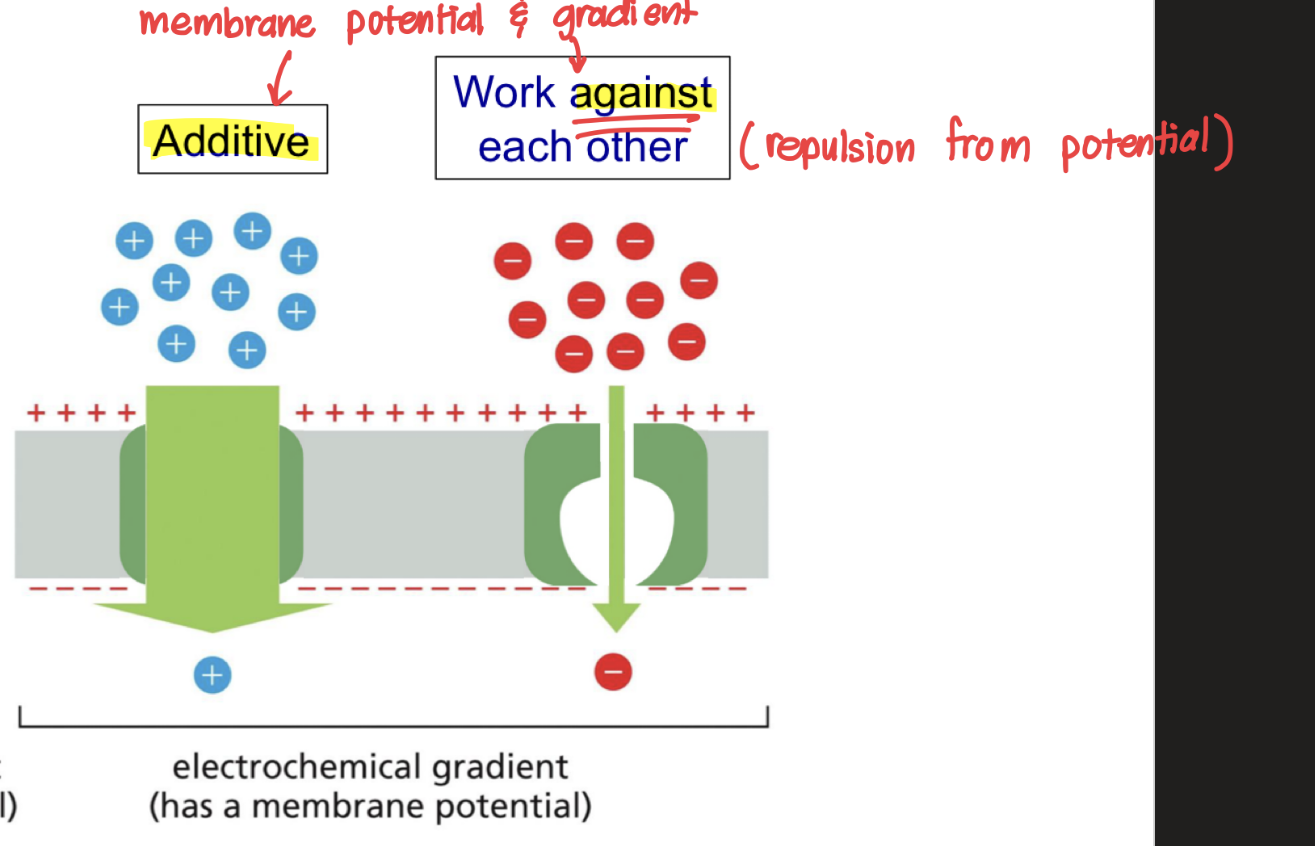
What are the key properties of channel proteins
hydrphillic pore, mostly selective and are much faster than transporters (ex. ion channels which can be both non-gated and gated, meaning they require a signal to open)
what are the 3 types of signals which would open gated ion channels
mechanical stress
ligand-gated: need some kind of molecule to bind (can be intracellular or extracellular)
voltage gated: change in voltage across the membrane
do transport/carrier proteins use active or passive transport
both
what type of transport protein performs passive transport
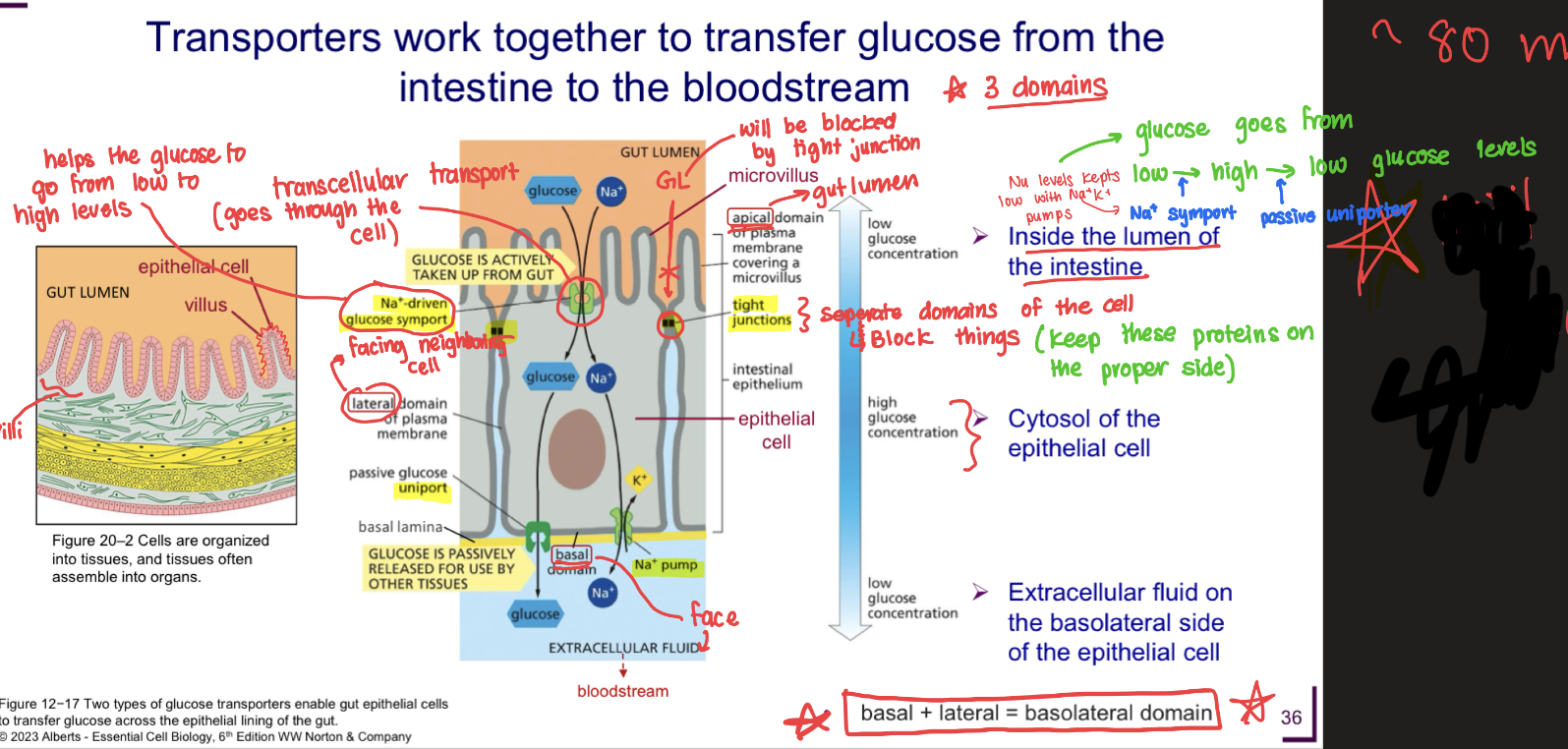
uniport: moves one solute down its electrochemical gradient, ex (GLUT = glucose transporter uniporter)
What are the three types of active transports used by transport proteins
gradient driven pumps (symport and antiports, ex. sodium glucose symporter and Na+H+ antiporter)
ATP driven pumps (ATPases)
light-driven pumps
Key: all three uses energy of some form
what does occluded mean for transporter proteins
blocked
what is an example of a symport, and how does it work
Na+ - glucose, moves sodium down the electrochemical gradient and glucose against (the conformation changes only occur after both sites are occupied or empty)
what is an example of an antiport
sodium hydrogen exchanger, to move sodium down its electrochemical gradient and H+ against, to maintain pH
does excess H+ mean high or low pH
low pH, more acidic
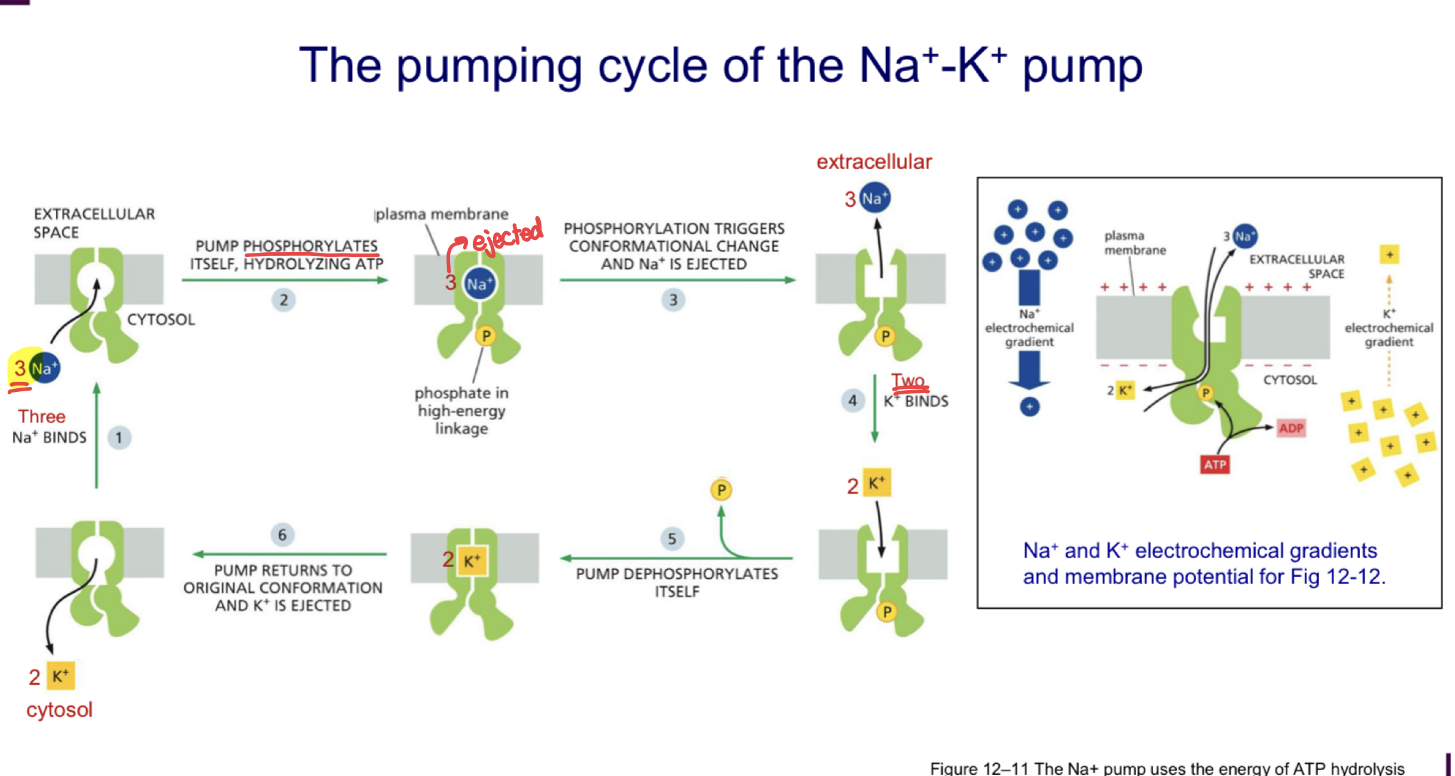
how is the concentration of Na+ maintained in the cell
through the sodium potassium pump (uses ATP)
what are p-type pumps
use ATP, and get phosphorylated during the pumping cycle, many transport ions but some such as flippases transfer phospholipids
What is are examples of a p-type pump
sodium potassium pumps (in animal cells) and H+ pumps (in plants)
How do sodium potassium pumps work?
what are ABC transporter pumps
uses 2 ATP to pump small molecules across the cell membrane
what is a v-type proton pump
uses ATP to pump H+ against its gradient into organelles to acidify the lumen
what are F-type ATP synthase
similar in structure to V-type pump, but uses the H+ gradient to drive the synthesis of ATP (in mitochondria, chloroplasts and bacteria)
Explain how the 3 transporters work together to transfer glucose from intestine to the bloodstream
look at diagram
what is membrane potential
difference in electrical charge on two sides of membrane
how is the membrane potential generated in animal cells
potassium leak channels and sodium potassium pumps
how is membrane potential maintained in plant cells?
H+ pumps and H+ driven symport

