Finance Exam
 Studied by 3 people
 Call Kai
 Learn
Learn Practice Test
 Spaced Repetition
 Match
Match Flashcards
 Knowt Play
1/187

There's no tags or description
Looks like no tags are added yet.
Name | Mastery | Learn | Test | Matching | Spaced | Call with Kai |
|---|
No analytics yet
Send a link to your students to track their progress
188 Terms
empirical evidence for non-random financing decisions
target debt ratios, clustering based on industry and risk, motivated by similar factors, market reaction to debt ratio.
with constant interest rates, as number of periods, n, increases:
future value increases, present value decreases
with constant number of periods, as interest rate, r, increases
future value increases, present value increases
time value of money
opportunity cost, inflation, risk
ordinary annuity
equal, periodic cash flows occurring at the end of each period and lasting for n periods
annuity due
cash flows start one period earlier - ie at t=0
deferred annuity
starts t periods later, worth less than an ordinary annuity
principal of a loan
balance of the loan, PV of the annuity
debt security
a loan issued by government or private entities that can be traded in the secondary market - eg: bonds, debentures, notes and bills of exchange
short term debt securities
term less than one year (usually less than 6 months), one future cash flow, simple interest. Eg: treasury notes, bills of exchange (bank guaranteed & paid for private issuer), promissory notes (private, not guaranteed)
long term debt securities - characteristics
term longer than one year, multiple cash flows (coupon-paying), compound interest, fixed interest rate. Eg: government securities (bonds), debentures (private, secured), corporate bonds (private, unsecured usually)
when the required yield (r) of a debt security increases, price ________?
decreases
when the term (n) of a debt security decreases, price ________?
increases
why would yields decline?
decreased risk, less inflation than expected
promissory note
issued by a private company, not guaranteed
treasure note
issued by government
bill of exchange
issued by company, guaranteed by bank
when a bond is first issued, coupon rate (c) is equal to, greater than or less than the current required rate of return/yield to maturity, r?
equal to
what is a bond’s yield?
rate of return an investor will achieve, determined by risk of the bond and the current interest rates in the economy - constantly changing. Ultimately determined by changes in price caused by supply and demand for bonds.
securities with a longer term are more or less price sensitive?
more, since they react more strongly to changes in ytm
bonds with a lower coupon rate are more or less price sensitive?
more, lower coupon rate = greater price reaction to interest rates
discount bond
coupon rate is less than ytm, immediately after a coupon payment it trades at a discount
premium bond
coupon rate is greater than the yield to maturity, it trades at a premium to face value
gradient of discount bond price graph
positive
gradient of premium bond price graph
negative
return on capital vs return of capital
ON = you get a return, ie dividends
OF = you get a full return on your investment
market capitalisation
number of shares x value of shares
PE ratio
price per share/earnings per share or market cap/total earnings, reflects relative market valuations of listed firms
public companies have ______ equity, private companies have ________ equity
listed, unlisted
rights of ordinary shareholders
right to equal dividends as declared by the board of directors
right to sell their shares
right to vote for members of the board of directors
assumptions of the dividend growth model
dividends are constant and forever
dividends grow at a constant rate
problems with the dividend growth model
sensitive to inputs - ie share price changes dramatically with different growth rates
does the dividend growth model account for capital gains/losses?
Yes - this simply reflects the market’s expectations of future dividends.
what is alpha?
payout ratio
assumptions for a high PE ratio
for a given level of earnings with all else constant the market will pay higher prices for a share when:
payout ratio (alpha) is higher
risk (ke) is lower
growth is higher
but high PE ratio isn’t necessarily always good - eg: firm with high dividend payout ratio (alpha) would have low growth (g)
preference shares - definition
Hybrid securities that display characteristics of both equity and debt. Owners have priority over ordinary shareholders in return on capital. Traditional preference shares can be valued as a perpetuity.
preference shares - equity-like features
variable dividend rate
irredeemable (infinite) life
non-cumulative dividend obligation (no need to pay back missed dividends)
participating (additional dividends)
voting rights
preference shares - debt-like features
fixed dividend rate
redeemable (finite) life
cumulative dividend obligation (must pay back missed dividends)
non-participating (no extra dividends)
non-voting
characteristics of a typical preference share
fixed dividend rate
infinite
cumulative dividend obligation
non-participating
non-voting
efficient markets hypothesis
quick price reaction to any news
unbiased ‘accurate’ price reaction
weak-form market
prices incorporate all information contained in the past record of prices
semistrong-form market
prices incorporate all publicly available information
strong-form market
prices incorporate all publicly and privately available information
problem with testing the EMH
any testing of EMH assumes the model used to estimate expected return is correct - ie you cannot test it in isolation without also testing the correctness of the expected return model.
Realised return
The actual gain or loss on an investment, taking into account both capital appreciation and any income generated, such as dividends or interest. Can be for ordinary shares or bonds.
Arithmetic average
Treats each period independently, and measures the average return earned from a single, one-period investment over a specific time horizon
Geometric Average
Average return earned per period from an investment over an investors entire time horizon. Accounts for the compounding effect of returns
Which is always higher, arithmetic or geometric average returns?
Arithmetic, since the compounding effect of geometric averaging always produces a smaller percentage
When do the differences between arithmetic and geometric average returns become less pronounced?
when the volatility/variability of returns declines
what are the two components of return from a share?
return from dividends
return from price changes
nominal vs real returns
Nominal returns: The total percentage gain or loss on an investment without adjusting for inflation.
Real returns: The actual purchasing power gained or lost on an investment after adjusting for inflation.
What is a portfolio’s expected return?
The weighted average of the expected returns of its component securities
What is a portfolio’s variance?
the weighted average of the variance of its component securities and the covariance between the securities’ returns
What is the covariance of returns?
measures the level of co-movement between security returns
positive covariance
above average returns on security 1 tend to coincide with above average returns on security 2, and the same with below average returns
negative covariance
above average returns on security 1 tend to coincide with below average returns on security 2 and vice versa
covariance equal to zero
security 1’s return tends to move independently of security 2’s.
correlation of returns
standardised measure of co-movement between two securities
what are the two ways of measuring a portfolio’s risk
correlation of returns and covariance of returns
when is there no diversification benefit?
when the returns are perfectly positively correlated - risk is equal to the weighted average of the individual assets.
when can we technically achieve a zero-risk portfolio
using two securities that are perfectly negatively correlated
portfolio leveraging
strategy where an investor borrows funds at the risk-free rate of return and invests all available funds in a risky security
increases potential returns but also potential losses, so it magnifies risk
short selling
borrowing shares and selling them now with a contractual obligation to buy them back later (at an expected lower price)
increases portfolio risk - risky borrowing but gives you quick cash
what does a leveraged position involve
borrowing funds, then investing those funds plus your own funds into a risky asset
results in a higher expected return, but also higher standard deviation of returns - ie more risk
incremental diversification benefits reduce as the number of assets in the portfolio ________
increase
as a portfolio becomes more diversified, which is more important - covariance between the assets or the individual risk of the assets?
covariance between assets
unsystematic risk
risk that is unique to a specific industry or company, can be diversified away.
systematic risk
risk that is inherent in the market, so cannot be diversified away.
Capital asset pricing model (CAPM)
relates a security’s required rate of return to its non-diversifiable, systematic risk.
what is the CAPM used for
to price individual securities by estimating their required rate of return and combining this with future expected cash flows to make a price estimate. can be used to indicate relative under/overvaluation of a company
Assumptions of the CAPM
investors are risk averse
investors only make portfolio decisions based on expected returns and variance of returns
investors have the same expectations about volatilities, correlations and expected returns of stocks
capital markets are perfect - no taxes, transaction costs or government interference
unlimited borrowing and lending at the risk free rate is possible
investors only hold efficient portfolios of securities all traded in financial markets
efficient frontier
a set of optimal portfolios that offer the lowest risk for a given expected return
market portfolio
a weighted sum of every asset in the market, with weights in the proportions that they exist in the market. Should theoretically be every asset, but in practice its usually the top 100 or 200 - eg: S&P/ASX 200 index
capital market line (CML)
a theoretical concept that represents all the portfolios that optimally combine the risk-free rate of return and the market portfolio of risky assets
CML limitations
can only be used to price efficient portfolios
assumes portfolios are fully diversified and efficient with zero unsystematic risk
cannot price individual securities, since these are not efficient and always have some unsystematic risk
the contribution of systematic risk by individual securities to the market portfolio depends on?
the covariance of the asset’s risk with the market portfolio, not its own risk (standard deviation)
Security market line (SML)
a graphical representation of the CAPM, plots the expected rate of return of a single security against systematic, non-diversifiable risk.
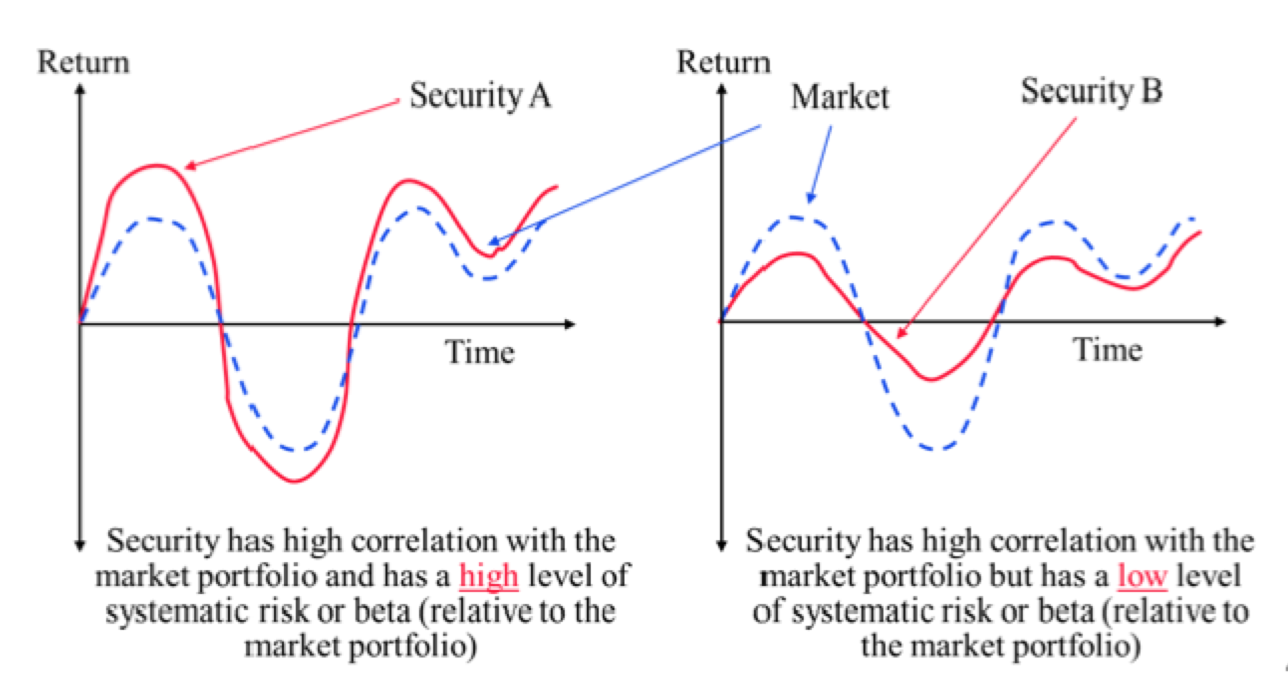
Beta
a measure of how sensitive a security’s return is to movements in the return on the market portfolio
Beta greater than 1
security has higher systematic risk than the market portfolio
Beta less than 1
security has lower systematic risk than the market portfolio
Beta = 1
Security has the same systematic risk as the market portfolio
Beta = 0
Security has no systematic risk
negative beta
security moves in the opposite direction to the market portfolio
Difference between beta and return correlation
return correlation is about whether a securities returns increase/decrease when the market portfolio returns increase/decrease, but beta is about whether systematic risk of the security is higher or lower than the market portfolio systematic risk.
which type of risk does the CAPM measure?
systematic/non-diversifiable risk
market model regression
where an individual asset’s beta is estimated by regressing it’s returns against the returns from a proxy for the market portfolio. It is an empirical model, whereas CAPM is theoretical
why is the beta for a portfolio just the weighted average beta of the portfolio’s assets?
because beta measures systematic risk and when a portfolio is formed systematic risk is only averaged, not eliminated
what should you do if you think shares are overpriced
short sell them - exert selling pressure and buy them back later at a lower price
Net present value (NPV)
difference between the present value of cash inflows and the present value of cash outflows over a period of time
when the discount rate/required rate of return increases, NPV ________
decreases
what is IRR?
rate of return expected to be earned by a project over its life. it is the discount rate that produces an NPV of 0 when applied to a project’s cash flows. it is not affected by scale of cashflows unlike NPV.
IRR decision rule
accept project if IRR is greater than r, reject if IRR is less than r
IRR - delayed investments
in the case where you get a big cash inflow at the start and then successive cash outflows IRR should be interpreted as the rate you are paying, so the decision rule should be to accept the project is IRR is less than r in this case, since you want cash outflows to be decreased less.
Problems with IRR
for delayed investments, decision rule is the opposite
sometimes if NPV is always positive or negative there is no IRR
multiple IRRs are possible with multiple sign changes of cashflows - ie 2 sign changes = 2 possible IRRs
inconsistent rankings of mutually exclusive projects
problems with incremental IRR
it may not exist
there many be multiple
even if the IRR exceeds the required rate of return for both projects, this doesn’t mean both projects have a positive NPV
the individual projects may have different required rates of return - therefore discount rate to use for incremental IRR is uncertain
payback period
calculate how long it takes for the initial outlay to be repaid and accept the project with the shortest payback period. can be improved using a discounted payback period, which takes the time value of money into account.
problems with payback period
biased against projects with longer development periods
ignores the time value of money
accounting rate of return (ARR)
average earnings generated by the project after deducting depreciation and tax costs, expressed as a percentage of the initial investment outlay. We accept the project if the ARR is above a pre-specified minimum rate of return, and prefer higher IRRs
problems with ARR
time value of money is ignored
earnings are not net cash flows
tends to favour projects with shorter lives
issues with cash flow estimation
net cash flows are assumed to be at the end of the period - errors in time value of money
 Note
Note  Flashcards (127)