Neuroscience: Myelination, Nerve Impulses, and CNS Structure
 Call Kai
 Learn
Learn Practice Test
 Spaced Repetition
 Match
Match Flashcards
 Knowt Play
1/27

There's no tags or description
Looks like no tags are added yet.
Name | Mastery | Learn | Test | Matching | Spaced | Call with Kai |
|---|
No analytics yet
Send a link to your students to track their progress
28 Terms
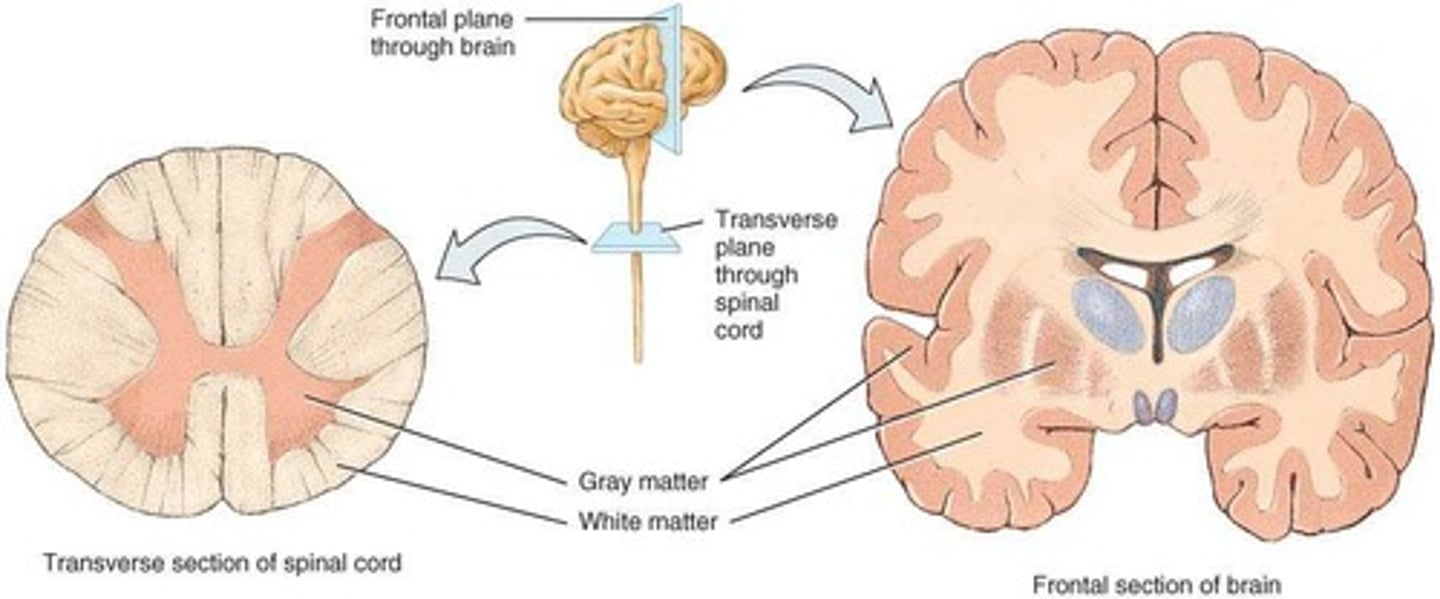
What are myelinated axons primarily composed of?
White matter
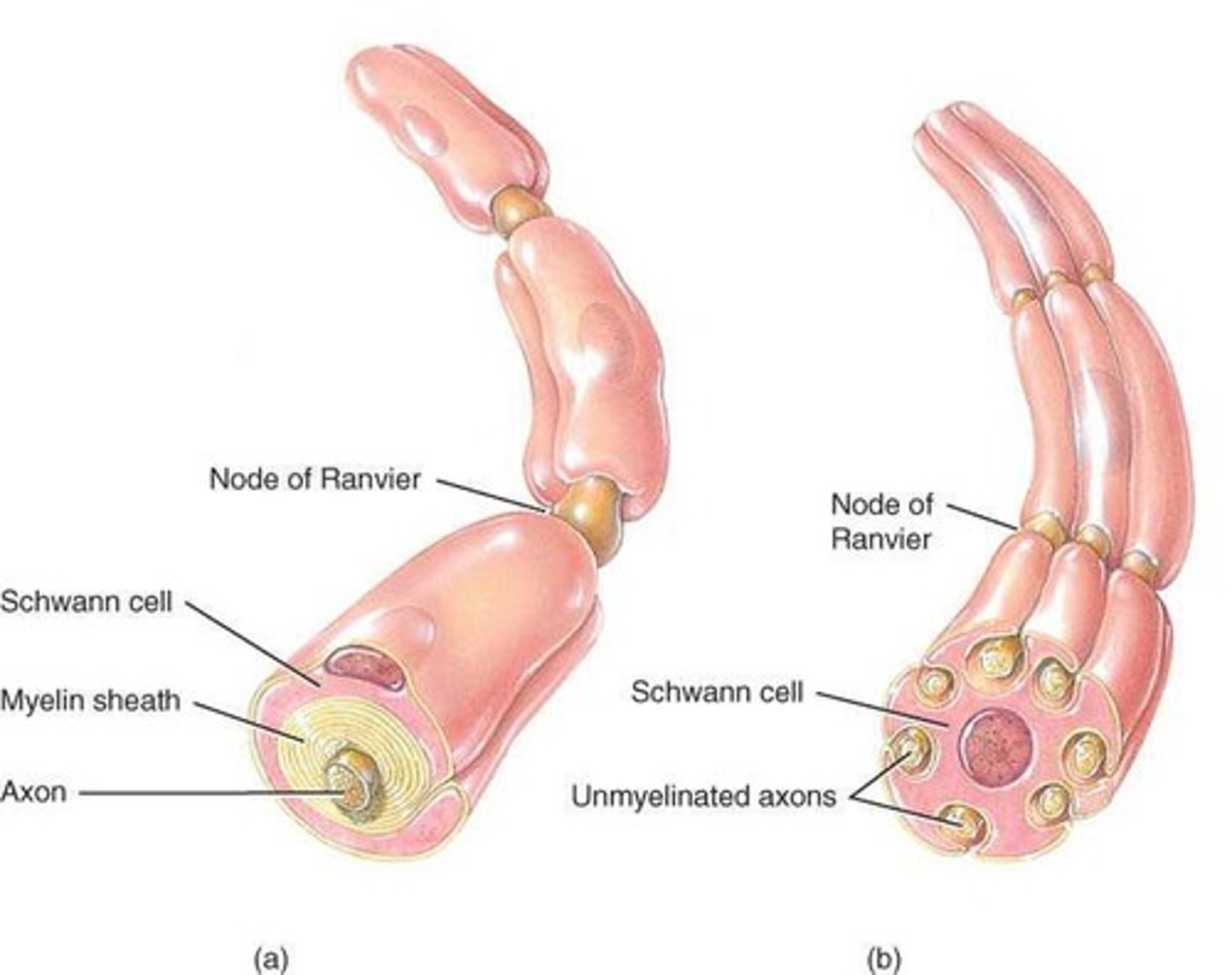
What is the function of myelin in axons?
It protects and insulates axons, speeds transmission, and aids in repair.
What are the nodes of Ranvier?
Gaps in the myelin sheath where action potentials are regenerated.
At what age is the development of myelin sheaths typically completed?
At 1 year of age.
What condition is characterized by degeneration of myelin sheaths?
Multiple sclerosis.
How do unmyelinated axons differ from myelinated axons?
Unmyelinated axons rest in invaginations of Schwann cells or oligodendrocytes and are part of gray matter.
What cells myelinate axons in the central nervous system (CNS)?
Oligodendrocytes.
What is the difference between gray matter and white matter?
White matter consists of myelinated processes, while gray matter contains nerve cell bodies, dendrites, and unmyelinated axons.
What is the resting membrane potential of neurons?
-70 mV.
What are the two types of electrical signals neurons use to communicate?
Action potentials and graded potentials.
What are leakage channels?
Ion channels that open and close constantly, allowing specific ions to diffuse through.
What is the role of the Na+/K+ ATPase pump?
It maintains the resting membrane potential by pumping Na+ out and K+ into the cell.
What occurs during depolarization?
Na+ channels open, allowing Na+ to rush into the cell, making the inside more positive.
What is hyperpolarization?
When the membrane becomes more negative than its resting potential.
What is the all-or-none principle in action potentials?
If a stimulus reaches threshold, the action potential is always the same size, regardless of stimulus strength.
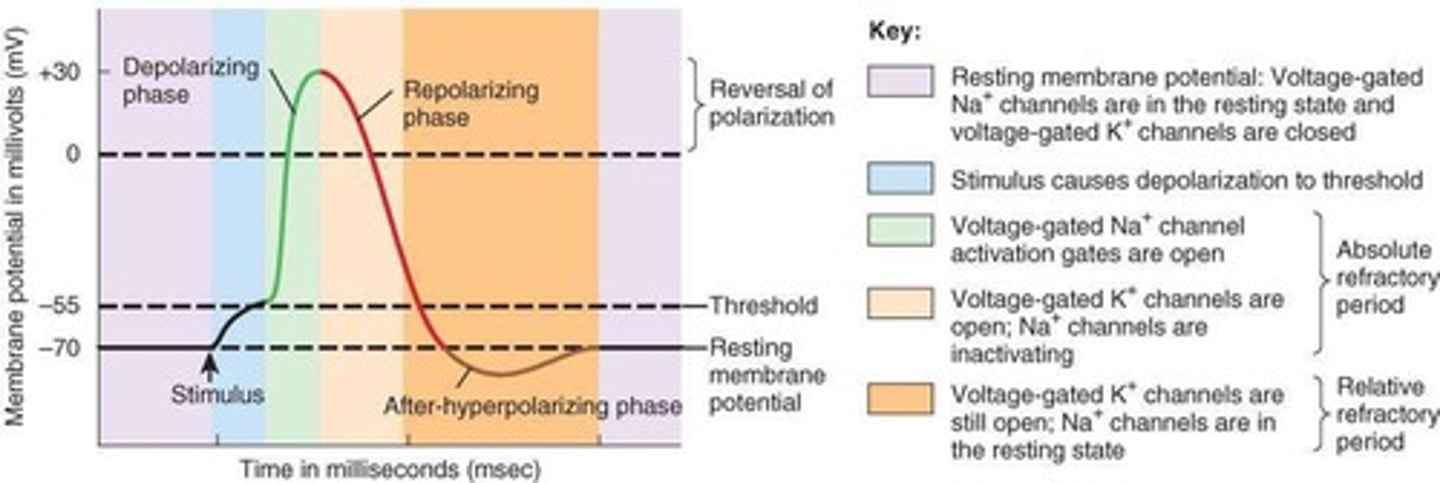
What is the refractory period?
The time during which a neuron cannot generate another action potential.
What is continuous conduction?
Step-by-step depolarization of unmyelinated fibers.
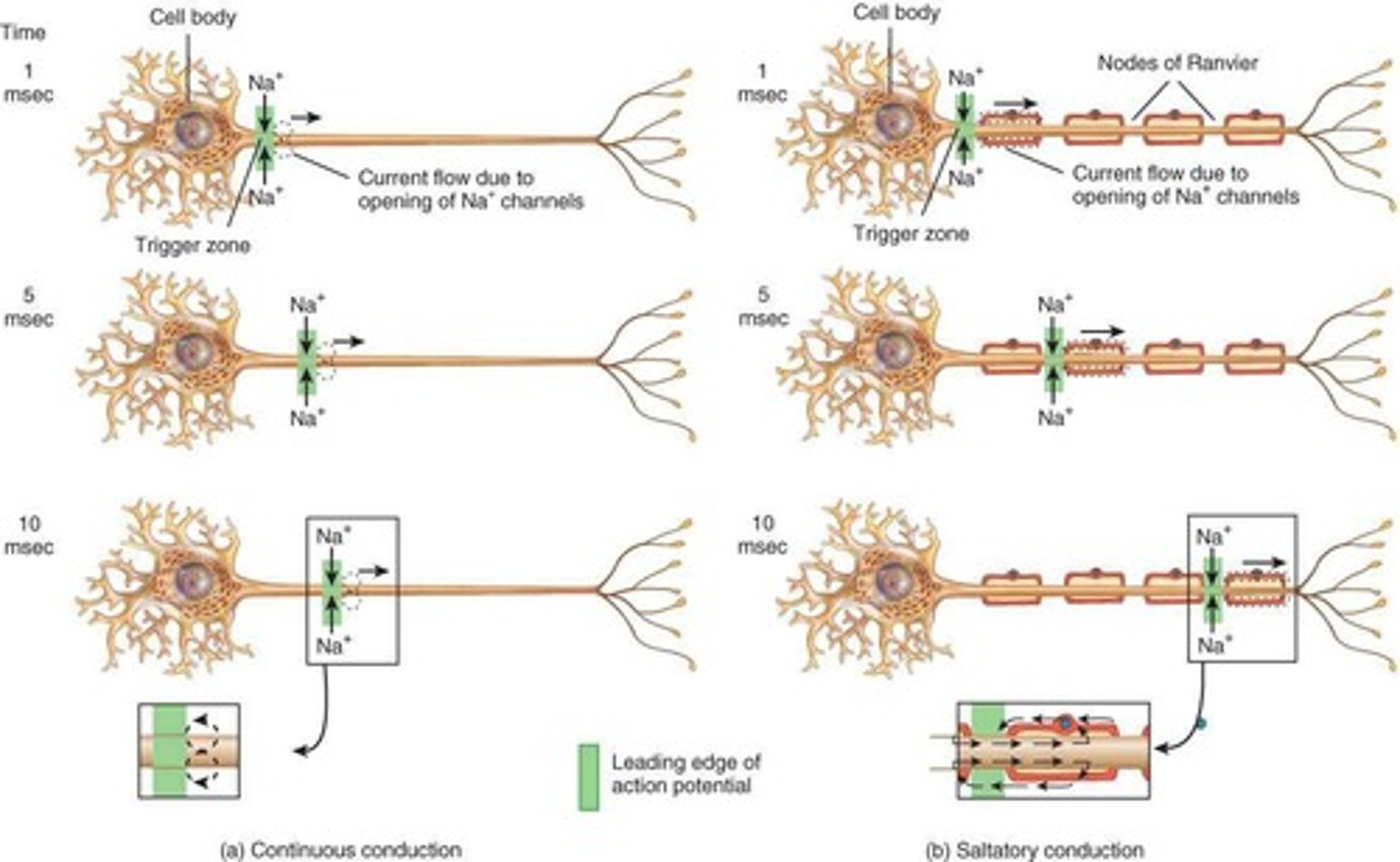
What is saltatory conduction?
Depolarization that occurs only at nodes of Ranvier in myelinated fibers, allowing faster impulse propagation.
What factors affect the speed of nerve impulse propagation?
Myelination, temperature, and the diameter of the axon.
What are A fibers?
Large diameter, myelinated fibers that conduct impulses at 130 m/sec.
What are B fibers?
Medium diameter, myelinated fibers that conduct impulses at 15 m/sec.
What are C fibers?
Small diameter, unmyelinated fibers that conduct impulses at 2 m/sec.
What is the role of local anesthetics like Novocaine?
They prevent the opening of voltage-gated Na+ channels, blocking nerve impulses.
What happens during repolarization?
K+ rushes out of the cell, returning the inside to a negative state.
What is the significance of the voltage-gated ion channels?
They respond to changes in membrane potential, allowing for action potentials.
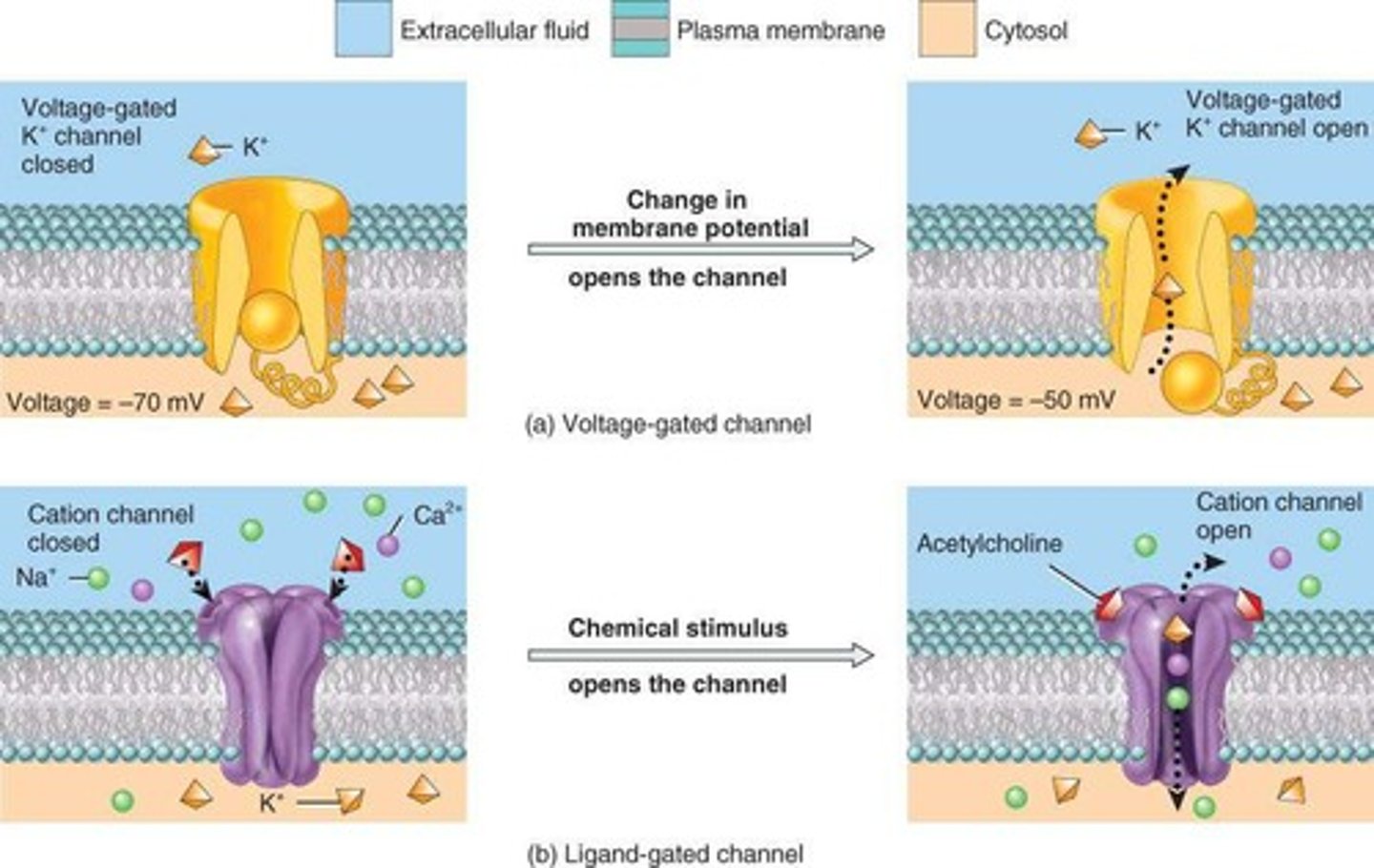
What is a graded potential?
A localized change in membrane potential that diminishes with distance from the stimulus.
How do graded potentials arise?
Through mechanical or chemical stimulation of membranes with gated ion channels.
What is the difference between graded potentials and action potentials?
Graded potentials are local and diminish in strength, while action potentials travel long distances without diminishing.

