CMA Exam
 Studied by 24 people
 Call with Kai
 Learn
Learn Practice Test
 Spaced Repetition
 Match
Match Flashcards
 Knowt Play
1/302

There's no tags or description
Looks like no tags are added yet.
Name | Mastery | Learn | Test | Matching | Spaced | Call with Kai |
|---|
No study sessions yet.
303 Terms
Professionalism
behavior based on a body of knowledge and ethical standards to serve the public
Competent MA
dependability, honesty, and tolerance
What is ethics based on?
integrity, responsibility to service and community, respect, self-discipline, and intent to further your career.
MA duty
to meet reasonable expectations of our patients also know as fidelity
Ethics is
knowledge of what right conduct versus what is wrong conduct
How should communication among peers be?
remain professional and appropriate throughout the workday
Nonverbal communication that is accepted by the senders culture such as:
smiling, looking straight into the speaker's eyes, or lightly touching someone's shoulder to show concern, may create interference if the gesture has a different significant meaning to that culture.
What is empathy?
the ability to understand the feelings and concerns of the person
Closed questions?
yes or no response
Open-ended questions?
encourages the pt to provide more information
Why do we use direct statements?
Its a helpful way to get a response from a pt without feeling questioned
Non-verbal communications
Gestures, body language, body posture, facial expressions, and intonation
When should a MA answer the telephone?
By the third ring, and always make sure the pt is not immediately placed on hold without speaker to them first
What is CMS responsible for?
Responsible for regulating and operating under the CLIA program
Do patients actively participate in their own health care?
Yes
3 multiple choice options
Patients have the right to:
-Receive treatment w/o discrimination as to race, color, religion, gender, national origin, disability, or the source of payment
-Be informed of name & position of Dr who will oversee your care in the hospital
-Receive all info needed to give informed consent for any procedure or treatment. inc possible risks and benefits
-Receive all info you need to give informed consent for an order not to resuscitate
Patients also have the right to:
2.
-Refuse treatment, exams, or observations
-Privacy while in the hospital and confidentiality of all info and records regarding your care
-Review medical record w/o charge
-Receive info about pain & pain relief measures
-Complain w/o fears of reprisals
-The right to request info about advance directives regarding your decisions about medical care
Living will
a document that expresses his or her wishes in case of terminal illness or an accident after which they cannot express their wishes
AIDS (acquired immune deficiency syndrome)
HIV - Human immunodeficiency virus
Hep B (HBV)
Inflammation to the liver
Tubercolosis (TB)
caused by Mycobacterium tb, an airborne pathogen, should wear fitted mask
Nosocomial infection
Any infection that occurs during a pt's stay at a health-care facility
Removal of PPE
gloves, gown, goggles, mask
Contact precautions
touching
Airborne precautions
Breathing
Droplet precautions
Coughing
Hazard Communication Standard (HCS)
Required by OSHA to ensure all employees are informed of the hazards associated with chemicals in their workplace.
Do not given medical advice
As a MA you must never lose sight of what advice you are and are not qualified to give
Disposing of waste
Get rid of contaminated or dangerous items left over when the procedure ends
How should you place needles in the sharp container?
Placed use needles and other sharp objects pointy end first into sharp containers
When should you dispose of the sharps container
when it is 3/4 full
Can an MA administer medications
Depending on local laws in the attending physician you may have to
T/F Confidentiality of patient information is a vital ethical principle that needs to be observed by a medical assistant
True
What is tort
Wrong committed against a person or the person's property also may be an intentional or unintentional
What is negligence
Unintentional wrong
What is malpractice
Negligence by a professional person (unintentional)
What are intentional torts
Acts that are meant to be harmful
What is defamation
Injuring a person's name in repetition by making false statements to a third person
What is libel
Making false statements in print writing or through pictures
What is slander
Making false statements orally
What is Invasion of Privacy
Violating persons right not to have his or her private affairs exposed
What is fraud
Saying or doing something to trick for deceive a person
What is assault
Intentionally attempting to touch or threaten a persons body without their consent
What is battery
Touching a person's body without their consent
What is informed consent
When the person clearly understands what is going to be done
What is abandonment
When a provider withdrawals from the care of a patient without reasonable notice of discharge
What are two types of civil actions
Lack of informed consent and violation of standard of care
Example of implied consent
When a patient makes an appointment for a visit
Example of expressed consent
Verbal/spoken approval by the patient
Example of informed consent
Involves the patient's right to receive an understand all information relatable to any specific procedure the patient will undergo at the hands of a licensed practitioner
How long should it take for a proper handwashing procedure
1 to 2 minutes
Hand antisepsis requires the use of
Antimicrobial soap
If hands are not visible soiled the CDC recommends
Alcohol base hand rub instead of handwashing due to over handwashing drying out the hands leading to irritation chapping or dermatitis
What is PPE
Mask, face shields, goggles, respirator, gowns, aprons, lab coats, and gloves
How long should a surgical handwashing procedure take
2 to 6 minutes
What is OSHA (Occupational Safety and Health Administration)
Assist employers in providing a safe and healthy working environment for their employees
What is ultrasonic cleaning used for
Delicate items in those with moving parts
What is disinfection
A a technique used to destroy many but not all pathogenic organisms such as spores
Types of disinfectants include
-alcohol 70%
-Sodium hydrochloride (household bleach 1:10 solution)
-Iodophors
-Glutaraldehyde
-Formaldehyde
What is medical asepsis?
Being free of disease producing microbes
What is surgical asepsis?
Practice that keeps items free of all microbes
What does sanitation do
The scrubbing of instruments with special brushes and detergent to remove blood and mucus and etc.
What does disinfection do
(Disinfection does…)The process that destroys pathogenic micro organisms
What is an autoclave
A device that forces the temperature of steam above the boiling point of water to sterilize instruments and equipment
What temperature in the auto clave are most microorganisms killed in a few minutes
130°C to 150°C
How long is sterilized packets from the auto clave good for
30 days
The following procedure should be completed at the beginning and end of the day and after every patient uses the exam room
1. Wash hands and don exam gloves
2. Dispose of all use paper products in the biohazard waste container
3. Disposable instruments in place in biohazard trash and or in the sharps container
4. Gather reusable instruments in place in stainless steel tray with the correct disinfect and cover for transport to the appropriate cleaning processing area
5. Using disinfectant wipes wipe down all surfaces in the room
6. Dispose of exam gloves wash hands and dawn clean exam gloves
7. Please protective covering such as paper and covering for instruments
8. if using 10% bleach solution for any procedures be sure to check and replace as needed
9. Record each room cleaning on appropriate documentation log
What are the modes of transmission
1. Direct contact
2. Indirect transmission
3. Airborne transmission
4. Vectors
5. Droplet spread
6. Vehicles
What is direct contact
Occurs through skin to skin contact kissing and sexual intercourse
What is indirect transmission
Refer to the transfer of an infectious agent from a reservoir to a whole spice suspended air particles in inanimate objects (vehicles) or animate intermediaries (vectors)
What is airborne transmission
Occurs when infectious agents are carried by dust or droplet suspended in air. Airborne dust includes material that has settled on surfaces and become resuspended by air currents as well as infectious particles blown from the soil by the wind. Example is tuberculosis
What is vectors
Mosquitoes fleas and ticks may carry infectious agent through purely mechanical means or may support growth or changes in the agent transmit to a human being
What is droplet spread
Refers to spray with large short range aerosol produced by sneezing coughing or even talking. Droplet spread is classified as a wreck because transmission is by direct spray over a few feet before the droplets fall to the ground. Example is pertussis or whooping cough
What is vehicles
Food, water, biological products (blood), and fomites (inanimate objects such as handkerchiefs, bedding, or surgical scalpels). a vehicle may passively carry a pathogen the vehicle may provide an environment in which the agent grows, multiplies, or produces toxin
What is hand hygiene
Refers to the process of cleansing or sanitizing the hands it is also considered the most important medical septic practice for preventing the spread of infection
What is Antiseptic handwashing
Washing the hands with the antimicrobial soap that contains an anti septic
What is antiseptic
An agent that functions to kill or inhibit the growth of microorganisms
When should you wash your hands with plain soap or anti-microbial soap
-the hands are visibly soiled with dirt or body fluids
-Before eating
-After using the restroom
When should you apply alcohol base hand rub aka hand sanitizer
-before having direct patient contact
-After contact with the patient intact skin
-Before applying or after removing gloves
-After contact with body fluids, non-intact skin, wound dressing (if the hands are not visibly soiled)
-When moving a contaminated body to a clean body site during patient care
-After contact with an inanimate object like medical equipment
What is personal protective equipment (PPE)
Clothing or equipment that protects an individual from contact with blood or OPIM
When should you wear gloves
Gloves are worn when it is anticipated that your hands will encounter blood in OPIM, mucous membranes, or nonintact skin. Gloves can prevent a pathogen entering the body through a break in the skin, abrasion, burn, or rash.
When should you wear a face shield or mask in combination with eye protection
Whenever splashes, spray, splatter, or droplets of blood are anticipated
When should you wear gowns
When growth contamination can be anticipated during performance of a task or procedure
What are infectious agents
bacteria, viruses, fungi, parasites
what is a nosomical infection?
An infection that first occurs during a patient stay at a healthcare facility . (Ventilator associated pneumonia)
Should you recap a needle
No, never
T/f Never filled the sharps container past the fill line on the contain
True
T/f
True; Never shake the sharps container to make more room
What is a hazardous substance
Any chemical in the workplace that can cause harm
What does OSHA require for healthcare employees
-understand the risk when dealing with such substances and know how to handle them safely
-Labeling is extremely important when handling any substance
-Hazardous substance a material safety data sheet
What is a safety data sheet
It provides detail information about the substance general and emergency information
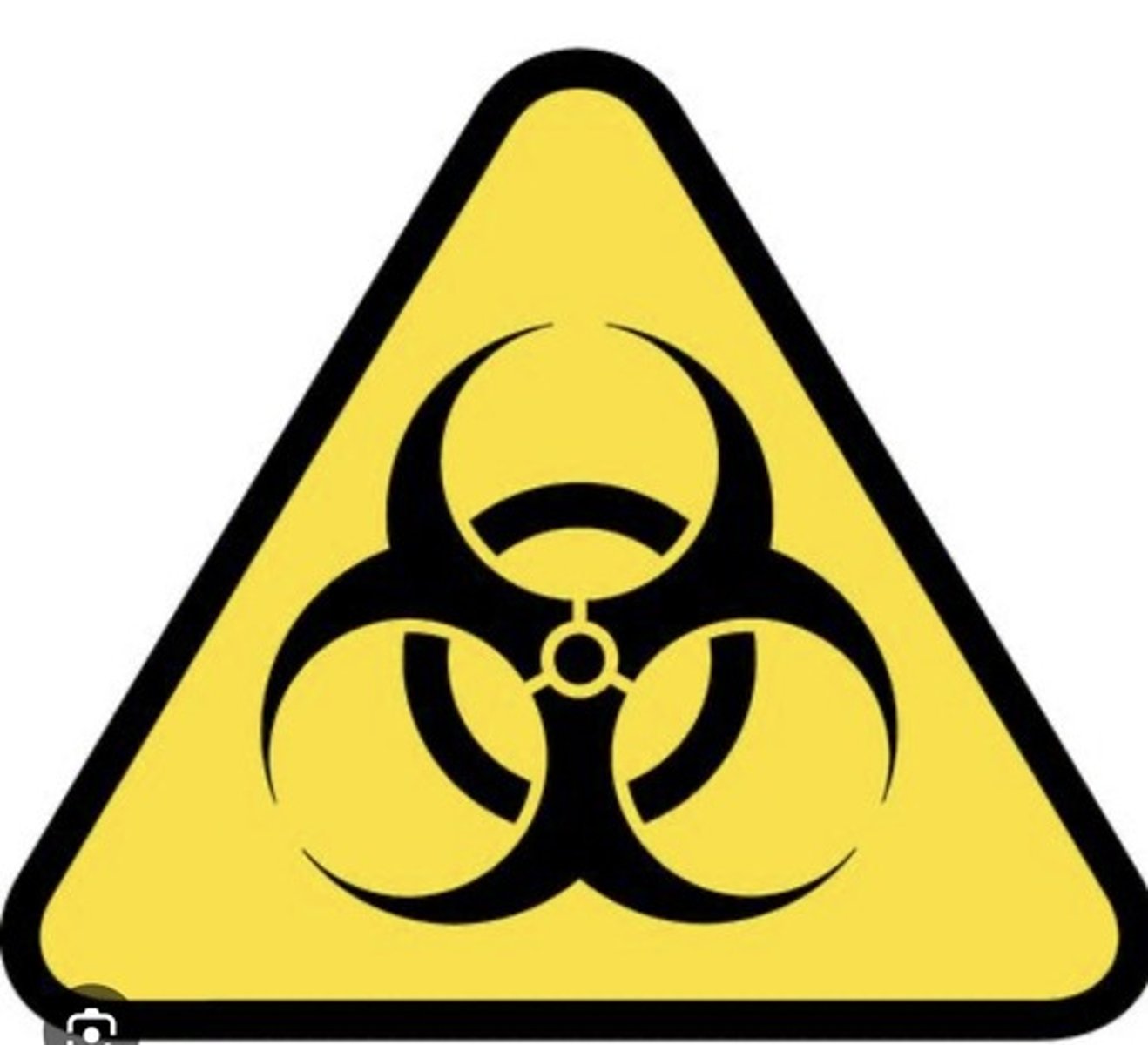
Biohazard symbol
What symbol is this
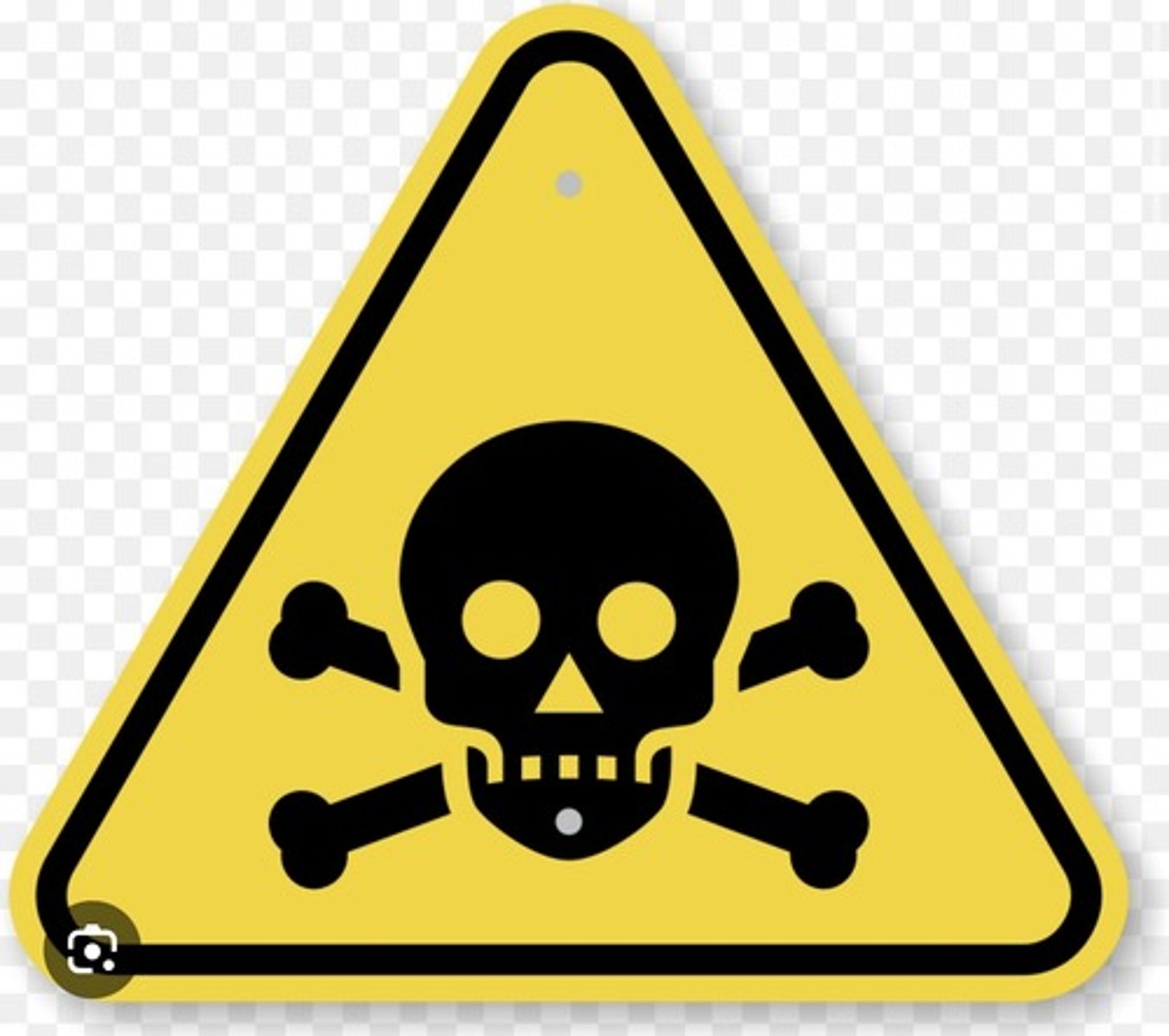
Poison symbol
What symbol is this?
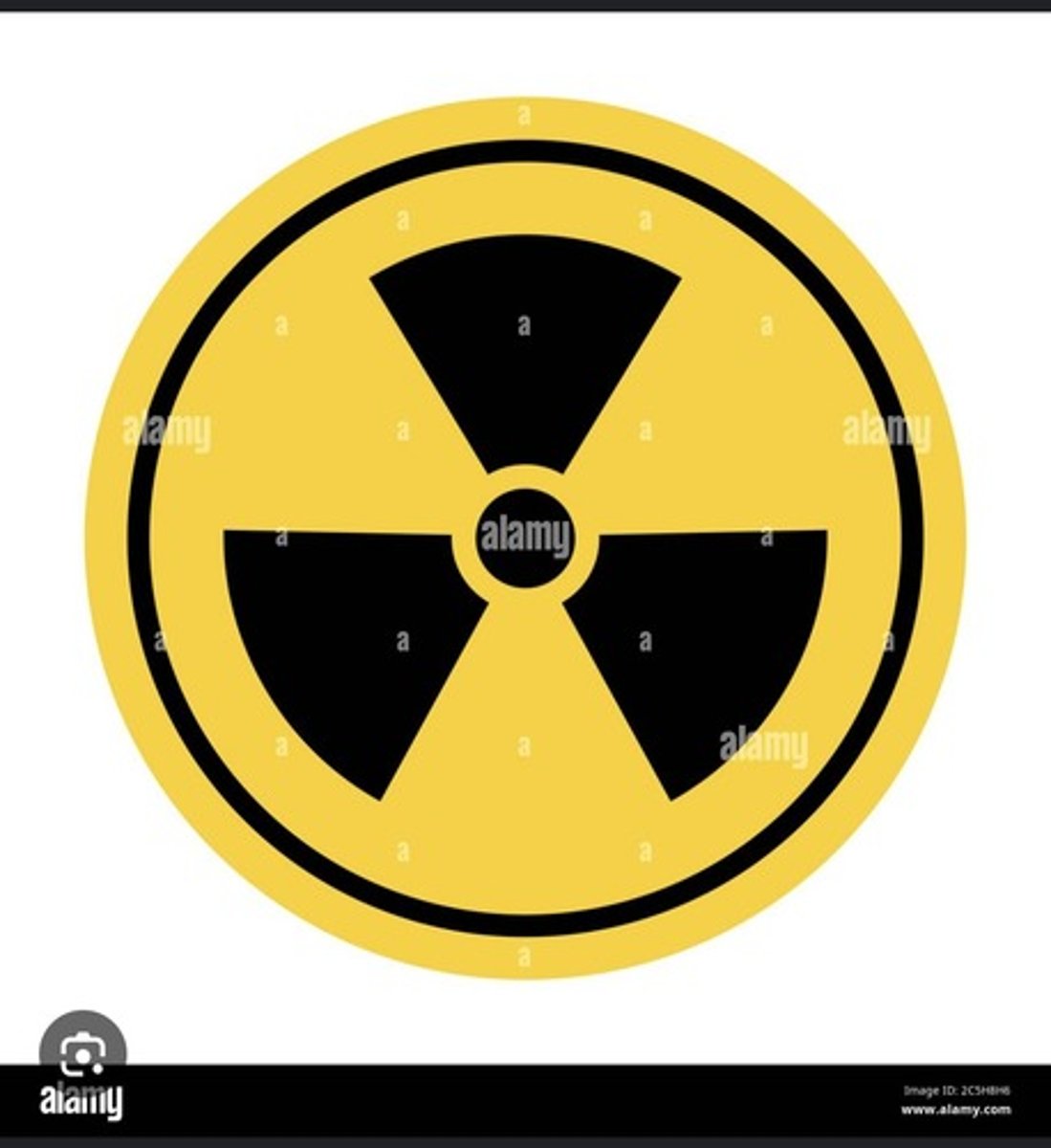
Toxic symbol
What symbol is this?
True or false is proper handwashing techniques the best method of preventing the spread of nosocomial infection
True
VLL
Left leg between hip and ankle
VRL
Right leg between hip and ankle
VLA
Left upper arm
VRA
Right upper arm
What is the rate the EKG travels at
25 millimeters per second
 Note
Note  Flashcards (58)