L11 Revision Strategies
 Studied by 0 people
 Call Kai
 Learn
Learn Practice Test
 Spaced Repetition
 Match
Match Flashcards
 Knowt Play
1/5

There's no tags or description
Looks like no tags are added yet.
Name | Mastery | Learn | Test | Matching | Spaced | Call with Kai |
|---|
No analytics yet
Send a link to your students to track their progress
6 Terms
Who did this systematic review of
Dunlosky et al., 2013
List the low/ moderate/ high-efficacy strategies
Low:
Summarisation; Highlighting/ Underlining; Re-reading; Keyword mnemonic
Moderate:
Elaborative interrogation; Interleaving
High:
Practice testing; Distributed practice
Top strategies:
Retrieving & generating; Spacing & interleaving; Variability & successive relearning
Why are low utility strategies low?
Summary – 1. ppl vary in their ability to effectively summarise, require training (impractical); 2. depends on whether with/ without notes → may copy instead of properly process/ benefit from retrieval but miss important info
Highlighting – 1. won’t affect rote memory for factual recall but impair deep processing (e.g., for inference questions), bcs ppl may focus on isolated details (shallow processing) at the expense of understanding the deeper meanings (connected ideas & understanding their meanings in broader contexts); 2. ppl vary in their ability to identify the key points
Re-reading – provides some benefits (esp. when spaced), yet is limited due to diminishing returns
Keyword – can improve memory by promoting deeper, more elaborative encoding (connecting new info to sth familiar), but benefits tend to be inconsistent: 1. Many concepts are not keyword/ imagery-friendly; 2. time-consuming (not cost-effective); 3. gains rarely persist over an extended period
Why is interleaving only moderate utility?
Strength:
Naturally produce spacing
Creates ‘discriminative contrast’ → helpful for studying domains that involve comparing & contrasting (e.g., categorical learning, maths problems)
Weakness
Relatively small literature, with some null effects (esp. when learners lack basic proficiency before interleaving)
*Require basic proficiency before interleaving
How does distributed practice benefit learning?
It spaces out study sessions over a longer period, which is more effective for long-term retention
Spacing effect
Lag effect: longer gaps btw sessions → better memory than short gaps
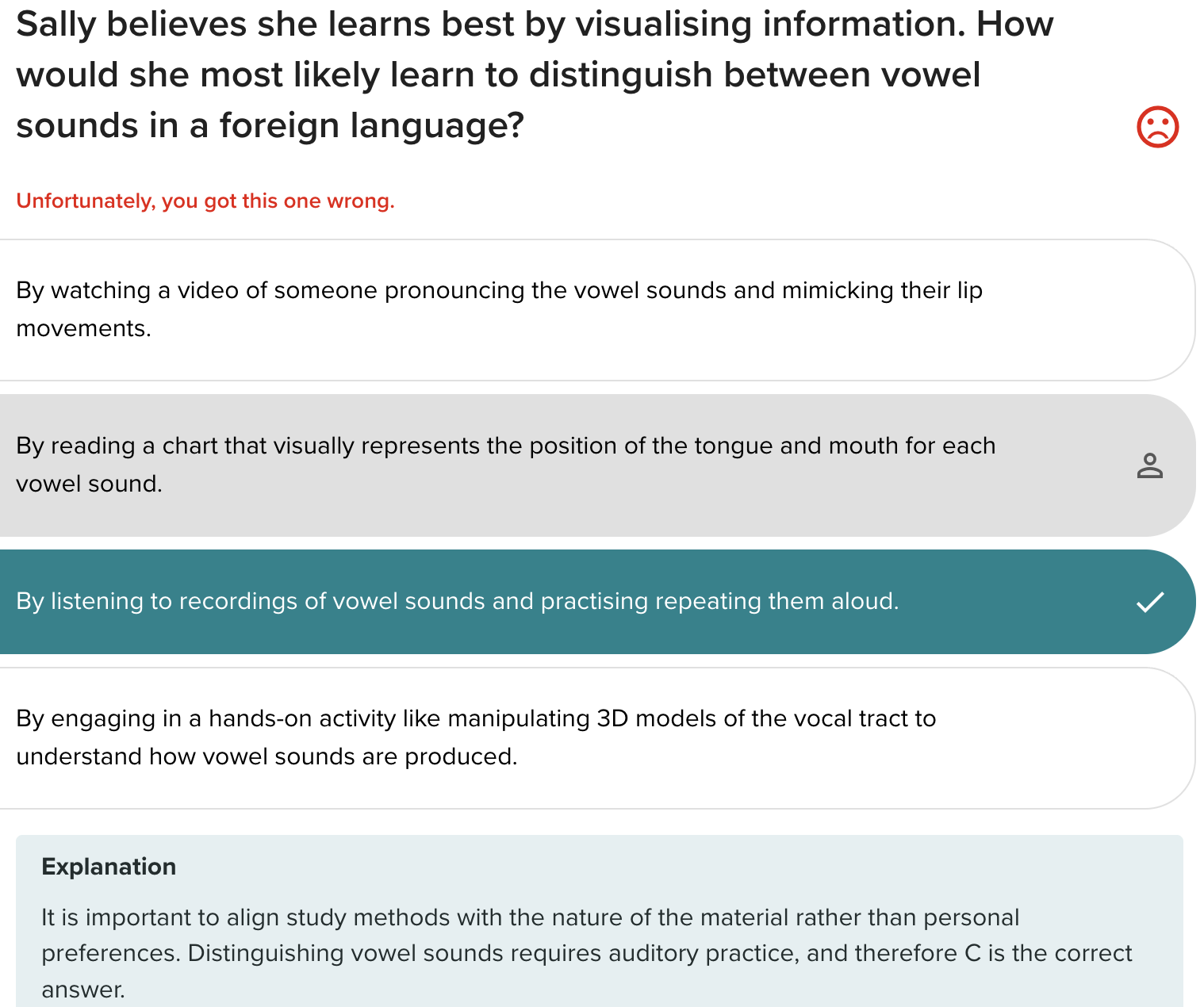
It is important to align study methods with the nature of the material rather than personal preferences.
 Note
Note  Flashcards (21)