Immune System, Specific Immunity

0.0(0)
Studied by 0 people
call kaiCall Kai
learnLearn
examPractice Test
spaced repetitionSpaced Repetition
heart puzzleMatch
flashcardsFlashcards
GameKnowt Play
Card Sorting

1/34

encourage image

There's no tags or description

Looks like no tags are added yet.

Last updated 5:26 PM on 3/25/26
Name
Mastery
Learn
Test
Matching
Spaced
Call with Kai

No analytics yet

Send a link to your students to track their progress

35 Terms

1
New cards

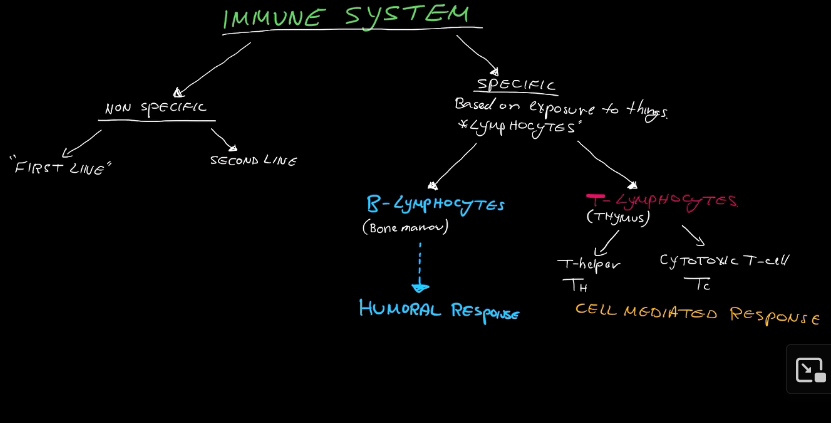
What are adaptive defenses?

Once the inate defenses have been exhausted, the body will start to target specific pathogens

  • This response is based on exposure

2
New cards

The two pathways of adaptive defenses:

  • B-Lymphocytes

  • T-lymphocytes

<ul><li><p>B-Lymphocytes</p></li><li><p>T-lymphocytes</p></li></ul><p></p>
3
New cards

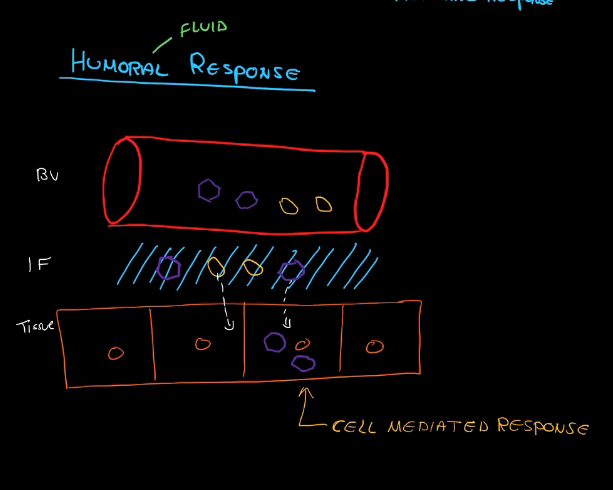
B-Lymphocytes

  • Mature in the bone marrow

  • Cause the humoral response, they attack pathogens located in the body’s fluids; like the blood or the interstitial fluid
<ul><li><p>Mature in the bone marrow</p></li><li><p>Cause the humoral response, they attack pathogens located in the body’s fluids; like the blood or the interstitial fluid</p></li></ul><p></p>
4
New cards

T-Lymphocytes

  • These cells mature in the thymus

  • T-Helper Cells

  • Cytotoxic T-Cells

  • These conduct the cell-mediated response, for when pathogens get into the non-fluid tissues of the body
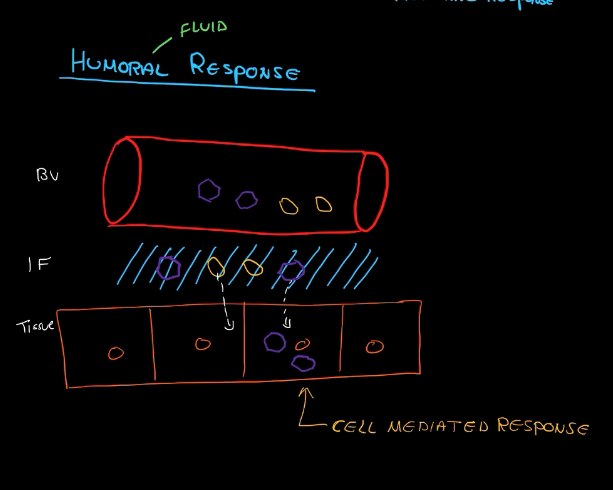
<ul><li><p>These cells mature in the thymus</p></li><li><p>T-Helper Cells</p></li><li><p>Cytotoxic T-Cells</p></li><li><p>These conduct the cell-mediated response, for when pathogens get into the non-fluid tissues of the body</p></li></ul><p></p>
5
New cards

How do B-cells attach themselves to foreign invaders?

  1. Every B-Cell has around 10,000 membrane-bound antibodies

  2. Each one of those antibodies has a variable region, a region that allows the B-Cell to attach to potential pathogens

  3. Each variable region is unique, giving rise to 10^10 combinations of variable regions

  4. We need this variation because pathogens are constantly mutating, but since we have so many different variable region combinations across so many B-Cells, we are guaranteed to have at least one successful match.
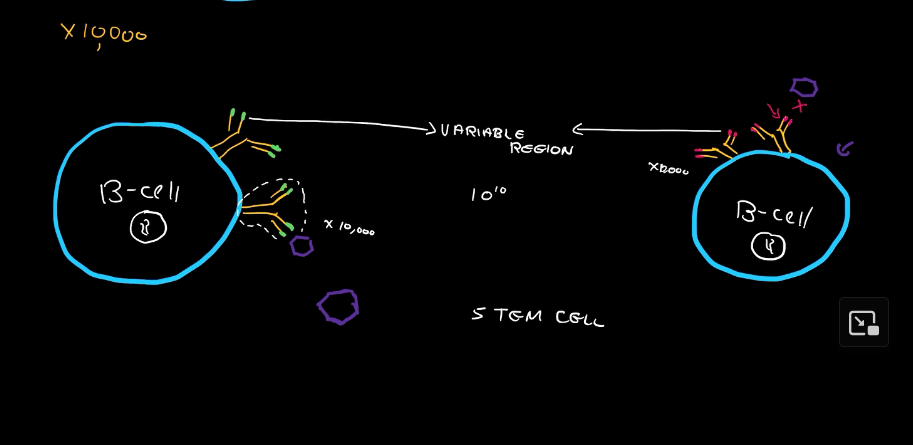
<ol><li><p>Every B-Cell has around 10,000 membrane-bound antibodies</p></li><li><p>Each one of those antibodies has a variable region, a region that allows the B-Cell to attach to potential pathogens</p></li><li><p>Each variable region is unique, giving rise to 10^10 combinations of variable regions</p></li><li><p>We need this variation because pathogens are constantly mutating, but since we have so many different variable region combinations across so many B-Cells, we are guaranteed to have at least one successful match.</p></li></ol><p></p>
6
New cards

How do we get different kinds of variable regions for each B-Cell?

  • Through the process of “random shuffling,” slightly different combinations of genes produce totally different and random variable regions, leading to unique B-Cells.

7
New cards

What if this random shuffling leads to a B-Cell that recognizes host cells as targets?

We obliterate it

8
New cards

What happens once a B-Cell attaches to the pathogen?

  1. Secret step

  2. B-Cell activates

  3. B-Cell begins to replicate into one of two things, either a Memory B-Cell or a Plasma Cell
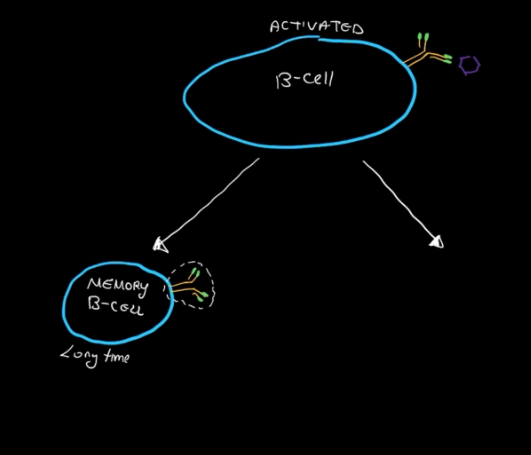
<ol><li><p>Secret step</p></li><li><p>B-Cell activates</p></li><li><p>B-Cell begins to replicate into one of two things, either a Memory B-Cell or a Plasma Cell</p></li></ol><p></p>
9
New cards

Memory B-Cell

  • Is identical to the original B-Cell

  • Has a very long life span

  • Serves as a memory cell for the immune system so that the immune response against the same pathogen in the future is much faster
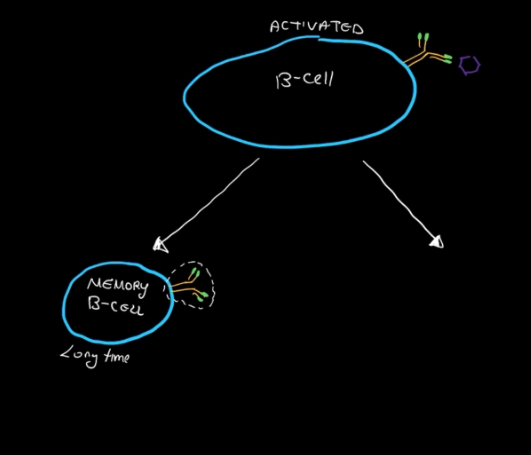
<ul><li><p>Is identical to the original B-Cell</p></li><li><p>Has a very long life span</p></li><li><p>Serves as a memory cell for the immune system so that the immune response against the same pathogen in the future is much faster</p></li></ul><p></p>
10
New cards

Plasma Cell

  1. Serves as an antibody factory, secreting 2000 antibodies every second

  2. These antibodies can then:

  • Clump viruses, disabling them and making it easier for phagocytes to destroy them (Opsonization)

  • Neutralize bacteria by just sitting on them, preventing the pathogen from interacting with the body
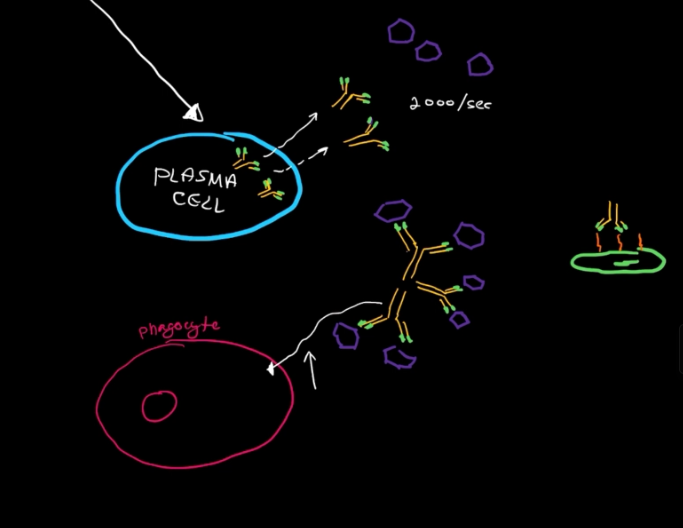
<ol><li><p>Serves as an antibody factory, secreting 2000 antibodies every second</p></li><li><p>These antibodies can then:</p></li></ol><ul><li><p>Clump viruses, disabling them and making it easier for phagocytes to destroy them (Opsonization)</p></li><li><p>Neutralize bacteria by just sitting on them, preventing the pathogen from interacting with the body</p></li></ul><p></p>
11
New cards

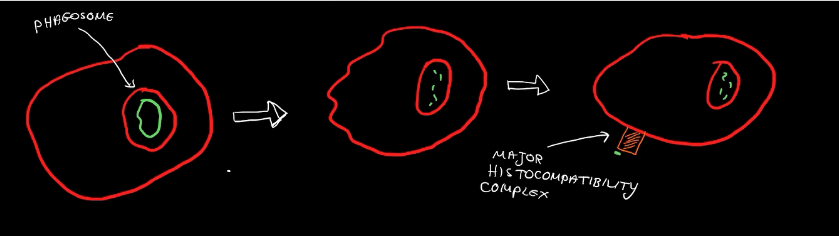
What is an Antigen Presenting Cell (APC)?

It is a cell that displays pieces of a pathogen to alert and inform other immune cells of a foreign invader by forming a Major Histocompatibility Complex
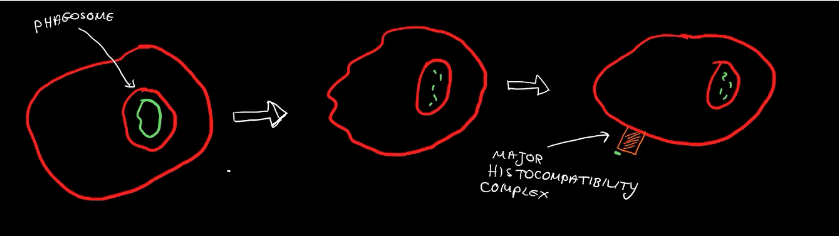
<p>It is a cell that displays pieces of a pathogen to alert and inform other immune cells of a foreign invader by forming a Major Histocompatibility Complex</p>
12
New cards

MHC1

Formed by phagosomes

<p>Formed by phagosomes</p>
13
New cards

MHC2

  1. A B-Cell forms plasma cells

  2. Plasma secretes antibodies

  3. An antibody attaches to the pathogen

  4. The B-Cell engulfs the antibody-pathogen complex

  5. B-Cell presents the pathogen

Also when macrophages or dendritic cells present
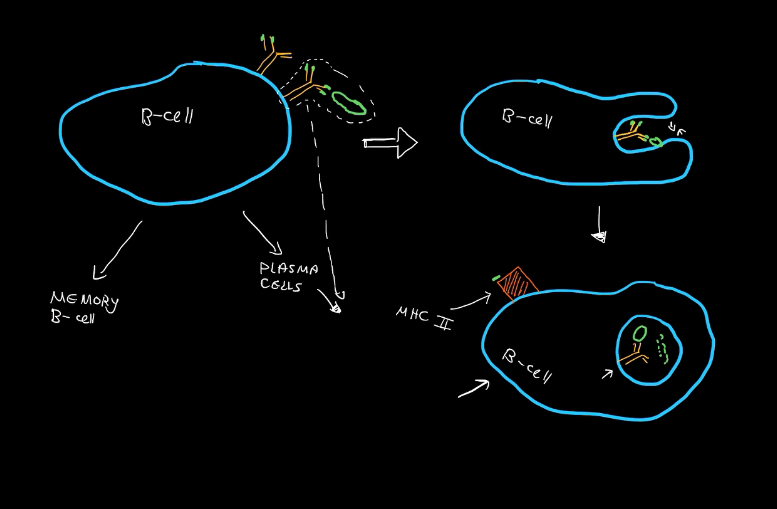
<ol><li><p>A B-Cell forms plasma cells</p></li><li><p>Plasma secretes antibodies</p></li><li><p>An antibody attaches to the pathogen</p></li><li><p>The B-Cell engulfs the antibody-pathogen complex</p></li><li><p>B-Cell presents the pathogen</p></li></ol><p></p><p>Also when macrophages or dendritic cells present</p><p></p><p></p>
14
New cards

Cell Mediated Response

  • Done by T-Cells

  • Utilized for attacking pathogens that have entered into the cells

  • T-Helper Cells

  • Cytotoxic T-Cells

15
New cards

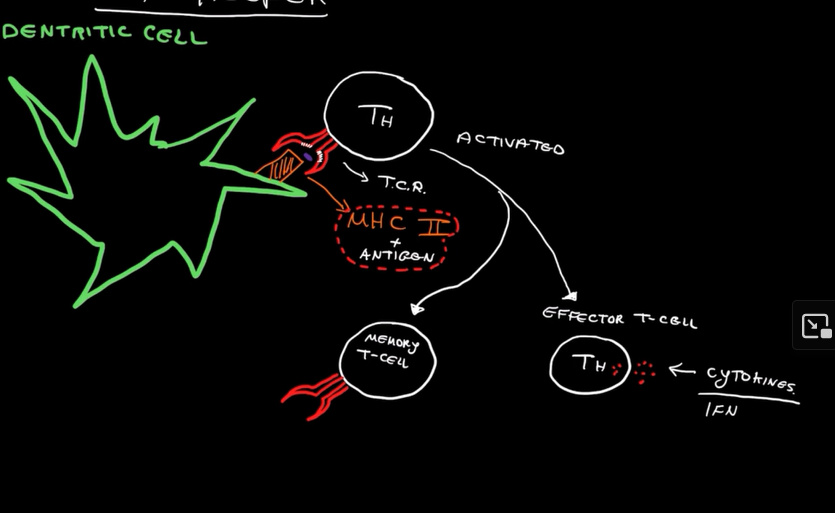
What Does a T-Helper Cell Do?

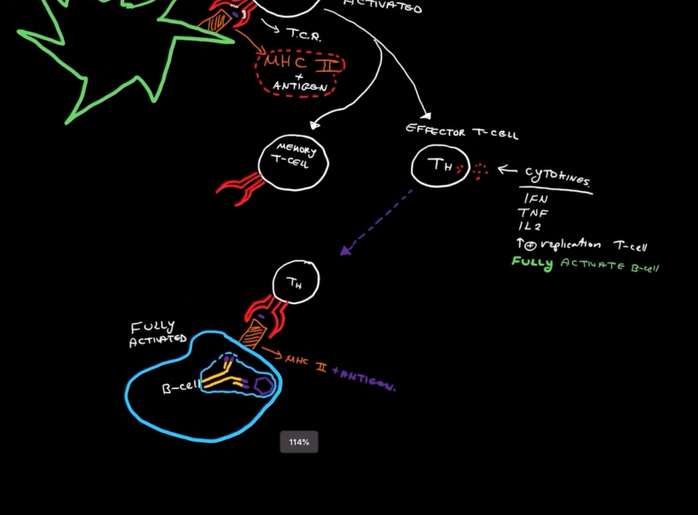
  • Forms a T-Cell Receptor (TCR) which recognizes a specific antigen with a specific antibody.

  • This activates the T-Helper cell, forming:

  • Memory T-Cells

  • Effecter T-Cells

<ul><li><p>Forms a T-Cell Receptor (TCR) which recognizes a specific antigen with a specific antibody. </p></li><li><p>This activates the T-Helper cell, forming:</p></li><li><p>Memory T-Cells</p></li><li><p>Effecter T-Cells</p></li></ul><p></p>
16
New cards

Memory T-Cells

Remain in the body for a long time and holds onto that specific TCR, in case the same pathogen attacks again
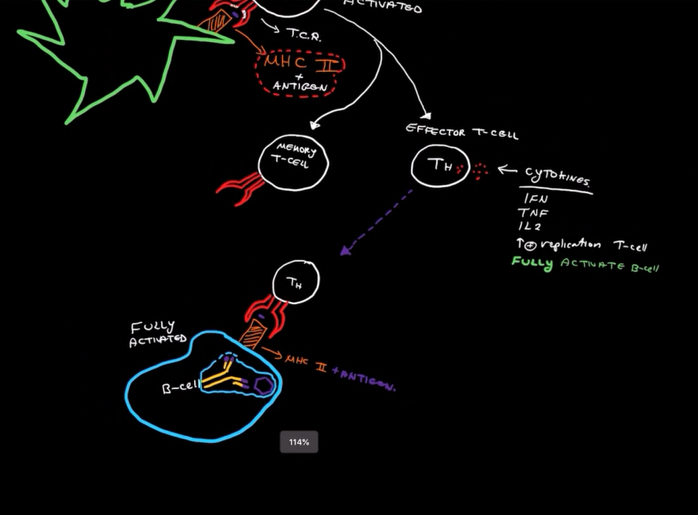
<p>Remain in the body for a long time and holds onto that specific TCR, in case the same pathogen attacks again</p><p></p>
17
New cards

Effector T-Cells:

  • Secreted molecules called cytokines:

  1. IFN

  2. TNF

  3. IL2

  4. T+ Replication T-Cells

  • These cytokines fully activate B-Cells
<ul><li><p>Secreted molecules called cytokines:</p></li></ul><ol><li><p>IFN</p></li><li><p>TNF</p></li><li><p>IL2</p></li><li><p>T+ Replication T-Cells</p></li></ol><ul><li><p>These cytokines fully activate B-Cells</p></li></ul><p></p>
18
New cards

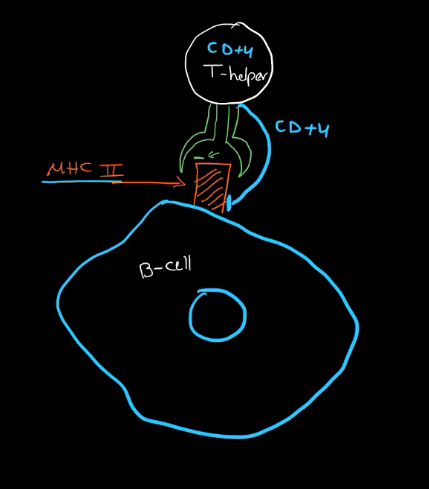
CD+4

Helps bind t-helper cells to MHC 2
<p>Helps bind t-helper cells to MHC 2</p>
19
New cards

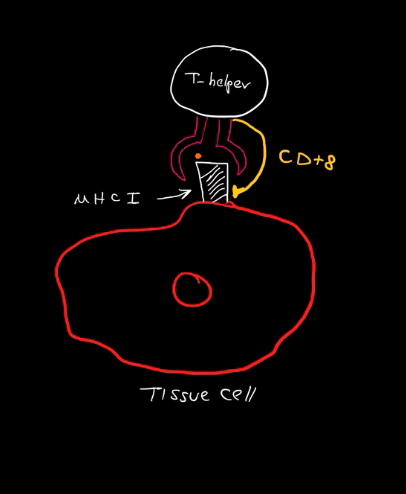
CD+8

Helps bind t-helper cells to MHC 8
<p>Helps bind t-helper cells to MHC 8</p>
20
New cards

What does a Cytotoxic T-Cell do?

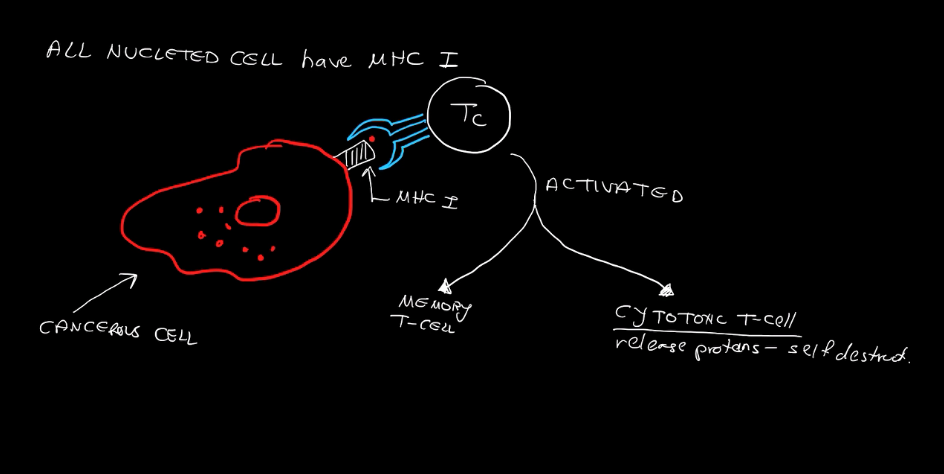
  • Binds to MHC 1 receptors, which are located on all nucleated cells.

  • Memory T-Cells

  • More cytotoxic T-Cells

21
New cards

Memory T-Cells

Just forms more T-Cells with the same receptor to remember this particular pathogen
<p>Just forms more T-Cells with the same receptor to remember this particular pathogen</p>
22
New cards

Cytotoxic T-Cells

Release Self Destruction Proteins that make the infected cell kill itself
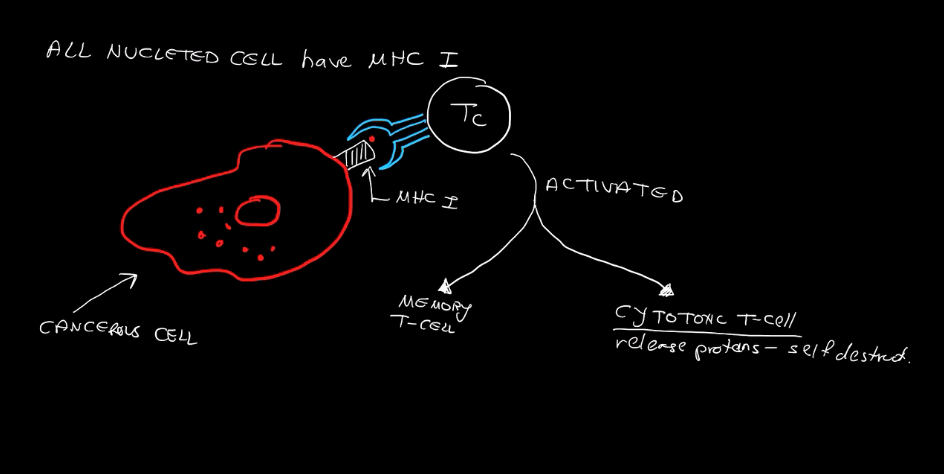
<p>Release Self Destruction Proteins that make the infected cell kill itself</p>
23
New cards

Where do Lymphocytes originate?

B-Cells in the bone marrow

T-Cells in the thymus

24
New cards

What are the two factors that lymphocytes must have to be considered mature?

  • They must be immunocompetent, recognizing foreign species.

  • They must be self tolerant, not recognizing our own tissue as dangerous

25
New cards

Positive Selection Test:

The T-Cells are tested to see if they can recognize MHC and bind to it.

If not, they undergo apoptosis (KILL YO SELF)

26
New cards

Negative Selection Test

The T-Cells are tested to see if they will fail to regonize our antigens

If they recognize our antigens, apoptosis

27
New cards

If they pass the tests?

The naive cells are sent to seed secondary lymphoid tissues

28
New cards

Process of Clonal Selection

  1. Each T-Cell and B-Cell coresponds to a single antigen

  2. They migrate to the lymph node

  3. A dendritic cell arives with a protein on its MH2 receptor, the associated B and T-Cell will be activated

  4. These B and T cells will clone themselves, producing more B and T cells that can respond to infection

“Clone themselves'“ hence clonal selection :P
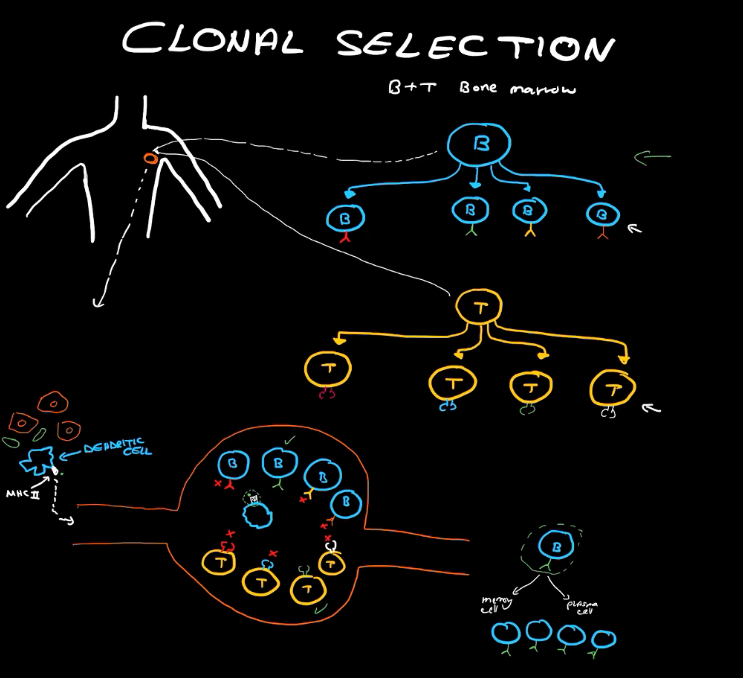
<ol><li><p>Each T-Cell and B-Cell coresponds to a single antigen</p></li><li><p>They migrate to the lymph node</p></li><li><p>A dendritic cell arives with a protein on its MH2 receptor, the associated B and T-Cell will be activated</p></li><li><p>These B and T cells will clone themselves, producing more B and T cells that can respond to infection</p></li></ol><p>“Clone themselves'“ hence clonal selection :P </p><p></p>
29
New cards

What is the process of phagocyte mobilization? How do they know where to go?

  1. Macrophage phagocytes a harmful pathogen.

  2. The Macrophage releases cytokines, a chemical messenger.

  • Endothelial cells express “sticky” proteins

  • Neutrophils also express “sticky proteins

  1. When neutrophils get close to these endothelial cells, they stick together, guiding neutrophils to the infection.

  2. Neutrophils enter via diapedesis, they consume the bacteria, and die.

  3. Macrophages present the pathogen on MHC 2.

  4. Macrophages travel down the lymphatic vessel, into a lymph node, and activate B-Cells and T-Cells

  5. The B-Cells, T-Cells, and their associated antibodies travel into the blood and towards the site of infection via chemotaxis.
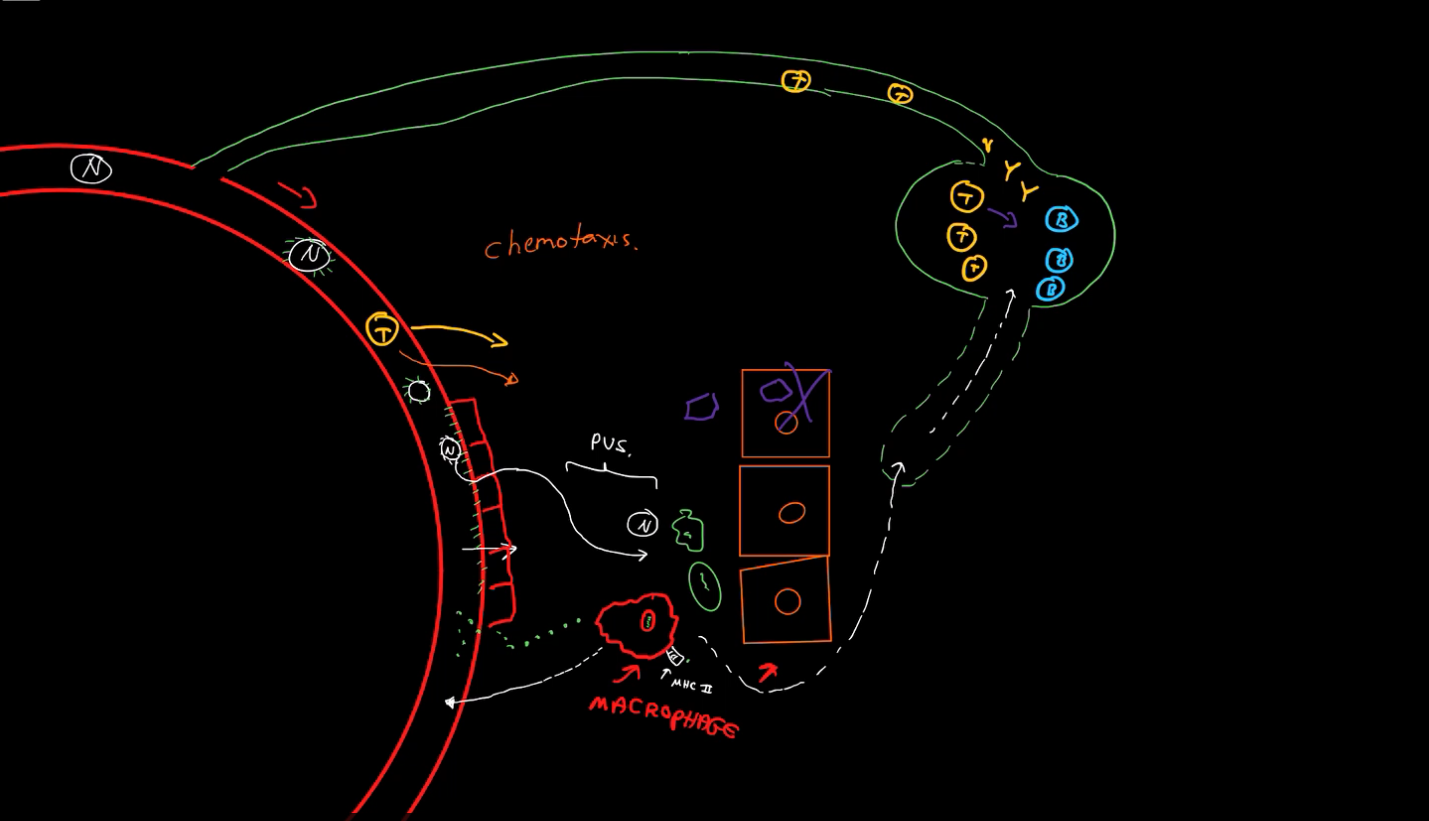
<ol><li><p>Macrophage phagocytes a harmful pathogen.</p></li><li><p>The Macrophage releases cytokines, a chemical messenger.</p></li></ol><ul><li><p>Endothelial cells express “sticky” proteins</p></li><li><p>Neutrophils also express “sticky proteins</p></li></ul><ol start="3"><li><p>When neutrophils get close to these endothelial cells, they stick together, guiding neutrophils to the infection.</p></li><li><p>Neutrophils enter via diapedesis, they consume the bacteria, and die.</p></li><li><p>Macrophages present the pathogen on MHC 2.</p></li><li><p>Macrophages travel down the lymphatic vessel, into a lymph node, and activate B-Cells and T-Cells</p></li><li><p>The B-Cells, T-Cells, and their associated antibodies travel into the blood and towards the site of infection via chemotaxis.</p></li></ol><p></p>
30
New cards

Why does immunological memory matter?

With no knowledge of infection, it can take seven days to form antibodies, and 10 days to reach the peak amount.

With memory, antibodies are produced instantly, only take 5 days to peak, and produce exponentially more antibodies to fight the infection.
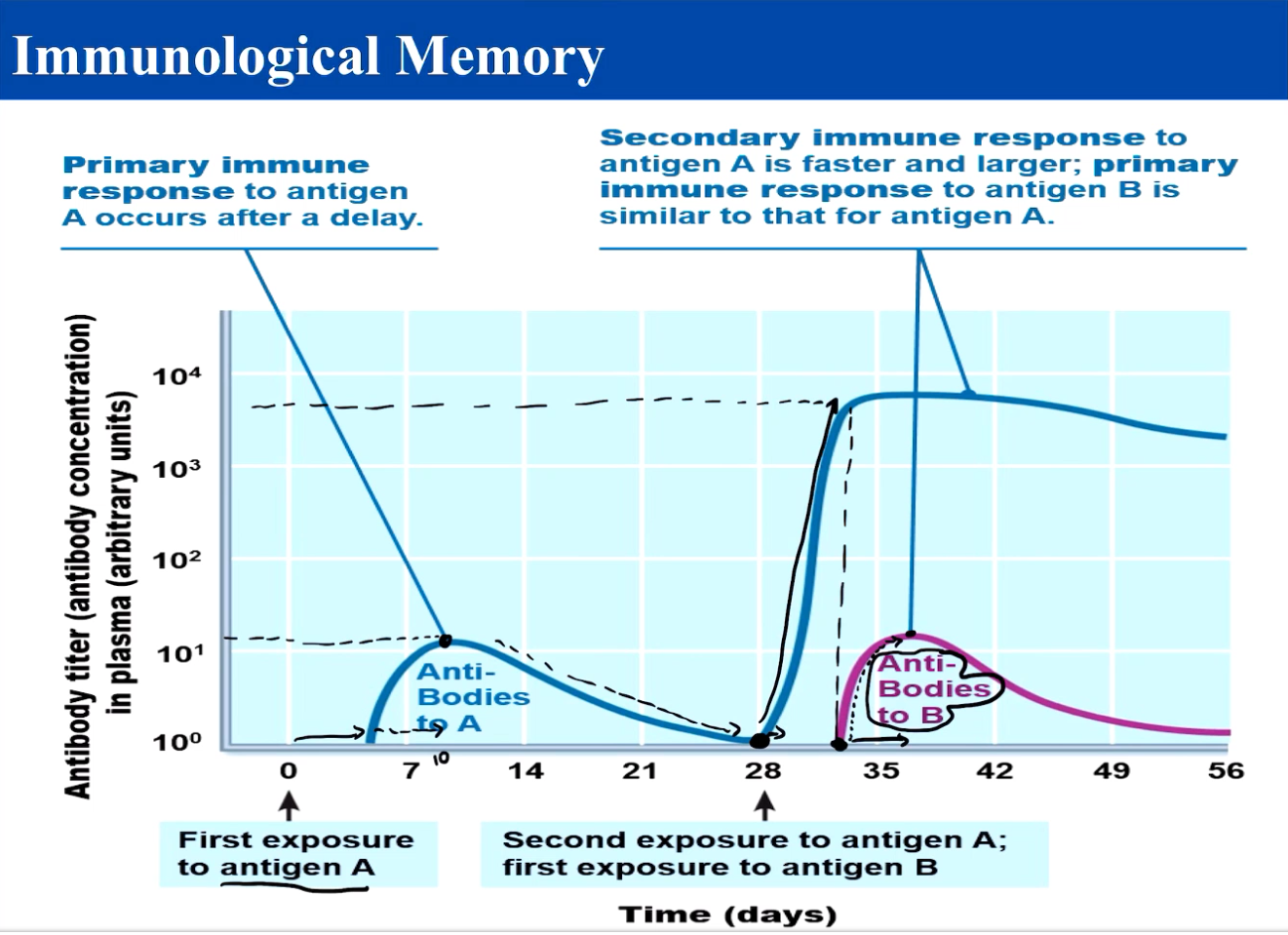
<p>With no knowledge of infection, it can take seven days to form antibodies, and 10 days to reach the peak amount.</p><p>With memory, antibodies are produced instantly, only take 5 days to peak, and produce exponentially more antibodies to fight the infection.</p><p></p>
31
New cards

Active Humoral Immunity, 2 types:

  • Artificial

  • Natural

32
New cards

Artificial Immunity

  • Cause a low level immune response by exposing the immune system to a “gutted” pathogen (only has receptors)

  • B-Cells attack the pathogen, form memory B-Cells

  • u good twin

33
New cards

Natural Immunity

  • Normal response to infection

  • U gonna get sick tho

34
New cards

Passive Humoral Immunity

  • Introduction of already made antibodies

  • Downside is that B-Cells never form memory B-Cells

  • You are only protected until the antibodies degrade.

  • Can be aquired through breast milk

  • Can be aquired via injection

35
New cards

What abdnormalities do Natural Killer Cells recognize?

  • Lack of Cells with MHC 1

  • Antibodies coating a cell

  • Different surface markers (cancer)

Explore top notes

note
English 2 Vocab 1
Updated 1198d ago
0.0(0)
note
Ch 2: Ecosystems and Ecology
Updated 1064d ago
0.0(0)
note
Factors and Multiples
Updated 1189d ago
0.0(0)
note
2.8: acids
Updated 1257d ago
0.0(0)
note
2. New and Emerging Technologies
Updated 1121d ago
0.0(0)
note
In Sickness and in Health
Updated 1064d ago
0.0(0)
note
concussion infographics
Updated 467d ago
0.0(0)
note
English 2 Vocab 1
Updated 1198d ago
0.0(0)
note
Ch 2: Ecosystems and Ecology
Updated 1064d ago
0.0(0)
note
Factors and Multiples
Updated 1189d ago
0.0(0)
note
2.8: acids
Updated 1257d ago
0.0(0)
note
2. New and Emerging Technologies
Updated 1121d ago
0.0(0)
note
In Sickness and in Health
Updated 1064d ago
0.0(0)
note
concussion infographics
Updated 467d ago
0.0(0)

Explore top flashcards

flashcards
3. Fallacies
30
Updated 831d ago
0.0(0)
flashcards
Spanish capitals
20
Updated 1210d ago
0.0(0)
flashcards
honors english exam terms
40
Updated 1197d ago
0.0(0)
flashcards
17 - TỪ VỰNG | Quizlet
23
Updated 560d ago
0.0(0)
flashcards
vocab 4
42
Updated 539d ago
0.0(0)
flashcards
Wetter
47
Updated 1062d ago
0.0(0)
flashcards
3. Fallacies
30
Updated 831d ago
0.0(0)
flashcards
Spanish capitals
20
Updated 1210d ago
0.0(0)
flashcards
honors english exam terms
40
Updated 1197d ago
0.0(0)
flashcards
17 - TỪ VỰNG | Quizlet
23
Updated 560d ago
0.0(0)
flashcards
vocab 4
42
Updated 539d ago
0.0(0)
flashcards
Wetter
47
Updated 1062d ago
0.0(0)