lecture 1- brain structure and function
 Studied by 0 people
 Call Kai
 Learn
Learn Practice Test
 Spaced Repetition
 Match
Match Flashcards
 Knowt Play
1/26

There's no tags or description
Looks like no tags are added yet.
Name | Mastery | Learn | Test | Matching | Spaced | Call with Kai |
|---|
No analytics yet
Send a link to your students to track their progress
27 Terms
Who was René Descartes?
1596-1650, french philosopher and mathmetician
Proposed mind and body interacted in pineal gland
Realised much behaviour is mechanical not requiring mental processing
Developed concept of automatic reflex- nerves conveying messages to brain
Some behaviour is reflexive
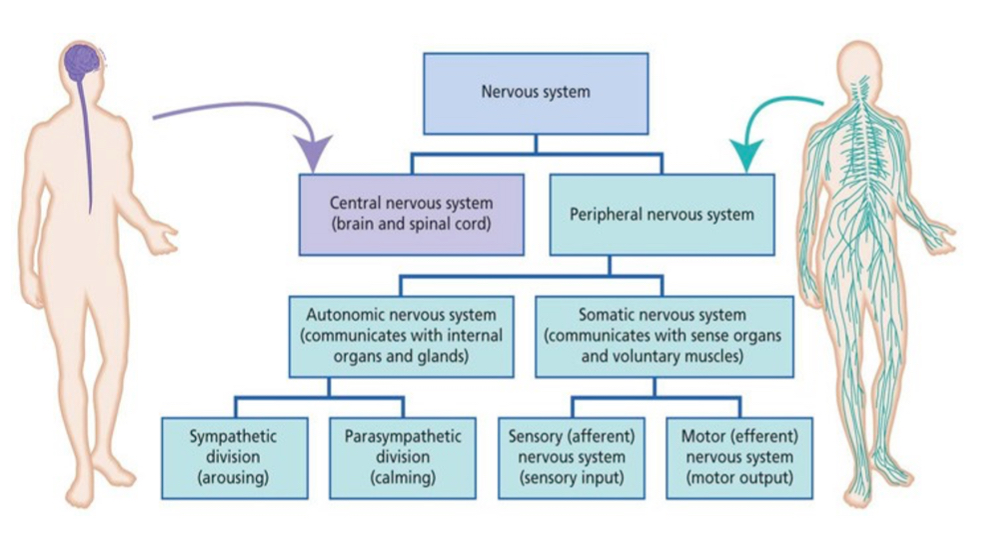
Divisions of the nervous system
What are afferents and efferents?
both ANS and SNS contain afferent and efferent nerves
Sensory nerves= afferent
Motor nerves= efferent
Example:
Sensory (afferent) nerve senses hot flame on skin. Afferents sense the heat and send rapid message to spinal cord, conveying the pain.
Motor (efferent) nerves respond by sending signal from CNS to muscles, to move hand away from flame.
What is the autonomic nervous system?
Causes motor actions that are involuntary and automatic
Communicates with internal organs and glands
divided into sympathetic and parasympathetic nervous systems. Has 2 types of efferent nerves.
Sympathetic= automatic motor neurones prepare us for action when responding to stressor- fight or flight e.g. heart rate increases, mobilises energy
Parasympathetic= automatic motor neurones that prepare us to relax into restful state. E.g. increases digestions, conserves energy
What is the somatic nervous system?
Controls voluntary movements e.g. moving hand from flame
Communicates with sense organs and voluntary muscles
What are directional terms in neuroanatomy?
terms for a 3D coordinate system to help neuroanatomists explain where something is in the brain
Described in relation to orientation of the neuraxis- the direction in which the CNS lies in relation to spinal cord
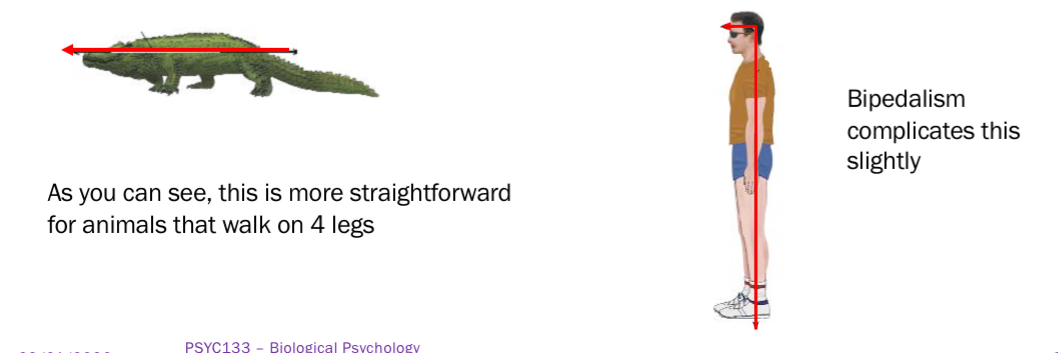
What are the directional terms in animals?
3 axes: anterior-posterior, dorsal-ventral, medial-lateral
Dorsal= towards back of body/top of head
Ventral= towards front of body/bottom of head
Anterior/rostral= towards front end of body (nose)
Posterior/caudal- towards tail
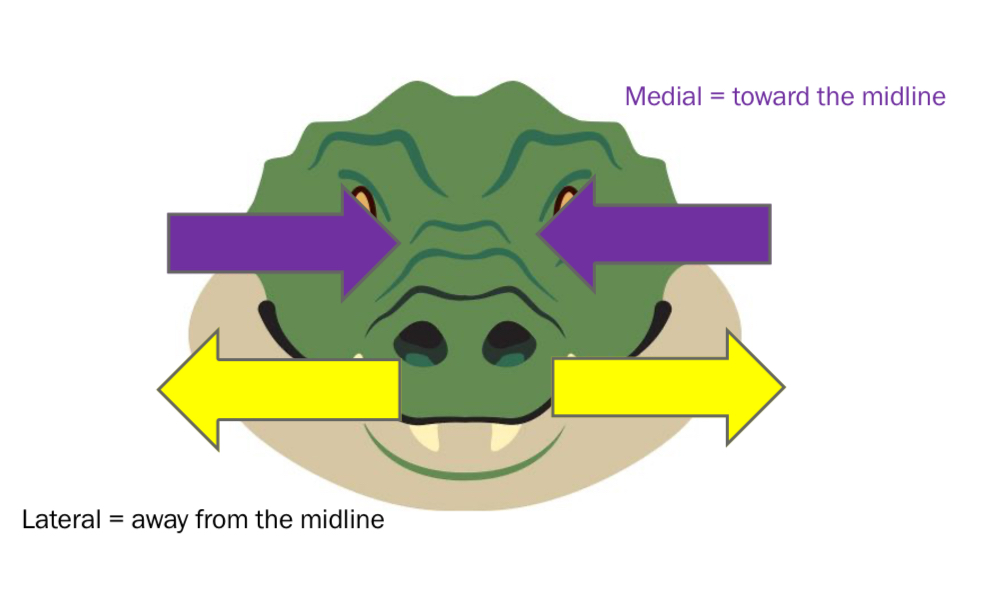
Medial= toward midline
Lateral= away from midline
What are the directional terms in humans?
Dorsal and ventral
Rostral/anterior= towards nose
Causal/posterior= towards feet
Proximal= close to CNS e.g. shoulders
Distal= far from CNS e.g. fingers
Lateral and medial
Bilateral= on both sides of head/body
Ipsilateral= on same side of head/body
Contralateral= on opposite side of head/body
What are the types of sections in directional terms?
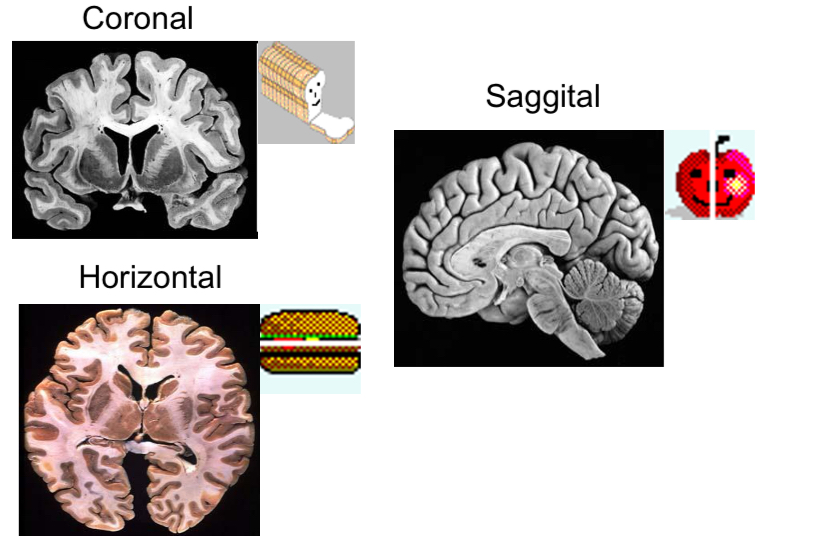
What is a cross section and midsaggital plane?
Cross-section= slice taken at right angles to neuraxis.
Midsaggital plane= plane through the neuraxis perpendicular to the ground; divides the brain in 2 symmetrical halves.
What are the meninges?
3 protective membranes that protect the CNS:
Dura mata
Arachnoid membrane
Subarachnoid space
What is cerebrospinal fluid?
fluid that fills the subarachnoid space, the spinal cord, and ventricles of the brain
CBF provides cushioning and support for brain
People who have it drained suffer headaches and pain
Excess CBF is continually absorbed into subarachnoid space, and sinuses which run through dura mata and drains into jugular vein
If obstructed, e.g. by tumour between ventricles, CBF can build up in ventricles leading to brain expanding = condition called hydrocephalus (water head)
What is the blood-brain barrier (BBB)?
semi-permeable membrane which separates blood from CBF, providing barrier that prevents many toxins entering the brain from bloodstream
The degree to which therapeutic or recreational drugs work, depends on the ease that they can cross the BBB
What are the 5 major structures of the brain?
myelencephalon= medulla- largely comprises tracts between brain and spinal cord
Metencephalon= pons and cerebellum
Mesencephalon= tectum and tegmentum
Diecephalon= thalamus and hypothalamus
Telencephalon= cerebral cortex, limbic system and basal ganglia
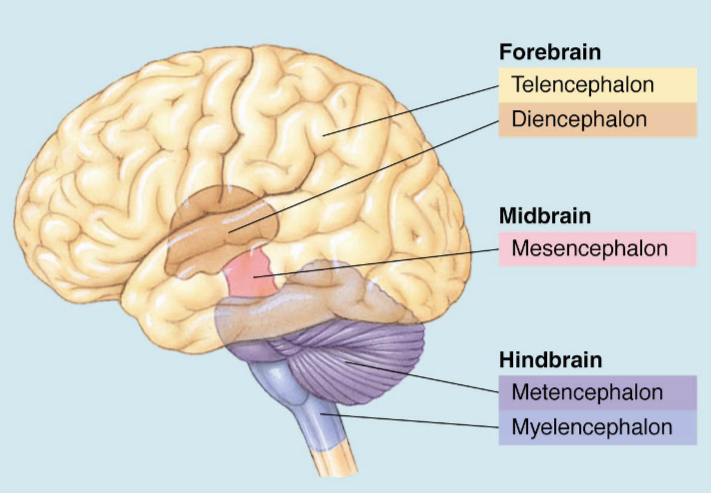
What is the myelencephalon (medulla)?
part of the hindbrain- most posterior part (brain stem)
Oldest part- medulla oblongata (long marrow) - controls breathing, heart rate, salivation, vomiting
If brain is cut above medulla, basic heart rate and breathing maintained. Damage to medulla= fatal
Contains reticular information
Involved in sleep, attention movement, and cardiac, circulatory and respiratory reflexes
What is the metencephalon?
part of the hindbrain
Contains pons and cerebellum
Pons (bridge)- enlargement of medulla, contains pontine nuclei- contains coeruleus and dorsal raphe= origin of noradrenergic and serotonergic containing fibres in forebrain.
Cerebellum is important for sensorimotor control of movements
Cerebellum damage can cause problems with decision making and language
What is the mesencephalon?
part of the midbrain- 2 divisions:
Tectum= dorsal of midbrain. Inferior colliculi (auditory function), superior colliculi (visual-motor)
Tegmentum= contains PAG- primary control centre for descending pain modulation
Substantia nigra- important component of sensory motor system
What is the diencephalon?
Part of the forebrain which mushrooms out so it covers and surrounds the older tubular brain and adds greater complexities and new structures:
Thalamus- inner chamber that relays sensory signals from skin to prepare motor signals to cerebral cortex. Involved in sleep, consciousness, alertness
Hypothalamus- important for motivated behaviours e.g. eating, sleeping, sexual behaviour
What is the telencephalon?
everything else. Mediates most of brain complex functiona- voluntary movement, sensory input, cognitive processes e.g. learning, speaking, problem solving
Contains cerebral cortex and subcortical structures, as well as important fibre bundles
What is the structure of the cerebral cortex?
composed of small unmyelinated neurons
Grey matter
Convolutions serve to increase SA
Large convolutions= fissures
Small convolutions= sulci
Ridges between fissures and sulci= gyri
Longitudinal fissure separates hemispheres
Contains the neocrotex, and subcortical structures (hippocampus, limbic system, basal ganglia)
What is the hippocampus?
subcortical structure with 3 major layers
Located at medial edge of cerebral cortex, folds back on itself in medial temporal lobe
Major role in memory
What is the limbic system?
Subcortical system which is a circuit of midline structures that circle the thalamus
Regulation of motivated behaviours
Consists of mammillary bodies, hippocampus, amygdala, fornix, cingulate, septum
What is the basal ganglia?
subcortical system. Motor system.
Consists of amygdala, striatum, globus pallidus
Extrapyramidal motor system- outer fibres do not cross pyramidal regions of medulla
Degeneration of nigral-striatal pathway causes rigidity, tremor and slow movement in Parkinson’s disease
Coordination of automated, smooth, fluent movement
What is the neocortex?
the newest part of the cerebral cortex to evolve
Largest part of the cerebral cortex (90%)
Has 6 layers
Large neocortex ratio correlates with complexity of behaviour. Larger neocortex=larger brain
Central and lateral fissure divide each hemisphere into 4 lobes- frontal, parietal, temporal, occipital
What are the 4 lobes of the cerebral cortex?
frontal lobe- complex cognitive functionS
Temporal lobe- hearing and language, complex visual patterns, memory
Parietal lobe- orientation, location of objects, and somatic sensations e.g. touch
Occipital lobe- visual processing
What are the amnesic effects of bilateral medial temporal lobectomy?
HM- epileptic who had temporal lobes removed
Before surgery he averaged one generalised seizure per week, and several focal seizures per day
Medial portions of both temporal lobes were removed, and his generalised seizures stopped and partial seizures reduced massively.
Normal perceptual and motor ability and intelligence, memories for events predating surgery intact, STM good
BUT total inability to form new LT memories
Who was Phineas Gage?
worked in railroad construction - explosion propelled tamping iron through his head
Entered under left cheekbone, penetrated base of skull behind left eye socket, emerged at top of skull
Within 5 mins, he was sitting up, conscious and recalling what happened
His personality radically changed- became fitful etc.
 Note
Note  Flashcards (46)