Campbell Bio Chapter 3
 Studied by 0 people
 Call with Kai
 Learn
Learn Practice Test
 Spaced Repetition
 Match
Match Flashcards
 Knowt Play
1/54

There's no tags or description
Looks like no tags are added yet.
Name | Mastery | Learn | Test | Matching | Spaced | Call with Kai |
|---|
No analytics yet
Send a link to your students to track their progress
55 Terms
1) In a single molecule of water, two hydrogen atoms are bonded to a single oxygen atom by
________.
A) hydrogen bonds
B) nonpolar covalent bonds
C) polar covalent bonds
D) ionic bonds
C) polar covalent bonds
2) The partial negative charge at one end of a water molecule is attracted to the partial positive
charge of another water molecule. What is this attraction called?
A) a covalent bond
B) a hydrogen bond
C) an ionic bond
D) a van der Waals interaction
B) a hydrogen bond
3) The partial negative charge in a molecule of water occurs because ________.
A) the oxygen atom donates an electron to each of the hydrogen atoms
B) the electrons shared between the oxygen and hydrogen atoms spend more time around the
oxygen atom nucleus than around the hydrogen atom nucleus
C) the oxygen atom has two pairs of electrons in its valence shell that are not neutralized by
hydrogen atoms
D) one of the hydrogen atoms donates an electron to the oxygen atom
B) the electrons shared between the oxygen and hydrogen atoms spend more time around the
oxygen atom nucleus than around the hydrogen atom nucleus
4) Sulfur is in the same column of the periodic table as oxygen, but has electronegativity similar
to carbon. Compared to water molecules, molecules of H2S will ________.
A) have greater cohesion to other molecules of H2S
B) have a greater tendency to form hydrogen bonds with each other
C) have a higher capacity to absorb heat for the same change in temperature
D) not form hydrogen bonds with each other
D) not form hydrogen bonds with each other
5) Water molecules can form hydrogen bonds with ________.
A) compounds that have polar covalent bonds
B) oils
C) oxygen gas (O2) molecules
D) chloride ions
A) compounds that have polar covalent bonds
6) Cohesion, surface tension, and adhesion are the properties of water molecules that ________.
A) increase when temperature increases
B) increase when pH increases
C) are a result of hydrogen bonding
D) are a result of polar covalent bonding
C) are a result of hydrogen bonding
7) Liquid water ________.
A) is less dense than ice
B) has a specific heat lower than that of most other substances
C) has a heat of vaporization higher than that of most other substances
D) is nonpolar
C) has a heat of vaporization higher than that of most other substances
8) Which of the following can be attributed to water's high specific heat?
A) Oil and water do not mix well.
B) A lake heats up more slowly than the air around it.
C) Ice floats on water.
D) Sugar dissolves in hot tea faster than in iced tea.
B) A lake heats up more slowly than the air around it.
9) The cities of Portland, Oregon, and Minneapolis, Minnesota, are at about the same latitude,
but Minneapolis has much hotter summers and much colder winters than Portland. Why?
A) They are not at the same exact latitude.
B) The ocean near Portland moderates the temperature.
C) Fresh water is more likely to freeze than salt water.
D) Minneapolis is much windier, due to its location in the middle of North America.
B) The ocean near Portland moderates the temperature.
10) To act as an effective coolant in a car's radiator, a substance has to have the capacity to
absorb a great deal of heat. You have a reference book with tables listing the physical properties
of many liquids. In choosing a coolant for your car, which table would you check first?
A) pH
B) density at room temperature
C) heat of vaporization
D) specific heat
D) specific heat
11) Water has many exceptional and useful properties. Which is the rarest property among
compounds?
A) Water is a solvent.
B) Solid water is less dense than liquid water.
C) Water has a high heat capacity.
D) Water has surface tension.
B) Solid water is less dense than liquid water.
12) Which of the following effects can occur because of the high surface tension of water?
A) Lakes cannot freeze solid in winter, despite low temperatures.
B) A raft spider can walk across the surface of a small pond.
C) Organisms can resist temperature changes, although they give off heat due to chemical
reactions.
D) Sweat can evaporate from the skin, helping to keep people from overheating.
B) A raft spider can walk across the surface of a small pond.
13) Thermal energy of the water in a bathtub is ________ than in a freshly brewed coffee pot
because of its ________.
A) higher; greater volume
B) higher; high kinetic energy
C) lower; low temperature
D) lower; low density
A) higher; greater volume
14) Low humidity in the atmosphere on a hot day ________.
A) helps in cooling because skin absorbs water from the atmosphere
B) does not help in cooling because water evaporates from the skin faster
C) helps in cooling because water evaporates from the skin faster
D) does not help in cooling because skin absorbs water from the atmosphere
C) helps in cooling because water evaporates from the skin faster
15) A dietary Calorie equals 1 kilocalorie. One kilocalorie equals ________.
A) 1000 calories, or the amount of heat required to raise the temperature of 1 g of water by 1°C
B) 10,000 calories, or the amount of heat required to raise the temperature of 1 kg of water by
1°F
C) 1000 calories, or the amount of heat required to raise the temperature of 1 kg of water by 1°C
D) 1000 calories, or the amount of heat required to raise the temperature of 100 g of water by
100°C
C) 1000 calories, or the amount of heat required to raise the temperature of 1 kg of water by 1°C
16) Why does ice float in liquid water?
A) The high surface tension of liquid water keeps the ice on top.
B) The ionic bonds between the molecules in ice prevent the ice from sinking.
C) Stable hydrogen bonds keep water molecules of ice farther apart than water molecules of
liquid water.
D) The crystalline lattice of ice causes it to be denser than liquid water.
C) Stable hydrogen bonds keep water molecules of ice farther apart than water molecules of
liquid water.
17) Hydrophobic substances such as vegetable oil are ________.
A) nonpolar substances that repel water molecules
B) nonpolar substances that have an attraction for water molecules
C) polar substances that repel water molecules
D) polar substances that have an affinity for water
A) nonpolar substances that repel water molecules
18) Why is a steam burn more severe than a hot water burn?
A) Burns caused by liquids are always milder.
B) Steam can penetrate into the skin.
C) Steam contains more energy than water.
D) Water evaporates and leaves the surface faster and helps in cooling.
C) Steam contains more energy than water.
19) Melting of ice and thus reduced feeding opportunities for polar bears is occurring because of
the ________.
A) increase in phytoplankton population
B) drying up of lakes and streams
C) constant breaking and reforming of hydrogen bonds in water
D) increase in CO2 and other greenhouse gases in the atmosphere
D) increase in CO2 and other greenhouse gases in the atmosphere
20) One mole (mol) of glucose (molecular mass = 180 daltons) is ________.
A) 180 × 1023 molecules of glucose
B) 1 kilogram of glucose dissolved in 1 liter of solution
C) 180 mL of dissolved glucose
D) 180 grams of glucose
D) 180 grams of glucose
21) When an ionic compound such as sodium chloride (NaCl) is placed in water, the component
atoms of the NaCl crystal dissociate into individual sodium ions (Na+) and chloride ions (Cl-). In
contrast, the atoms of covalently bonded molecules (e.g., glucose, sucrose, glycerol) do not
generally dissociate when placed in aqueous solution. Which of the following solutions would be
expected to contain the greatest number of solute particles (molecules or ions)?
A) 1 liter of 0.5 M NaCl
B) 1 liter of 1.0 M NaCl
C) 1 liter of 1.0 M glucose
D) 1 liter of 1.0 M NaCl and 1 liter of 1.0 M glucose will contain equal numbers of solute
particles.
B) 1 liter of 1.0 M NaCl
22) The molar mass of glucose is 180 grams per mole (g/mol). Which of the following
procedures should you carry out to make a 1 M solution of glucose? In 0.8 liter (L) of water,
dissolve ________.
A) 1 g of glucose, and then add more water until the total volume of the solution is 1 L
B) 18 g of glucose, and then add more water until the total volume of the solution is 1 L
C) 180 g of glucose, and then add 0.2 L more of water
D) 180 g of glucose, and then add more water until the total volume of the solution is 1 L
D) 180 g of glucose, and then add more water until the total volume of the solution is 1 L
23) You have a freshly prepared 0.1 M sucrose (molecular mass 342) solution, which means
________.
A) 6.02 × 10²³ of sucrose molecules are present in the solution
B) 6.02 × 10²² of sucrose molecules are present in the solution
C) 34.2 g of sucrose is present in the solution
D) 6.02 × 10²² of sucrose molecules or 34.2 g of sucrose is present in the solution
D) 6.02 × 10²² of sucrose molecules or 34.2 g of sucrose is present in the solution
24) How does 0.5 M sucrose (molecular mass 342) solution compare to 0.5 M glucose
(molecular mass 180) solution?
A) Both have 6.02 × 10²³ molecules.
B) Sucrose has 171 molecules, whereas glucose has 90.
C) Both have 3.01 × 10²³ molecules.
D) Sucrose has 171 mg/L, whereas glucose has 90 mg/L.
C) Both have 3.01 × 10²³ molecules.
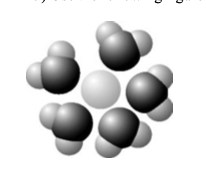
Based on your knowledge of the polarity of water molecules, the solute molecule depicted is
most likely ________.
A) positively charged
B) negatively charged
C) without charge
D) nonpolar
A) positively charged
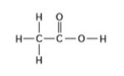
Two moles of the compound in the figure would weigh how many grams? (Note: The atomic
masses, in daltons, are approximately 12 for carbon, 1 for hydrogen, and 16 for oxygen.)
A) 30
B) 60
C) 90
D) 120
D) 120
27) How many grams of the compound in the figure are required to make 1 liter of a 0.5 M
solution? (Note: The atomic masses, in daltons, are approximately 12 for carbon, 1 for hydrogen,
and 16 for oxygen.)
A) 30
B) 60
C) 90
D) 120
A) 30
28) How much of 0.5 M glucose (molecular mass 180) is needed to provide 100 mg of glucose?
A) 1.11 mL
B) 0.11 mL
C) 100 mL
D) 10 mL
A) 1.11 mL
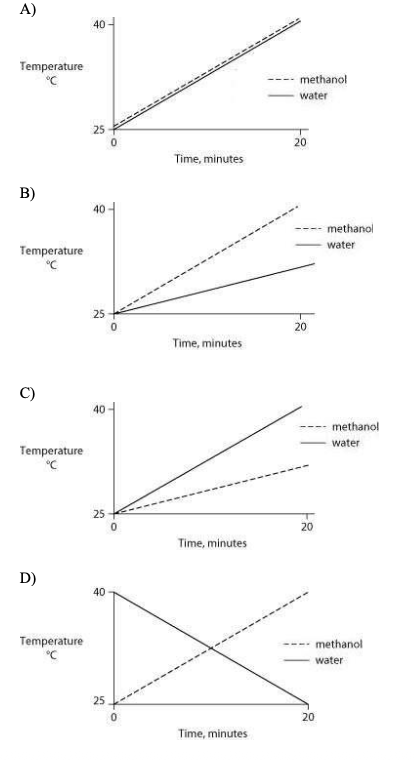
Identical heat lamps are arranged to shine on two identical containers, one containing water
and one methanol (wood alcohol), so that each liquid absorbs the same amount of energy minute
by minute. The covalent bonds of methanol molecules are nonpolar, so there are no hydrogen
bonds among methanol molecules. Which of the following graphs correctly describes what will
happen to the temperature of the water and the methanol?
B
30) Rank, from low to high, the pH of blood, stomach acid, and urine.
A) blood, urine, and stomach acid
B) stomach acid, blood, and urine
C) urine, blood, stomach acid
D) stomach acid, urine, blood
D) stomach acid, urine, blood
31) A solution with a pH of 2 has how many more protons in it than a solution with a pH of 4?
A) 5 times more
B) 10 times more
C) 100 times more
D) 1000 times more
C) 100 times more
32) Consider the following reaction at equilibrium: CO2 + H2O effect of adding additional H2O?
A) It would drive the equilibrium dynamics to the right.
B) It would drive the equilibrium dynamics to the left.
C) Nothing would happen because the reactants and products are in equilibrium.
D) Reactions in both the directions will slow down.
A) It would drive the equilibrium dynamics to the right.
33) Which of the following is considered to be a strong base (alkali)?
A) HCl → H+ + Cl-
B) NH3 + H+ ⇔ NH4+
C) H2CO3 ⇔ HCO3- + H+
D) NaOH → Na+ + OH-
D) NaOH → Na+ + OH-
34) A 0.01 M solution of a substance has a pH of 2. What can you conclude about this
substance?
A) It is a strong acid that dissociates completely in water.
B) It is a strong base that dissociates completely in water.
C) It is a weak acid.
D) It is a weak base.
A) It is a strong acid that dissociates completely in water.
35) A solution contains 0.0000001 (10-7) moles of hydrogen ions [H+] per liter. Which of the
following best describes this solution?
A) acidic: H+ acceptor
B) basic: H+ acceptor
C) acidic: H+ donor
D) neutral
D) neutral
36) What is the pH of a solution with a hydroxyl ion (OH-) concentration of 10-10 M?
A) pH 2
B) pH 4
C) pH 10
D) pH 12
B) pH 4
37) What is the hydroxyl ion (OH-) concentration of a solution of pH 8?
A) 8 M
B) 8 × 10⁻⁶ M
C) 10-8 M
D) 10-6 M
D) 10-6 M
38) Which of the following statements is true about buffer solutions?
A) They maintain a constant pH of 7.
B) They maintain a constant pH when acids are added to them but not when bases are added to
them.
C) They fluctuate in pH when either acids or bases are added to them.
D) They maintain a relatively constant pH when either acids or bases are added to them.
D) They maintain a relatively constant pH when either acids or bases are added to them.

39) One of the buffers that contribute to pH stability in human blood is carbonic acid (H2CO3).
Carbonic acid is a weak acid that, when placed in an aqueous solution, dissociates into a
bicarbonate ion (HCO3-) and a hydrogen ion (H+). (See figure.)
If the pH of blood drops, one would expect ________.
A) a decrease in the concentration of H2CO3 and an increase in the concentration of HCO3-
B) the concentration of bicarbonate ions (HCO3-) to increase
C) the HCO3- to act as a base and remove excess H+ by the formation of H2CO3
D) the HCO3- to act as an acid and remove excess H+ by the formation of H2CO3
C) the HCO3- to act as a base and remove excess H+ by the formation of H2CO3
40) Carbon dioxide in the atmosphere dissolves with the raindrops. The pH of raindrops is
________.
A) slightly acidic
B) slightly basic
C) same as pure water
D) depends on the altitude where rain drops are formed
A) slightly acidic
41) Assume that acid rain has lowered the pH of a particular lake to pH 5.0. What is the
hydroxide ion concentration of this lake?
A) 1 × 10⁻⁹ mol of hydroxide ions per liter of lake water
B) 1 × 10⁻⁵ mol of hydroxide ions per liter of lake water
C) 5.0 M hydroxide ion
D) 5.0 × 10⁻⁵ mol of hydroxide ions per liter of lake water
A) 1 × 10⁻⁹ mol of hydroxide ions per liter of lake water
42) Consider two solutions: solution X has a pH of 4; solution Y has a pH of 7. From this
information, we can reasonably conclude that ________.
A) solution Y has no free hydrogen ions (H+)
B) the concentration of hydrogen ions in solution Y is 1000 times as great as the concentration of
hydrogen ions in solution X
C) the concentration of hydrogen ions in solution X is 3 times as great as the concentration of
hydrogen ions in solution Y
D) the concentration of hydrogen ions in solution X is 1000 times as great as the concentration of
hydrogen ions in solution Y
D) the concentration of hydrogen ions in solution X is 1000 times as great as the concentration of
hydrogen ions in solution Y
43) As the [H3O+] of the solution decreases, the [OH-] ________.
A) increases and thus pH increases
B) increases and thus pH decreases
C) decreases and thus the pH decreases
D) decreases and thus the pH increases
A) increases and thus pH increases
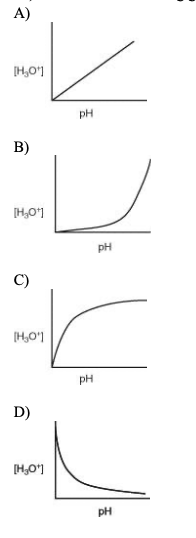
44) Which of the following graphs describes the relationship between [H3O+] and pH?
D
45) A beaker contains 100 milliliters (mL) of NaOH solution at pH = 13. A technician carefully
pours into the beaker 10 mL of HCl at pH = 1. Which of the following statements correctly
describes the result of this mixing?
A) The concentration of Na+ ions will rise.
B) The pH of the beaker's contents will increase.
C) The pH of the beaker's contents will be neutral.
D) The pH of the beaker's contents will decrease.
D) The pH of the beaker's contents will decrease.
46) Increased atmospheric CO2 concentrations might have what effect on seawater?
A) Seawater will become more alkaline, and carbonate concentrations will decrease.
B) There will be no change in the pH of seawater, because carbonate will turn to bicarbonate.
C) Seawater will become more acidic, and carbonate concentrations will decrease.
D) Seawater will become more acidic, and carbonate concentrations will increase.
C) Seawater will become more acidic, and carbonate concentrations will decrease.
47) How would acidification of seawater affect marine organisms? Acidification of seawater
would ________.
A) increase dissolved carbonate concentrations and promote faster growth of corals and shell-
building animals
B) decrease dissolved carbonate concentrations and promote faster growth of corals and shell-
building animals
C) increase dissolved carbonate concentrations and hinder growth of corals and shell-building
animals
D) decrease dissolved carbonate concentrations and hinder growth of corals and shell-building
animals
D) decrease dissolved carbonate concentrations and hinder growth of corals and shell-building
animals
48) If the cytoplasm of a cell is at pH 7, and the mitochondrial matrix is at pH 8, then the
concentration of H+ ions ________.
A) is 10 times higher in the cytoplasm than in the mitochondrial matrix
B) is 10 times higher in the mitochondrial matrix than in the cytoplasm
C) in the cytoplasm is 7/8 the concentration in the mitochondrial matrix
D) in the cytoplasm is 8/7 the concentration in the mitochondrial matrix
A) is 10 times higher in the cytoplasm than in the mitochondrial matrix
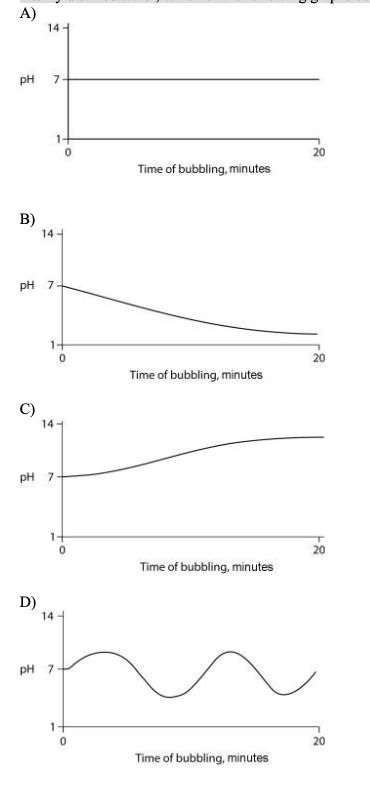
49) Carbon dioxide (CO2) is readily soluble in water, according to the equation CO2 + H2O ↔
H2CO3. Carbonic acid (H2CO3) is a weak acid. If CO2 is bubbled into a beaker containing pure,
freshly distilled water, which of the following graphs correctly describes the results?
B
50) The loss of water from a plant by transpiration cools the leaf. Movement of water in
transpiration requires both adhesion to the conducting walls and wood fibers of the plant and
cohesion of the molecules to each other. A scientist wanted to increase the rate of transpiration of
a crop species to extend its range into warmer climates. The scientist substituted a nonpolar
solution with an atomic mass similar to that of water for hydrating the plants. What do you
expect the scientist's data will indicate from this experiment?
A) The rate of transpiration will be the same for both water and the nonpolar substance.
B) The rate of transpiration will be slightly lower with the nonpolar substance as the plant will
not have evolved with the nonpolar compound.
C) Transpiration rates will fall to zero as nonpolar compounds do not have the properties
necessary for adhesion and cohesion.
D) Transpiration rates will increase as nonpolar compounds undergo adhesion and cohesion with
wood fibers more readily than water.
C) Transpiration rates will fall to zero as nonpolar compounds do not have the properties
necessary for adhesion and cohesion.
1) Which of the following is a hydrophobic material?
A) paper
B) table salt
C) wax
D) sugar
C) wax
2) We can be sure that a mole of table sugar and a mole of vitamin C are equal in their
A) mass.
B) volume.
C) number of atoms.
D) number of molecules.
D) number of molecules.
3) Measurements show that the pH of a particular lake is 4.0. What is the hydrogen ion
concentration of the lake?
A) 4.0 M
B) 10-10 M
C) 10-4 M
D) 104 M
C) 10-4 M
4) Measurements show that the pH of a particular lake is 4.0. What is the hydroxide ion
concentration of the lake?
A) 10-10 M
B) 10-4 M
C) 10-7 M
D) 10.0 M
A) 10-10 M
5) A slice of pizza has 500 kcal. If we could burn the pizza and use all the heat to warm a 50-L
container of cold water, what would be the approximate increase in the temperature of the water?
(Note: A liter of cold water weighs about 1 kg.)
A) 50°C
B) 5°C
C) 100°C
D) 10°C
D) 10°C
 Note
Note  Flashcards (51)