5. Energy Changes
 Studied by 0 people
 Call Kai
 Learn
Learn Practice Test
 Spaced Repetition
 Match
Match Flashcards
 Knowt Play
1/25

There's no tags or description
Looks like no tags are added yet.
Name | Mastery | Learn | Test | Matching | Spaced |
|---|
No study sessions yet.
26 Terms
What happens to energy during chemical reactions?
It’s conserved
Amount of energy in universe at beginning and end
Same
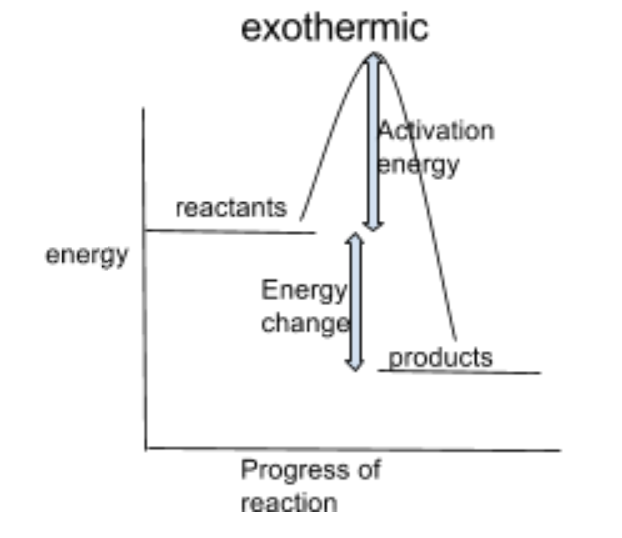
Energy levels of products and reactants in EXO
Product molecules must have less energy than reactants by amount transferred
What is an exothermic reaciton?
Transfers energy to the surroundings, so temp of surroundings increases
What are some examples of exothermic reactions?
Combustions, Oxidation, Neutralisation
Self-heating cans, hand warmers
What is an endothermic reaction?
Takes in energy from surroundings so temp of surroundings decreases
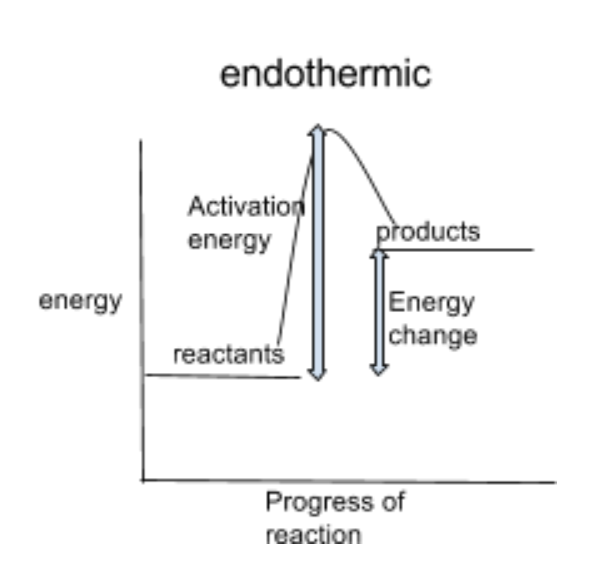
Product molecules must have more energy than reactants
What are examples of endothermic reactions?
Thermal Decomposition, Reaction of citric acid and sodium hydrogencarbonate
Some sports injury packs
When can chemical reactions occur?
When reacting particles collide with a sufficient energyW
What is activation energy?
Minimum amount of energy that particles must have to react
What do reaction profiles show?
Relative energies of reactants and products
Activation Energy
Overall Energy Change
Exo reaction profile
Energy of reactants higher than energy of products (products have less energy than reactants because heat is released to surroundings)
Endo reaction profile
Energy of products higher than energy of reactants (energy from surroundings taken in)
Energy during reactions?
Energy must be SUPPLIED to BREAK bonds in reactants
Energy is RELEASED when bonds are FORMED
Bond energy calculations
Sum of energy taken in to break bonds - sum of energy released to form bonds = overall energy change
Energy taken in to break MORE THAN (>) energy released when formed
ENDO : overall energy taken in
Energy taken in to break LESS THAN (<) energy released when formed
EXO (overall energy released)
What reacts to produce electricity in cells?
Chemicals
What does voltage produced by a cell depend on?
A number of factors like type of electrode and electrolyte
How can a simple cell be made?
By connecting two different metals in contact with an electrolyte
What are batteries?
Two or more cells connected together in series to provide a greater voltage
Non-rechargeable cells and batteries
Chemical reactions stop when one of the reactants has been used up
Alkaline batteries are non-rechargeable
Rechargeable cells and batteries
Can be recharged because the chemical reactions are reversed when an external electrical current is supplied
What are fuel cells?
Supplied by external source of fuel (e.g Hydrogen) and oxygen or air. The fuel is oxidised electrochemically within the fuel cells to produce a p.d
Overall reaction hydrogen fuel cell involves the oxidation of hydrogen to produce water
Hydrogen fuel cells offer a potential alternative to rechargeable cells and batteries
Qualities of Hydrogen Fuel Cells
Fuel cells can be used constantly provided that fuel keeps being put in
Hydrogen is a gas so needs to be stored at high pressure and so is harder to transport
Only produces water when burnt
Qualities of rechargeable batteries
Can be recharged by reversing reaction, so fuel doesn’t need to keep being supplied
Hard to dispose of (non-biodegradable)
Will eventually stop working
Equations for each half-cell (Fuel Cells)
Anode (positive electrode): H2 (g) → 2e- + 2H+(aq)
Cathode (Negative electrode): 4H+(aq) + O2(g) + 4e- → 2H2O(g)
 Note
Note  Flashcards (225)