3.2 Pathophysiology of the Eye - Brisket
 Call Kai
 Learn
Learn Practice Test
 Spaced Repetition
 Match
Match Flashcards
 Knowt Play
1/94

Earn XP
Description and Tags
booooo
Name | Mastery | Learn | Test | Matching | Spaced | Call with Kai |
|---|
No analytics yet
Send a link to your students to track their progress
95 Terms
sebaceous glands produce the ____ components of tears
protective lipid
________ glands produce the protective lipid components of tears
sebaceous
name the three sebaceous glands that make tears
glands of zeis
glands of moll
meibomian glands
wehre are glands of zeis found
base of eyelash hair follicle
where are glands of moll found
base of eyelash
where are meibomian glands found
inner rim of the eyelid
eyelids function
protection, moisture, tear production, tear spreading
the bulbar conjunctiva cover the …
sclera
the palpebral conjunctiva lines the …
eyelid
the palpebral conjunctiva is continuous with …
the corneal epithelium
what is the fornix
the space formed at reflection of bulbar and palpebral conjunctivae
what part of the eye makes the aqueous component of tears?
Lacrimal apparatus
what part of the eye drains tears from eyes?
Lacrimal apparatus
function of the Lacrimal apparatus
Produces the aqueous component of tears; drains tears from eye
tears have layers (like ogres), describe the outer layer
lipid layer made by the eyelid sebaceous glands
tears have layers (like ogres), describe the aqueous layer
thick, made by the lacrimal gland
contains salts, lysozymes and other proteins
tears have layers (like ogres), describe the inner layer
mucin layer made by specialized cells in the conjunctiva and corneal epithelium
what is the purpose of tears
Protects, cleans, lubricates, and moistens the eyeball
what type of innervation controls tears
parasympathetic
anticholinergic drugs can ____ tear production
decrease
tears pathway
pass through two lacrimal puncta into canaliculi which drain into the lacrimal sac; the nasolacrimal duct carries tears to the nasal cavity
the eye is made of ____ layers (tunics)
3
the outside layer is called the …
fibrous tunic
what two structures make up the fibrous layer of the eye
the sclera and the cornea
describe the sclera
avascular
white of the eye
dense with collagen fibers
protective
site of muscle attachment
what part of the eye is the site of muscle attachment?
sclera
describe the cornea
vascular
physical characteristics
avascular
transparent and made of five layers
what part of the eye is the major refractory structure?
cornea
what part of the eye is responsible for the majority of the eye focusing?
cornea
what is the role of the cornea?
major refractory structure
majority of the eye focusing
what is the limbus
transitional zone where the cornea meets the sclera
the limbus contains which structures (3)
bulbar conjunctiva
Trabecular meshwork
Canal of Schlemm
what is the middle layer of the eye called
the vasucalr/uvea layer
the vascular/uvea layer of the eye contains what three structures
choroid, ciliary body, and iris
describe the choroid characteristics
hella vascular
melanocyte produced melanin absorbs light rays
what part of the eye prevents light scattering?
choroid
function of the choroid?
prevent light scattering
describe ciliary bodies
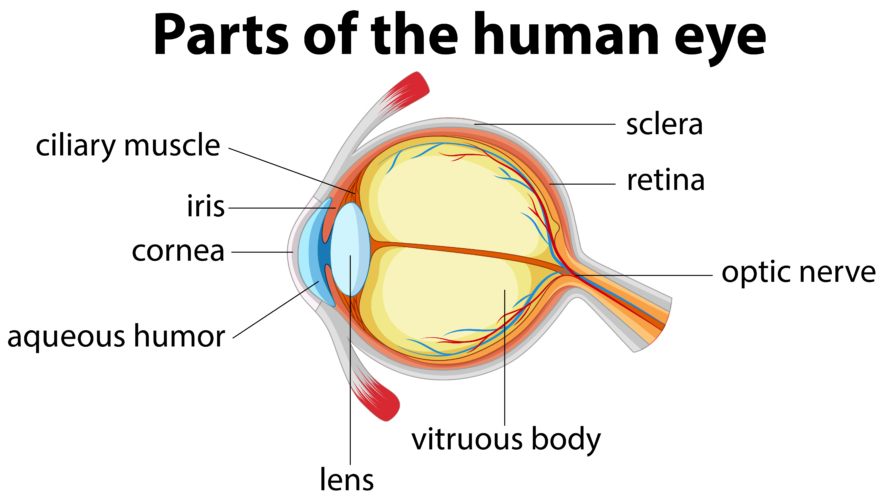
makes the aqueous humor
zonular fibers that attach to the lens
ciliary muscle that alters the shape of the lens
where is the lens
posterior to the iris/pupil
describe the lens
crystallin proteins arranged like onion layers
held in place by zonular fibers;
describe the iris
Stroma consisting of melanocytes (number determines eye color)
which part of the eye has the pupille muscles?
iris
function of pupillae muscles
control the size of the pupils
which part of the eye is responsible for fine focusing?
the lens
what is the function of the lens?
fine focus
decreased ability to fine focus by the lens is a condition called…
presbyopia
what is presbyopia?
decreased ability to fine focus by the lens
describe the Pupil
hold defined by the iris
appears black due to pigmentation of choroid and retina
size is controlled by pupillae muscles
the interior of the eye consists of two fluid filled cavities, what are tehy
anterior and posterior cavity
the anterior cavity contains a ____ fluid called the ________
clear watery
aqueous humor
the anterior cavity is divided into _____ chambers
2
the anterior cavity is divided into two chambers, name them
anterior and posterior
where is the anterior chamber of the anterior cavity
bt the cornea and iris
where is the posterior chamber of the anterior cavity
between the iris and the vitreous/posterior chamber
the posterior cavity is the _____
vitreous chamber
which cavity of the eye is divided into two chambers?
anterior
the posterior cavity is filled with…
the vitreous humor
describe the vitreous humor
jelly/watery
contains hyaluronic acid and collagen fibers
the posterior cavity of the eye occupies _____ of the eyeball
4/5
the posterior cavity of the eye maintains…
eye shape
the posterior cavity of the eye holds the ______ against the _______
retina against choroid
the posterior cavity of the eye contains ____to clear debris
phagocytic cells
describe the Aqueous humor physical characteristics
clear fluid
serum ultrafiltrate
Aqueous humor fills the…
anterior and posterior chambers (anterior compartment) of the eye
Aqueous humor is made by…
ciliary body epithelium
Aqueous humor function
Provides nutrients, removes wastes, transports neurotransmitters to avascular lens and cornea.
Maintains structural integrity of ocular structures via intraocular pressure (IOP)
How is the Aqueous humor made:
step 1:
ciliary body epithelial cells actively secrete Na and bicarbonate
How is the Aqueous humor made: ;
step 1: ciliary body epithelial cells actively secrete Na and bicarbonate
step 2:
osmotic gradient is formed
How is the Aqueous humor made: ;
step 1: ciliary body epithelial cells actively secrete Na and bicarbonate
step 2: osmotic gradient is formed
step 3:
pulls water from the ciliary stromal ultrafiltrate
How is the Aqueous humor made: ;
step 1: ciliary body epithelial cells actively secrete Na and bicarbonate
step 2: osmotic gradient is formed
step 3: pulls water from the ciliary stromal ultrafiltrate
step 4:
puts water into the posterior chamber of the anterior cavity
How is the Aqueous humor made: ;
step 1: ciliary body epithelial cells actively secrete Na and bicarbonate
step 2: osmotic gradient is formed
step 3: pulls water from the ciliary stromal ultrafiltrate
step 4: puts water into the posterior chamber of the anterior cavity
step 5:
the AH is made! (woo!)
Carbonic anhydrase (primarily isoenzyme type II), α and β adrenergic receptors, and sodium- and potassium-activated adenosine triphosphatases are expressed by __________ and are involved in sodium and bicarbonate secretion.
ciliary epithelium
which receptors does the ciliary epithelium express that are involved in Na and bicarb secretion?
Carbonic anhydrase (primarily isoenzyme type II),
α and β adrenergic receptors
sodium- and potassium-activated adenosine triphosphatases
what is the major contributor to aqueous humor formation?
Active transport by non-pigmented epithelial cells
Energy required for active transport is generated by ATP hydrolysis to ADP, mediated by the enzyme Na-K-ATPase, where is this enzyme found?
on both pigmented and non-pigmented ciliary epithelia
Carbonic anhydrase, an enzyme also found in pigmented and non-pigmented ciliary epithelia, mediates ______
bicarbonate transport across ciliary epithelium
How does Carbonic anhydrase, an enzyme also found in pigmented and non-pigmented ciliary epithelia, mediates bicarbonate transport across ciliary epithelium?
via hydration of CO₂, forming HCO₃⁻ and protons
Bicarbonate formation regulates pH for optimal active ion transport, which influences________ by affecting sodium.
fluid transport
molecules actively transported across epithelium via chloride channels include…
Chloride
ascorbic acid
certain amino acids
Active transport produces an _____ across the ciliary epithelium
osmotic gradient
Active transport produces an osmotic gradient across____
the ciliary epithelium
Active transport produces an osmotic gradient across the ciliary epithelium, promoting _______ via ultrafiltration and diffusion
the movement of other plasma components
Active transport produces an osmotic gradient across the ciliary epithelium, promoting the movement of other plasma components via ________
ultrafiltration and diffusion
Aqueous humor exits the anterior chamber by two routes, what are they?
conventional and unconventional
describe the conventional outflow pathway for the AH
trabecular network to the canal of schlemm
describe the unconventional outflow pathway for the AH
through ciliary body and suprachoroidal pathway
Cholinergic agents (pilocarpine) ______ outflow by physically opening the meshwork pores secondary to ciliary muscle contraction
increase

how do Cholinergic agents (pilocarpine) increase outflow?
by physically opening the meshwork pores secondary to ciliary muscle contraction
ROCK inhibitors enhance the _____ outflow through trabecular meshwork.
aqueous humor
Prostaglandins remodel meshwork extracellular matrix, ______ mainly uveoscleral outflow.
increasing
Uveoscleral aqueous humor outflow is increased by ______
prostaglandin analogs and α2 adrenergic agonists.
Novel adenosine receptor agonists, cannabinoids, serotonin agents, and dopamine agonists increase aqueous humor outflow, ________ IOP.
reducing
IOP is not constant and changes with ….
pulse, blood pressure, forced expiration or coughing, neck compression, and posture.
T or F:
IOP is constant
F
name drugs that can increase IOP
all steroids
anticholinergics
succinylcholine

