Chapter 5
 Studied by 0 people
 Call Kai
 Learn
Learn Practice Test
 Spaced Repetition
 Match
Match Flashcards
 Knowt Play
1/15

There's no tags or description
Looks like no tags are added yet.
Name | Mastery | Learn | Test | Matching | Spaced | Call with Kai |
|---|
No analytics yet
Send a link to your students to track their progress
16 Terms
What are the two ways to compute rentals?
Earnings leftover in the industry after paying labor or as the marginal product of capital or land times the price of the good produced in each industry.
Payments to Capital
PM * QM - W * LM
Payments to Land
PA * QA - W * LA
Wage in Manufacturing
PM * MPLM
Wage in Agriculture
PA * MPLA
We assume wages will equalize represented in this formula
(PM / PA) = (MPLA / MPLM)
In Specific-Factors, Land and Labor are ___.
fixed
In the long-run and inflow of either factor of production will leave factor prices ____.
unchanged
When an inflow of FDI causes K in the economy to increase, the K will go to the ____-intensive industry and cause that output to ____ while the other industry ____.
capital, rise, fall
Immigration benefits the Home country in the ____.
Specific-Factors Model
Suppose Home uses only capital and labor for production of two goods, computers and shoes. There are a total 100 workers and 100 units of capital in the economy. Computers use 2 units of capital for each worker, so that Kc = 2 Lc, whereas shoes use 0.5 unit of capital for each worker, so that Ks = 0.5 Ls. What formula do you use to solve for L and K?
Ks+Kc = Kbar
How does factor earnings (Wage and Rentals on Capital) change due to the inflow of FDI?
With no change in the capital/labor ratios across the two industries, the marginal productivity of the factors remains unchanged, as each L in each sector has same amount of capital to work with even after FDI, similarly each K in each sector has same amount of L to work with. As a result, the wage and the rental on capital remain unchanged.
Suppose Mexico receives an inflow of FDI. There are two factors (labor and capital), and two sectors (Food and Televisions). Televisions are capital intensive goods and Food is labor-intensive. What happens to the output of each good?
As the Rybczynski Theorem states, the increase in capital through FDI increases the output of the capital-intensive industry and reduces the output of the labor-intensive industry.
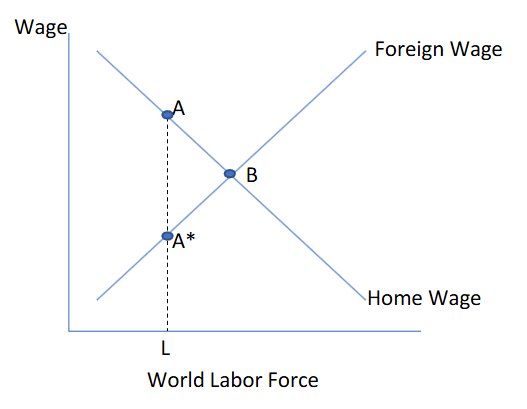
The figure below is a supply and demand diagram for the world labor market. Starting at points A and A*, consider a situation where some Foreign workers migrate to Home, but not enough to reach the equilibrium with full migration (point B). Are there gains that accrue to the Home country?
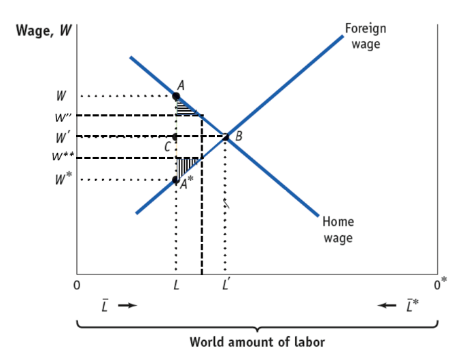
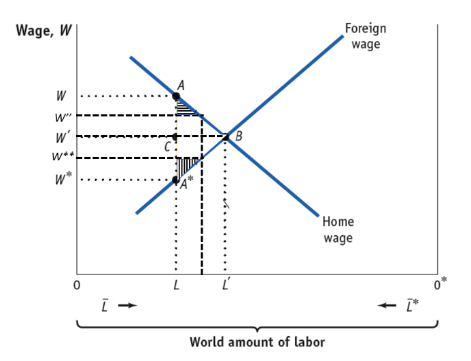
Gains from trade in the following graph are analogous to consumer and producer surplus in the conventional supply and demand setting. In this case, Home employers are willing to pay up to W for the marginal product of labor that they obtain for W′′; thus the gains to the Home country are illustrated by the horizontally striped triangle. Similarly, the immigrating Foreign workers are willing to supply their marginal product for a lower wage in the Foreign country (W) but receive a higher wage in the Home country (W).
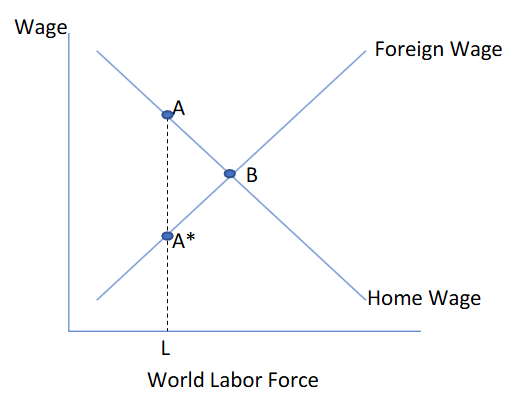
The figure below is a supply and demand diagram for the world labor market. Starting at points A and A*, consider a situation where some Foreign workers migrate to Home, but not enough to reach the equilibrium with full migration (point B). Are there gains that accrue to the Foreign country?
Gains to Foreign (including foreign emigrants) are represented by the vertically striped triangle. Given positive gains to both countries, total gains from immigration are also positive in this model.
Rybczynski Theorem
States that, in the Heckscher–Ohlin model with two goods and two factors, an increase in the amount of a factor found in an economy will increase the output of the industry using that factor intensively and decrease the output of the other industry.
 Note
Note  Flashcards (66)