synapse
 Call Kai
 Learn
Learn Practice Test
 Spaced Repetition
 Match
Match Flashcards
 Knowt Play
1/25

There's no tags or description
Looks like no tags are added yet.
Name | Mastery | Learn | Test | Matching | Spaced | Call with Kai |
|---|
No analytics yet
Send a link to your students to track their progress
26 Terms
synapse
junction between two neurones [or a neurone and an effector]
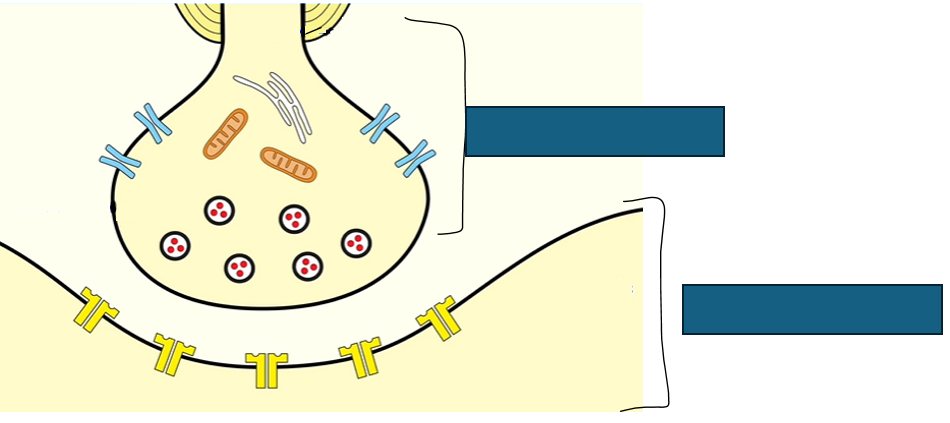
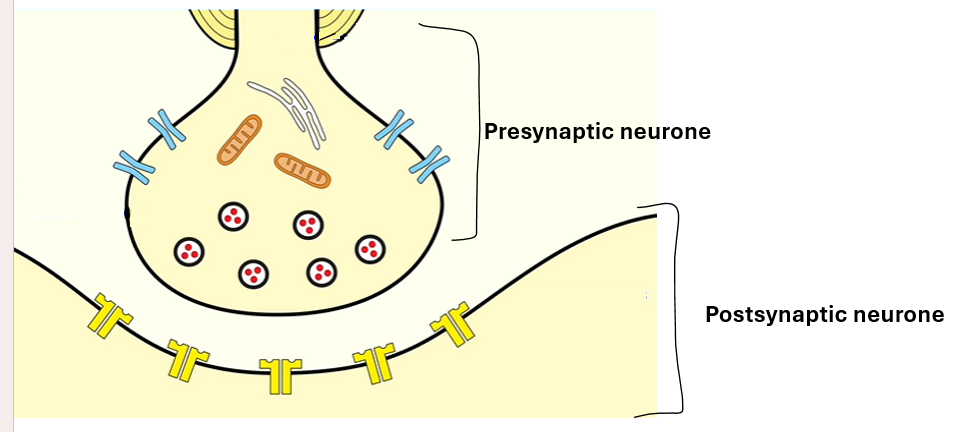
presynaptic neurone→ the neurone before the synapse
postsynaptic neurone→ the neurone after the synapse
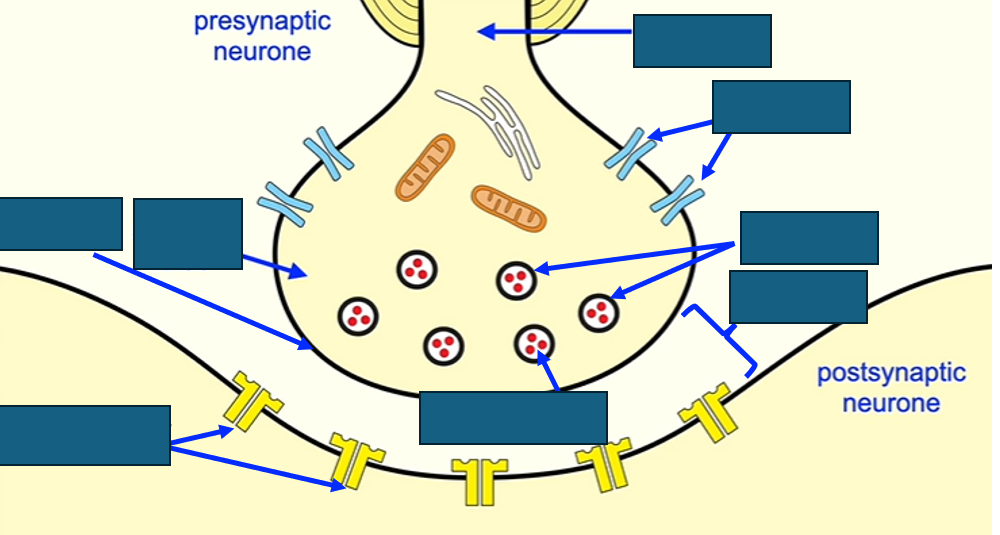
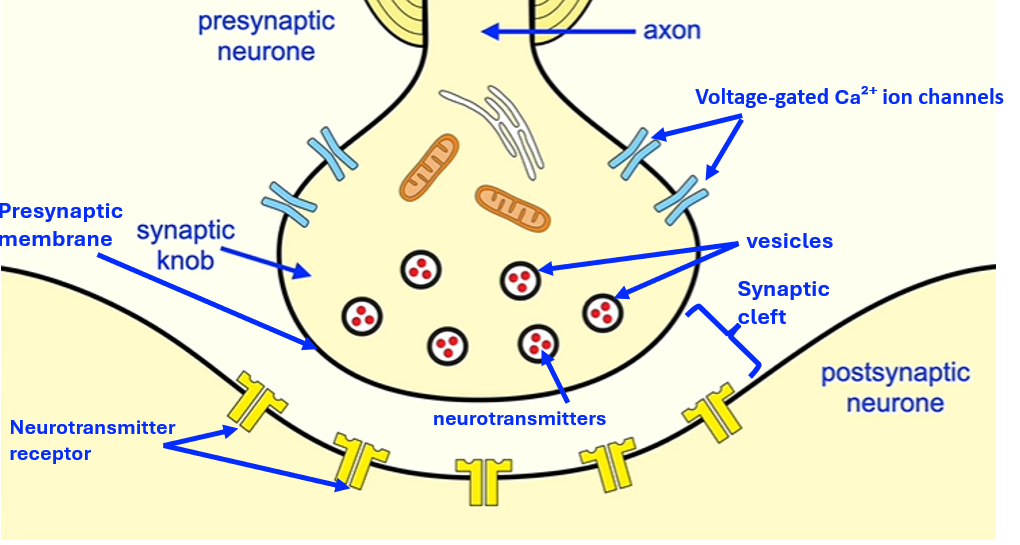
synaptic cleft
narrow gap between the two neurones
what does synaptic knob contain?
what does postsynaptic membrane contain?
synaptic knob
-vesicles containing neurotransmitters
postsynaptic membrane
-Specific neurotransmitter receptor
example of synapse and its neurotransmitters and receptors
synapse: cholinergic synapse
neurotransmitter: acetylcholine (ACh)
receptors: cholinergic receptors
Describe the process of synaptic transmission [nerve impulse is transmitted from one neurone to another across a synapse] (7)
-an action potential arrives at the synaptic knob of the presynaptic neurone
-depolarisation causes voltage-gated Ca2+ channels to open and Ca2+ to diffuse into the synaptic knob
-the influx of calcium ions causes synaptic vesicles to fuse with the presynaptic membrane and release acetylcholine into the synaptic cleft by exocytosis
-acetylcholine diffuses across the synaptic cleft and bind to specific cholinergic receptors on the postsynaptic membrane
-This causes sodium ion channels to open in the postsynaptic membrane and sodium ions diffuse into the postsynaptic neurone
-the influx of sodium ions into the postsynaptic neurone causes depolarisation
-If depolarisation reaches the threshold, a new action potential is generated in the postsynaptic neurone.
what happens to acetylcholine after it binds to a receptor on a postsynaptic membrane? (3)
-Acetylcholinesterase breaks down acetylcholine into choline and ethanoic acid
-choline and ethanoic acid diffuses back into presynaptic neurone
-the products are recycled into acetylcholine
why is it important that acetylcholine is removed?
prevent overstimulation of the postsynaptic membrane
Sometimes, a single impulse is insufficient to generate an action potential in the postsynaptic neurone as the threshold is not reached. what occurs to overcome this?
summation [the build up of neurotransmitters in the synapse to help generate an action potential]
types of summation
spatial summation
-multiple presynaptic neurones release neurotransmitters onto a postsynaptic neurone at the same time→ the combined effect of the neurotransmitters reaches the threshold to trigger an action potential in the postsynaptic neurone
temporal summation
-multiple impulses arrive in quick succession from the same presynaptic neurone→ makes an action potential more likely as more neurotransmitter is released into the synaptic cleft.
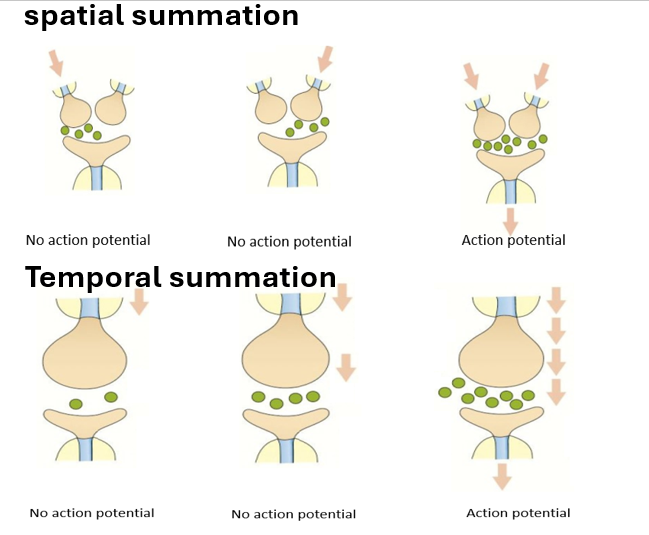
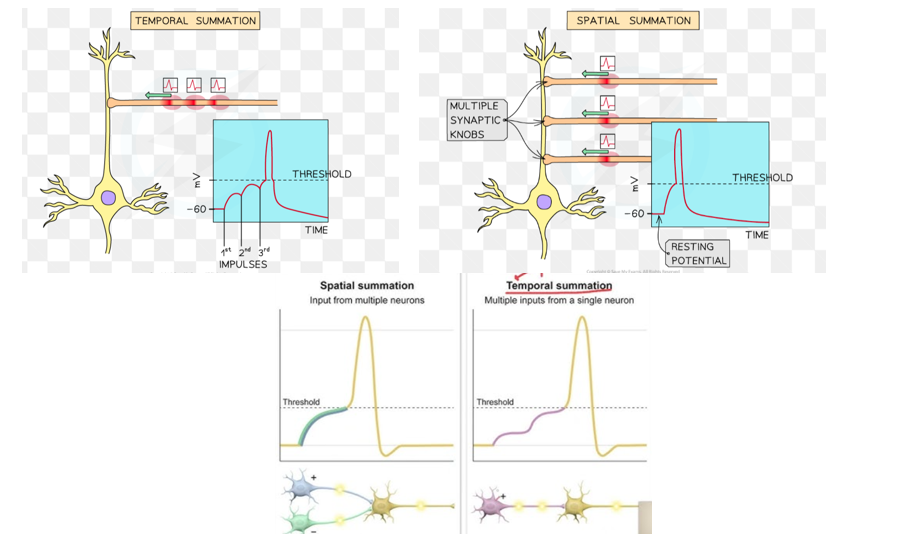
look at ‘Synapses, Neuromuscular Junction and Summation. Cholinergic and inhibitory synapses Miss Estruch’ vid
roles of synapse (7)
-allow neurones to communicate
-ensures transmission is in one direction only
-allow impulses from more than one neurone to be passed to a single neurone [synaptic divergence]
-allow impulses from a single neurone to be passed to more than one neurone [synaptic convergence]
-prevents overstimulation
-enable learning and memory
-allows amplification of many low-level stimuli
![<p>-allow neurones to communicate</p><p>-ensures transmission is in one direction only</p><p>-allow impulses from more than one neurone to be passed to a single neurone <strong>[synaptic divergence]</strong></p><p>-allow impulses from a single neurone to be passed to more than one neurone<strong> [synaptic convergence]</strong></p><p>-prevents overstimulation</p><p>-enable learning and memory</p><p>-allows amplification of many low-level stimuli</p>](https://knowt-user-attachments.s3.amazonaws.com/4b8ca720-da21-44c3-9729-f2478b90955c.png)
how is unidirectional transmission achieved?
-only the presynaptic neurone releases neurotransmitter
-only the postsynaptic neurone has receptors
is transmission slower across a synapse or along a neurone? explain
Transmission across a synapse is slower because neurotransmitters must be released, diffuse across the synaptic cleft and bind to receptors.
types of synapses
excitatory synapse
-a synapse where excitatory neurotransmitters are released
-excitatory neurotransmitters cause depolarisation of the postsynaptic membrane.
-If the depolarisation reaches threshold, it triggers an action potential.
inhibitory synapse
-a synapse where inhibitory neurotransmitters are released
-inhibitory neurotransmitters cause hyperpolarisation of the postsynaptic membrane.
-makes it less likely for an action potential to be triggered
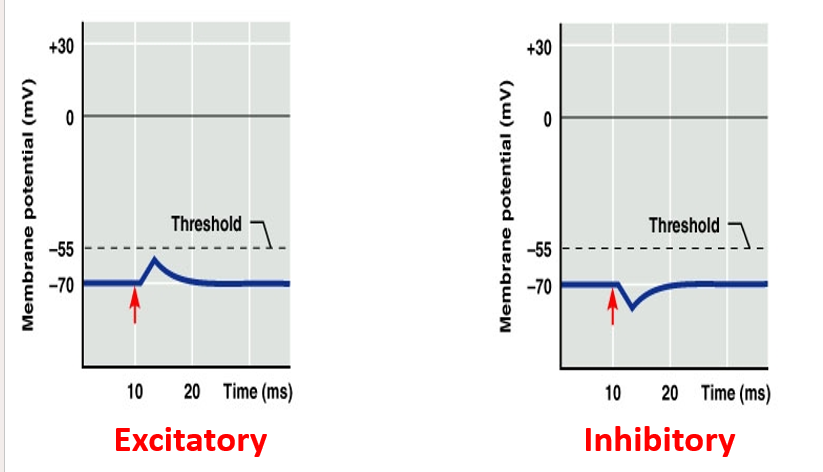
is acetylcholine an example of excitatory or inhibitory neurotransmitter?
excitatory
As synapses use chemical communication, they can be affected by drugs:
•Mimicking
•Inhibiting neurotransmitters
•Inhibiting enzymes
•blocking [pg 304]
a drug blocks blocks voltage-gated sodium ion channels in neurone. affect of this? (7)
-sodium ions cannot diffuse into neurones
-neurone membrane is not depolarised
-membrane potential remains below threshold
-no action potential generated
-Voltage-gated calcium channels do not open
-no neurotransmitter released by exocytosis into synaptic cleft
-no neurotransmitter binds to receptor
why is toxin released from a fish not toxic for them? (2)
-the fish have receptors with a different shape so the toxin cannot bind
-the fish contains antibodies that neutralise the toxin
a toxin has a similar shape to acetylcholine. explain how the presence of the toxin in the synapse will prevent the initiation of an action potential
-toxin has a similar shape to acetylcholine so binds to receptor on postsynaptic neurone
-this blocks acetylcholine from binding to receptor
-sodium ions cannot diffuse in neurone
-The postsynaptic membrane is not depolarised.
-The membrane potential does not reach threshold so no action potential is initiated.
nerve gases inhibit acetylcholinesterase, prolonging the effect of acetylcholine. Atropine has a similar shape to acetylcholine. how can atropine act as a antidote to nerve gas?
-atropine binds to receptors
-this blocks acetylcholine from binding to receptor
-prevents overstimulation of the postsynaptic membrane
a drug enters vesicles, causing vesicles to fuse with presynaptic membrane. explain the effect of the drug on the nervous system. (3)
-more exocytosis of neurotransmitters into synaptic clefts
-more neurotransmitters binds to receptors on postsynaptic membranes
-more action potentials are generated in postsynaptic neurones
a drug blocks the transport of neurotransmitters from the synaptic cleft back into the presynaptic neurone. explain the effect of the drug on the nervous system. (3)
-more neurotransmitters remain the the synaptic cleft
-neurotransmitters bind to receptors on postsynaptic membranes
-more action potentials are generated in postsynaptic neurones
a chemical blocks acetylcholine on postsynaptic membranes. explain the effect of the chemical on the nervous system. (2)
-fewer acetylcholine molecules bind to receptors on postsynaptic membranes
-fewer action potentials are generated in postsynaptic neurones
a drug blocks receptors at neuromuscular junctions. Doctors use this drug as an anaesthetic as it temporarily paralyses muscles. explain how drug works. (3)
-the drug prevents neurotransmitter from binding to the receptors
-sodium ion channels on the muscle cells do not open so sodium ions cannot diffuse into the muscle cells
-no action potentials can be generated so the muscles cannot be stimulated to contract [resulting in temporary paralysis]

