Neuro Lab 2
 Call Kai
 Learn
Learn Practice Test
 Spaced Repetition
 Match
Match Flashcards
 Knowt Play
1/166

There's no tags or description
Looks like no tags are added yet.
Name | Mastery | Learn | Test | Matching | Spaced | Call with Kai |
|---|
No analytics yet
Send a link to your students to track their progress
167 Terms
the motor neural pathway has upper motor neuron synapsing to
lower motor neuron
parts that make up the motor nervous system include:
motor planning areas (cortex), control circuits (cerebellum, basal nuclei), motor tract, spinal interneurons, lower motor neurons, skeletal muscles
premotor cortex:
plans, organizes, and coordinates groups of muscles to work together. plans how to move based on sensory feedback
supplementary motor cortex:
movement coordination particularly both sides of the body
Primary motor cortex:
carries out the complex movements and is located in the posterior region of the frontal lobe within the precentral gyrus
control circuts consist of:
cerebellum, basal nuclei
cerebellum provides for smooth coordinated movement by
processing info from the motor cortex, proprioception, and other sensory inputs
Basal nuclei can influence motor movements made by
the primary motor cortex: also helps start, stop, and control the intensity of movements; helps influence balance and gait.
Motor tracts deliver movement information from
primary motor cortex to lower motor neurons in the spinal cord or brain stem
there are three types of descending motor tracts
Postural/gross movement tracts
fine movement and limb flexion tracts
nonspecific UMN tract
Postural/gross movement tracts
control skeletal muscle activity (unconscious or involuntary)
fine movement and limb flexion tracts
controls limbs and face movements
nonspecific UMN tract
facilitates all LMNs
spinal interneurons:
some descending pathways connect to a connector neuron before synapsing with LMNs
lower motor neurons (LMNs)
directly innervates the effector (skeletal muscle fibers)
There are two types of LMNs:
Alpha motor neurons and Gamma motor neurons
Alpha motor neurons
have large cell bodies and large myelinated axons. Axons of alpha motor neurons project to extrafusal skeletal muscle
Gamma motor neuron:
have medium sized myelinated axons.Axons of gamma motor neurons project to intrafusal fibers in the muscle fibers
skeletal muscles (effectors)
composed of proteins like actin and myosin
Upper motor neurons (UMN) arise directly from the
cerebral cortex or arise within the brainstem
The UMNs axon travel in descending tracts to synapse with
LMN or interneurons in the brainstem or spinal cord.
UMNs are classified into 3 types according to whether they synapse
medially, laterally, or throughout the ventral horn
medial UMNs signal LMNs that innervate
postural and trunk muscles.
Four tracts arise from the brain stem and are involuntary and one arises directly from the cerebral cortex and is voluntary
Tectospinal tract
medial vestibulospinal tract
lateral vestibulospinal tract
medial reticulospinal tract
medial (anterior) corticospinal tract
tectospinal tract
this tract arises in the superior colliculus section of the tectum (posterior midbrain), crosses the midline and synapses in the cervical region of the spinal cord
medial vestibulospinal tract
This tract arises from the medial vestibular nucleus in the upper medulla, crosses midline and projects bilaterally and synapses in the cervical region of the spinal cord
lateral vestibulospinal tract
this tract arises from the lateral vestibular nucleus in the upper medulla, projects ipsilateally and synapses in the cervical and lumbar regions of the spinal cord.
medial reticulospinal tract
this tract begins in the pontine reticular formation, travels ipsilaterally and synapses in the cervical and limbar spinal cord regions
medial (anterior) corticospinal tract
this pathway is the direct connection from the cerebral cortex to the spinal cord and travels ipsilaterally; synapse in the cervical spinal region.
stimulates muscles, coordinates movements of the head and neck toward visual and auditory stimuli
tectospinal tract
stimulates LMNs innervating head, neck, and upper back muscles. Helps maintain balance during standing and moving.
Medial vestibulospinal tract
facilitates stimulation of LMNs to extensors and inhibits LMNs to flexors
lateral vestibulospinal tract
neural activity stimulates postural, trunk muscles (muscle tone) and stimulates proximal limb extensors
medial reticulospinal tract
voluntary pathway conveys information to LMNs that consciously controls head movemnets
Medial (anterior) corticospinal tracts.
Upper motor neuron disorders
Paresis or paralysis
causes of paresis or paralysis
spinal cord injury, cerebral palsy, ms, trauma or stroke
Paresis
partial loss of voluntary muscle contraction due to UMN lesion
paralysis
complete loss of voluntary muscle contraction
three types of paralysis
Hemiplegia, Paraplegia, Tetraplegia/quadriplegia
hemiplegia
loss affecting one side of the body; usually brain injury
paraplegia
loss affects the body below the arms: usually spine below T1
tetraplegia/quadriplegia
loss affects all four limbs; spinal damage, cervial region
Lower motor neuron disorders
atrophy, flaccid paralysis, abnormal reflexes
causes of LMN disorders
trauma, poliovirus, degenerative or vascular disorders and tumors can damade LMNs
Atrophy
loss of muscle bulk. two types: disuse- results from lack of muscle use and Neurogenic- results from damage to the LMNs
Flaccid paralysis:
weakness or loss of muscle tone (stiffness or resistance to stretch or limp and cannot contract. caused by infections or inflamations
Abnormal reflexes
abnormal cutaneous reflexes, Babinskis sign, clonus
abnormal cutaneous reflexes
changes in cutaneous reflec in respnse to normally innocuous stimuli, can be due to spinal cord injury with testing of flexors
Babinskis sign reflex
Extension of great toe, often accompanied by fanning of the other toes. It occurs onlu in people with corticospinal tract lesions or infants less than 7months
clonus reflex
involuntary, repeating, rhythmic muscle contractions
Tract
A bundle of axons traveling together in the CNS
Nerve
A bundle of axons traveling together in the PNS
Nucleus
A cluster of neuron cell bodies in the CNS
Ganglion
A cluster of neuron cell bodies in the PNS
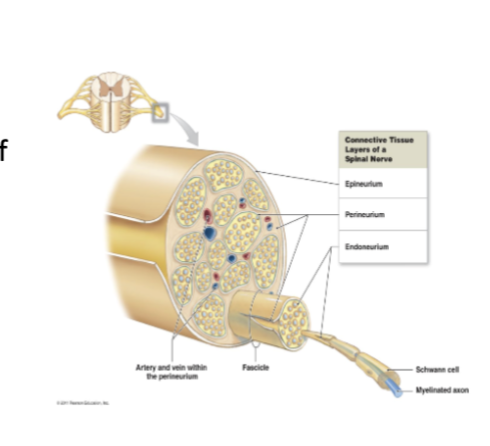
Structure of a peripheral nerve
nerve fiber, Fascicle, Endoneurium, perineurium, Epineurium
nerve fiber
myelinated or unmyelinated axonpresent in a nerve
fascicle
a bundle of nerve fibers/axons
endoneurium
connective tissue layer that surrounds a single nerve fiber
perineurium
connective tissue layer that surrounds a fascicle
epineurium
connective tissue layer that surrounds an entire nerve trunk
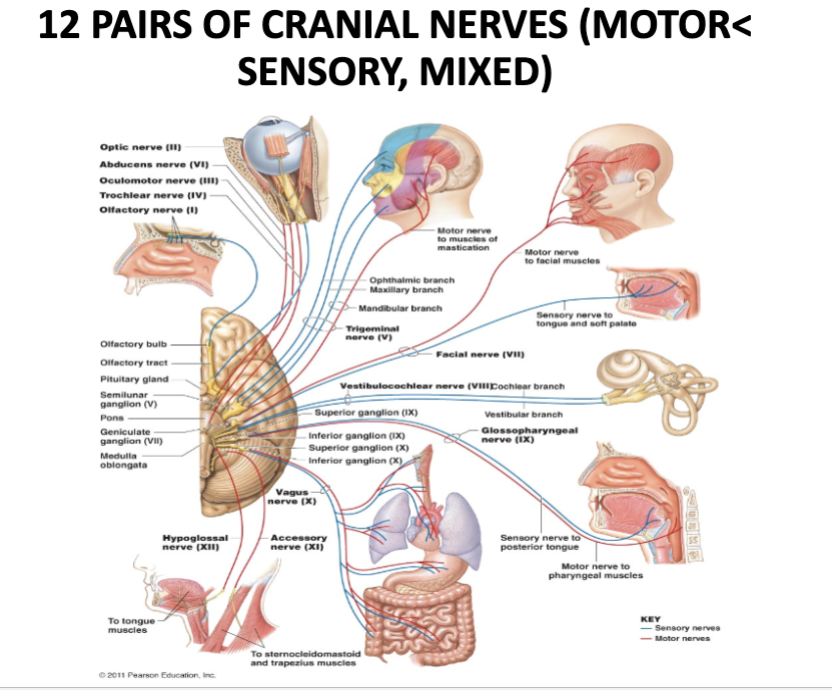
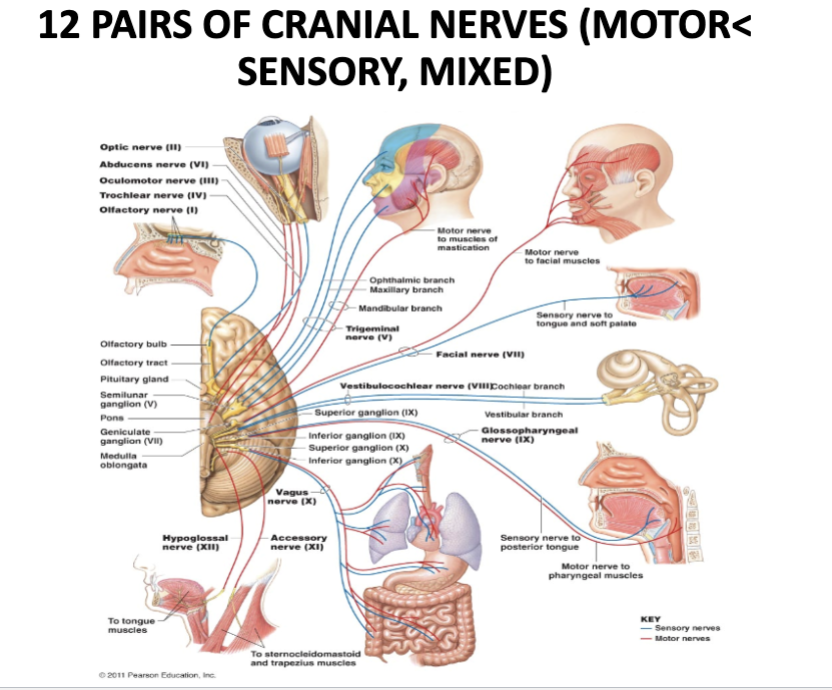
know this
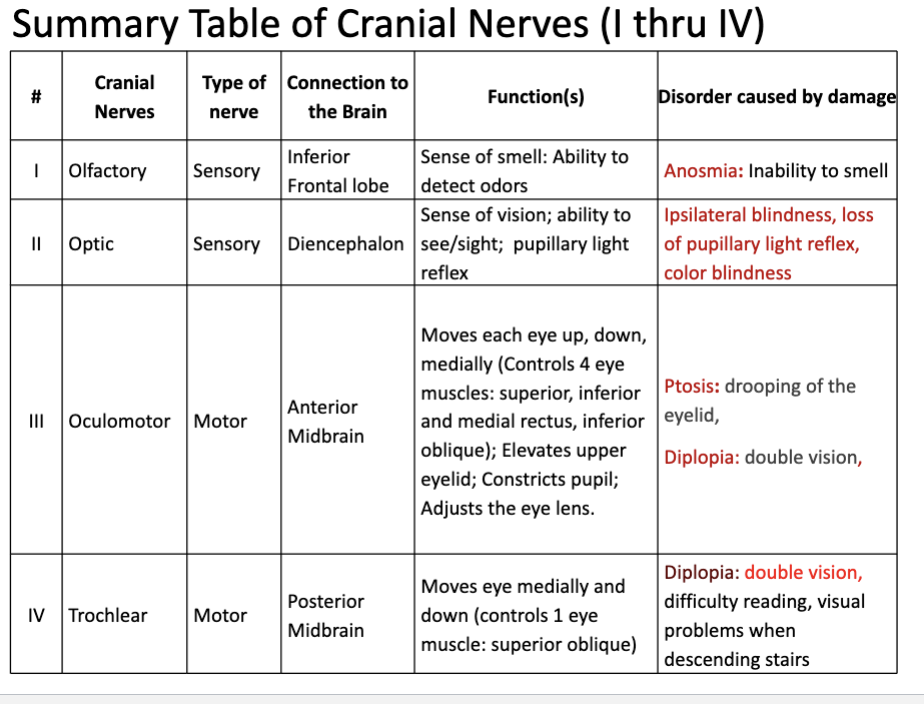
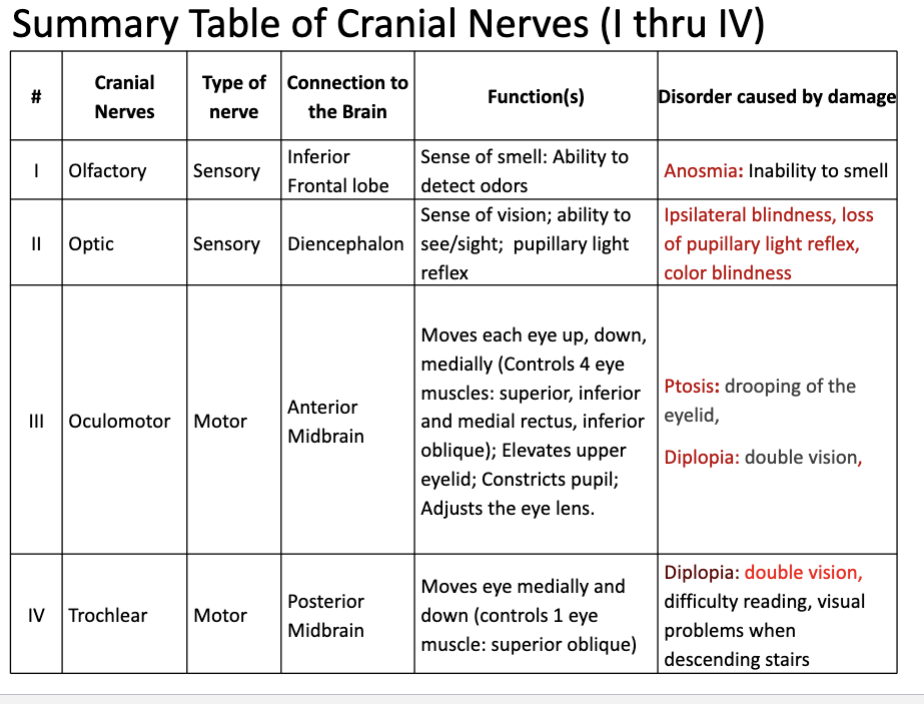
Cranial nerves I-IV
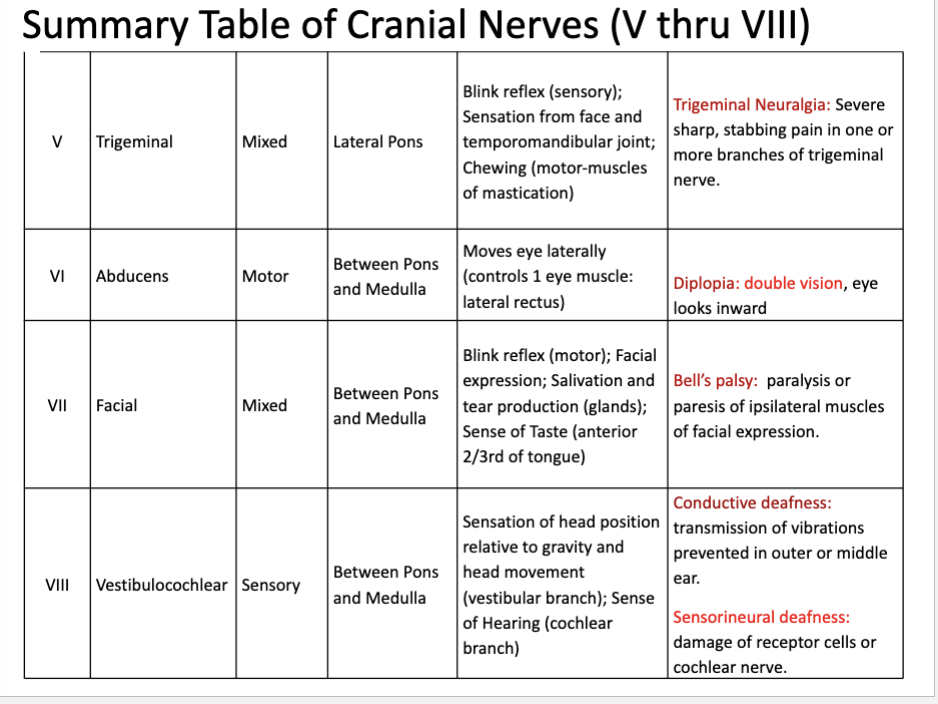
Cranial nerve V-VIII
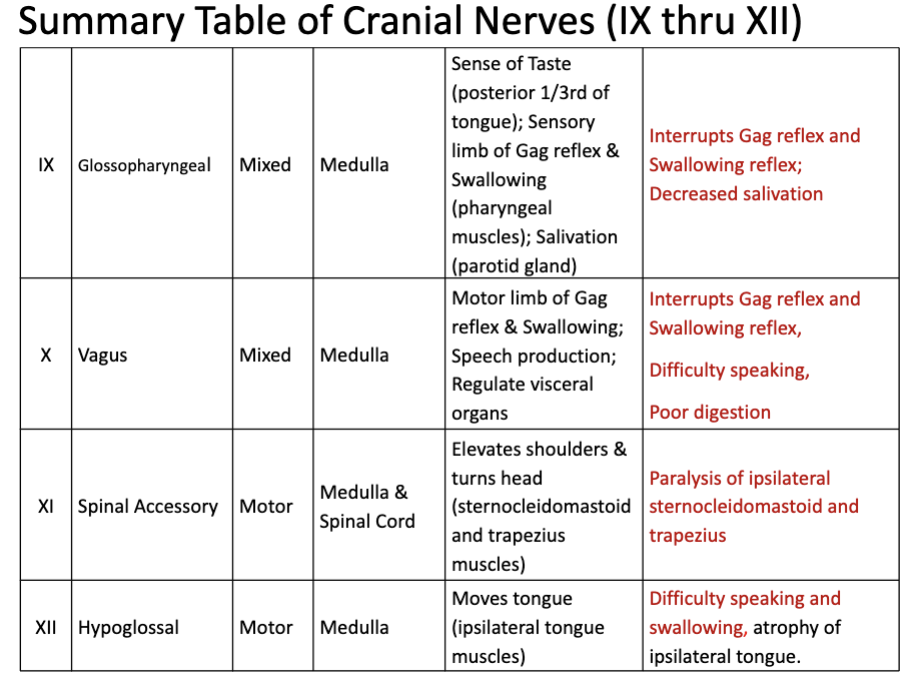
Cranial nerve IX through XII
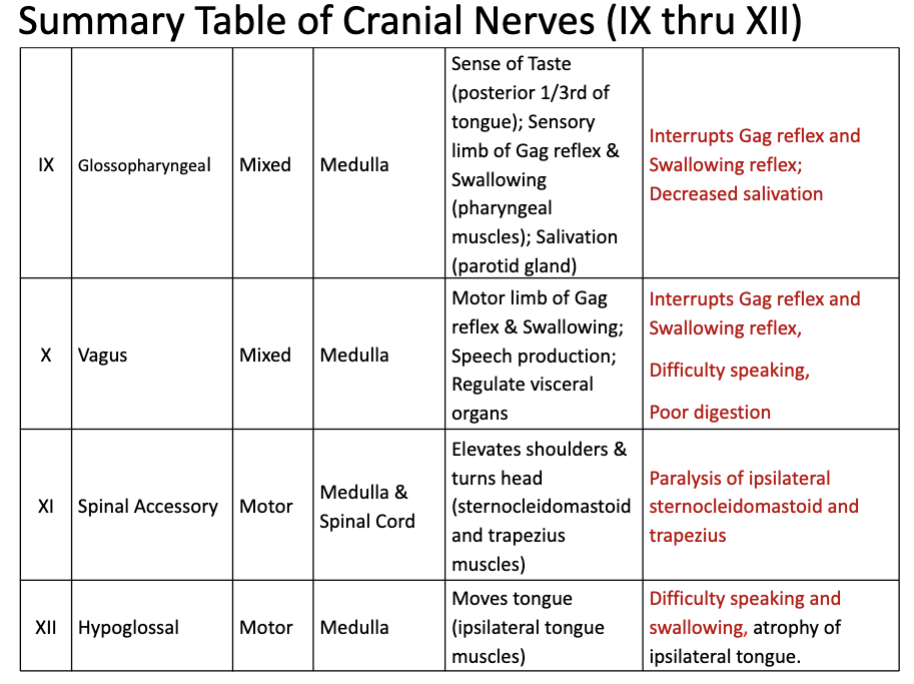
Cranial nerve numbers and pairs mneumonics
Oh, Once One Takes The Anatomy Final Very Good Vacations Are Heavenly ( I Olfactory, II Optic, III Oculomotor, IV Trochlear, V Trigeminal, VI Abducens, VII Facial, VII Vestibulocochlear, IX Glossopharyngeal, X vagus, XI Accessory, XII Hypoglossal
Cranial nerve Classification Mneumonics
Some Say Marry Money But My Brother Says Beautiful Blondes Marry Money
(sensory, Motor, Both. in the order of cranial nerves)
I Olfactory connection to the brain and function
Inferior frontal lobe and sense of smell/ ability to detect odors
II optic connection to the brain and function
diencephalon and sense of vision: the ability to see
III Oculomotor connection to the brain and function
anterior midbrain and moves each eye up and down, constricts pupils, elevates upper eyelid
IV Trochlear connection to the brain and function
posterior midbrain and moves eye medially and down
V Trigeminal connection to the brain and function
Lateral pons and blink reflex, chewing
VI Abducens connection to the brain and function
between pons - medulla and moves eye laterally
VII facial connection to the brain and function
between pons/medulla and blink reflex, facial expression, tear production
VII Vestibulocochlear connection to the brain and function
Between pons -medulla and sensation of head position relative to gravity and head movement
IX glossophanygeal connection to the brain and function
Medulla and sense of taste, gag reflex, salivation
X Vagus connection to the brain and function
Motor limb gag reflex, swallowing, speech production
XI Spinal Accessory connection to the brain and function
medulla and moves tounge
Disorder caused by damage to the olfactory nerve
Anosmia; inability to smell
Disorder caused by damage to the Optic
Ipsilateral blindness, loss of pupillary light reflex
Disorder caused by damage to the occulomotor
ptosis; drooping of eyelid and Diplopia; double vision
Disorder caused by damage to the trochlear
Diplopia; double vision, difficulty reading
Disorder caused by damage to the trigeminal
Trigeminal neuralgia; servere sharp/ stabbing pain to trigeminal nerve
Disorder caused by damage to the abducens
Diplopia; double vision ab
Disorder caused by damage to the facial
bells palsy; paralusis or paresis of muscles
Disorder caused by damage to the vestibulocochlear
conductive deafness and sensorineural deafness
Disorder caused by damage to the glossopharyngeal
interrupts gag reflex and swallowing reflex
Disorder caused by damage to the vagus
interrupts gag reflex and swallowing reflex, trouble speaking
Disorder caused by damage to the spinal accessory
paralysis of ipsilateral sternocleidomastoid and trapezius
Disorder caused by damage to the hypoglossal
difficulty speaking and swallowing, atrophy of tounge
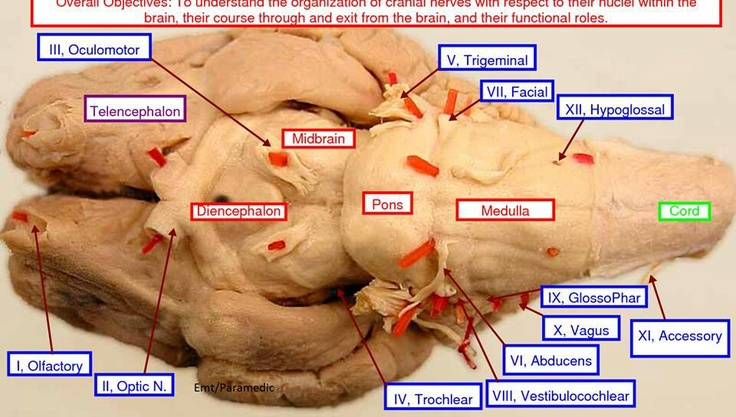
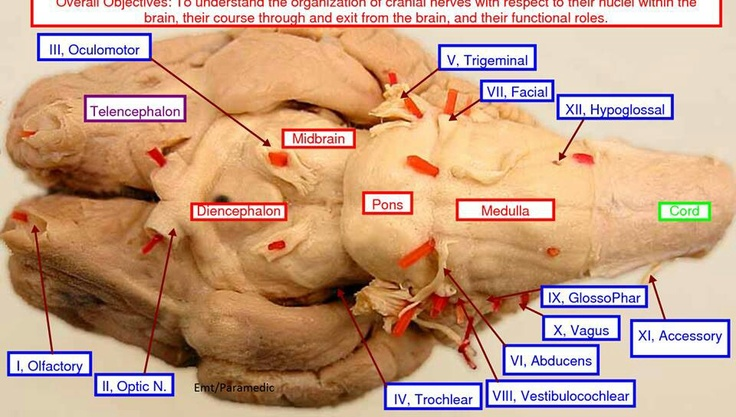
sheep brain know
Somatosensory system
complex system of sensory neurons and pathways that respond to changes at the surface of the skin
the somatosensory part of the NS process sensory info and consists of
sensory receptors, sensory neural pathways, parts of the brain involved in sensory perception
Types of somatosensation
touch, pain, temp, proprioception
stages of somatosensation
activation of sensory receptors by stimuli, Receptor responds to stimuli by conversion of a sensory signal to an electrical signal, the electrical signal is carried to the brain and processed in specialized region of the brain
Types of somatosensory receptors
mecanoreceptors, chemoreceptors, thermoreceptros, nociceptors
mechaoreceptors
respond to mechanical deformities/ forces (touch pressure, vibration, stretch, hearing)
chemoreceptors:
respond to chemical changes in the cellular environment, including cell death. (taste, smell, blood composition)
Thermoreceptors
respond to changes in temp (hot, cold, warm)
Nociceptors
ability to respond to painful stimuli: a subset of each type of somatosensory receptors (respond when something may cause harm/ damage)
What affects conduction speed of info to the cerebrum
Myelinated fibers conduct info more quickly than unmyelinated fibers due to saltatory conduction
Axons with a large diameter conduct info faster than small-diameter axons
more connections or synapses along the path slow speed of conduction

