Blood, Breathing, Tissues, Transpiration (Paper 1 Mock)
 Studied by 0 people
 Call Kai
 Learn
Learn Practice Test
 Spaced Repetition
 Match
Match Flashcards
 Knowt Play
1/26

Earn XP
Description and Tags
Name | Mastery | Learn | Test | Matching | Spaced | Call with Kai |
|---|
No analytics yet
Send a link to your students to track their progress
27 Terms
How are red blood cells are adapted to their function?
They have a biconcave shape for maximum SA, a high concentration of hemoglobin to bind oxygen, the absence of a nucleus to maximise volume, and small, flexible size to navigate narrow capillaries.
Summarise the process of blood clotting?
Blood clotting is a rapid process designed to stop bleeding and prevent infection after a vessel injury. It acts as a temporary seal (a clot or scab) formed by a cascade of reactions, primarily using platelets and proteins in the blood plasma.
How do you view blood under a light microscope and recognise components?
Prepare a thin "blood smear" on a slide, staining it to enhance contrast, and using high magnification to identify the four main components:
White blood cells - Less common usually and contain stained nucleus usually purple or blue.
Red blood cells - Smaller than WBC, appear small red/pink biconcave disc, paler in the centre.
Platelets - Even smaller and often appear in purple-stained clusters.
Plasma - Usually not visible under light microscope.
Explain how the structure of artery’s relate to the functions of blood vessels?
Arteries have thick, muscular, and elastic walls to withstand and maintain high-pressure blood flow from the heart.
Explain how the structure of veins relate to the functions of blood vessels?
Veins have thinner walls and a large lumen to transport low-pressure blood back to the heart, featuring valves to prevent backflow.
Explain how the structure of capillaries relate to the functions of blood vessels?
Capillaries have walls only one cell thick to minimise the diffusion distance for efficient substance exchange.
How do you work out the rate of blood flow?
Volume of blood / number of minutes
Describe the function of the main structures of the human heart?
Atria (Left and Right): The upper chambers that receive blood from veins (vena cava for right atrium, pulmonary vein for left) and contract to push blood into the ventricles below.
Ventricles (Left and Right): The lower, thick-walled chambers that contract to pump blood out the heart, into the arteries.
Right Ventricle: Pumps deoxygenated blood to lungs via pulmonary artery.
Left Ventricle: Pumps oxygenated blood to rest of body via aorta. Much thicker wall than right to generate high pressure needed to circulate blood systemically.
Valves: Between atria and ventricles, and at the exits of the ventricles. They open to allow blood flow and close automatically to prevent backflow of blood, maintaining a one-way circuit.
Describe the problems that can develop with blood vessels in the heart and their treatments?
The most common issue affecting blood vessels in the heart is Coronary Heart Disease (CHD), which is a type of cardiovascular disease. The coronary arteries, which supply oxygenated blood to the heart muscle, become blocked by a build-up of fatty material.
Treatment: Statins or Stents
Statins: Drugs that lower blood cholesterol levels. Reduce the amount of "bad" cholesterol in blood = slow down buildup of fatty deposits in coronary arteries, reducing the risk of heart attack.
Stents: Small, expandable mesh tubes inserted into a narrowed or blocked coronary artery, they’re inflated to widen the artery, keeping it open for blood flow and oxygen supply to the heart muscle.
Suggest the advantages and disadvantages of using stents and statins?
Stents:
Advantages - Lowers risk of heart attack of those with CHD, long-term effectiveness, fast recovery.
Disadvantages - Risk of complications and infection during operation (e.g heart attack) and risk of developing blood clot near stent (thrombosis).
Statins:
Advantages - Reducing amount of ‘bad’ cholesterol in the blood = reduces risk of strokes and increases amount of ‘good’/HDL cholesterol.
Disadvantages - Long term drug having to be taken regularly (could forget), negative side effects (e.g headaches, kidney failure, liver damage or memory loss) and the drug takes a while to kick in (not instant).
Explain why an irregular heartbeat is detrimental to health?
It disrupts the efficient, coordinated pumping of blood, preventing the body from receiving enough oxygen and nutrients. It can cause the heart to beat too slowly, quickly, or in an uncoordinated, chaotic way.
Describe why people may have objections to heart transplants?
Medical risks and complications - Risk of organ rejection, lifelong drugs, side effects.
Practical and ethical reasons - Shortage of donors, age and fitness, quality of life / recovery.
Religious and moral objections - Body integrity (Do not want to violate the person), definition of death when it comes to "donation after circulatory death".
Summarise the advantages and disadvantages of the different treatments of heart problems?
Artificial Hearts (Mechanical) - Temporary devices to sustain life or allow the heart to recover.
Advantages: Immediate availability (no waiting list), no immune rejection.
Disadvantages: Risk of blood clots and infection, less efficient than natural hearts, usually requires extended hospital stays.
Heart Valve Replacement (Surgery) - Replacing faulty valves, using biological / mechanical options.
Advantages: Long-lasting (mechanical), no long-term clotting medication needed (biological).
Disadvantages: Requires lifelong anti-clotting drugs (mechanical), lower durability/potential rejection (biological).
Describe the function of the main structures of the gas exchange system?
Trachea, Bronchi, and Bronchioles: These airways act as a passage for air to travel into and out of the lungs. Their walls contain smooth muscle to help regulate airflow.
Alveoli: The primary site of gas exchange. Their structure is highly adapted for efficiency: Large Surface Area, Thin Walls, Rich Blood Supply.
Describe how alveoli are adapted?
Large surface area, thin Walls (short diffusion pathway), good blood supply, ventilation (constant airflow), moist surface and permeable walls.
Describe the processes of ventilation and gas exchange?
Ventilation is the physical process of breathing, where air is moved into and out of the lungs to maintain steep concentration gradients. Gas exchange is the biological process of diffusion occurring in the alveoli, where oxygen moves into the blood and carbon dioxide moves out.
Describe how plant organs are involved in the transport system?
The plant transport system is an organ system with roots, stems, and leaves, which work together to move water, minerals, and sugars around the plant via the xylem and phloem. This system relies on the transpiration stream (water movement) and translocation (sugar movement).
How do you prep a microscope to identify the different features of a leaf?
Obtain a thin sample: Use a sharp razor blade to cut a cross-section of a leaf as thinly as possible. The section must be thin enough for light to pass through to show cell structure.
Make a wet mount: Place the thin section onto the center of a glass slide. Add one or two drops of water (or a stain like iodine/toluidine blue) to prevent dehydration and add contrast.
Add a coverslip: Gently lower a coverslip onto the specimen using a mounted needle to avoid trapping air bubbles.
Mount the slide: Clip the slide onto the stage.
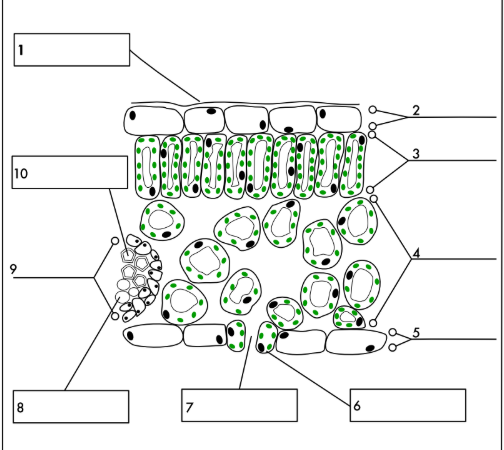
Label the different features of a leaf?
Waxy cuticle
Upper epidermis
Palisade mesophyll
Spongy mesophyll
Lower epidermis
Guard cell
Stomata
Phloem
Vascular bundle
Xylem
How are the different parts / tissues of the leaf related to their functions in photosynthesis?
(Waxy cuticle, Upper epidermis, Palisade mesophyll, Spongy mesophyll, Lower epidermis, Phloem, Xylem)
Waxy cuticle - Helps minimise water loss through evaporation of the leaves.
Upper epidermis - Transparent skin layer allowing light to pass to palisade mesophyll for photosynthesis.
Palisade mesophyll - Absorbs light energy and converts CO2 + H2O into glucose.
Spongy mesophyll - Rapid gas exchanges photosynthesis/respiration by CO2 + O diffusing via air spaces.
Lower epidermis - Protective layer and regulator of gas exchange and transpiration.
Phloem - Transports dissolved sugars/amino acids from leaves to other areas of the plant (e.g stem, roots).
Xylem - Transports water + dissolved mineral ions up from roots via stem to leaves in a continuous one-way process called transpiration stream.
Describe why transport in plants is important?
Essential for survival, growth, and metabolic functions, acting as a "circulatory system" to move water, nutrients, and sugars between different parts of the plant, such as roots and leaves.
Explain how the structure of xylem and phloem are adapted to their functions?
Xylem consists of dead, hollow cells forming continuous tubes that transport water and minerals upward from roots to leaves via the transpiration stream. Phloem is composed of living cells with punctured end walls called sieve plates. These allow the two-way transport of sugars + amino acids, supported by companion cells that provide necessary energy.
Describe how transpiration maintains the movement of water from roots to leaves?
This constant flow, known as the transpiration stream, ensures that leaves receive a steady supply of water for photosynthesis, while also transporting mineral ions and keeping the plant cells for structural support.
Describe how the opening and closing of stomata is controlled by guard cells?
By regulating their water content through osmosis. When the plant has ample water and light, guard cells actively take up solutes (such as potassium ions), lowering their water potential. Water then enters by osmosis, causing the cells to become turgid and swell, which opens the stoma. Conversely, when the plant is water-stressed, guard cells lose water, become flaccid, and close.
How do you use sampling to estimate the number of stomata on a leaf?
Create a clear impression of the leaf surface by painting clear nail varnish onto the underside, allowing it to dry, and peeling it off with sellotape. Place this impression on a microscope slide and count the stomata in several random fields of view. Calculate the mean number of stomata per field of view and divide this by the area of that field to determine density.
Explain why temperature, humidity, light intensity and the amount of air flow affect the rate of transpiration?
Temperature: Higher temps gives water molecules more kinetic energy, causing them to evaporate and diffuse out of the leaf faster.
Light Intensity: Increased light triggers stomata to open allowing CO2 into the leaf for photosynthesis. When stomata are open, water vapour can more easily diffuse out.
Air Flow (Wind Speed): Good air flow sweeps away water vapour that gathers just outside the stomata. This keeps the concentration of water vapour outside the leaf low, maintaining a steep concentration gradient that speeds up diffusion.
Humidity: If the air is already very humid, it is saturated with water molecules. This makes the concentration gradient between the inside and outside of the leaf shallow, which slows down the rate of diffusion.
Describe the differences between a moving bubble potometer and a mass photometer?
Moving Bubble Potometer (Volumetric Potometer)
What it measures: The volume of water taken up by the plant stem per unit of time.
Method: A cut shoot is sealed into a tube filled with water. A single air bubble is introduced into a calibrated capillary tube. As the plant transpires and absorbs water from the tube, the bubble moves along the scale.
Pros/Cons: It is very sensitive and allows for fast, repeated measurements by resetting the bubble with a syringe. It is generally used to look at rapid changes (e.g., impact of a light source).
Key Assumption: Water uptake is roughly equal to water loss (transpiration), although some water is used for photosynthesis and turgidity.
Save My Exams +6
Mass Potometer (Weight Potometer)
What it measures: The decrease in total mass of the potometer/plant apparatus, which represents the water lost by evaporation.
Method: The entire potometer setup, including the plant and reservoir, is placed on an electronic top-pan balance. The change in mass is recorded over a period of time.
Pros/Cons: It provides a more direct measure of actual water loss, but it is less sensitive to rapid, short-term changes compared to the bubble potometer.

