Discourse Strategies (Spoken Texts)
 Studied by 0 people
 Call with Kai
 Learn
Learn Practice Test
 Spaced Repetition
 Match
Match Flashcards
 Knowt Play
1/11

There's no tags or description
Looks like no tags are added yet.
Name | Mastery | Learn | Test | Matching | Spaced | Call with Kai |
|---|
No study sessions yet.
12 Terms
Strategies
Turn-taking, Holding/Ceding the floor, Topic Management
Purpose Of Strategies
Help maintain the flow and direction of the discourse, and aid in meeting a certain agenda
Turn-taking
How often speakers swap turns to talk
How is it done does anyone control it and how
Can be disorderly, controlled or spontaneous
Reflects power hierarchy, setting and text type
Examples of turn taking
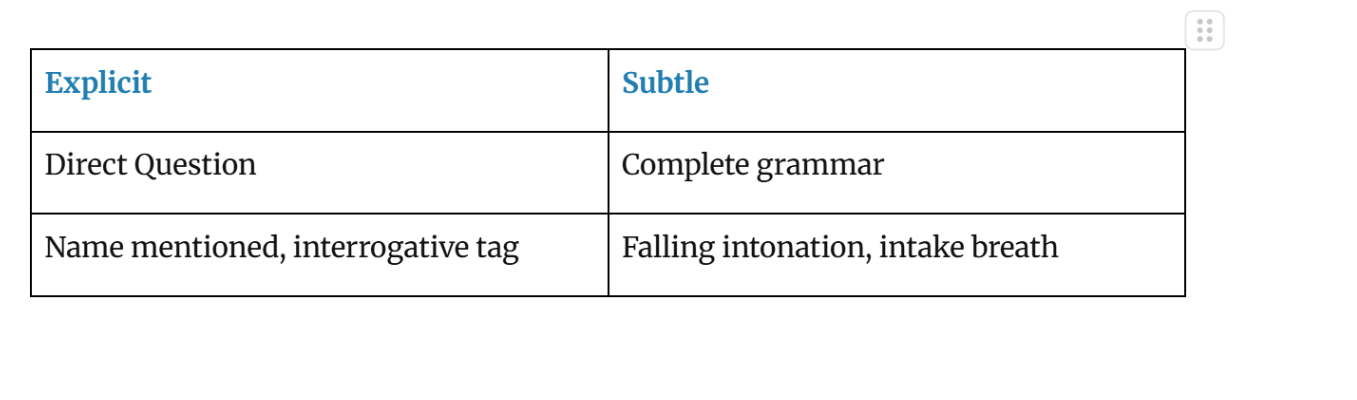
Interviews (controlled turn-taking, where the interviewer will often use the name of the other person, signaling them to speak/interrogative)
Radio programs - control when and what to speak (have set agenda)
How is discourse controlled
Turn-taking - how it is done
Holding the floor
Topic management
How is the conversation cooperative (how does it establish flow)
Turn-taking
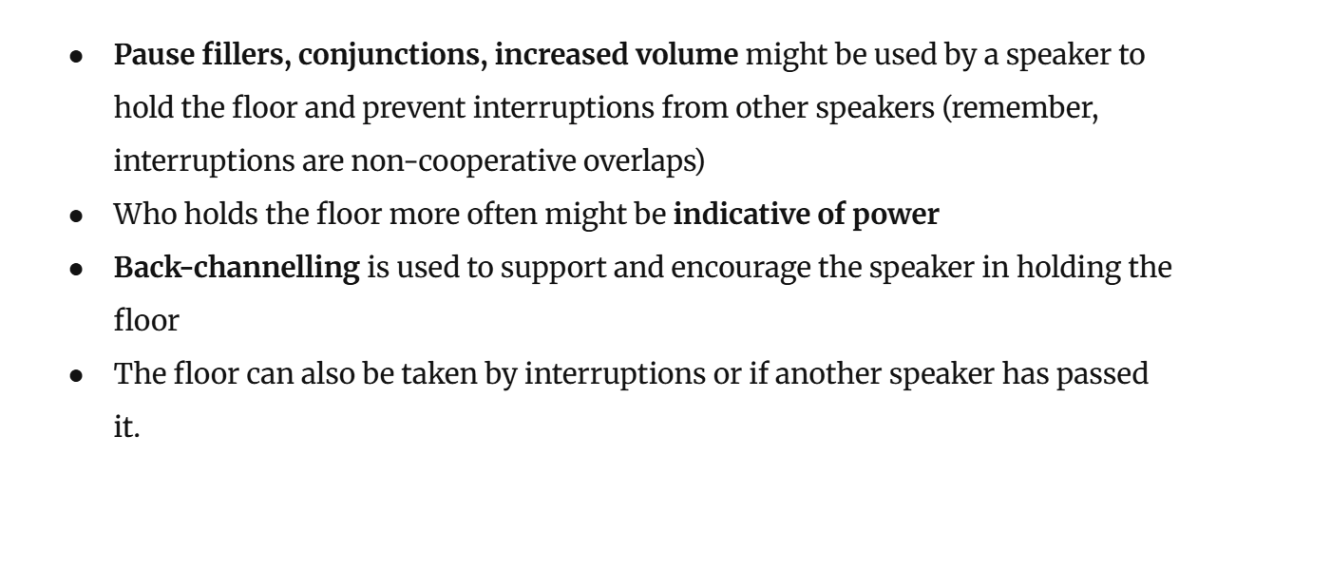
Back-channeling
Floor holding strategies
How often there are interruptions (if less interruptions - cooperative - speakers respect each other, and support each others speech - backchanneling)
Proportion of turn-taking (one person talking more - imbalance of power)
Explicit vs. Subtle Turn-taking
Explicit - Raising hand - clear signalling through words or expression
Subtle - Is done indirectly through pauses, falling intonation, taking in breath
Holding the floor
Topic management
Can be ordely managed (formal) or spontaneous (informal)
Topic shifts, topic loops, topic development
Topic shifts
Changing the topic (often done by discourse particles)
e.g. “Well, what do you think about the new zoo?” - Indicates a new topic change
Whoever changes the topic may hold more power in coversation
Topic Loops
When the speaker returns to a previous topic (often using a discourse marker)
May be as they strayed away from set agenda
e.g. “So, as we were saying” or “Anyway, lets get back to work.”
Topic Development
How topics are developed and expanded within the discourse itself
Development can be non-linear
Can be done through a discourse particle (e.g. “Well, what’s our experience on this…”)
 Note
Note  Flashcards (87)