AP Psychology - Unit 4.7 Motivation
 Studied by 0 people
 Call Kai
 Learn
Learn Practice Test
 Spaced Repetition
 Match
Match Flashcards
 Knowt Play
1/34

Earn XP
Description and Tags
Name | Mastery | Learn | Test | Matching | Spaced | Call with Kai |
|---|
No analytics yet
Send a link to your students to track their progress
35 Terms
Motivation
a need or desire that directs people to take action
consists of biological, emotional, social, and cognitive factors
Instinct Theory
non-human organisms have fixed patterns of complex behaviors that aid in their survival
focuses on genetic predispositions
Drive-Reduction Theory
proposes that behavior is often driven by the need for an individual to maintain homeostasis or reduce physiological imbalances
hypothalamus plays a major role in regulation
Arousal Theory
proposes that people are driven toward experiences and activities that will maintain an optimal level of arousal
arousal: alertness, interest, and energy
optimum levels differ between people
too little stimulation leads to boredom, while too much can lead to stress
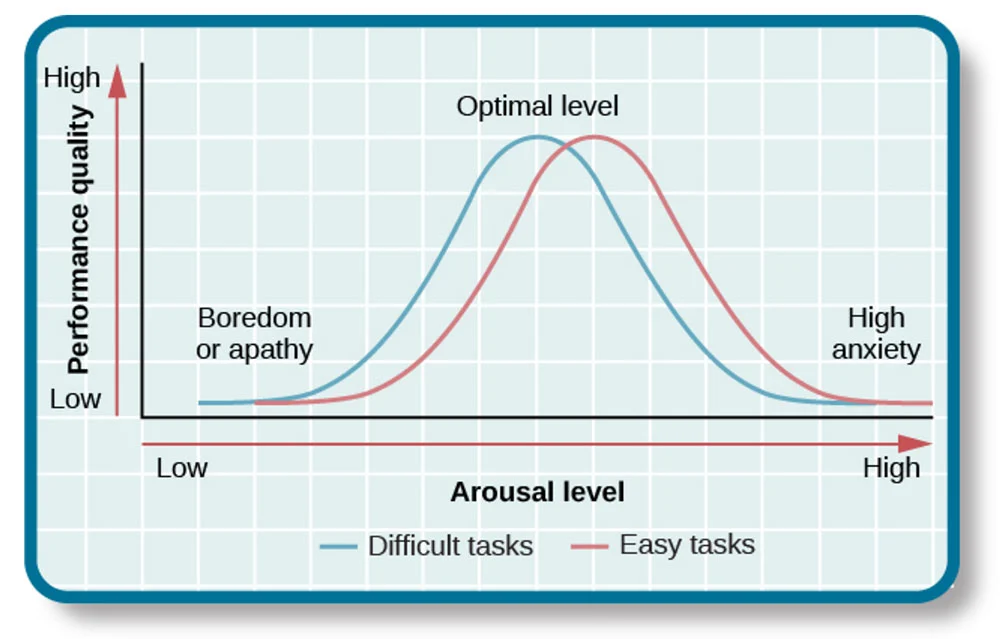
Yerkes-Dodson Law
claims that higher arousal levels are correlated with improved performance up until the optimal arousal level is reached
once it is reached, an individual’s performance decreases if their arousal level continues to increase
graphed as a bell curve
difficult tasks require lower arousal for better performance
Primary Needs
include basic biological/physiological needs
food
water
sleep
Secondary Needs
psychological needs that help with a person’s well-being and social fulfillment
social approval
love
sense of belonging
Incentive Theory
emphasizes the idea that behaviors are largely driven by external rewards or punishments
individuals are motivated to act due to extrinsic motivation
Sensation Seeking Theory
proposes that individuals have different needs for experiences
each need impacts an individual’s motivation
Experience Seeking
the desire for novel or unconventional experiences
Thrill or Adventure Seeking
an attraction to physically risky or fear-inspiring activities
ex: skydiving
Disinhibition
the tendency for individuals to attend social events that allow them to let go of their self-consciousness
Boredom Susceptibility
refers to an individual’s tolerance for repetitive or routine experiences
influences how much an individual will seek new stimulation to avoid feeling bored
Affiliation Need
the need to build and maintain relationships and to feel part of a group
an innate desire for humans
promotes connection and trust
Social Identity
the sense of feeling part of a group
boosts people’s health and well-being
Self-Determination Theory
people feel motivated to satisfy their needs of autonomy (a sense of control over one’s actions), competence, and relatedness
behaviors motivated by these needs tend to be intrinsically motivated
fulfilling these motives causes a reduction in stress and a boost in self-esteem
Kurt Lewin’s Motivational Conflict Theory
proposes that people are driven by the motivation to solve internal conflicts
individuals become motivated to act when confronted with a choice
Approach-Approach Conflict
a person has to choose between two desirable outcomes
Avoidance-Avoidance Conflict
a person must choose between two undesirable outcomes
Approach-Avoidance Conflict
one choice has both positive and negative aspects
Ostracism
the act of deliberately socially excluding an individual or group
used to punish and control social behavior
threatens one’s need to belong
Self-Disclosure
an individual shares their joys, worries, and weaknesses with others
can act as a healthy way of coping
Achievement Motivation
a desire for significant accomplishment, for mastery of skills or ideas, for control, and for attaining a high standard
Grit
passion and perseverance in the pursuit of an ambitious, long-term goal
Glucose
a form of sugar that provides the major source of energy for body tissues
when levels drop, the stomach, intestines, and liver send signals to the brain to motivate appetite
Lateral Hypothalamus
increases hunger when stimulated
if it is destroyed, animals feel no desire to eat
Ventromedial Hypothalamus
suppresses hunger when stimulated
if it is destroyed, animals can not stop eating
Ghrelin
“hunger-arousing hormone”
signals to the brain that the body needs energy
secreted by an empty stomach
Orexin
hunger-triggering hormone
secreted by hypothalamus
Leptin
produced by fat cells
causes the brain to increase metabolism and decrease hunger
“satiety hormone”
PYY
digestive tract hormone
signals fullness to the brain
Set-Point
refers to the natural range of weight that an individual’s body gravitates to
when the body falls below this weight, increased hunger and a lowered metabolic rate may combine to restore lost weight
Basal Metabolic Rate
the resting rate of energy expenditure for maintaining basic body functions
rate drops if an individual decreases their food intake
Hypothalamus
processes signals from hormones to help the body
Pituitary Gland
secretes hormones that influence bodily functions

