BIOL 205 EXAM 3
 Call Kai
 Learn
Learn Practice Test
 Spaced Repetition
 Match
Match Flashcards
 Knowt Play
1/58

Earn XP
Description and Tags
Name | Mastery | Learn | Test | Matching | Spaced | Call with Kai |
|---|
No analytics yet
Send a link to your students to track their progress
59 Terms
blood coagulation
thickening of blood resulting in slower bleeding
some thought black people’s blood coagulates faster than white people’s blood
blood
made up of plasma (liquid) → contains CO2
90% water
7% proteins
buffers
hormones
immune system (ex. blood clotting)
~2% salts, nutrients/wastes/gases
located within blood vessels (closed circulatory system)
blood rerouted to places needing more heat (homeostasis)
buffer
keeps solution at pH of 7+
safer way to hold CO2 (ex. converting $1 bills to a $20)
enzymes can convert it back (ex. converting $20 to a $1 bills)
primary functions of blood
pickup and delivery
defense
regulation
blood flow through body
heart → arteries → arterioles → capillaries → exchange of material through tissue fluid → venules → veins → heart
formed elements
non-fluid part of blood
includes all blood cells
pieces of dead/dying RBCs
main types of formed elements (differences)
erythrocytes: red blood cells (RBCs)
leukocytes: white blood cells (WBCs)
thrombocytes: platelets
erythrocytes
red blood cells
most numerous
primary function → carry O2
small biconcave disks (more surface area and flexible)
missing organelles (mature RBCs have no nucleus)
hemoglobin
iron that contains protein → carries O2
RBCs carry over a billion O2 molecules (~20-30 trillion in the body)
iron and O2 bind to make blood red (ex. rusted nail)
more O2 = more red
CO2 (waste) transport
~25% carried by globin (not heme binding site!)
~7% dissolved in plasma
~70% carried as bicarbonate in plasma
CO2 + water (plasma/liquid) = acid → “ceviche”
CO2 + water → carbonic acid → hydrogen/bicarbonate ion (buffer)
red blood cell cycle
stem cell in bone marrow
loses nucleus when mature and enters bloodstream
cycle lasts ~120 days
hemoglobin destroyed in liver/spleen
globin and iron get recycled
heme excreted (w/ feces) as bile
how does bruising happen?
capillaries break and blood leaks out into surrounding tissue
blood doping
Erythropoietin (hormone → EPO) stimulates red blood cell production
normally insufficient oxygen content in blood/kidneys secretes EPO
removes extra blood; blood w/ EPO taken out and reinjected before race
more oxygen-carrying capacity
difficult to test for b/c it’s your own blood
Lance Armstrong controversy
anemia
decreased RBC production/not enough hemoglobin in each RBC (low iron)
low iron reduces oxygen-carrying capacity (smaller RBCs)
symptoms → tiredness, pale color, “going to pass out” feeling
most common in menstruating women and children (strong bitterness of iron-dense foods like spinach/kale); rare in men
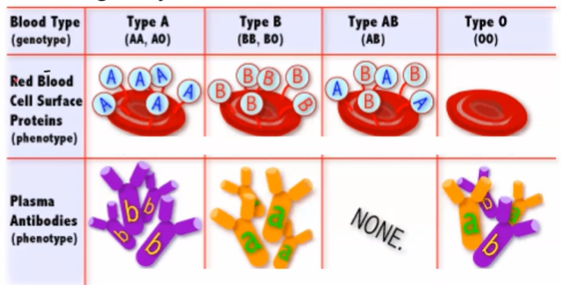
two main blood groups
antigens: surface proteins that help cells detect “self” from “non-self”
antibodies: large Y-shaped proteins made by immune system (usually) to identify viruses, bacteria, etc.
ABO blood groups based on presence/absence (±) of A & B antigens
***If you have one antigen, you make OPPOSITE antibodies (protection)
Rh factor
protein on surface of RBCs determining if blood type is positive or negative
ex. if exposed to Rh+, THEN make anti-Rh+ antibodies
A+ can receive +/-, A- can only receive + ONCE before dying
how does hemolytic disease work?
Rh- mother carries Rh+ fetus OR mother w/ O blood has fetus with A/B/AB
First time body doesn’t know how to make antibodies; second time antigens attack unfamiliar blood cells (can kill mom and 2nd baby)
Rhogam injection used for prevention
what are type AB and O (respectively) known as?
note: AB blood can receive A/B/AB blood
O = universal donor
AB = universal receiver
leukocyte
white blood cells
larger w/ nucleus
made in bone marrow
released into blood
squishes/squeezes between tissues
also found in tissue and lymphs
specific immune system functions
main types of WBCs
granulocytes and agranulocytes
granulocytes vs. agranulocytes
granulocytes: cells w/ granules (end in phil)
agranulocytes: cells w/ out granules (end in cytes)
leukemia (blood cancer)
group of cancers usually beginning in bone marrow
increase of abnormal (cancerous) immature WBCs
***most common in children
symptoms → bleeding/bruising problems, tiredness, fever, increased risk of infection
genetic and environmental
smoking, family history, T21 (Down Syndrome)
treated w/ chemo, bone marrow transplants, radiation
infectious mononeucleosis (mono)
herpes virus infection of lymphocytes
often spread through saliva (e.g. kissing, airplanes, classrooms, etc.)
enlarged/swollen lymphs → immune system cells try to fight virus
atypical lymphocytes in blood
symptoms → fever, sore throat, etc. (can last for months!)
thrombocytes
platelets → cell fragments
makes 200 billion each day
starts blood clotting process (w/ plasma proteins)
hemostasis
blood clotting
blood vessels constrict
platelets start plug (w/ fibrin)
coagulation cascade → 12 steps
hemophilia
genetic disorder decreasing body’s ability to make blood clots
easy bruising (bleeding lasts longer)
increased risk of bleeding inside joints/brain
x-linked gene
carriers (female) may have mild symptoms; can give to XYs
can also pass on to offspring
medications (ex. clotting factors from blood donors)
what makes up the cardiovascular system?
heart (pump)
blood vessels (transport)
blood (connective tissue)
O2-poor blood vs. O2-rich blood
O2-poor blood (deoxygenated)
high in CO2
usually in arteries
O2-rich blood (oxygenated)
low in CO2
usually in veins
two types of circulation (one-way)
pulmonary circulation
systemic circulation
pulmonary circulation vs. systemic circulation
pulmonary circulation
carries O2-poor blood from heart to lungs
returns O2-rich blood to heart
systemic circulation
carries O2-rich blood from lungs to body
returns O2-poor blood to heart
artery vs. vein
artery
BV carrying blood away from heart
more muscular and has thicker layers
higher blood pressure
vein
BV carrying blood towards heart (valves)
less muscular and has thinner layers
~70% blood
*veins closer to heart are BIGGER
capillary
thinnest/smallest blood vessels
exchange site for nutrients/gases/waste
in lymphs too!
what happens when you lock your knees for extended periods of time?
stops blood flow to heart (risk of fainting)
primary function and location of blood vessels
primary function → pump blood
located underneath sternum
pericardium (sac)
double-layered
holds heart in place
reduces friction
anatomy of heart
four chambers
right atrium (upper left)
right ventricle (lower left)
left atrium (upper right)
left ventricle (lower right)
two septa
atrial septum → separates atria
ventricular septum → separates ventricles
four valves
tricuspid valve
pulmonary valve
bicuspid valve
aortic valve
chordae tendineae
“heart strings”
attached to papillary muscles
supports in keeping valves closed
“lub and dub”
technical term for heartbeat
ventricular systole
ventricular diastole
ventricular systole vs. ventricular diastole
ventricular systole (“lub”)
contraction of heart
blood leaves ventricles
blood enters pulmonary arteries + aorta
ventricular diastole (“dub”)
relaxation of heart
blood leaves atrium
blood enters ventricles
electrical conduction system of heart (ECSH)
unique cells w/ both muscular and nervous characteristics
SA (sinoatrial) node → natural pacemaker
AV (atrioventricular) node → slows down heart rate/electricity
Bundle of His
Bundle Branches
Purkinje Fibers
artificial pacemaker
medical device using electrical impulses to regulate heartbeat
used if SA node too slow or there’s a block in ECSH
stimulates heart if beat is not detected
pulse
rhythmic expansion/recoil of arterial wall b/c of blood entering blood vessel
normal pulse = 60-80 bpm
blood pressure (BP)
pressure of blood against wall of blood vessel (artery)
average BP = 120/80
too high BP can damage artery walls
what is calculated to measure blood pressure?
systolic blood pressure and diastolic blood pressure
systolic blood pressure vs. diastolic blood pressure
systolic blood pressure: BP while ventricles are contracting
normal = 100-120
diastolic blood pressure: BP while ventricles are relaxing
normal 69-80
hypertension
persistent high blood pressure (>140/90)
increased risk of artery disease, stroke, heart failure, peripheral vascular disease, vision loss, kidney disease, etc.
affected by genetics and lifestyle (e.g. excess salt, excess body weight, smoking, alcohol, etc.)
can be treated w/ diet adjustments and medication
hypotension
persistent low blood pressure
chest pain, shortness of breath, irregular heartbeat, seizures etc.
low blood volume, hormonal changes, widening of BVs, medicinal side effects, anemia, etc.
can be treated with medication
atherosclerosis
thickening of artery wall (plaque buildup)
LDL (bad) cholesterol + dead WBCs + scarring
smooth muscle proliferation and restricts blood flow
leads to stroke, heart attack, aneurysm, etc.
aneurysm
ballooning of blood vessel
atherosclerosis and hypertension weaken wall of BV
if BV bursts → death
heart attack (myocardial infarction)
blood flow stops to part of heart
can occur due to lifestyle choices (e.g. smoking, no exercise, etc.)
damages heart muscle
women have completely different symptoms than men
50% more likely to get misdiagnosed
heart failure vs. cardiac arrest
heart failure: slow death
cardiac arrest: quick death
stroke
poor blood flow to brain resulting in death of neurons (fast)
minor → smoking, obesity, high blood cholesterol, T1/T2 diabetes
major → high BP
two main types of strokes
ischemic: blockage leads to lack of blood flow
hemorrhagic: breakage leads to bleeding
inequity in women’s health
1993 (cis/white) women were included in scientific research (b/c of periods)
everyone else had adverse reactions to drugs
ex. ambien drugs → sleepwalking/sleepeating women
(cis) women live longer but have worse quality of life b/c of chronic illness
80%; more likely to get autoimmune disorders
usually treated w/ therapy instead of pain medication
more likely to live in poverty and rural areas (less access)
even worse for WOC
lymphatic system
part of circulatory system
plays critical role in immune system
what is the lymphatic system made up of?
lymph (fluid)
lymph vessels
one-way system
valves
needs help
location and functions of lypmhatic system
located all over body (nodes + vessels)
primary function
absorb excess tissue fluid
defense against pathogens
secondary function
absorbs fats from small intenstine
primary vs. secondary lymph organs
primary LOs = where lymphocytes are born/mature
secondary LOs = store/work
mucosa associated lymphoid tissue (MALT)
in respirartory/genital tracts
lymph nodes
filters lymphs along lymph vessel pathway
clusters (inguinal, axillary, cervical)
swells while fighting infection → increases number of cells

