Kines 350 Exam 4: training
 Call Kai
 Learn
Learn Practice Test
 Spaced Repetition
 Match
Match Flashcards
 Knowt Play
1/50

There's no tags or description
Looks like no tags are added yet.
Name | Mastery | Learn | Test | Matching | Spaced | Call with Kai |
|---|
No analytics yet
Send a link to your students to track their progress
51 Terms
what are the principles of exercise training design?
training variables
specificity
overload
individuality
reversibility
variation (periodization)
overtraining
what is specificity in regards to training?
training effect is specific to
muscle fibers recruited
energy system involved
force and velocity of contraction
type of contraction
type of training dictates adaptation
what is overload?
a system being stressed beyond its normal point for adaptation
should be progressive
may be achieved by altering FITT
what is FITT?
Frequency of training
Intensity of training
Time of training
Type of activity
what is individuality?
adaptations and their rate may vary between individuals
largely genetic
program must be specific to individual needs
every responds given right time + stimulus
what is reversibility?
over time - adaptions will reverse
endurance: within 2 weeks
strength: within 3 weeks
a few days would not hurt (tapering)
once a certain level of fitness is achieved ________ is needed to maintain training adaptations
minimum amount of regular exercise
endurance: 2-3 times / week intensity >70% VO2 max
what would the goal “starting faster” entail?
decrease the O2 deficit
what would the goal an increased endurance time entail?
increase lipolysis and spare glycogen
_____ is smaller in endurance training
O2 deficit
less PCr depletion
less lactate accumulation
how would an increase in VO2 max impact performance?
greater endurance performance and capacity
what are the suggested trainings to increase VO2 max
large muscle groups, dynamic activity
20-60 min >3 times a week (>50% VO2max)
6 weeks or more
who would expect a greater increase in VO2 max with training, those with high initial VO2 max or those with low?
low (up to 50% increase)
training intensity of 40-50% VO2max
how much do genetics determine the VO2 response to training
about 50%
Polymorphisms in 21 genes account for 47% of the change in VO2 max in white men
Heart size and lipid metabolism also matter
predisposition for exceptional VO2 max
why does VO2 improve with training?
central adaptations: enhance blood and oxygen delivery
larger blood volume
larger stroke volume and cardiac output
peripheral adaptations: increase oxygen extraction
increased oxidative capacity
increased blood supply within muscle
how is VO2 max solved?
HR max X SV max X O2(a-v) max
why are longitudinal studies better than cross-sectional for VO2 max improvement, what do they show?
cross sectional: differences primarily because of SV differences
longitudinal: reveal exercise-induced improvements in extraction of O2
short duration: notable increase in VO2 max, small increase in SV, smallest increase in O2 extraction
long duration: moderate increase in Vo2max, small increase in SV, notable increase O2 extraction
What are the cardiac output changes due to endurance exercise?
no change is resting CO
10-20% increase in CO during maximal exercise
unchanged at rest and submaximal exercise
what are the adaptations to HR due to endurance exercise?
decreased HR at rest and fixed rates of submax work (↑ PNS, ↓ below intrinsic HR)
no change/ slight ↓ in maximal HR
faster HR recovery following exercise
same HR at same VO2max
what are the adaptations to SV due to endurance exercise training?
greater SV at rest, submax, and maximal exercise
reflects cardiac hypertrophy
maintains CO with lower HR
contributes to greater max CO
why does maximal SV increase due to endurance training?
↑ Preload (EDV)
↑ plasma volume, ↑ venous return, ↑ ventricular volume
↓ Afterload (SVR)
↓ arterial constriction
↑ capillaries
↑ maximal muscle blood flow with no change in MAP
↑ Contractility
what rapid changes (within 6 days) occur from training?
11% ↑ in plasma volume
7% ↑ VO2max
10% ↑ in SV
what remodeling occurs in the heart with training
↑ heart size
chamber (endurance)
wall thickness (strength)
pericardial size
endurance training adaptations of O2 extraction
unchanged at rest and submaximal
↑ oxygen extraction during maximal (very long time…months/years)
how does an ↑ O2 extraction impact a-v O2 difference?
increases the difference
CvO2 max drops to 2-3 ml/100ml blood in trained athletes
why does O2 extraction increase with training?
↑ muscle blood flow (decrease SNS)
↑ capillary density (recruitment + better BF distribution)
↑ mitochondria number
what occurs 2-3 weeks of detraining
decrease SV (10%)
decrease Q (10%)
decrease VO2 max (~5-10%)
longer term decreased O2 (a-v)
what is the goal of cardiac rehab?
minimizing the changes from detraining
what are the adaptations to blood from training?
↑ total blood volume (10-30%)
↑ plasma volume, ↑ RBC mass (0-10%)
↓ Hct
↓ blood pressure (with endurance training)
training ____ the submaximal ventilatory response to exercise
reduces
what is the endurance trained phenotype?
improves the ability to exercise at the same intensity
more rapid transition rest-steady state
reduced reliance on glycogen
cardiovascular/thermoregulatory adaptations increase BF and O2 delivery
neural and hormonal adaptations
biomchemical changes to muscle
what are the net results of training?
increase VO2max of muscle
↓ O2 deficit (by increasing rate of increase in VO2 at exercise onset)
what are the responses that improved oxygen extraction
mitochondrial
increases in amount of mitochondria
(size has larger effect than number)
capillary supply
angiogenesis
affects substrate delivery and waste removal
per fiber (15%)
per unit area (30%)
myoglobin content
muscle form of O2 storage, ~80% increase
Muscle fiber type
Endurance activities rely mostly on ST fibers
training: small increase in fiber size, shift from faster fibers to slower (FG to FOG, FOG to SO)
enzymatic activity
all fiber types show an increase in enzymes of glycolysis, beta oxidation, and oxidative system
endurance training _____ mitochondrial volume and turnover
increases
what are the muscle fiber mitochondria, what are their differences?
subsarcolemmal - 20%, larger and faster turnover
intermyofibrillar - 80% more abundance, greater ATP synthesis
what are the mitochondrial changes seen with endurance training?
mitochondrial content (biogenesis) increases quickly
depends on intensity/duration of training
can increase 50-100%
improved bioenergetics
decrease glucose utilization
increase fat metabolism
faster ADP uptake (spares PCr, tempers glycolysis, less lactate and H+ formation)
increased mitochondrial turnover in muscle
faster removal of damaged mitochondria
how do mitochondria response to training/detraining?
half-time response within 1 week
99% of responses occur in about 6 weeks
same response with detraining (50% loss within one week)
majority lost within 2 weeks
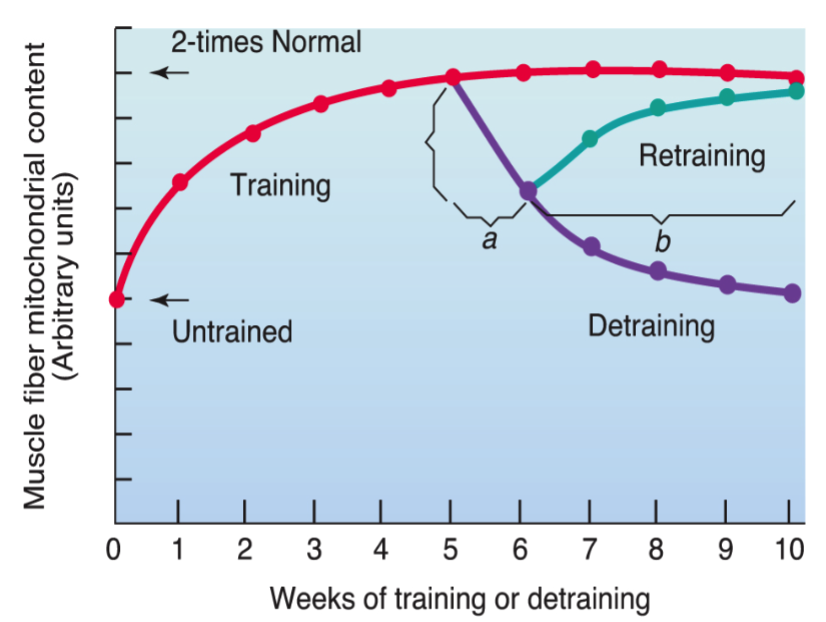
one week of detraining requires _____ of retraining to regain mitochondrial adaptations
3-4 weeks
when the mitochondrial training response drops, why does VO2 responses not follow?
because the heart is the limiting factor, there are still exercise adaptations to the heart for longer
exercise is the most potent stimulator of _______ in skeletal muscle
angiogenesis
10-30% increase after 6-8 weeks (up to 200% in highly trained)
what are the benefits of angiogenesis?
greater diffusion of oxygen: slower RBC transit time, increased O2(a-v)
faster rise in VO2 at the start of exercise
increased removal of wastes
how does endurance training impact oxygen carriers?
total amount of hemoglobin mass and muscle myoglobin
partial pressure and concentration change little
allows for more O2 delivered to mitochondria
how are muscle fibers adapted due to training?
muscle fiber type conversion: fast to slow
FG fiber prevalence decreases
FOG/IIa fiber prevalence and cross-sectional
SO/I fibers may increase as well
in response to training: muscles are becoming slower and more oxidative
how are muscle fibers adapted due to detraining?
conversion slow to fast
for both fibers, peak force and power reduced
large (30%) and variable decreases in type I cross sectional area, peak force, and velocity
smaller decrease in type II number, area and velocity
how does endurance exercise impact oxidative enzymes?
Citrate synthase: biomarker of oxidative capacity
intensity:
increased CS activity with all intensities
independent of intensity in IIa fibers
duration:
increased CS activity independent of duration in IIa fibers
increase in CS activity in IIx fibers with higher intensity, longer duration training
what are the overall muscle changes to endurance training?
reduction in O2 deficit
increased oxygen extraction
change in muscle fiber type
increased capillary density
increased myoglobin content
increased mitochondrial content
increased oxidative enzyme activity
how are bioenergetic systems adapted by endurance training?
lactate threshold occurs at higher work rate (untrained: 50-65% VO2max, trained: 70-85% VO2max)
ability to maintain higher exercise intensity before fatiguing
faster race pace
how is glycogen availability adapted by endurance training?
increased muscle and liver stores
greater CHO availability delays fatigue
how is the use of lipids adapted by endurance training?
adipose tissue:
increased sensitivity of HSL to catecholamines (lipolysis elevated)
higher pH, less suppression of FA mobilization
muscle:
IM lipid droplets smaller
increased amount of adipose triglyceride lipase (ATGL) - greater IM lipid turnover
greater use of fat, sparing glycogen
how does endurance training adapt fuel utilization?
increased utilization of fate, spares plasma glucose + muscle glycogen
transport of FFA into muscle
increased capillary density
increased FA binding protein and FA transclocase
transport FFA from cytoplasm to mitochondria
increased mitochondrial content
mitochondrial oxidation of FFA
increased enzymes of beta oxidation (increased acetyl-CoA formation, high citrate lvl inhibits PFK and glycolysis)
how is the acid-base balanced adapted due to endurance training?

