Public Health Surveillance Study Designs
 Call Kai
 Learn
Learn Practice Test
 Spaced Repetition
 Match
Match Flashcards
 Knowt Play
1/39

There's no tags or description
Looks like no tags are added yet.
Name | Mastery | Learn | Test | Matching | Spaced | Call with Kai |
|---|
No analytics yet
Send a link to your students to track their progress
40 Terms
Examples of intervention and outcomes
Measles vaccine (intervention) and measles disease (outcome)
Hand hygiene messaging (intervention) and improved handwashing (outcome)
Examples of exposures and outcomes
smoking (exposure) and lung cancer (outcome)
potato salad (exposure) and gastrointestinal illness (outcome)
BMI (risk factor) and diabetes (outcome)
Confounding
complex relationships among variables that can distort relationships between risk factors and disease
need to remove the effect of confounding before we can describe the relationship
Information bias
incorrect measurement or classification of outcome (or exposure) status
recall bias
Selection bias
the prevalence of exposure and disease may be different in those who chose to participate as opposed to those who did not
non-response bias
loss to follow-up
study design
methodology used to collect the information to address the research question
observational studies
we observe a phenomenon
sometimes called nonrandomized, or historical studies
Experimental studies
we intervene and measure a response
sometimes called randomized or clinical trials
types of observational study designs
case report/case series
cross-sectional survey
cohort study
case-control study
Case report:
Detailed report of specific features of case (1case only)
Case series:
systematic review of common features of a small number of cases (5 cases)
advantages: cost-efficient, easy to conduct
disadvantages: no comparison group, no specific research question
Cross-sectional surveys
conducted at one point in time
advantages: cost-efficient, easy to implement, ethical
disadvantages: no temporal information
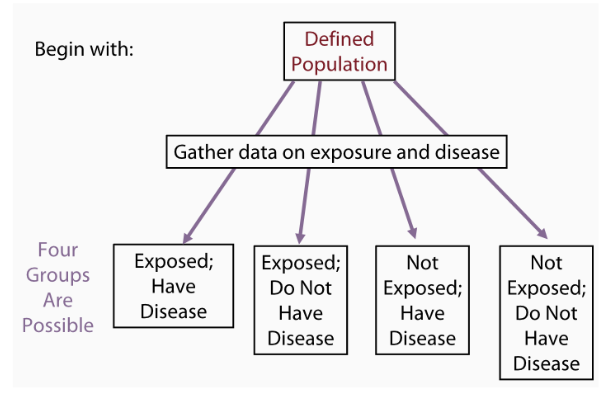
when are cross-sectional surveys used
when measuring prevalence of disease or practice
information for practical decision making
Case-control studies
a study involving individuals with (cases) and without (controls) outcome of interest
advantages: cost and time efficient for rare outcomes
disadvantages: need careful selection of cases and controls, bias
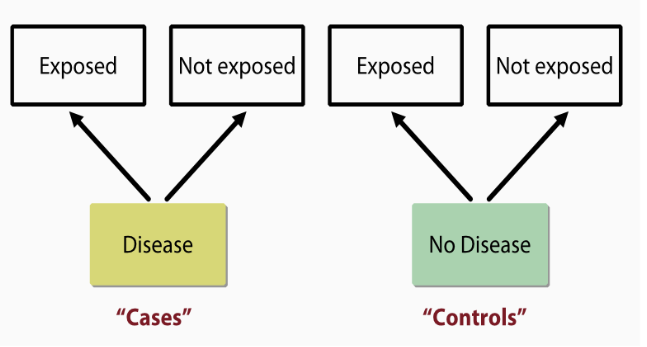
when are case-control studies used
when the outcome is rare
limited resources
when you are not interested in incidence rates
cohort studies
a study involving a group (cohort) of individuals who meet inclusion criteria at the start of a study
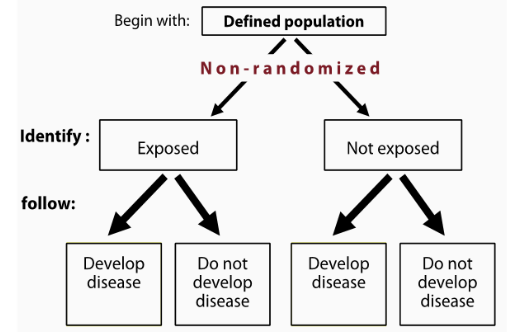
Prospective cohort study (concurrent; longitudinal)
individuals are enrolled and followed going forward in time
Retrospective Cohort Study (Non-concurrent; historical)
The exposure or risk factor is ascertained by looking back in time (or retrospectively)
advantages of a cohort study
assess temporal relationships
estimate and compare incidence of disease
the rate at which participants free of the disease develop the disease
disadvantages of a cohort study
need large numbers for rare outcomes
confounding (distortion of the effect of a risk factor on the outcome by other characteristics)
when are cohort studies used
when determining the incidence of an outcome
exposure/risk factor is rare
when you have a lot of time and resources
Ex: Framingham cardiovascular studies, nurses health study
Experimental Study Designs
Randomized controlled trial (“clinical trial)
crossover trial
Randomized controlled trials
Experimental study where patients are randomized to receive one of several comparison treatments
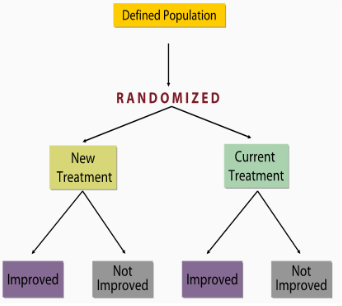
advantages to a randomized control trial
gold standard from a statistical point of view
casual inference
minimizes bias and confounding
disadvantages of a randomized control trial
expensive
requires extensive monitoring
inclusion criteria can limit generalizability
when are randomized controlled trials used
when you want to find efficacy of intervention
when feasible and ethical to randomize
Ex: studies of investigational drugs or vaccines, studies of non-pharmaceutical interventions or programs
crossover trial
each participant is assigned to two or more treatments sequentially
washout period in between treatments
advantages: each participant is their own control
disadvantages: carry over effects
what is the key difference between an observational and experimental study
in an experimental study we impose a change to their lives (intervention) while in an observational study we just observe
Explore top notes

Explore top flashcards
