Thermal Expansion
 Studied by 0 people
 Call Kai
 Learn
Learn Practice Test
 Spaced Repetition
 Match
Match Flashcards
 Knowt Play
1/29

There's no tags or description
Looks like no tags are added yet.
Name | Mastery | Learn | Test | Matching | Spaced | Call with Kai |
|---|
No analytics yet
Send a link to your students to track their progress
30 Terms
Thermal Expansion
The increase in length, area, or volume of a material when its temperature rises. It occurs because atoms move farther apart as their kinetic energy increases
vibrate
As temperature goes up, atoms _______ more.
Asymmetry of the Lennard-Jones potential
Strong repulsion when close
Weaker attraction when farther
Atoms spend slightly more time farther apart
Increasing the average spacing → expansion
Isotropic Expansion
Expansion that occurs equally in all directions.
Most solids behave like this way under ordinary conditions
So they keep their shape but scale up in size.
Gases, liquids
_____ and _______ expand significantly with heat, driving natural convection currents such as rising hot air, ocean mixing, and weather patterns.
Expansion Joints
Gaps placed in structures (bridges, railroad tracks) to allow thermal expansion and prevent buckling or cracking.
Coefficient of Linear Expansion (α)
A material constant that tells how much a material’s length changes per degree of temperature change.
Units: 1/°C or 1/K
Linear Expansion
Predicts how much a material’s length changes with temperature.
ΔL = αLΔT
Mathematical representation of the Linear Expansion
dL/dT = αL
Differential form of the Linear Expansion that describes the instantaneous change in length per degree.
Area Expansion
Increase in the surface area of an object when heated. Applied to 2-D shapes like plates or thin sheets.
ΔA = 2αAΔT
Mathematical representation of the Area Expansion
Volume Expansion
Increase in volume of an object when temperature rises; affects solids, liquids, and gases.
Coefficient of Volume Expansion (β)
A constant describing how much a material’s volume changes per degree.
β = 3a
Coefficient of Volume Expansion for Solids.
ΔV = βVΔT
Mathematical Representation of the Volume Expansion.
Hole Expansion Paradox
When a metal plate with a hole is heated, the hole gets bigger, because the entire metal expands uniformly as if the removed piece were still present.
Bimetallic Strip
A strip made up of two metals with different expansion coefficients. Heating makes it bend, allowing it to act as a simple thermometer or thermostat switch.
T_0
(i)
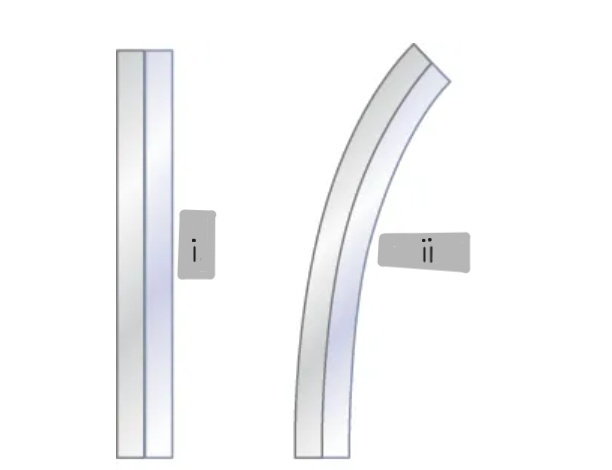
T > T_0
(ii)
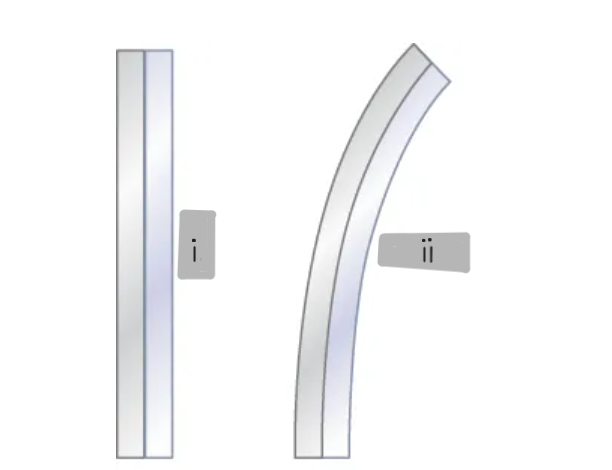
expands, smaller α
In a Bimetallic Strip, the side with the larger α _______ more, causing the strip to curve toward the metal with the _________.
4 °C
Temperature at which the water is most dense
contracts, cooled, density decreases
Between 4°C and 0°C, water ______ when ______ (________________).
insulates
Cold surface water below 4°C stays on top and can freeze, forming ice that _________ the warmer 4°C water below. This allows aquatic life to survive winter.
Thermal Stress
Stress produced when an object’s temperature changes but expansion or contraction is physically blocked. Can cause cracking or breaking
Compressive Thermal Stress
Thermal stress that occurs when object wants to expand but is constrained.
Tensile Thermal Stress
Thermal stress that occurs when object wants to contract but is constrained.
Young’s Modulus (Y)
A measure of a material’s stiffness. How much stress is needed to produce a certain strain.
F/A = Y(ΔL/L_0)
Stress-Strain Relation
ΔLthermal = ΔLelastic; αL_0ΔT = (F/A)(L_0/Y)
Set the thermal expansion equal to the elastic compression
 Note
Note  Flashcards (178)