BILD 3 Midterm
0.0(0)
 Studied by 8 people
 Call Kai
 Learn
Learn Practice Test
 Spaced Repetition
 Match
Match Flashcards
 Knowt Play
Card Sorting
1/222

Earn XP
Description and Tags
Last updated 10:01 AM on 12/9/22
Name | Mastery | Learn | Test | Matching | Spaced | Call with Kai |
|---|
No analytics yet
Send a link to your students to track their progress
223 Terms
1
New cards
Define evolution in genetic terms.
Evolution is the change in allele frequencies over numerous generations that become more common.
The process by which living organisms change over time through changes in the genome. Such evolutionary changes result from mutations that produce genomic variation, giving rise to individuals whose biological functions or physical traits are altered.
The process by which living organisms change over time through changes in the genome. Such evolutionary changes result from mutations that produce genomic variation, giving rise to individuals whose biological functions or physical traits are altered.
2
New cards
Allele Frequency
The relative frequency of an allele at a particular locus in the population. This is a fraction/percentage where the numerator is that allele over the total amount of alleles.
3
New cards
Genotype Frequency
The amount of the various genotypes found in a population over the total population.
-The proportion of the total number of people represented by a single genotype.-
-The proportion of the total number of people represented by a single genotype.-
4
New cards
Genotype Count
The observed amount of genotypes/the total.
5
New cards
Gene Pool
A gene pool refers to the combination of all the genes (including alleles) present in a reproducing population or species.
6
New cards
Population
The individuals within an environment.
-A group of individuals of the same species living and interbreeding within a given area.-
-A group of individuals of the same species living and interbreeding within a given area.-
7
New cards
Calculate allele frequencies for a gene in a population.
Allele Frequency: Dividing the number of times the allele of interest is observed in a population by the total number of copies of all the alleles at that particular genetic locus in the population.
* * *
TT, Tt, tt.
9 individuals, 3 of each.
Frequency of T: (2(3) + 3)/18 or (2(TT) + Tt)/Total alleles.
Frequency of T: (2(3) + 3)/18 or (2(tt) + Tt)/Total alleles.
* * *
TT, Tt, tt.
9 individuals, 3 of each.
Frequency of T: (2(3) + 3)/18 or (2(TT) + Tt)/Total alleles.
Frequency of T: (2(3) + 3)/18 or (2(tt) + Tt)/Total alleles.
8
New cards
Calculate genotype frequencies for a gene in a population.
Genotype Frequency: Dividing the number of times the genotype of interest is observed in a population by the total number of individuals in the population.
* * *
TT, Tt, tt.
9 individuals, 3 of each.
Frequency of TT = 3/9
Frequency of Tt = 3/9
Frequency of tt = 3/9
* * *
TT, Tt, tt.
9 individuals, 3 of each.
Frequency of TT = 3/9
Frequency of Tt = 3/9
Frequency of tt = 3/9
9
New cards
Explain why we test for Hardy-Weinberg Equilibrium (HWE) and what we learn from the results.
HWE is when a specific list of conditions are satisfied. Some examples would be random mating, no natural selection, no genetic drift, and more. We test for HWE to find out which one of the conditions is not being satisfied or met. So the results will also tell you what was the cause of it to be not in HWE. For example in lecture we discovered that assortative mating and natural selection were some causes for that particular weasel experiment to not be in HWE.
- The Hardy-Weinberg model enables us to compare a population's actual genetic structure over time with the genetic structure we would expect if the population were in Hardy-Weinberg equilibrium (not evolving). If genotype frequencies differ from those we would expect under equilibrium, we can assume that one or more of the model's assumptions are being violated, and attempt to determine which one(s). -
- The Hardy-Weinberg model enables us to compare a population's actual genetic structure over time with the genetic structure we would expect if the population were in Hardy-Weinberg equilibrium (not evolving). If genotype frequencies differ from those we would expect under equilibrium, we can assume that one or more of the model's assumptions are being violated, and attempt to determine which one(s). -
10
New cards
Describe the five conditions that must be met for a gene in a population to be at HWE (i.e.
the assumptions of HWE). ,1. No mutations: No new alleles are generated by mutation, nor are genes duplicated or deleted.
2. Random mating: Organisms mate randomly with each other, with no preference for particular genotypes.
3. No natural selection: All alleles confer equal fitness.
4. No genetic drift (extremely large population size): This condition is needed in order to combat the impact of genetic drift.
5. No gene flow: Neither individuals nor their gametes enter or exit the population.
2. Random mating: Organisms mate randomly with each other, with no preference for particular genotypes.
3. No natural selection: All alleles confer equal fitness.
4. No genetic drift (extremely large population size): This condition is needed in order to combat the impact of genetic drift.
5. No gene flow: Neither individuals nor their gametes enter or exit the population.
11
New cards
Calculate the expected genotype frequencies and genotype counts for a single gene under HWE. Compare these with observed genotype counts.
Use the results to perform a statistical test to evaluate whether a population is in HWE for that gene. (Note: I will provide the chi-squared goodness-of-fit test equation and significance cutoff value if
needed but you should know how to do the other calculations.)
Use the results to perform a statistical test to evaluate whether a population is in HWE for that gene. (Note: I will provide the chi-squared goodness-of-fit test equation and significance cutoff value if
needed but you should know how to do the other calculations.)
Expected genotype frequency: p^2 + 2pq + q^2
Genotype counts: Given in the population, given as the alleles.
!!!
Genotype counts: Given in the population, given as the alleles.
!!!
12
New cards
Use the results of a HWE analysis to provide evidence for whether a population is evolving and/or mating non-randomly. If the genotype counts are not in HWE offer explanations of how the population is evolving/mating non-randomly at that gene (i.e., which condition(s) of HWE are not met) that could explain the data.
!!!
13
New cards
Explain how genetic drift arises from sampling effects in finite populations. Explain how genetic drift affects allele frequencies and why the intensity of those effects depends on population size.
Genetic drift is random mating, because the population is finite there are only so many draws that will occur, the smaller the size the more quickly and apparent. The genetic drift can only move the population by a set amount of increments, however the size of the population will determine how much it will affect it; for example if there are three more of X alleles after being in a fifty/fifty split a pop. of 10 would be 8/10 having X alleles vs. a pop. of 100 where 53/100 have X alleles.
-Coins turn up heads or tails with equal probability. But
just a few tosses in a row are unlikely to produce heads and tails in equal number. The numbers are no more likely to be exactly equal for a large number of tosses in a row. Similarly allele frequencies in real populations are not probability distributions; rather,
they are a random sample, and are thus subject to statistical fluctuations. "Correct" sampling would involve taking a sample representative of the total population you are researching or testing, but that is rarely the case.
-Genetic drift can cause populations to loose genetic variation, potentially reducing a population's ability to evolve in response to new selective pressures. Genetic drift acts faster and has more drastic results in smaller populations. This effect is particularly important in rare and endangered species. Genetic drift can contribute to speciation. For example, a small isolated population may diverge from the larger population through genetic drift.
-Coins turn up heads or tails with equal probability. But
just a few tosses in a row are unlikely to produce heads and tails in equal number. The numbers are no more likely to be exactly equal for a large number of tosses in a row. Similarly allele frequencies in real populations are not probability distributions; rather,
they are a random sample, and are thus subject to statistical fluctuations. "Correct" sampling would involve taking a sample representative of the total population you are researching or testing, but that is rarely the case.
-Genetic drift can cause populations to loose genetic variation, potentially reducing a population's ability to evolve in response to new selective pressures. Genetic drift acts faster and has more drastic results in smaller populations. This effect is particularly important in rare and endangered species. Genetic drift can contribute to speciation. For example, a small isolated population may diverge from the larger population through genetic drift.
14
New cards
Explain why genetic drift tends to reduce genetic diversity. Explain how genetic drift can reduce the overall fitness of populations.
Genetic drift can be lost due to random chance, and this is more likely to occur populations are small.
Random fluctuations in allele frequencies in small populations reduce genetic variation, leading to increased homozygosity and loss of evolutionary adaptability to change and therefore lowering the fitness.
Random fluctuations in allele frequencies in small populations reduce genetic variation, leading to increased homozygosity and loss of evolutionary adaptability to change and therefore lowering the fitness.
15
New cards
Describe the bottleneck effect and the founder effect. Explain how they can change allele frequencies and intensify the effect of genetic drift.
Bottlenecking effect- sudden change that drastically and randomly reduces the population size.
- Genetic diversity decreases- may recover over time.
- Changes allele frequencies by chance.
* * *
Founder effect- small number of individuals start a new population.
- Gene frequencies of new populations are different from the source population by chance.
- Genetic diversity decreases- may recover over time.
- Changes allele frequencies by chance.
* * *
Founder effect- small number of individuals start a new population.
- Gene frequencies of new populations are different from the source population by chance.
16
New cards
Describe how natural selection can change allele frequencies in a population over time.
Natural selection is when due to external factors some alleles are being selected for or against and that results in alleles being passed to the next generation in proportions that *can* vastly differ from the present population.
17
New cards
Describe how gene flow can change allele frequencies
make populations more similar, and/or counteract the effects of natural selection. Give an example of how gene flow can occur. ,Gene flow describes alleles entering or leaving a population which can bring in new alleles or reduce the frequency of existing alleles. Gene flow can increase genetic variation and oppose natural selection and adaptation (by bringing in new alleles that are unsuited for the environment).
18
New cards
Explain what mutation is
why it is essential to evolution, and why it tends not to affect allele frequencies in a statistically significant way over short time scales. ,Mutation is when the gene structure changes, resulting in a variant form that may be transmitted to subsequent generations.
Mutation is important because it creates new alleles for particular genes, these then will be passed down through generations.
Whilst it is a strong force for introducing new alleles, it is weak in affecting gene frequency, because mutations rates are low, mutation at any locus only causes minute changes in allele frequency across generations.
Mutation is important because it creates new alleles for particular genes, these then will be passed down through generations.
Whilst it is a strong force for introducing new alleles, it is weak in affecting gene frequency, because mutations rates are low, mutation at any locus only causes minute changes in allele frequency across generations.
19
New cards
Define assortative mating and disassortative mating. Predict the effects of non-random mating (assortative mating or disassortative mating) on genotype frequencies.
Assortative mating: Preference to similar genotypes or phenotypes. Homozygote offspring.
Disassortative mating: Preference to differing genotypes or phenotypes. Heterozygote offspring.
Disassortative mating: Preference to differing genotypes or phenotypes. Heterozygote offspring.
20
New cards
Differentiate between microevolution and macroevolution.
Microevolution happens on a small scale (within a single population), while macroevolution happens on a scale that transcends the boundaries of a single species.
When populations change in small ways over time, the process is called microevolution. "Microevolution results in changes within a species."
Macroevolution refers to much bigger evolutionary changes that "result in new species".
Macroevolution may happen:
1. When microevolution occurs repeatedly over a long period of time and leads to the creation of a new species.
2. As a result of a major environmental change, such as a volcanic eruption, earthquake, or an asteroid hitting Earth, which changes the environment so much that natural selection leads to large changes in the traits of a species.
When populations change in small ways over time, the process is called microevolution. "Microevolution results in changes within a species."
Macroevolution refers to much bigger evolutionary changes that "result in new species".
Macroevolution may happen:
1. When microevolution occurs repeatedly over a long period of time and leads to the creation of a new species.
2. As a result of a major environmental change, such as a volcanic eruption, earthquake, or an asteroid hitting Earth, which changes the environment so much that natural selection leads to large changes in the traits of a species.
21
New cards
Explain the principle of stratigraphy and how it results from the process of how sedimentary rock and fossils are formed.
The principle of stratigraphy is that the oldest life forms reside at the base level of rock, which the more recent life forms are closer to the top level.
This results from the process of sedimentary rock and fossilization because as sediment layers settle, they can contain dead organisms or, by chance, entrap living organisms, with each layer compressing into the one below it.
This results from the process of sedimentary rock and fossilization because as sediment layers settle, they can contain dead organisms or, by chance, entrap living organisms, with each layer compressing into the one below it.
22
New cards
*Cuvier*
Cuvier started studying fossils, and is tied to the ideas of the principle of stratigraphy. He denied evolution, and thought the individual levels of strata were caused due to catastrophes not time.
23
New cards
Explain how extinction and transitional forms in the fossil record provide evidence for evolution.
- Descent with modification.
The fossil record documents the pattern of evolution, showing that past organisms differed from present-day organisms and that many species have become extinct. *Transitional forms provide evidence of intermediates between different modern day and extinct forms.* If you find fossils that are different from extant(still existing) species, then you know it went extinct. Principle of succession states that living organisms are similar to the fossils in their region because they are descended from those ancestors with modification.
The fossil record documents the pattern of evolution, showing that past organisms differed from present-day organisms and that many species have become extinct. *Transitional forms provide evidence of intermediates between different modern day and extinct forms.* If you find fossils that are different from extant(still existing) species, then you know it went extinct. Principle of succession states that living organisms are similar to the fossils in their region because they are descended from those ancestors with modification.
24
New cards
Describe the hypothesis that Tiktaalik's discoverers were testing when they searched for a transitional tetrapod in 375 million year old rocks.
They were looking to find a transitional form in between fish and tetrapods, in doing so they found Tiktaalik exactly where they thought it would be.
25
New cards
List the main ways in which Tiktaalik resembles modern tetrapods and the main ways in which it resembles fish.
Tetrapods: Flat heads, eyes on top of their head, limbs, ribs, and neck.
Tiktaalik: Flat heads, eyes on top of their head, necks, limbs, ribs, and an intermediate between fins and limbs.
Fish: Round head, eyes on the side, no neck, no ribs, and fins.
Tiktaalik: Flat heads, eyes on top of their head, necks, limbs, ribs, and an intermediate between fins and limbs.
Fish: Round head, eyes on the side, no neck, no ribs, and fins.
26
New cards
Explain what a tetrapod is, name the major groups of animals that are tetrapods, and give an example of a tetrapod (Covered partly in the reading).
A tetrapods, the four legged creates; an major group are Amphibians, Reptiles (including dinosaurs and birds) and Mammals.
Tetrapods include all land-living vertebrates, such as frogs, turtles, hawks, and lions.
Tetrapods include all land-living vertebrates, such as frogs, turtles, hawks, and lions.
27
New cards
Describe the evidence that Archaeopteryx is a transitional form between reptiles and birds.
They have teeth, they do not fly but they have feathers, and they have long tails.
Dinosaurs/Reptiles: Long vertebral tails.
Birds: Feathers and the wings (form of limbs).
Dinosaurs/Reptiles: Long vertebral tails.
Birds: Feathers and the wings (form of limbs).
28
New cards
List some vestigial structures in humans and the functions they served in our ancestors.
Goosebumps: they raised in order to puff themselves up and look more threatening.
Tail: Coccyx: In the sixth week of gestation, the human embryo possesses a tail, complete with several vertebrae. In the next couple weeks of development, however, the tail disappears, and over time the vertebrae fuse to form the coccyx. Tails were used for balance.
Wisdom teeth: Were necessary to grind these foods for proper digestion. Today, modern food preparation and eating utensils have eliminated our need for wisdom teeth.
Auricular muscles: The auricular, or extrinsic, muscles of the human ear include the anterior auricular muscle, the superior auricular muscle, and the posterior auricular muscle. Together, they control the pinna, or the visible part of the ear. In many mammals, ear movements produced by the auricular muscles play a role in sound localization and the expression of emotion, but in humans, the muscles are considered nonfunctional.
Tail: Coccyx: In the sixth week of gestation, the human embryo possesses a tail, complete with several vertebrae. In the next couple weeks of development, however, the tail disappears, and over time the vertebrae fuse to form the coccyx. Tails were used for balance.
Wisdom teeth: Were necessary to grind these foods for proper digestion. Today, modern food preparation and eating utensils have eliminated our need for wisdom teeth.
Auricular muscles: The auricular, or extrinsic, muscles of the human ear include the anterior auricular muscle, the superior auricular muscle, and the posterior auricular muscle. Together, they control the pinna, or the visible part of the ear. In many mammals, ear movements produced by the auricular muscles play a role in sound localization and the expression of emotion, but in humans, the muscles are considered nonfunctional.
29
New cards
Explain why vestigial structures are evidence for evolution.
They suggest that an organism changed from using the structure to not using the structure.
30
New cards
Explain how different types of homology (molecular, structural, developmental) can reveal common evolutionary origins. Give an example of a homologous structure and two species in which it is homologous.
Molecular Homology: Similarity that two organisms share at the molecular level due to common ancestry.
Structural Homology: similar physical features in organisms that share a common ancestor, but the features serve different functions.
Development Homology: Similarity in the way that the embryos development.
Structural Homology: similar physical features in organisms that share a common ancestor, but the features serve different functions.
Development Homology: Similarity in the way that the embryos development.
31
New cards
Describe an example of evolution that has occurred within the past 50 years in a multicellular species (e.g., insect, bird).
Drug resistant bacteria and pesticide resistant insects.
Antibiotics in Human beings; the development of antibiotic resistance is observable evolution in action.
Antibiotics in Human beings; the development of antibiotic resistance is observable evolution in action.
32
New cards
Using evolutionary reasoning, explain why much of the National Institutes of Health budget is devoted to research on non-human organisms.
Since we are molecularly homologous with other organisms, given by the idea that we descended from common ancestors, testing on non-human organisms and their reaction can give clues to how humans will react to similar drugs or situations.
33
New cards
Define relative fitness. (Covered in the reading).
- The contribution an individual makes to the gene pool of the next generation relative to the contributions of other individuals. -
Relative Fitness (w) is the survival/reproduction-rate of a genotype relative to the maximum survival/reproductive-rate of other genotypes in the population.
Relative Fitness (w) is the survival/reproduction-rate of a genotype relative to the maximum survival/reproductive-rate of other genotypes in the population.
34
New cards
Given an example of natural selection and information about whether the trait is heritable, predict the outcome of evolution via natural selection.
Rock Pocket mice (coat color)
- Natural selection favored the mice with a mutation that gave them a darker coat color because they were able to camouflage in the lava rock that had formed.
- This trait is at least partially inherited, thus the outcome of evolution should be an increase in mice with dark coats over others with light coats via natural selection.
- Natural selection favored the mice with a mutation that gave them a darker coat color because they were able to camouflage in the lava rock that had formed.
- This trait is at least partially inherited, thus the outcome of evolution should be an increase in mice with dark coats over others with light coats via natural selection.
35
New cards
Given a population histogram with a trait shown on the horizontal axis and a description of how natural selection acts on the trait, sketch a histogram showing how the population will change after natural selection. If the trait is heritable, sketch the histogram of how the population will likely look in subsequent generations. (This was
also partly covered in the "Overview of evolution by natural selection" topic earlier in the quarter.)
also partly covered in the "Overview of evolution by natural selection" topic earlier in the quarter.)
Over time, if the trait is heritable, the normal shape of the histogram should shift to the right over subsequent generations.
36
New cards
Compare and contrast the 3 modes of natural selection covered in class (directional, stabilizing, disruptive) with regards to which phenotypes are most fit, how the population mean changes as a result of selection, and (for stabilizing and disruptive selection) how phenotypic variation changes as a result of selection.
Directional:
An extreme phenotype is the most fit. (Shifts left or right).
Effects of selection:
- The population mean changes.
- The population variation decreases.
Stabilizing:
An intermediate phenotype is the most fit. (This will become skinner and weighted in the middle.)
Effects of selection:
- The population mean stays the same.
- The population variation decreases.
Disruptive:
Two extreme phenotypes are more fit than intermediate phenotypes. (The left and right values will be the highest).
Effects of selection:
- The population mean stays the same.
- The population variation goes up.
An extreme phenotype is the most fit. (Shifts left or right).
Effects of selection:
- The population mean changes.
- The population variation decreases.
Stabilizing:
An intermediate phenotype is the most fit. (This will become skinner and weighted in the middle.)
Effects of selection:
- The population mean stays the same.
- The population variation decreases.
Disruptive:
Two extreme phenotypes are more fit than intermediate phenotypes. (The left and right values will be the highest).
Effects of selection:
- The population mean stays the same.
- The population variation goes up.
37
New cards
For each mode of selection, sketch the fitness plot (fitness vs. trait value) and explain what it means; also, be able to generate histograms of how phenotypes change over time. Given a scenario or graph of how natural selection affects a population, infer which mode of selection is at work, sketch the fitness plot, and predict the consequences of the selection.
---
38
New cards
Explain how balancing selection maintains genetic variation. Give examples of two kinds of balancing selection. Covered mostly in the reading.
Balancing selection maintains the genetic variation because of the two homozygotes will mate and have heterozygote offspring.
Maintains multiple alleles in a population. Mechanisms:
- Heterozygote advantage.
- (Negative) frequency dependent selection.
Maintains multiple alleles in a population. Mechanisms:
- Heterozygote advantage.
- (Negative) frequency dependent selection.
39
New cards
Describe how the sickle cell allele is selected for or selected against, depending on the genotype and environment of the individual that carries it. Explain why the sickle cell allele is an example of heterozygote advantage and thus of balancing selection. Covered primarily in the reading, part of which may have been assigned for the Population Genetics topic.
- Homozygotes with two sickle-cell alleles are strongly selected against because of mortality caused by sickle-cell disease. In contrast, heterozygotes experience few harmful effects from sickling yet are more likely to survive malaria than are homozygotes.
- In regions where malaria is common, the net effect of these opposing selective forces is heterozygote advantage. This has caused evolutionary change in populations—the products of which are the areas of relatively high frequencies of the sickle-cell allele shown in the map below.
- In regions where malaria is common, the net effect of these opposing selective forces is heterozygote advantage. This has caused evolutionary change in populations—the products of which are the areas of relatively high frequencies of the sickle-cell allele shown in the map below.
40
New cards
Give reasons why natural selection often does not produce optimal (perfect) phenotypes, and provide an example of each. Covered only in the reading.
- Selection can act only on existing variations.
- Evolution is limited by historical constraints.
- Adaptations are often compromises.
- Chance, natural selection, and the environment interact.
- Evolution is limited by historical constraints.
- Adaptations are often compromises.
- Chance, natural selection, and the environment interact.
41
New cards
Identify the typical results of sexual selection. Give two different types of sexual selection and give an example of each one. Covered only in the reading.
Sexual selection can result in sexual dimorphism: a difference in secondary sexual characteristics between males and females of the same species. These distinctions include differences in size, color, ornamentation, and behavior.
Intrasexual:
Selection within the same sex, individuals of one sex compete directly for mates of the opposite sex.
- Ex. A single male may patrol a group of females and prevent other males from mating with them.
Intersexual:
Individuals of one sex (usually the females) are choosy in selecting their mates from the other sex.
- In many cases, the female's choice depends on the showiness of the male's appearance or behavior
- Ex: Peacocks.
Intrasexual:
Selection within the same sex, individuals of one sex compete directly for mates of the opposite sex.
- Ex. A single male may patrol a group of females and prevent other males from mating with them.
Intersexual:
Individuals of one sex (usually the females) are choosy in selecting their mates from the other sex.
- In many cases, the female's choice depends on the showiness of the male's appearance or behavior
- Ex: Peacocks.
42
New cards
Describe the prevailing view regarding evolution and species in Europe in the 1800s.
Each species were created individually by God via "special creation."
A secondary view is that God created the species, sat back, and watched impassively as they compete to survive
A secondary view is that God created the species, sat back, and watched impassively as they compete to survive
43
New cards
Define the hypothesis of gradual and consistent geologic change, name its main proponent, describe its predictions about the age of the Earth, and discuss the evidence to support it that Darwin found on his voyage.
Geologic change results from slow, continuous actions; rather than from sudden events, then Earth must be much older than the widely accepted age of a few thousand years.
He later reasoned that perhaps similarly slow and subtle processes could produce substantial biological change.
He experienced geologic change firsthand when a violent earthquake shook the coast of Chile, and he observed afterward that rocks along the coast had been thrust upward by several feet. Finding fossils of ocean organisms high in the Andes, Darwin inferred that the rocks containing the fossils must have been raised there by many similar earthquakes. These observations reinforced what he had learned from Lyell: Physical evidence did not support the traditional view that Earth was only a few thousand years old.
He later reasoned that perhaps similarly slow and subtle processes could produce substantial biological change.
He experienced geologic change firsthand when a violent earthquake shook the coast of Chile, and he observed afterward that rocks along the coast had been thrust upward by several feet. Finding fossils of ocean organisms high in the Andes, Darwin inferred that the rocks containing the fossils must have been raised there by many similar earthquakes. These observations reinforced what he had learned from Lyell: Physical evidence did not support the traditional view that Earth was only a few thousand years old.
44
New cards
Describe the biogeographical patterns Darwin observed on his voyage and explain how each of them provides support for the theory of evolution.
Darwin described in The Origin of Species, most island species are closely related to species from the nearest mainland or a neighboring island. He explained this observation by suggesting that islands are colonized by species from the nearest mainland. These colonists eventually give rise to new species as they adapt to their new environments. Such a process also explains why two islands with similar environments in distant parts of the world tend to be populated not by species that are closely related to each other, but rather by species related to those of the nearest mainland, where the environment is often quite different.
45
New cards
Explain the principle of succession and why it constitutes evidence for descent with modification.
Living organisms are similar to the fossils in their region because they are descended from those ancestors with modification.
For example how Australian fossils are similar to Australian living organisms.
For example how Australian fossils are similar to Australian living organisms.
46
New cards
Describe the process of artificial selection, compare it to natural selection, and explain why it contributed to Darwin's understanding of evolution.
- Humans modify other species by selecting which traits are desired.
- Darwin extended these ideas to natural selection / evolution.
- Natural selection similarly selects and breeds individuals with desired traits, specifically for survival and reproduction.
- Darwin extended these ideas to natural selection / evolution.
- Natural selection similarly selects and breeds individuals with desired traits, specifically for survival and reproduction.
47
New cards
Give some examples of how organisms have colonized new habitats via dispersal.
- Animals and plants disperse on their own.
- Fed seeds to sparrow → fed sparrow to hawk → hawk poop can grow plants.
- Vegetation rafts.
- Fed seeds to sparrow → fed sparrow to hawk → hawk poop can grow plants.
- Vegetation rafts.
48
New cards
Describe the process of adaptive radiation that led from one mainland species to many Galapagos finch species with different beaks. Explain how local adaptation can contribute to increased differences between populations.
Adaptive radiation: periods of evolutionary change in which groups of organisms form many new species whose adaptations allow them to fill different ecological roles, or niches, in their communities.
Character displacement requires competition between two populations and shows evolutionary divergence where natural selection favors those organisms that develop modifications to reduce their competition for resources.
The finches needed to fit the need of the various types of seeds on the island, so individuals were selected for each type of seeds and fragmented into those roles.
Character displacement requires competition between two populations and shows evolutionary divergence where natural selection favors those organisms that develop modifications to reduce their competition for resources.
The finches needed to fit the need of the various types of seeds on the island, so individuals were selected for each type of seeds and fragmented into those roles.
49
New cards
Describe the two main ideas in Darwin's Origin of Species.
All organisms evolved from a common ancestor showing descent with modification and the inspiration for this was adaptive radiation and biogeography.
The mechanism causing evolution was natural selection and the inspiration for this was heritable variation and the struggle for existence.
The mechanism causing evolution was natural selection and the inspiration for this was heritable variation and the struggle for existence.
50
New cards
Discuss the response to the publication of The Origin of Species: which ideas were rapidly accepted, which were not, and why.
Descent with modification was widely accepted by the public but natural selection was rejected for 50-60 years because:
- it opposed the religious belief of divine right.
- scholars thought the Earth was not old enough for natural selection to create so much diversity.
- no understanding of genetic inheritance.
- it opposed the religious belief of divine right.
- scholars thought the Earth was not old enough for natural selection to create so much diversity.
- no understanding of genetic inheritance.
51
New cards
Identify the later knowledge that helped garner widespread support for natural selection within the scientific community.
Later knowledge that garnered widespread support for natural selection was:
- radioactivity and radiometric dating showing the Earth is 4.6 billion years old.
- the understanding genetics.
- radioactivity and radiometric dating showing the Earth is 4.6 billion years old.
- the understanding genetics.
52
New cards
Name the three domains of life and the three multicellular kingdoms within Eukarya. (Covered in the reading.)
The three domains of life are the Archaea, the Bacteria, and the Eukarya.
Within Eukarya there is Fungi, Plantae, and Animalia (and Protista).
- Archaea constitute single-celled organisms that lack nuclei and are prokaryotes.
- Bacteria is a unicellular microorganisms that have cell walls but lack organelles and an organized nucleus.
- Eukaryotes are organisms whose cells have a nucleus enclosed within an envelope.
The kingdoms in Eukarya:
- Fungi contain a cell wall and are omnipresent. They are classified as heterotrophs among the living organisms.
- Plantae contain a cell wall and are omnipresent. They are classified as heterotrophs among the living organisms.
- Animalia: Everything else.
Within Eukarya there is Fungi, Plantae, and Animalia (and Protista).
- Archaea constitute single-celled organisms that lack nuclei and are prokaryotes.
- Bacteria is a unicellular microorganisms that have cell walls but lack organelles and an organized nucleus.
- Eukaryotes are organisms whose cells have a nucleus enclosed within an envelope.
The kingdoms in Eukarya:
- Fungi contain a cell wall and are omnipresent. They are classified as heterotrophs among the living organisms.
- Plantae contain a cell wall and are omnipresent. They are classified as heterotrophs among the living organisms.
- Animalia: Everything else.
53
New cards
Define the term "branch point" and identify branch points in an evolutionary tree. (Covered in reading and lecture.)
A branch point is where the two lineages have diverged. It is the common ancestor.
54
New cards
Explain what makes a hypothesis testable. Name the two criteria that a hypothesis must meet in order to be a scientific hypothesis. (Covered in the reading.)
A scientific hypothesis must lead to predictions that can be tested by making additional observations or by performing experiments.
55
New cards
Identify and explain the main ideas of the following scholars: Hutton, Lyell, Cuvier, and Lamarck. Be able to evaluate the impact of each of these scholars on Darwin. (Primarily covered in the reading.)
Linnaeus: Developed the two part/binomial format for naming species and adapted a nested classification system, grouping similar species into increasingly general categories. Darwin argued that classification should be based on evolutionary relationships.
Hutton: Proposed that Earth's geological features could be explained by gradual mechanisms.
Lyell: Proposed that the same geological processes as Hutton described are operating today as in the past, and at the same rate. Darwin argued that if geological changes are slow and continuous then the Earth is very old.
Cuvier: Inferred that extinctions must have been a common occurrence and speculated that each boundary between strata represents a sudden catastrophic event.
Malthus: Contented that much of human suffering resulted from the human's population potential to increase faster than food supplies and other resources. Darwin saw an important connection between Natural Selection and the capacity of organisms to overproduce.
Lamarck: Use Disuse: parts of the body used excessively become stronger while those that are not used deteriorate. Inheritance of acquired characteristics: organism could pass these modifications to its offspring. Darwin rejected idea of evolution happening because organisms have innate drive to become more complex, but thought that variation was introduced into the evolutionary process through inheritance of acquired characteristics.
Hutton: Proposed that Earth's geological features could be explained by gradual mechanisms.
Lyell: Proposed that the same geological processes as Hutton described are operating today as in the past, and at the same rate. Darwin argued that if geological changes are slow and continuous then the Earth is very old.
Cuvier: Inferred that extinctions must have been a common occurrence and speculated that each boundary between strata represents a sudden catastrophic event.
Malthus: Contented that much of human suffering resulted from the human's population potential to increase faster than food supplies and other resources. Darwin saw an important connection between Natural Selection and the capacity of organisms to overproduce.
Lamarck: Use Disuse: parts of the body used excessively become stronger while those that are not used deteriorate. Inheritance of acquired characteristics: organism could pass these modifications to its offspring. Darwin rejected idea of evolution happening because organisms have innate drive to become more complex, but thought that variation was introduced into the evolutionary process through inheritance of acquired characteristics.
56
New cards
Explain Lamarckian evolution, and be able to give an example of how this mechanism was hypothesized to lead to change. Evaluate Lamarck's views in light of current biological knowledge. (Covered only in the reading.)
Lamarckian evolution: 1. use and disuse, the idea that parts of the body that are used extensively become larger and stronger, while those that are not used deteriorate. 2. inheritance of acquired characteristics, stated that an organism could pass these modifications to its offspring.
He cited a giraffe stretching its neck to reach leaves on high branches, and he reasoned that the long, muscular neck of the living giraffe had evolved over many generations as giraffes stretched their necks ever higher.
He cited a giraffe stretching its neck to reach leaves on high branches, and he reasoned that the long, muscular neck of the living giraffe had evolved over many generations as giraffes stretched their necks ever higher.
57
New cards
Describe the lessons learned from the rock pocket mice studies. (Covered in the video/quiz.)
In a population with light furred pocket mice, there suddenly appears a dark furred pocket mice due to mutation in the Mc1r gene which gives advantage to them in the dark desert sands. The light furred mice were easily captured and killed by predators so as natural selection occurs, the dark furred mice have a higher chance of surviving and therefore reproducing. By genetic flow and the advantage, the population is more likely to turn all dark furred over time.
This film uses the rock pocket mouse as a living example of Darwin's process of natural selection. It highlights the research of Michael Nachman, who has quantified predation on rock pocket mice and identified adaptive changes in coat-color genes that allow the mice to travel under the radar of hungry predators.
This film uses the rock pocket mouse as a living example of Darwin's process of natural selection. It highlights the research of Michael Nachman, who has quantified predation on rock pocket mice and identified adaptive changes in coat-color genes that allow the mice to travel under the radar of hungry predators.
58
New cards
Define the terms "lineage" and "trait." Given an evolutionary tree containing a particular species, draw the lineage of that species on the tree.
A lineage is a single line of descent or linear chain within the tree, while a clade is a (usually branched) monophyletic group, containing a single ancestor and all its descendants.
Into nested groups based on shared derived traits (traits different from those of the group's ancestor). Traits are structural characteristics.
Into nested groups based on shared derived traits (traits different from those of the group's ancestor). Traits are structural characteristics.
59
New cards
Define convergent evolution and illustrate it on an evolutionary tree.
In evolutionary biology, convergent evolution is defined as the process whereby distantly related organisms independently evolve similar traits to adapt to similar necessities.
Example birds and bats evolving wings.
Example birds and bats evolving wings.
60
New cards
Define homology and illustrate it on an evolutionary tree.
In biology, homology is similarity due to shared ancestry between a pair of structures or genes in different taxa.
61
New cards
Given a phylogenetic tree with character transitions marked, identify which traits are homologies in which species and which are the result of convergent evolution.
Homologies have a common ancestor with that trait, however, convergent evolution develops it after the split.
62
New cards
Explain what "descent with modification and divergence" means. Use the ideas of descent, evolutionary modification, and divergence to explain the patterns of evolution: how lineages change over time on an evolutionary tree.
As species adapt to different environments over time, they accumulate differences from their ancestors. This phrase captured the duality of life's unity and diversity--unity in the kinship among species that descended from common ancestors and diversity in the modifications that evolved as species branched from their common ancestors.
63
New cards
Name three evolutionary processes and explain which of the processes are random.
Natural Selection, Genetic Drift, and Gene Flow. Genetic drift is random.
64
New cards
Predict what will happen to the size of a population that has infinite resources available.
This population will continue to grow in a pattern called exponential growth because there is nothing that will cap the growth.
65
New cards
Given a description of a species, propose some plausible mechanisms that could limit the growth of its population.
Environment, predator, natural disaster, loss of resources, and humans.
66
New cards
Interpret a histogram.
---
67
New cards
Explain that populations evolve, but individuals do not.
Individual organisms do not evolve, they retain the same genes throughout their life. When a population is evolving, the ratio of different genetic types is changing -- each individual organism within a population does not change.
68
New cards
Define the three properties of a trait required for it to be subject to evolution by natural selection. For each property, explain why evolution by natural selection would not happen if that property were absent.
- Heritable: must be able to pass along to future generations to induce evolution.
-Variable: allows some traits to prevail over others.
- Affects survival or reproduction: some traits are more advantageous than others, have a noticeable effect on their lives
-Variable: allows some traits to prevail over others.
- Affects survival or reproduction: some traits are more advantageous than others, have a noticeable effect on their lives
69
New cards
Explain why natural selection only causes evolution if the trait under selection is at least partly heritable.
The trait must be able to provide a survival/reproductive advantage to offspring; but if they are not able to be passed on then there is no way for selection for or against that trait to occur.
70
New cards
Explain how there can be natural selection without evolution. Explain how there can be evolution without natural selection. Give an example of each process.
Natural selection without evolution → natural disasters. Evolution without natural selection → mutation, genetic drift, gene flow.
I.e. some are luckier than others.
I.e. some are luckier than others.
71
New cards
Define sexual selection (in this case, the selection imposed by female choice on male guppy coloration).
Natural selection arising through preference by one sex for certain characteristics in individuals of the other sex.
72
New cards
Explain the evolutionary advantages and disadvantages of brightly colored spots for male guppies.
The advantages allow for the bright male guppies to reproduce and the disadvantages are that it makes them more vulnerable to predators as they are more visible.
73
New cards
Predict how male guppy spots will evolve if you put guppies in an environment with many visual predators vs. an environment with few/no visual predators.
If you put the guppies in an environment where there are many visual predators they will have duller coloring that allow for better camouflage whereas in an area with few visual predators there will be brighter and more varied coloration.
74
New cards
Define the Biological Species Concept and describe the criteria by which it defines a species.
A species in a group whose members have the potential to interbreed in *nature* and produce viable and fertile offspring.
75
New cards
Explain how gene flow unites populations within a species and reproductive isolation divides species.
The gene flow between populations of that species.
76
New cards
Define these alternative species concepts and describe the situations where they are used instead of the Biological species concept: Morphological species concept, Ecological species concept.
Morphological species concept: Defined by the morphological traits alone, it is used to define fossils by paleontologist and is used when Morphological species concept, Ecological species concept reproductive biology is unavailable.
Ecological species concept: Species are defined by the ecological niches they occupy. Neches select for different adaptions, so this often overlaps with the morphological species concept.
Ecological species concept: Species are defined by the ecological niches they occupy. Neches select for different adaptions, so this often overlaps with the morphological species concept.
77
New cards
Describe each of the following prezygotic barriers to reproduction between populations and give an example of each: habitat isolation, temporal isolation, behavioral isolation, mechanical isolation, gametic isolation.
Habitat isolation: There habits do not overlap or rarely overlap.
Temporal isolation: Time, their reproductive cycles do not match.
Behavioral isolation: Different types of courtship needs.
Mechanical isolation: Their reproductive parts do not fit.
Gametic isolation: Egg and Sperm do not fuse.
Temporal isolation: Time, their reproductive cycles do not match.
Behavioral isolation: Different types of courtship needs.
Mechanical isolation: Their reproductive parts do not fit.
Gametic isolation: Egg and Sperm do not fuse.
78
New cards
Explain what postzygotic barriers to reproduction between populations are. Give an example of two species that are separated by a postzygotic barrier.
Mating occurs, but the offspring is less viable or is less fertile.
79
New cards
Describe what nested hierarchical categorization of organisms means, and identify whether or not this type of organizational system is still in use today.
Nested classification system: grouping similar species into increasingly general categories. For example, similar species are grouped in the same genus, similar genera (plural of genus) are grouped in the same family, and so on.
Yes it is still used today.
Yes it is still used today.
80
New cards
Explain why phylogenetic trees are hypotheses.
One cannot go back to confirm the proposed relationships. In other words, a “tree of life” can be constructed to illustrate when different organisms evolved and to show the relationships among different organisms.
81
New cards
Given a phylogenetic tree, be able to identify branchpoints, branches, most recent common ancestors, species, sister taxa, the root of the tree, clades, and the orientation of the time axis.
- Node: represents the common ancestor of lineages (branch points).
- Sister taxa: share immediate common ancestor.
- Ingroup: group taxa of interest, assumed monophyletic.
- Outgroup: one or more taxa outside the ingroup which does not share the ingroup's trait.
- Clade: group of taxa and their most recent common ancestors. An ancestor (node) and everything that it is descended from.
- Sister taxa: share immediate common ancestor.
- Ingroup: group taxa of interest, assumed monophyletic.
- Outgroup: one or more taxa outside the ingroup which does not share the ingroup's trait.
- Clade: group of taxa and their most recent common ancestors. An ancestor (node) and everything that it is descended from.
82
New cards
Define and correctly use these terms: taxon/taxa, lineage, character/trait, character transition.
- Taxon: a named level in the hierarchy.
- Lineage: evolutionary history.
- Character/trait: genotype/phenotype.
- Character transition: when a character changes/ appears on a phylogenetic tree.
* * *
- Synapomorphy: Shared derived character (derived because ancestors don't have it, shared because all members have it ). Sets members of a clade apart from other individuals.
- Lineage: evolutionary history.
- Character/trait: genotype/phenotype.
- Character transition: when a character changes/ appears on a phylogenetic tree.
* * *
- Synapomorphy: Shared derived character (derived because ancestors don't have it, shared because all members have it ). Sets members of a clade apart from other individuals.
83
New cards
Interpret a phylogenetic tree to determine the hypothesized relationship between clades or between species. Use a tree to determine the relative relatedness of taxa on the tree (e.g., A is more closely related to B than to C).
84
New cards
Discuss the usefulness of topology and branch length when reading phylogenetic trees. Given a tree, represent its topology using parenthetical notation. Be able to identify trees of different style or arrangement that share a common topology.
Topology are the tips of the branches, and they can be arranged in all sorts of ways and still be equivalent. Look for the nodes in relation to the tips. review writing them in parenthesis.
- Branch length is usually not informative.
In SOME tree diagrams, branch lengths are proportional to the amount of evolutionary change or time since when a particular event happened. The branch length of the phylogenetic tree reflects the number of changes that have taken place in a particular DNA sequence in that lineage.
- Branch length is usually not informative.
In SOME tree diagrams, branch lengths are proportional to the amount of evolutionary change or time since when a particular event happened. The branch length of the phylogenetic tree reflects the number of changes that have taken place in a particular DNA sequence in that lineage.
85
New cards
Identify monophyletic and non-monophyletic groups in a phylogenetic tree, and explain how they differ. List the branchpoints/taxa that you would have to add to a non-monophyletic group to convert it into a monophyletic group.
A monophyletic group includes an ancestor and all of its descendants. It is identified by the presence of shared, unique characters.
86
New cards
Demonstrate how characters are used to build a phylogenetic tree.
- Morphological: homologies and analogous structures
- The fewer changes in DNA there is within organisms, the more closely related they are. The DNA sequence would have to be a good match. If the species are very closely related, the sequences probably differ at only one or a few sites. In contrast, comparable nucleic acid sequences in distantly related species usually have different bases at many sites and may have different lengths. This is because insertions and deletions accumulate over long periods of time.
- The fewer changes in DNA there is within organisms, the more closely related they are. The DNA sequence would have to be a good match. If the species are very closely related, the sequences probably differ at only one or a few sites. In contrast, comparable nucleic acid sequences in distantly related species usually have different bases at many sites and may have different lengths. This is because insertions and deletions accumulate over long periods of time.
87
New cards
Given two trees with character transitions marked, infer which is the most parsimonious tree.
Most parisomous tree requires the fewest evolutionary events, as measured by the origin of the shared derived morphological characters. Tree with least amount of character transitions is most parsimonious.
88
New cards
Given a tree and character transitions marked: Identify which characters are derived vs. ancestral for each taxon or clade.
There are marking that will denote it.
89
New cards
Explain how phylogenetic trees can be used to answer evolutionary questions. Given a phylogenetic tree, be able to interpret it to determine evolutionary relationships, patterns of evolutionary change, or divergence times.
---
90
New cards
Correctly answer the kind of questions reviewed in the Tree Thinking quiz in discussion section and explain your reasoning. (Covered in discussion sections).
--
91
New cards
Describe what nested hierarchical categorization of organisms means, and identify whether or not this type of organizational system is still in use today.
Nested classification system: grouping similar species into increasingly general categories. For example, similar species are grouped in the same genus, similar genera (plural of genus) are grouped in the same family, and so on.
Yes it is still used today.
Yes it is still used today.
92
New cards
Explain why phylogenetic trees are hypotheses.
One cannot go back to confirm the proposed relationships. In other words, a “tree of life” can be constructed to illustrate when different organisms evolved and to show the relationships among different organisms.
93
New cards
Given a phylogenetic tree, be able to identify branchpoints, branches, most recent common ancestors, species, sister taxa, the root of the tree, clades, and the orientation of the time axis.
- Node: represents the common ancestor of lineages (branch points).
- Sister taxa: share immediate common ancestor.
- Ingroup: group taxa of interest, assumed monophyletic.
- Outgroup: one or more taxa outside the ingroup which does not share the ingroup's trait.
- Clade: group of taxa and their most recent common ancestors. An ancestor (node) and everything that it is descended from.
- Sister taxa: share immediate common ancestor.
- Ingroup: group taxa of interest, assumed monophyletic.
- Outgroup: one or more taxa outside the ingroup which does not share the ingroup's trait.
- Clade: group of taxa and their most recent common ancestors. An ancestor (node) and everything that it is descended from.
94
New cards
Define and correctly use these terms: taxon/taxa, lineage, character/trait, character transition.
- Taxon: a named level in the hierarchy.
- Lineage: evolutionary history.
- Character/trait: genotype/phenotype.
- Character transition: when a character changes/ appears on a phylogenetic tree.
* * *
- Synapomorphy: Shared derived character (derived because ancestors don't have it, shared because all members have it ). Sets members of a clade apart from other individuals.
- Lineage: evolutionary history.
- Character/trait: genotype/phenotype.
- Character transition: when a character changes/ appears on a phylogenetic tree.
* * *
- Synapomorphy: Shared derived character (derived because ancestors don't have it, shared because all members have it ). Sets members of a clade apart from other individuals.
95
New cards
Interpret a phylogenetic tree to determine the hypothesized relationship between clades or between species. Use a tree to determine the relative relatedness of taxa on the tree (e.g., A is more closely related to B than to C).
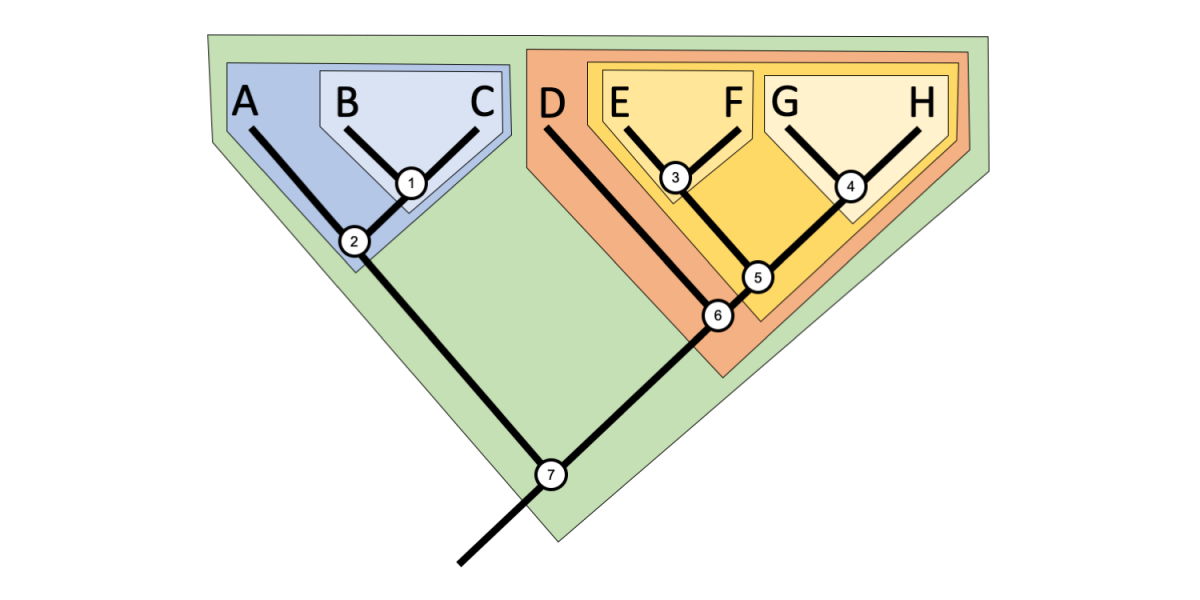
96
New cards
Discuss the usefulness of topology and branch length when reading phylogenetic trees. Given a tree, represent its topology using parenthetical notation. Be able to identify trees of different style or arrangement that share a common topology.
Topology are the tips of the branches, and they can be arranged in all sorts of ways and still be equivalent. Look for the nodes in relation to the tips. review writing them in parenthesis.
- Branch length is usually not informative.
In SOME tree diagrams, branch lengths are proportional to the amount of evolutionary change or time since when a particular event happened. The branch length of the phylogenetic tree reflects the number of changes that have taken place in a particular DNA sequence in that lineage.
- Branch length is usually not informative.
In SOME tree diagrams, branch lengths are proportional to the amount of evolutionary change or time since when a particular event happened. The branch length of the phylogenetic tree reflects the number of changes that have taken place in a particular DNA sequence in that lineage.
97
New cards
Identify monophyletic and non-monophyletic groups in a phylogenetic tree, and explain how they differ. List the branchpoints/taxa that you would have to add to a non-monophyletic group to convert it into a monophyletic group.
A monophyletic group includes an ancestor and all of its descendants. It is identified by the presence of shared, unique characters.
98
New cards
Demonstrate how characters are used to build a phylogenetic tree.
- Morphological: homologies and analogous structures
- The fewer changes in DNA there is within organisms, the more closely related they are. The DNA sequence would have to be a good match. If the species are very closely related, the sequences probably differ at only one or a few sites. In contrast, comparable nucleic acid sequences in distantly related species usually have different bases at many sites and may have different lengths. This is because insertions and deletions accumulate over long periods of time.
- The fewer changes in DNA there is within organisms, the more closely related they are. The DNA sequence would have to be a good match. If the species are very closely related, the sequences probably differ at only one or a few sites. In contrast, comparable nucleic acid sequences in distantly related species usually have different bases at many sites and may have different lengths. This is because insertions and deletions accumulate over long periods of time.
99
New cards
Given two trees with character transitions marked, infer which is the most parsimonious tree.
Most parisomous tree requires the fewest evolutionary events, as measured by the origin of the shared derived morphological characters. Tree with least amount of character transitions is most parsimonious.
100
New cards
Given a tree and character transitions marked: Identify which characters are derived vs. ancestral for each taxon or clade.
There are marking that will denote it.
 Note
Note  Flashcards (334)