C25 CAS FINANCIAL REPORTING
 Call Kai
 Learn
Learn Practice Test
 Spaced Repetition
 Match
Match Flashcards
 Knowt Play
1/19

There's no tags or description
Looks like no tags are added yet.
Name | Mastery | Learn | Test | Matching | Spaced | Call with Kai |
|---|
No analytics yet
Send a link to your students to track their progress
20 Terms
SAP vs GAAP → Objective
SAP: measures ability to pay future claims
GAAP: measures emerging earnings from period to period
SAP vs GAAP → Intended User
SAP: Regulators
GAAP: General audience
SAP vs GAAP → Asset Recognition
SAP: Policy Acq costs treated as expense when incurred
GAAP: Policy Acq costs recognized as asset
SAP vs GAAP → Treatment of Reinsurance
SAP: Loss reserve NET of reinsurance
GAAP: Loss reserve GROSS of reinsurance
SAP vs GAAP → Deferred Income Taxes
SAP: NOT recognized
GAAP: recognized
Primary Financial Statements
Balance Sheet
Income statement
Capital & surplus
Cash flows
Balance Sheet
Company’s assets & liabilities as of point in time
Income Statement
Company’s financial balance at point in time
Liquidation vs Going Concern Basis
Liquidation: sees assets/liabilities as a run-off
Regulator’s interest
Going Concern: sees assets/liabilities as ongoing business
Investor’s interest
Fair Value vs Historical Cost
Fair Value: current market value
More accurate
Historical Cost: OG purchase cost - depreciation
Easier to calculate
Principle vs Rule-Based Accounting
Principle-based: general accounting approach that must be interpreted & applied
More flexible
Rule-based: provides specific accounting guidance
Easier to apply & audit
Solvency II
Principles-based insurance regulatory system
For capital levels of insurance companies in EU
Solvency II → 3 Pillars
QGT
Quantitative
Sets capital requirements
Solvency Capital Req (SCR)
Min Capital Req (MCR)
Uses total balance sheet approach
Governance
Requires adequate governance for:
Internal audit
Actuarial
Risk mgmt
Compliance
Requires companies to complete ORSA
Transparency
Disclosure/reporting of info from other 2 Pillars
Inc market discipline bc company’s decisions will be public
Solvency Capital Requirement (SCR)
Defined as 99.5% VaR over one year
> Minimum Capital Requirement (MCR)
Governance → 3 Conditions & 4 Functions
Conditions:
Fitness & propriety
Outsourcing
Internal control
Functions:
Internal audit
Actuarial
Risk mgmt
Compliance
Windows & Walls Approach in US
Gives windows for regulators to look into group-wide operations
Maintains walls at statutory legal entity level
Solvency II vs MCT
Both: capital adequacy frameworks
MCT: for Canada
Solvency II: for EU
Principle based → more flexible but harder to apply
Solvency II → Liabilities
IFRS Assets = Liabilities
= Free Surplus + SCR + Technical Provisions
SCR = MCR + (SCR-MCR)
Technical Provisions = Best est of Liabilities + Risk Margin
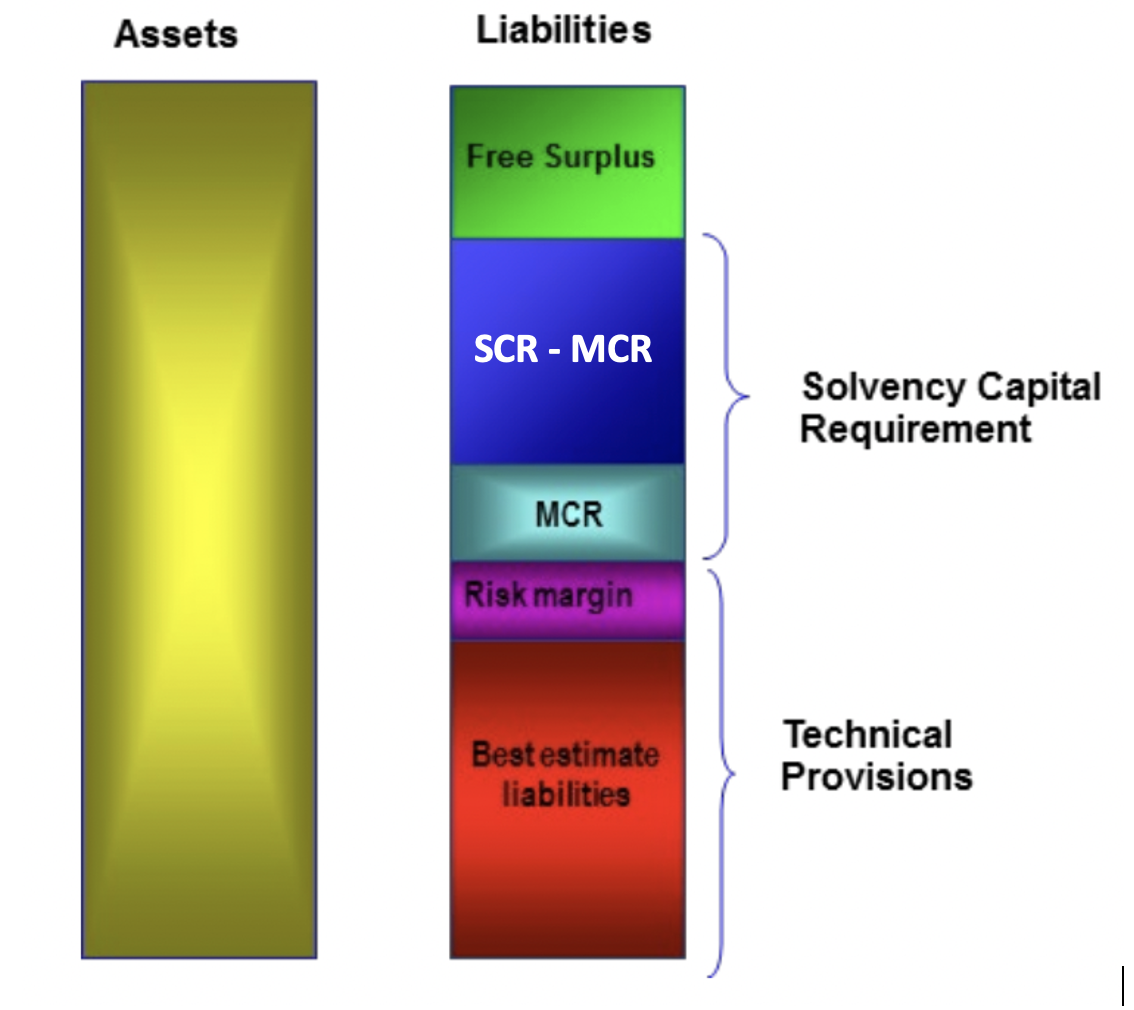
Calculating Asset Required
MCR Asset Required = Technical Provision + MCR
SCR Asset Required = Technical Provision + SCR
What if SCR/MCR not met?
MCR assets < IFRS assets < SCR assets → regulator intervention
IFRS assets < MCR assets → not permitted to operate

