Lecture 15: Chemical Senses Peripheral
 Call Kai
 Learn
Learn Practice Test
 Spaced Repetition
 Match
Match Flashcards
 Knowt Play
1/62

There's no tags or description
Looks like no tags are added yet.
Name | Mastery | Learn | Test | Matching | Spaced | Call with Kai |
|---|
No analytics yet
Send a link to your students to track their progress
63 Terms
What are the 2 things peripheral receptors + their central connections are designed to do?
Stimulate eating of foods that provide source of energy (carbohydrates), protein (glutamate), and salt.
Drive an animal to avoid items that might be poisonous (bitter) or contaminated by bacteria (marked by presence of H+ → sour)
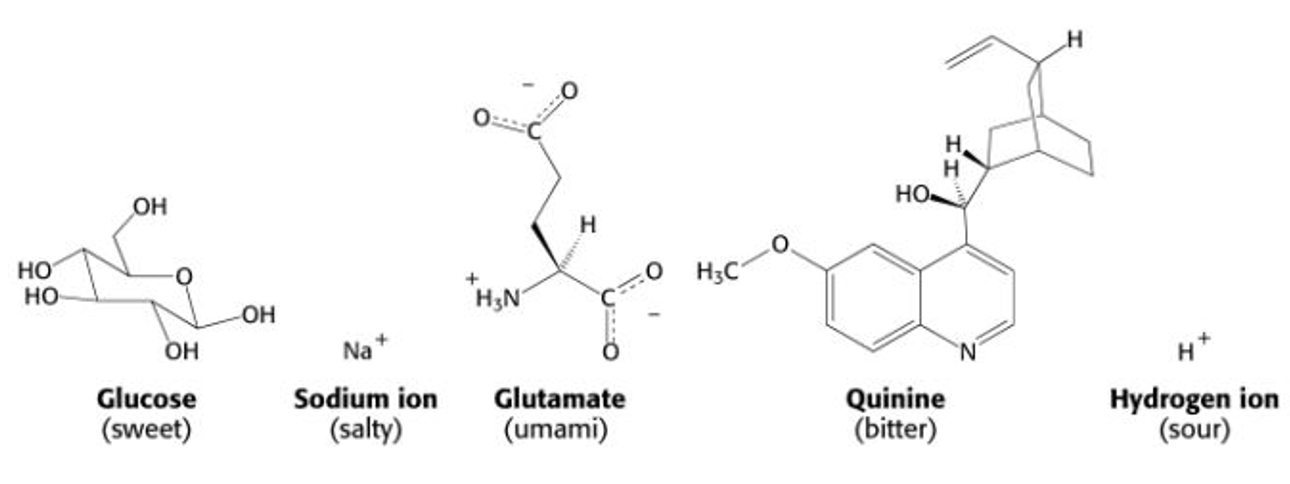
List the 5 basic taste modalities + their tastants
Sweet → glucose
Salty → sodium ion
Umami → glutamate
Bitter → quinine
Sour → hydrogen ion
We have 5 types of taste receptor cells for each 5 tastants
What is the structural organization of the gustatory system from tongue → brain?
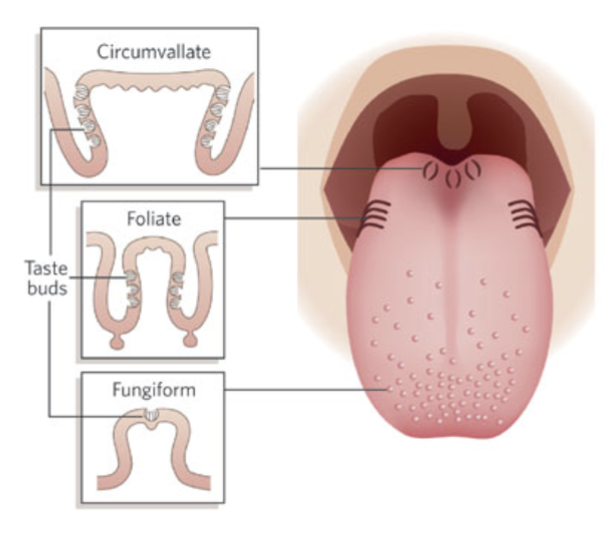
Papillae (circumvallate, foliate, fungiform) have microscopic taste buds → each bud has taste ~100 receptor cells release neurotransmitter onto cranial nerves VII, IX, X → nucleus of solitary tract (NST) → thalamus → gustatory cortex
What are the key properties of taste receptor cells?
NOT neurons (epithelial-like)
Release neurotransmitter (especially ATP) onto afferents
Depolarize gustatory ganglion neurons
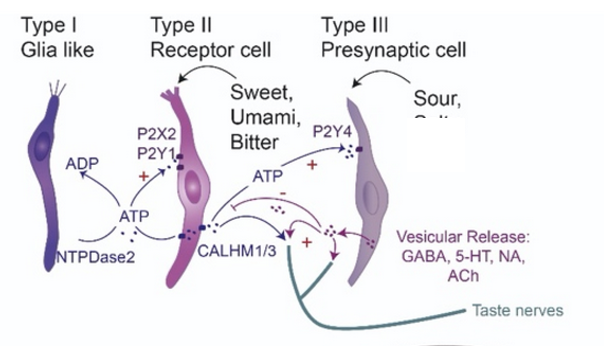
What are the 3 types of taste receptor cells and their functions?
Type I: glia-like (support)
Type II: receptor cells → sweet, bitter, umami (subdivided, specific tastants)
Type III: presynaptic → sour, vesicular neurotransmitter release
How is taste transduction different from typical sensory systems?
Receptor cells are not neurons → they synapse onto afferent neurons using neurotransmitter (ATP) instead of directly generating action potentials
Are papillae and taste buds macroscopic or microscopic?
Papillae → macroscopic (can see w/ naked eye)
Types:
Fungiform → buds on top
Foliate → buds on sides
circumvallate → buds on back
Taste buds → microscopic
What are the 3 cell types of each taste bud?
~100 taste receptor cells (TRCs): stick microvilli into the only opening of the bud (taste pore → route that saliva + molecules dissolve in to reach TRCs); life span = 2 weeks
Supporting cells: form an outer envelope for the bud
Basal cells: serve as progenitors for TRCs (short-lived + easily damaged); proliferate throughout life
What are gustatory afferents and what do they do?
Gustatory afferents = distal axon ends of gustatory ganglion cells
gather input from TRCs + carry it into the brain
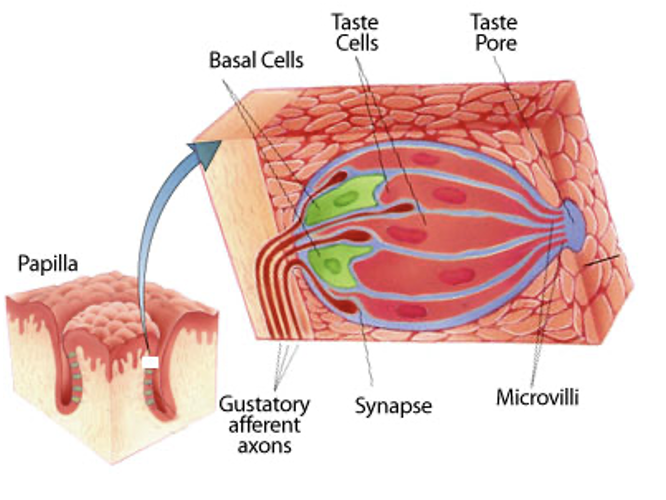
Where do the foliate vs. circumvallate papillae vs. fungiform papillae have the buds?
Foliate: taste buds along their sides
Circumvallate: taste buds at the back
Fungiform papillae: taste buds at their tops
What are the morphological vs functional types of taste receptor cells?
3 morphological TRC types: Type I, II, III
5 functional TRC types:
Sweet
Umami
Bitter
Sour
(Salty – likely Type I, less certain)
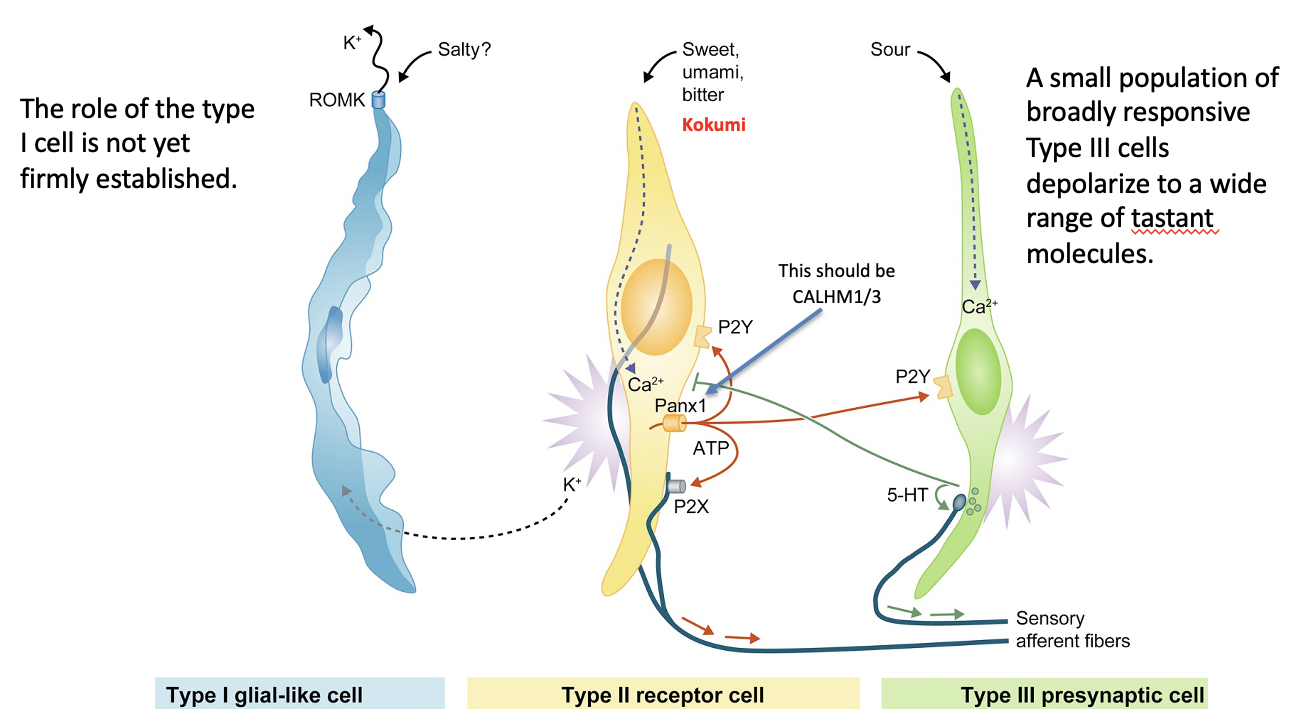
What is the role of Type I taste receptor cells?
Not firmly established*
Might depolarize to elevated Na+ concentration
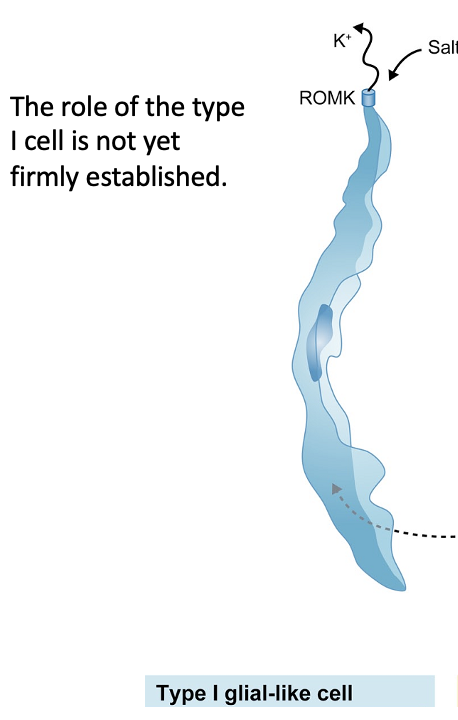
What do Type II taste receptor cells detect and how do they signal?
Subdivided into 3 receptor-specific groups
Detect sweet (has receptor for carbs), umami (has receptors for amino acids), bitter (has receptors binding range of compounds for bitterness)
All use same signaling leading to release ATP (non-vesicular) onto peripheral axons of gustatory cells
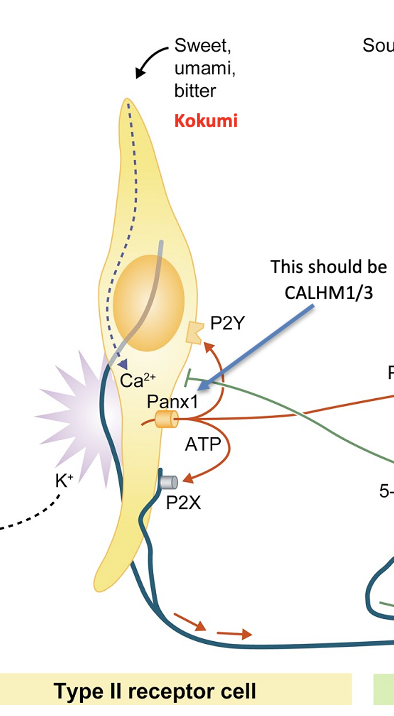
What do Type III taste receptor cells detect and how do they signal?
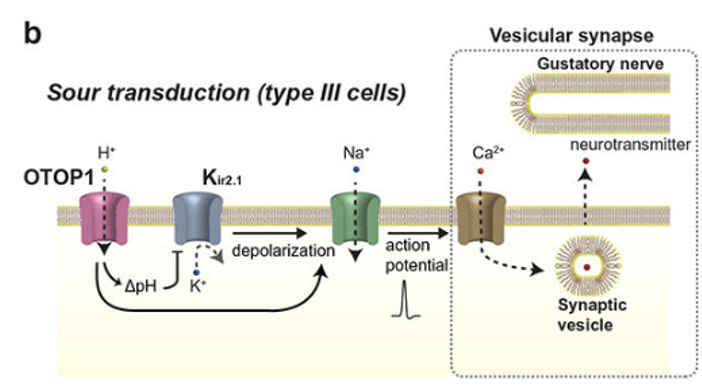
Have channels gated by [H+]
Depolarize in response to acids + begin process of tasting acidic things as sour
![<ul><li><p>Have channels gated by [H+]</p><ul><li><p>Depolarize in response to acids + begin process of tasting acidic things as sour</p></li></ul></li></ul><p></p><p></p>](https://assets.knowt.com/user-attachments/85d60d44-7e98-404f-94bb-93bfe1bd53cf.png)
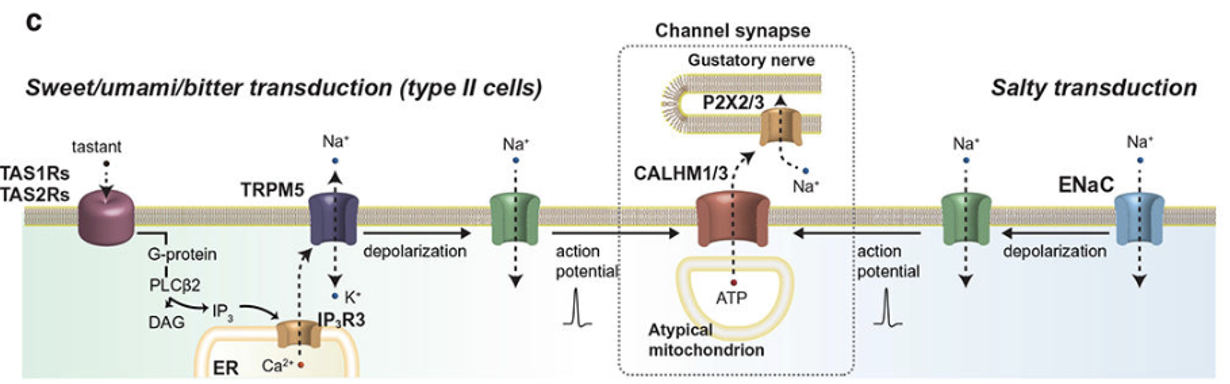
What is the full signaling pathway for sweet/bitter/umami (Type II cells)?
Type II taste receptors are GPCRs:
Bind tastant → turns on G protein gustducin → its beta/gamma subunit activates PLCb2 → PLCb2 splits PIP2 into IP3+DAG → ↑ Ca²⁺ (ER) → TRPM5 (non-selective cation channel) opens → depolarization → opens voltage-gated Na+ chanels → train of APs → opens CALHM1 (ATP channel) in presynaptic TRC membrane → releases ATP in a non-vesicular fashion → binds to P2X (ligand-gated cation channels) in tips of gustatory ganglion cell peripheral axons to depolarize them
Draw the signaling pathway for type II cells (sweet/umami/bitter)
How is salty taste transduced?
Na⁺ influx via ENaC (epithelial Na+ channels) → depolarizes TRCs → APs → ATP release
don’t know which population of TRC
How is sour taste transduced (Type III cells)?
H⁺ enters via OTOP1 (proton channel) → depolarization + K⁺ channel closure (for further depol) → APs → vesicular release of 5-HT (+ maybe other NTs)
What are the key differences between Type II and Type III signaling?
Type II: GPCR, intracellular cascade, ATP (non-vesicular)
Type III: direct ion channels (H⁺), vesicular NT release
What receptors do Type II taste cells use for sweet, umami, and bitter?
Sweet: T1R2 + T1R3 (form a heterodimer to bind carbs)
Umami: T1R1 + T1R3 (form a heterodimer to bind glutamate)
Bitter: T2Rs (≈30 class I GPCRs)
What is the key shared feature between sweet and umami receptors?
Both use T1R3 → shared subunit
What signaling pathway do ALL Type II cells use?
Use the same intracellular signaling pathway that leads to the non-vesicular release of ATP and its binding to ionotropic ATP receptors (P2Xs) in the postsynaptic membrane of gustatory ganglion cell axons.
What are kokumi receptors and what do they do?
CaSR (calcium-sensing receptors)
Do NOT produce a taste → enhance other tastes
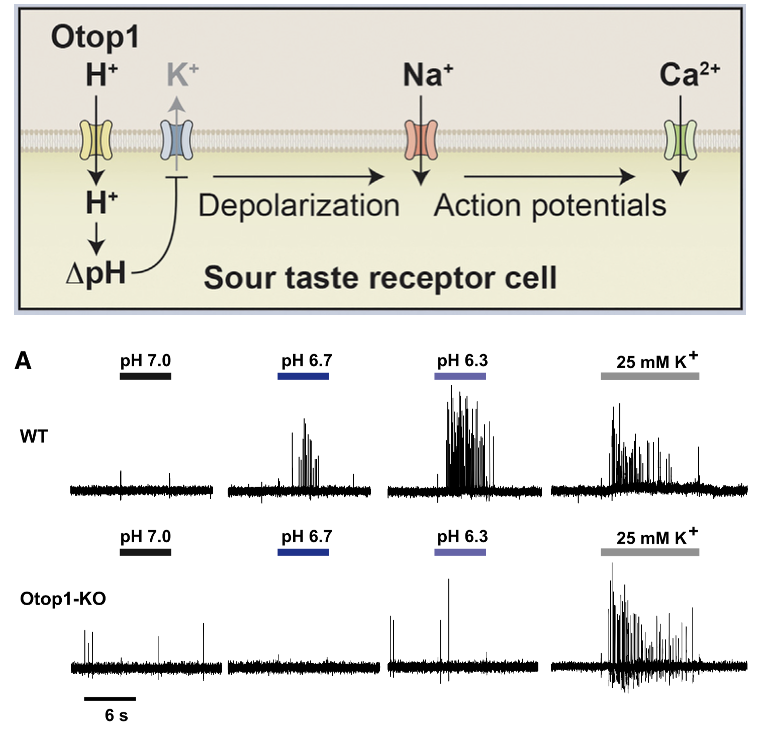
What happens in Opto1-KO mice?
They have severely reduced celluar responses to acids
Figure shows APs recorded from Type III TRCs
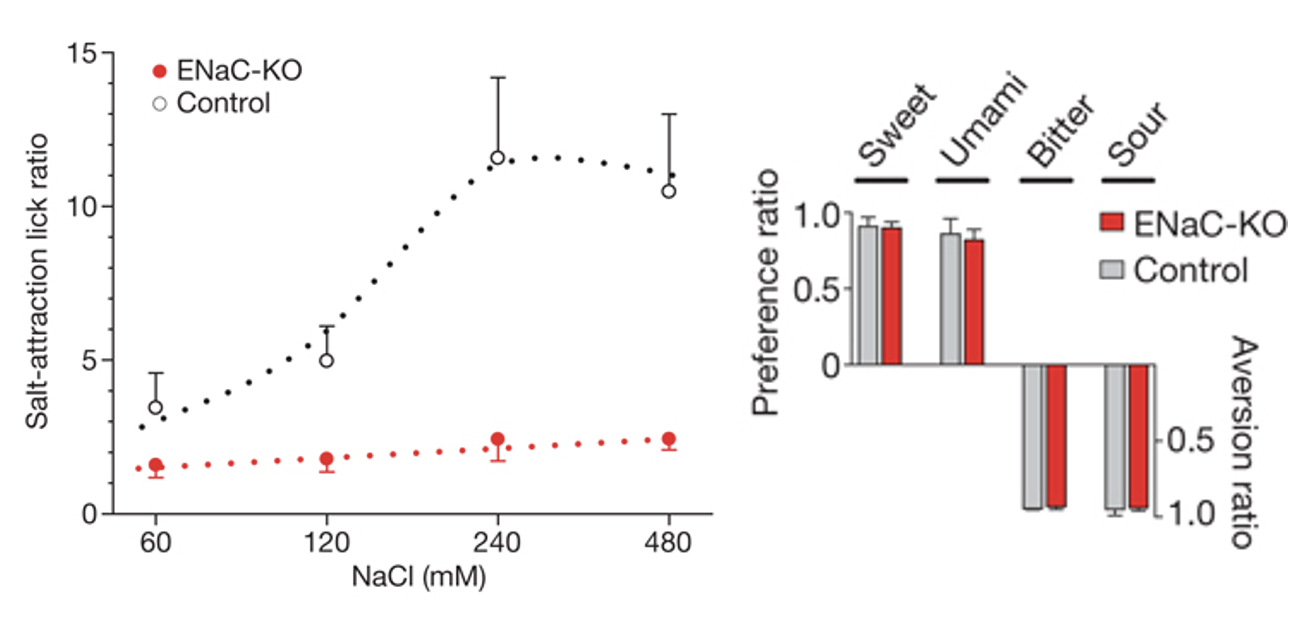
What happens in ENaC-KO mice?
Selectively abolishes the attractive taste of NaCl
Does not affect other taste responses
Epithelial sodium channels: Na+-selective ion channels
ENaC is expressed in TRCs that do not express receptors for other tastants
What are the 2 extreme models of gustatory coding?
Labeled-line model → each cell/fiber = one tastant
like somatosensory system w/ C nociceptors → SC → synapse w/ lamina I neurons in dorsal horn → axons cross midline + ascent to thalamic nucleus VMpo
Across-fiber model → taste = pattern across many fibers
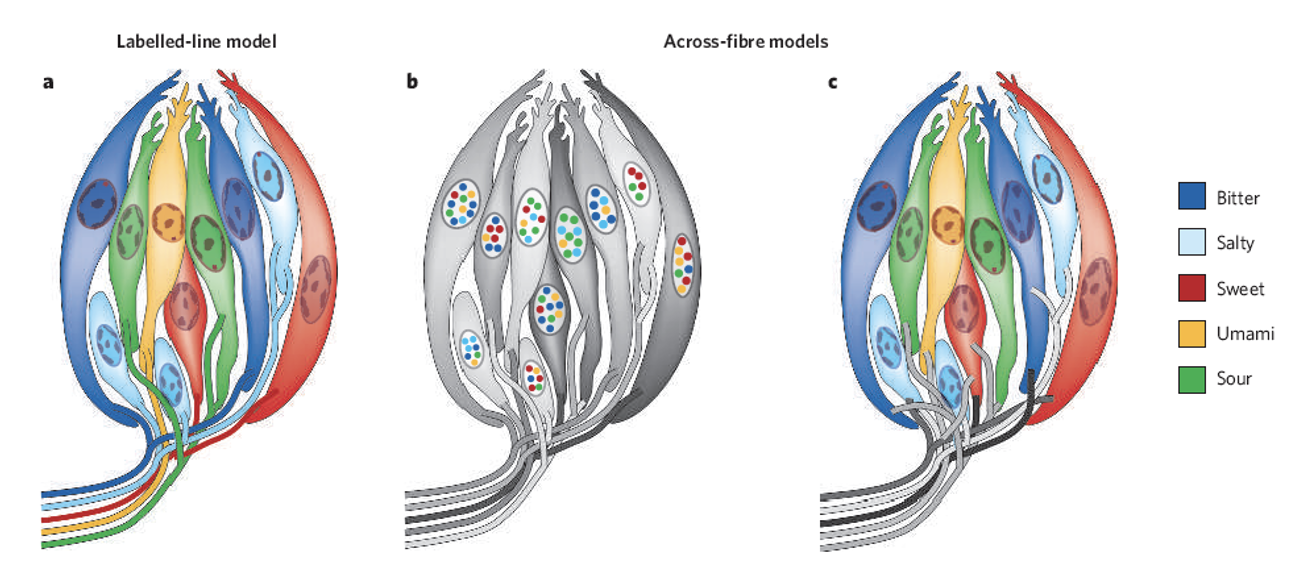
What does the labeled-line model predict about TRCs and ganglion cells?
Each TRC expresses one receptor → one tastant
Each TRC connects to a specific ganglion cell
Each afferent fiber carries one taste quality (sweet, sour, etc.)
What evidence supports the labeled-line model?
Most TRCs express only one receptor type
Many ganglion cells contact only one TRC type
→ fibers are taste-specific
What findings challenge the labeled-line model?
Some TRCs (likely Type III subtype) respond to multiple tastants
Some ganglion cells receive input from multiple TRC types
What is the combinatorial model of taste coding?
Taste is encoded by a mix of specialist + generalist cells and neurons, producing a pattern of activity across multiple inputs rather than strictly one-to-one mapping.
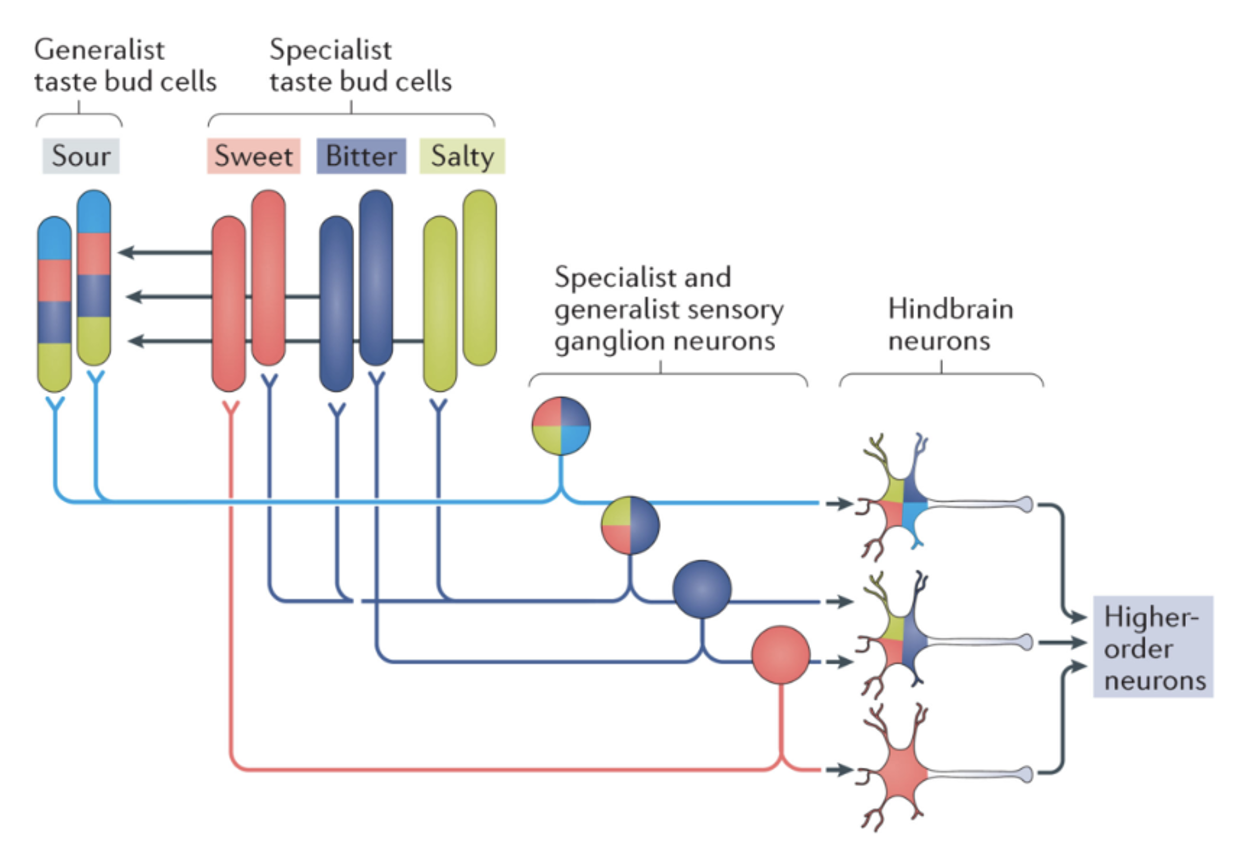
Which taste receptor cells are specialists vs generalists?
Specialists: Type II (sweet, umami, bitter) + salty TRCs
Generalists: many Type III (sour) cells → respond to multiple tastants
Why can Type III (sour) cells respond to multiple tastants?
They receive paracrine (cell-to-cell) signaling within the taste bud → indirect responses to other tastants.
What happens in the nucleus of the solitary tract (NTS)?
Taste ganglion cells synapse on neurons in NTS
Neurons can be:
Modality-specific (labeled-like)
Multimodal (combinatorial)
What does “cells, not receptor proteins, dictate behavior” mean in taste?
Behavior depends on which cell type is activated (neural pathway), NOT the receptor itself.
What was the key experiment using the human bitter receptor (T2R49)?
Mice don’t naturally have T2R49
Insert T2R49 into:
Bitter cells → mice avoid tastant
Sweet cells → mice prefer same tastant
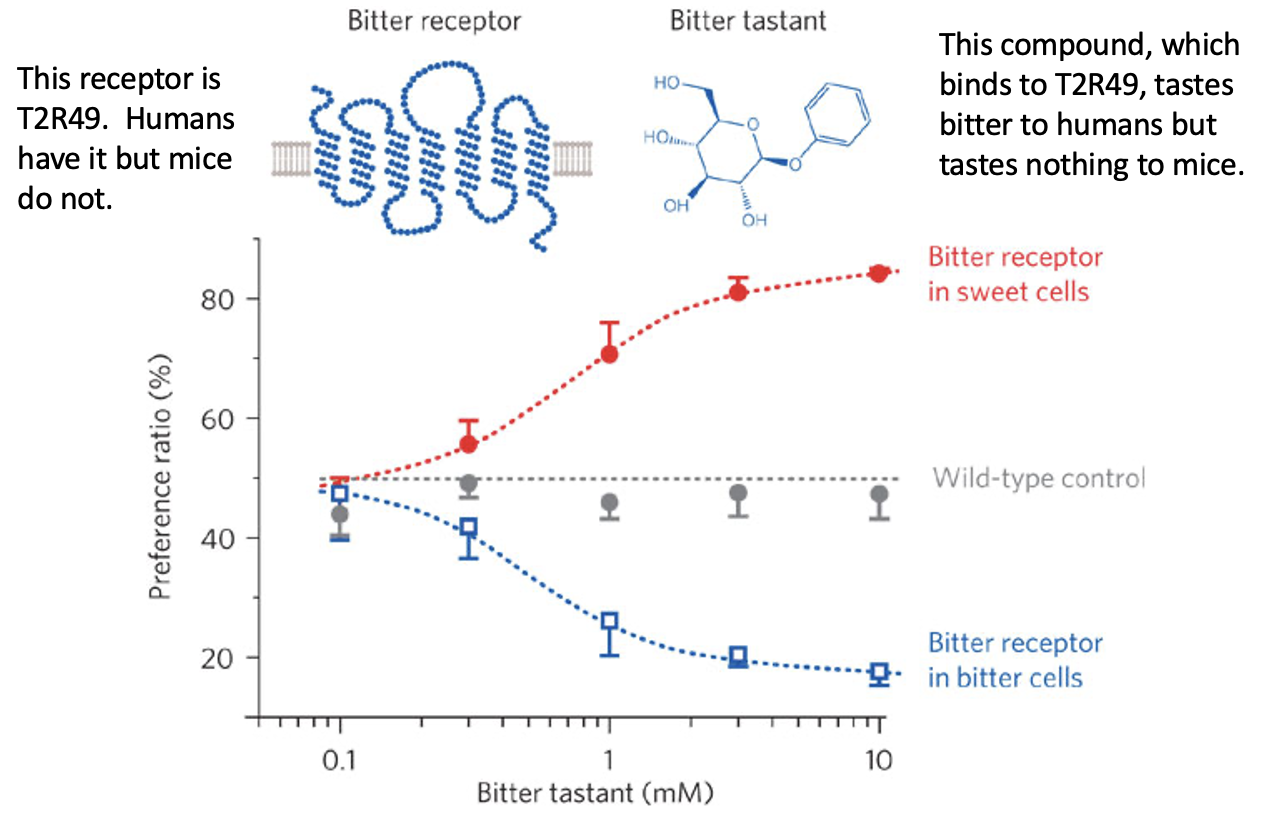
What does the result of expressing a bitter receptor in sweet cells show?
The same molecule becomes “sweet” behaviorally → meaning is determined by cell identity, not receptor type.
What happens in wild-type mice with this compound?
They ignore it (no receptor → no perception → no behavior).
Which parts of olfaction are PNS vs CNS?
Olfactory epithelium = PNS (contains olfactory sensory neurons, OSNs)
Olfactory bulb = CNS (part of the brain)
Where does odor transduction occur and what happens?
In olfactory epithelium → OSNs convert odorant binding into changes in membrane potential
How do olfactory signals get from nose to brain?
OSN axons → pass through cribriform plate → terminate in olfactory bulb
OB is CNS!!!
How is olfactory input organized across sides?
Two olfactory bulbs (one per hemisphere)
Each bulb receives input from the same side (ipsilateral) nose
What is the full early olfactory pathway?
Odorant → olfactory epithelium (OSNs, PNS) → axons through cribriform plate → olfactory bulb (CNS)
What type of receptors do OSNs use and where are they located?
GPCRs (odorant receptors)
Located on dendritic cilia of OSNs
Bind odorants → depolarization → action potentials → axons carry signal to olfactory bulb
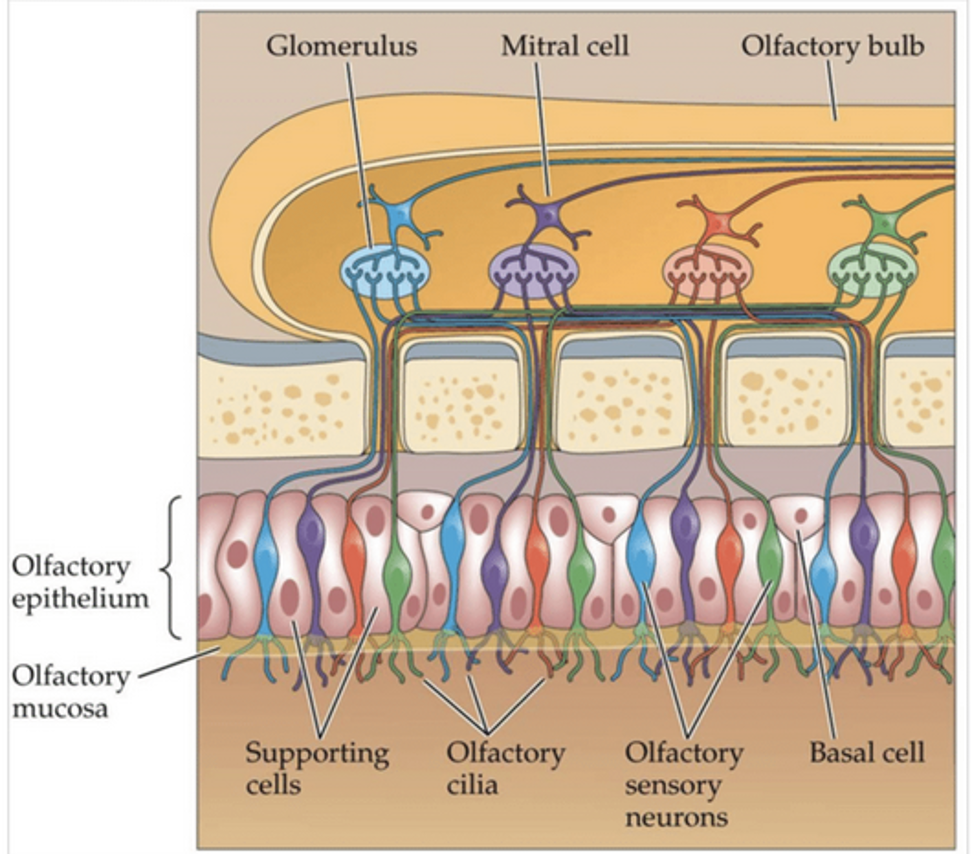
How many receptor types does each OSN express?
Only ONE odorant receptor gene (of 350) per OSN
Rodents have 1000 genes, dogs have 1200, elephants have 2000)
Where do OSNs expressing the same receptor project?
They converge onto specific glomeruli (same receptor → same glomerulus)
What happens in the glomerulus?
OSN axons terminate onto mitral cells in olfactory bulb (CNS)
What cell types are in the olfactory epithelium?
Olfactory sensory neurons (OSNs)
Supporting cells
Basal cells
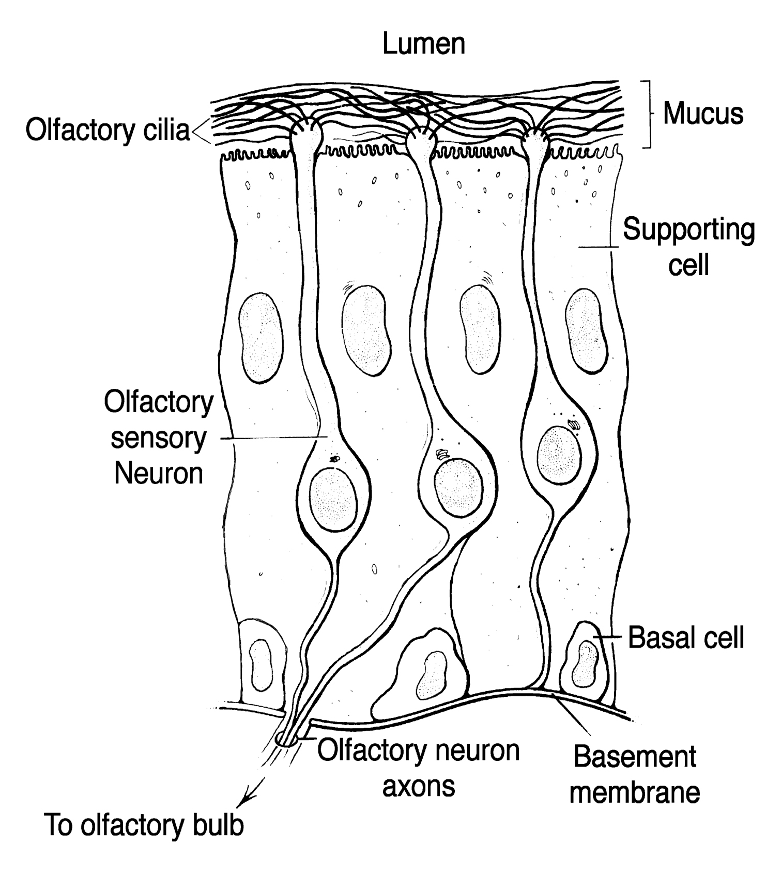
What is the structure and polarity of an OSN?
Bipolar neuron
It gives off a single dendrite that extends to surface of olfactory epithelium
It also gives one axon that goes in opposite direction → cribriform plate (part of skull) → olfactory bulb
Where are odorant receptors located and where does transduction occur?
OSN’s dendrite breaks up into ~20 cilia at its itp in olfactory mucosa
GPCR odorant receptors on cilia
Cilia (in mucus) = main site of odor binding + transduction
What are key features of olfactory cilia?
~20 per OSN
Extend into mucus
Contain most GPCRs that bind odorant molecules (rest of OSN has little)
What cells are in the olfactory epithelium and how are OSNs maintained?
OSNs + supporting cells + basal cells
Basal cells = stem cells → replace OSNs throughout life
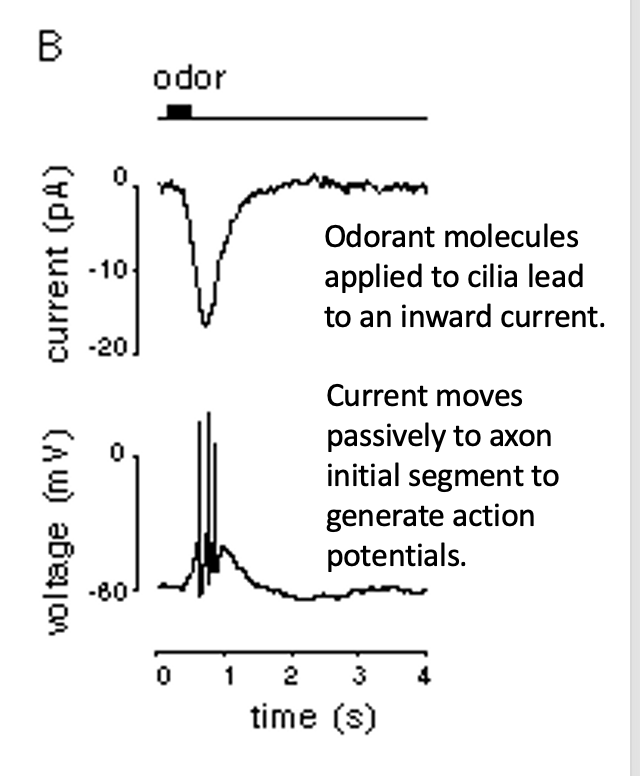
What happens when an odorant binds to OSN cilia?
Generates an inward (depolarizing) current at the cilia → moves passively to axon initial segment to generate APs
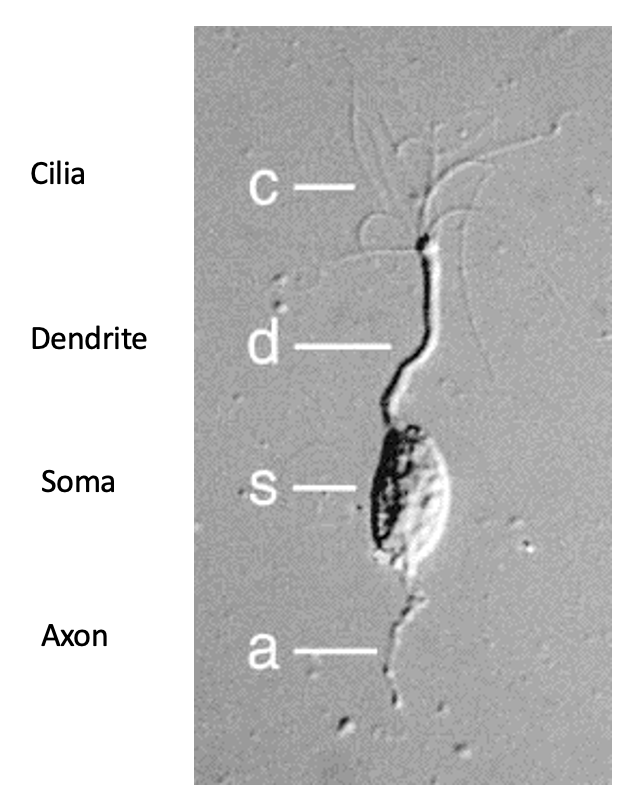
Match structure to function in OSNs: cilia, dendrite, soma, axon
Cilia → odor detection + current generation
Dendrite → conducts signal to soma
Soma → integrates
Axon → carries APs to olfactory bulb
axon initial segment generates APs
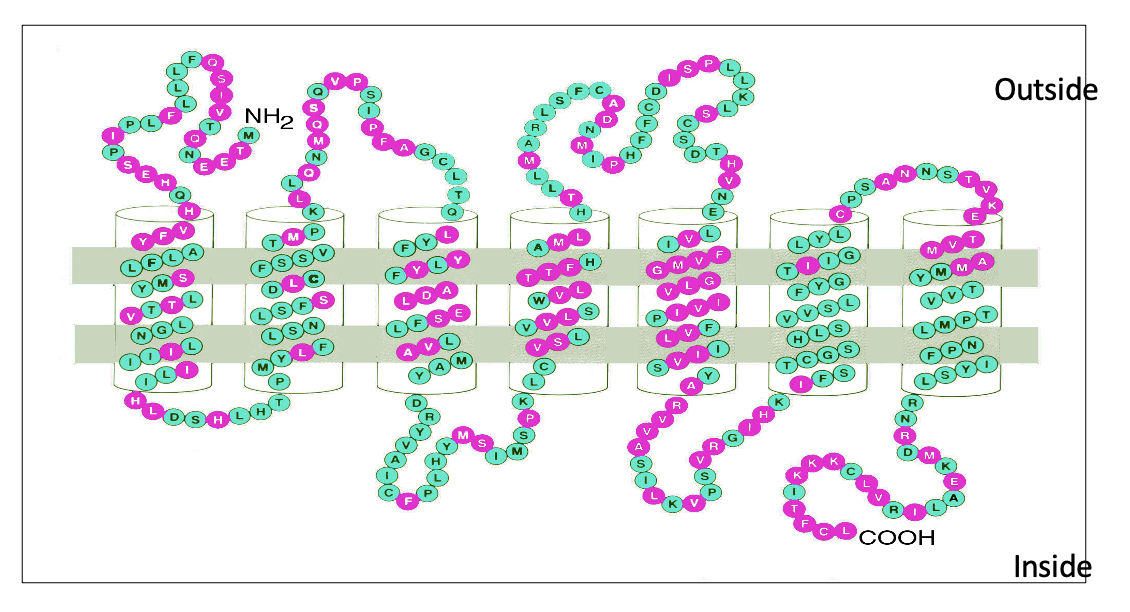
What type of receptors are odorant receptors?
GPCRs (7 TM domains)
Figure: green is common AA in many ORs, pink is highly variable (det. odor specificity)
Each OSN expresses only 1 odorant receptor gene
Why can we detect so many different odors?
Huge receptor gene family (represents up to 5% of protein-coding genome)
>1000 genes in mammals
~350 functional in humans
Variable regions allow binding of many odorants
What is the olfactory transduction pathway from odorant to depolarization?
Odorant → OR (GPCR) → Gₒlf (G protein) → ACIII → ↑ cAMP → CNG channels open → Na⁺ + Ca²⁺ influx → Ca²⁺ activates ANO2 (Cl⁻ channel) → Cl⁻ exits → depolarization
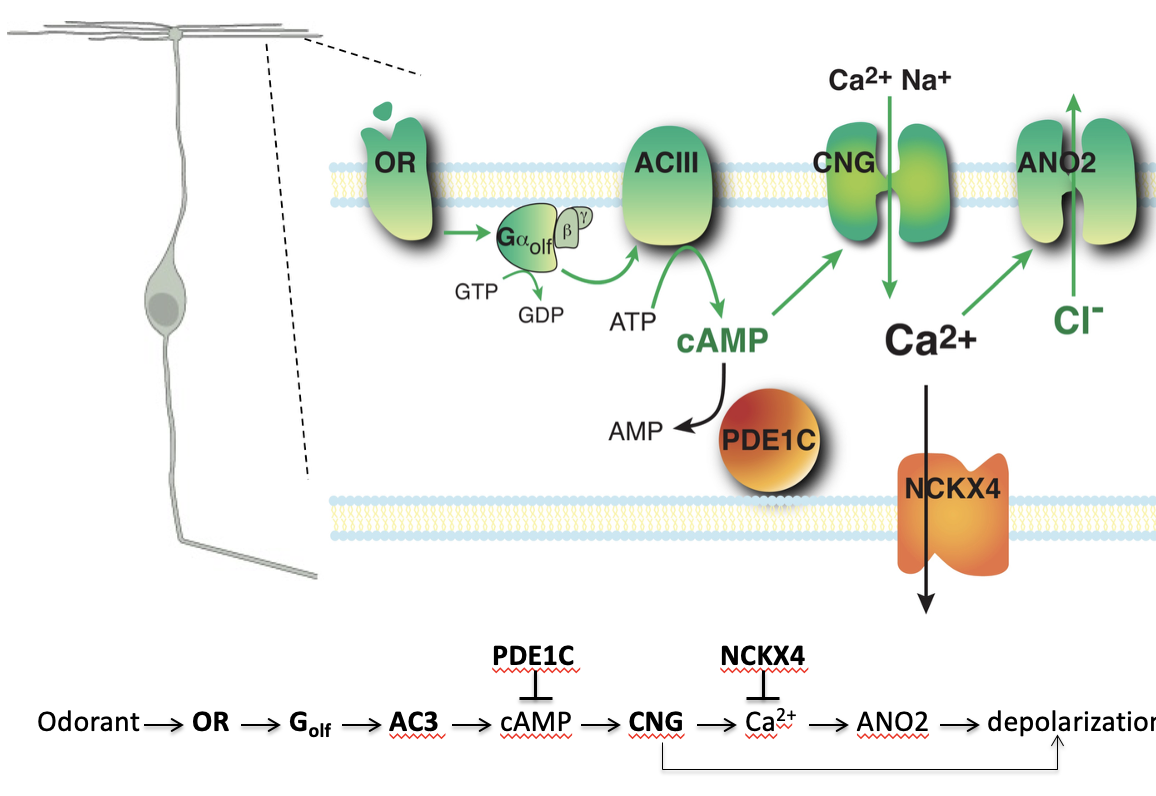
What are the two key ion channels in olfactory transduction and how are they activated?
CNG channel → opens with cAMP → lets in Na⁺ + Ca²⁺
ANO2 (Cl⁻ channel) → opens with Ca²⁺ through CNG channels → Cl⁻ exits (amplifies depolarization + current is inward); OSNs have high intracellular [Cl-] originally
What role does Ca²⁺ play in olfactory adaptation?
Ca²⁺ provides negative feedback by:
Activating PDE1C → breaks down cAMP
Activating CaMKII → phosphorylates ACIII + inhibits its activity
Binding calmodulin → reduces CNG channel affinity to cAMP
What is the key principle of odor coding at the receptor level?
One receptor per neuron, but one receptor can respond to multiple odorants
How do OSN1, OSN2, and OSN3 differ in tuning?
OSN1: broadly tuned (responds to many odors)
OSN2: narrowly tuned (specific)
OSN3: selective but different preference pattern
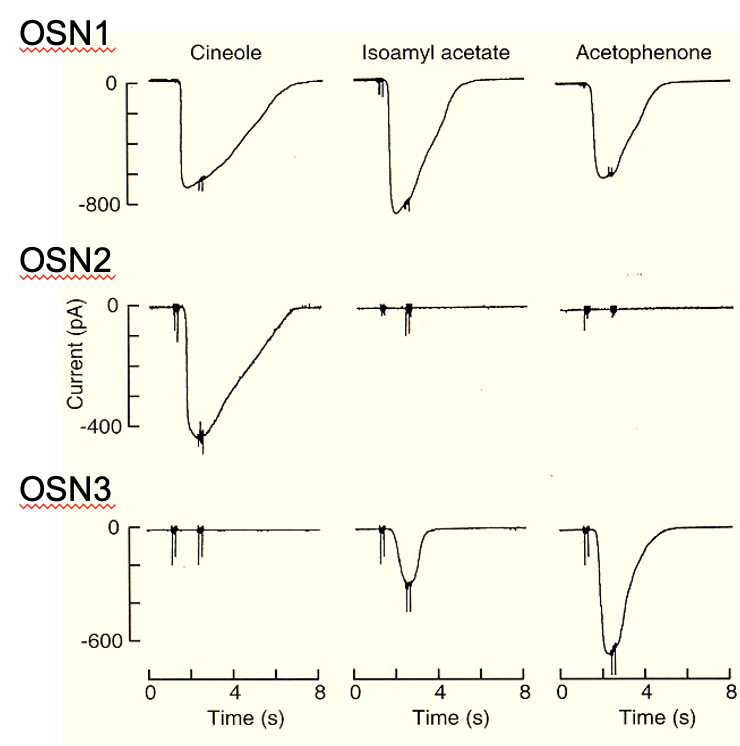
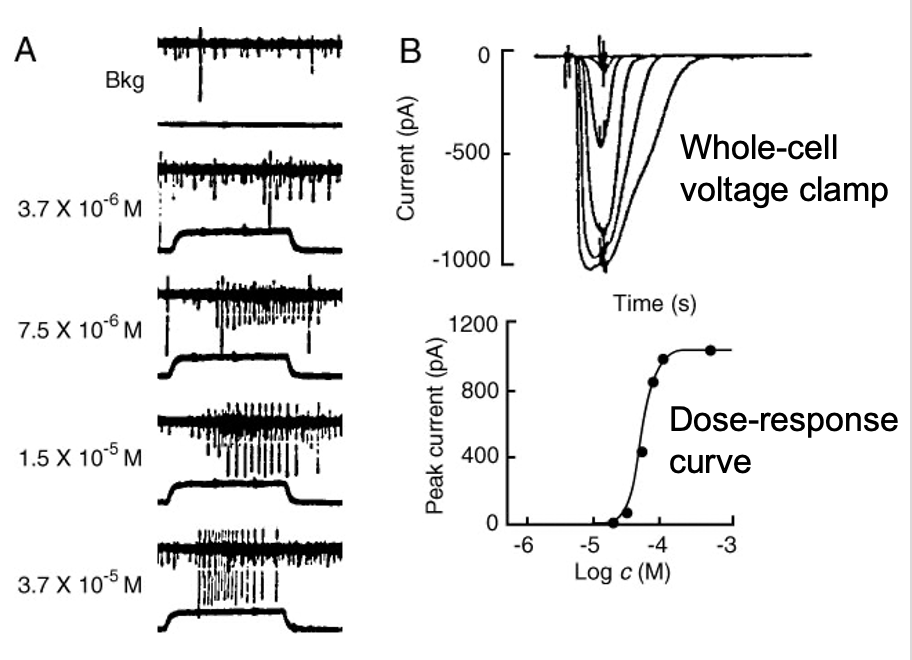
How do patch clamp experiments measure neuronal responses?
Allow researchers to measure, record, and control the ionic current or membrane voltage passing through individual or multiple ion channels on a cell's membrane.
A glass pipette forms a tight seal on the membrane
Inward current (negative deflection) = positive ions entering (depolarization)
Larger current = stronger response of the cell
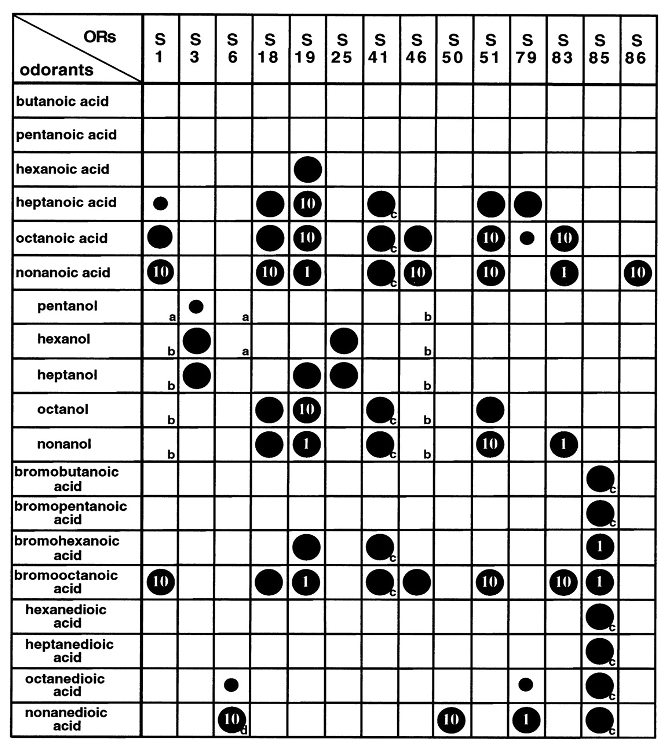
How are odorants encoded in the olfactory system?
Each odorant activates a unique combination of odorant receptors (ORs)
Each OR can respond to multiple odorants
→ Odor identity = pattern of activity across many receptors (combinatorial code)
How is odor intensity encoded by olfactory sensory neurons (OSNs)?
Higher odor concentration → higher spike rate (frequency)
Transduction currents increase with concentration but show a steep (narrow) dose-response range