Race, Class, Gender & Crime Exam 2
 Call Kai
 Learn
Learn Practice Test
 Spaced Repetition
 Match
Match Flashcards
 Knowt Play
1/47

There's no tags or description
Looks like no tags are added yet.
Name | Mastery | Learn | Test | Matching | Spaced | Call with Kai |
|---|
No analytics yet
Send a link to your students to track their progress
48 Terms
Gender Gap in Crime: Historical Patterns
Most criminological theories were developed by men to explain why (some) men and boys break the law
Historically, women and girls are excluded from much of criminological research
Sex/gender is one of the strongest correlates of criminality across time
Gender Gap in Crime is Narrowing: Convergence Theories and Current Trends
Changes in Conviction Rates
increased convictions for women and decreased convictions for men (especially for nonviolent crimes)
The Liberation Hypothesis
As women gain more social power and freedoms, they may have more opportunities to commit crime
Economic Marginalization Hypothesis
as women experience increasing economic hardship relative to men, the gender gap in crime may narrow
Gender Gap in Crime: Explanation for Differences
Research has focused mainly on men!
This is because:
women make up a small percentage of people in prison (<15%) and a small number of people arrested each year (<30%)
criminal justice authorities are more likely to oppose research on women than on men — viewed as “niche” or too specialized
women and their crimes have been deemed insignificant or less deserving of resources compared to men
Theories of Female Offending: Early Theories (Biological Determinism)
1. Innate biological characteristics, not society, are responsible for criminal behavior
2. women have a different biological makeup than men; simple and less rational
3. offending women are “masculine”
4. differences between male and female criminals are due to sex, not gender differences
Theories of Female Offending: Early Theories (Atavism)
Deviants are less evolved than law-abiding citizens
women display fewer signs of degeneration than men
women had not evolved as much as men
minority women were deemed less evolved
Women with stronger jaws, cheekbones, and coarser features were deemed more criminal
Lombroso and Ferraro provided two categories available to women, both considered inferior to men:
Bad, primitive, and masculine women
law-abiding, civilized, and feminine women
AKA Madonna/whore duality or good girl/ bad girl duality
early studies confused promiscuity with crime
Theories of Female Offending: Early Theories (Freud)
women are anatomically inferior to men
the deviant woman wants to be a man
develops “penis envy”
rebellion against natural feminine roles
women can be cured if they adjust to their “proper” lady roles
Theories of Female Offending: Early Theories (Pollak)
assumes that male and female crime rates are similar
female treatment is “masked” by their lenient treatment in the crime processing system
women are better at hiding their crimes since they are inherently deceitful… explained by the fact they can hide their orgasms….
women are instigators of crime rather than perpetrators
Theories of Female Offending: Feminist Critiques
took issue with the fact that socially undesirable characteristics were attributed to women and assumed to be intrinsic characteristics of their sex
called attention to the structural features of society and the gendered natures of the roles of men and women
critiqued early theories for being sexist, classist, and racist
Theories of Female Offending: Cycle of Violence
many women who engage in crime have histories of childhood physical and sexual abuse and violent victimization
trauma affects emotional regulation, mental health, and drug and alcohol problems that increase the likelihood of offending
early life experiences with victimization propel many women into crime
Theories of Female Offending: Modern Explanations
Gendered Pathways
Life-course perspective
focuses on girls’ and women’s life histories
identifies early life experiences that put individuals on developmental pathways to crime
recognizes the roles of violence, trauma, and substance abuse in shaping criminal pathways
considers race/ethnicity influences on crime, violent partners, and drug use
Childhood:
violent and unstable family backgrounds
sexual abuse and incest
multiple types of abuse and neglect
caring for others at an early ahe
educational neglect and racial violence
Adolescence:
survival strategies
fleeing abusive homes, running away
onset of delinquency
drug use, truancy, stealing, “hustling” money for food
adultification
an adolescent, because of the need for survival, young people take on adult roles too soon
street work and revictimization
abusive relationships
addiction, mothering, caretaking
Feminization of Poverty
gender divergence in drug arrests, women’s continue to grow as men’s return to early 1990s level
Processing of Women and Girls in the Criminal Justice System: Chivalry Hypothesis
leniency for girls and women
afforded to certain women under certain circumstances
Processing of Women and Girls in the Criminal Justice System: “Evil Woman” Hypothesis
Women are treated more harshly than men, leniency for boys and men
Processing of Women and Girls in the Criminal Justice System: Are women and men treated equally in case processing?
early studies found strong evidence of chivalry in women’s treatment
now, findings are more mixed
women in general recieve lighter sentences since they commit less serious crimes than men
Processing of Women and Girls in the Criminal Justice System: Importance of Race, Class, and Gender Combined
Judges consider three main factors when making sentencing decisions:
blameworthiness: how culpable the defendant is
community protection: risk posed to the community
practical constraints: practical realities of the CJ system that may infleunce sentencing choices beyond just the defendant’s blameworthiness or the need for community protection
perceptual shorthand: don’t have enough time or information about a defedant’s case
attribution about a defendant’s character and future behavior based on stereotypes and other extralegal variables such as race, gender, or class
Juvenile Justice Processing: Gender Differences in Processing
female juvenile misconduct was traditionally depicted as sexual or “relational” in nature — distorted and inaccurate
different societal responses to girls’ minor social deviance versus boys — parents more likely to refer daughters than sons
JJ system has reinforced a cultural double standard by selectively attending to female sexual and family problems
Juvenile Justice Processing: Treatment of Girls in the System
girls are more likely than boys to be referred for status offenses
“Juvenile only” offenses that would not be crimes if committed by adults
historically, girls referred for these kinds of offenses recieved much harsher treatment in the system
chivalry/paternalism hypothesis:
police are less likely to arrest female youth suspected of person or property crimes
female youth are less likely to be formally charged
female youth are less likely to be incarcerated than male youth
Juvenile Justice Processing: Intersections of Gender, Race, and Class
juvenile justice officials often make disposition recommendations using class-based standards
“middle class measuring rod”
influence of gender on system actors’ decisions depends on race and class
Juvenile Justice Processing: Gender and Culturally Responsive Treatment and Programming
programming that addresses and supports the psychosocial developmental process of female youth, while fostering connections in the context of a safe and nurturing environment
counseling support and education around issues of sexual abuse, domestic violence, sexuality, and pregnancy; womens’ empowerment
attention to cultural background, language barriers, and immigration concerns
economic needs, housing, jobs, and medical services
Juvenile Justice Processing: Probation Officer Perceptions
stereotypical views of girls outweighed realities (criers, liars, manipulators)
Three themes:
Gap between views of girls as “whiny and manipulative” and the realities of the girls lives
gap between views of girls families as “trashy” and irresponsible and the realities of the girls family circumstances
lack of knowledge and understnading regarding culturally and gender-appropriate treatment for girls and reality of limited programming
Juvenile Justice Processing: Probation Officer Perceptions (Theme 1: Perceptions of Girls vs. Realities)
fabricating reports of abise
whining too much
attempting to manipulate the court system
20% depicted as sexually promiscuous
16.5% as liars and manipulators
viewed girls as “harder to work with",”too many issues,” and “too needy”
disconnected between these perceptions and the realities of their lives
Juvenile Justice Processing: Probation Officer Perceptions (Theme 2: Perception of Girls’ Families)
officers spoke of girls’ mothers in terms similar to those used to describe themselves
class was an important factor: some girls labeled as delinquent because they were homeless or living in poverty
language barriers, poverty, discrimination
realities: girls’ family systems troubled and fragmented, substance abuse compounds problems
Juvenile Justice Processing: Probation Officer Perceptions (Theme 3: Gender-Specific Needs)
probation officers reported girls more likely to be referred for status offenses
boys more likely to be rewarded for sexual behavior, girls more likely to be punished
some rejected the need for gender-specific programming
many stated they were “confused at what is best”
most officers understood need for self-esteem, parenting, and sex education for girls
only resources offered were Planned Parenthood and Parents Anonymous
Punishment of Girls: School Discipline & Black Girls: Key Concepts
Adultification
they take on adult roles quicker because of need for survival
Constant Surveilliance Without Recognition
they are more likely to be under constant surveillance by school administrators and disciplines for “disobedience” and “defiance'“
black girls faced excessive punishemnt for subjectivr behaviors (like “attitudes”), while similar actions by non-Black peers went unchallenged
beyond formal discipline, they experienced constant surveillance and harassment, with normal activies being treated as infractions
though suspended less than boys, black girls reported persistent monitoring and discipline for minor actions like chewing gum
“unarchived” punishments (being sent out, public shaming) were common by rarely documented in discipline records
“Afterlife of Slavery”
black lives are still imperiled and devalued by a racial calculus and a political arithmetic that were entrenched centuries ago. This is the afterlife of slavery — skewed life chances, limited access to health and education, premature death, incaraceration, and impoverishment
Institutional Responses
fears of school shootings drive the creation of disciplinary policies, monitoring, and use of law enforcement/SROs
expanded surveillance and control
less about controlling violence, these policies regulate students’ non-violent movements, labeling expressions and forms of communication as “defiance” and “disobediance” — disproportionately affect Black students
interpretations are highly subjective
Punishment of Girls: School Discipline & Black Girls: Case Study Findings
School discipline policies criminalize Black girls’ responses to trauma and structural violence rather than addressing their needs, demonstrating how educational institutions often reproduce intersecting racial, gender, and economic inequalities through surveillance and punishment rather than support
Sexual Victimization: Defining Sexual Assault: Evolution of Definitions
traditionally, narrow legal definitions of rape were used:
“carnal knowledge by a male of a female, forcibly and against her will”
“unlawful sexual intercourse committed by a man with a woman who is not his wife, through force and against her will”
FBI revised the definition:
“the penetration, no matter how slight, of the vagina or anus with any body part or object, or oral penetration by a sex organ of another person, without the consent of the victim.”
Colorado Law
any forced or non-consensual act of sexual penetration
Sexual Victimization: Defining Sexual Assault: Role of Consent
lack of consent occurs in the following circumstances:
when physical force is used, threatened, or implied
when someone is physically unable to indicate consent
when someone is mentally incapacitated or mentally disabled
when someone is under the age of consent
consent not possible in some relationships (prisoner, patient, student)
Sexual Victimization: Defining Sexual Assault: Colorado Age of Consent
consent is impossible for minors under 17
Sexual Victimization: Reporting and Investigation: Barriers to Reporting
sexual assault is highly underreported
false reports are rare, but media makes it seem like its more common
barriers to reporting:
most sexua assault assailants are known to victims
perception that police will not take allegations seriously
don’t want to face offender again or relive abuse s
tranger rapes far more likely to be reported to police
Sexual Victimization: Reporting and Investigation: Police Response
if victims decide to call the police, this is where the case processing begins
police decide the amount of investigative resources to devote to the case
they also determine whether to make an arrest of an identified suspect and to refer the case to the prosecutor
these decisions largely determine the fate of the case
police are mobilized as soon as there is notification that a sexual assault has taken place
police are supposed to:
protect, interview, and support the victim
collect and preserve evidence
investigate the crime and apprehend the offender
when police percieve barriers:
if victims do not report their assault quickly
if victims do not perserve evidence
if victims do not recieve a forensic medical exam
these decisions are influenced by:
legally relevant characteristics
legally irrelevant characteristics
Sexual Victimization: Reporting and Investigation: Role of Forensic Evidence
Medical Examination
many hospitals have established procedures for sexual assault victims and minimizing the emotional trauma they experience
a support person (advocate or nurse) will remain with the victim throughout
Sexual Assault Nurse Examiner (SANE)
conduct forensic exam (rape kit)
Sexual Victimization: Reporting and Investigation: Rape Kit Backlog
rape kits went untested in many areas
2017: NYC, an estimated 17,000 kits went untested, in Houston there were 6,000, in Detroit, LA, and Memphis there were more than 11,000 each
since then: widespread reforms passed
Sexual Victimization: Reporting and Investigation: Case Attrition Patterns
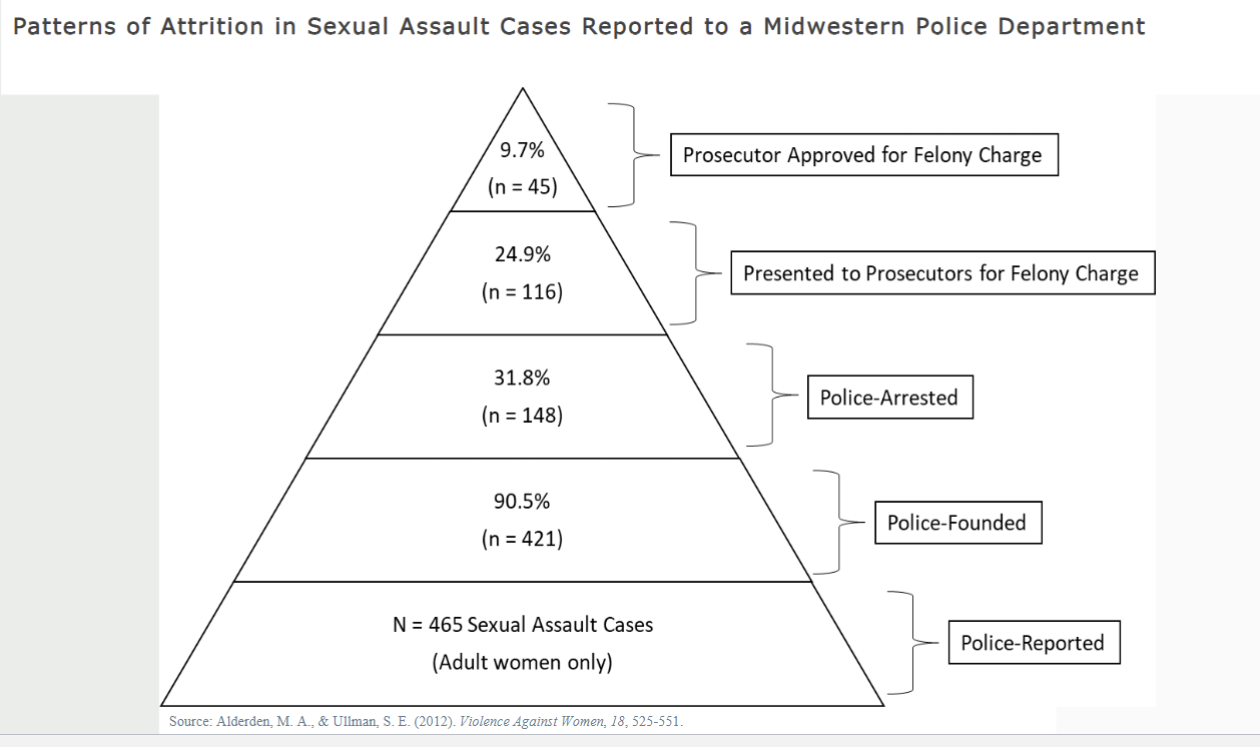
Sexual Victimization: Prosecution Challenges: Downstream Orientation
Prosecutors orient toward “the jury”
Sexual Victimization: Reporting and Investigation: Legally Relevant vs. Irrelevant Factors
legally relevant case characteristics (offense seriousness)
legally irrelevant offender and victim characteristics (race)
Sexual Victimization: Reporting and Investigation: Victim Credibility
prosecutors unlikely to file charges in cases where victims could be perceived by judges and juries as “blameworthy”
prosecutors work off stereotypes of “real rapes” and “genuine victims”
file charges in cases where they think they will readily secure a conviction
a “standup” victim is an essential element of a strong case
Sexual Victimization: Reporting and Investigation: Case Rejection Norms
norm is case rejection
decisions have implications for promotion, transfers, their own reputation of their unit, and their branch office
Sexual Victimization: Reporting and Investigation: Problematic Factors Affecting Charging Decisions
engaged in risky behavior
worked in the sex industry
entered the assailant’s home willingly
dated or were romantic with the assailant
were sexually assaulted in the past
have a criminal history
lived or spent time in dangerous neighborhoods
did not get a Forensic Medical Examination
did not fight back physically
have poor “moral character”
Rape Culture: Contemporary Understanding: An Intersectional Analysis
Myths: specifci archetypal stories about rape
Discourses: general beliefs and attitudes
Practices: individual actions that reinforce myths/discourses
These elements together:
shape how we interpret victimhood and perpetration
determine innocence and guilt
define power and powerlessness
normalizes sexual violence as a tool to maintain power structures
Rape Culture: Contemporary Understanding: How Rape Culture Maintains Power
cultural interpretation of what “counts” as rape
who is recognized as victim/perpetrator
how institutions respond
how myths adapt to maintain control
Rape Culture: Contemporary Understanding: Myths
The Black Male Rapist Myth
emerged during the recontruction period
had not existed prior to emancipation
used to justify lynching, served economic purposes
The “Bad Man” Rapist Myth
emerged in the 1970s
portrayed rape as committed by violent predatory males, strangers, “bad apples”
Rape Culture: Contemporary Understanding: Consequences of Rape Myths
Political Impact:
gained support for anti-rape reforms, but obscured everyday nature of rape
protected perpetrators who were judged to be “good guys”
These myths worked together to:
justify ongoing white male dominane
deflect attention from white male rape
support other myths about who could/couldn’t be victimized
Rape Culture: Contemporary Understanding: Discourses
1. Cultural Attitudes About Men’s Behavior:
male sexual aggression seen as inevitable
male sexual desire framed as “nature and uncontrollable”
2. Cultural Attitudes About Women:
viewed as both “demure and (secretly) desirous of being raped”
expected to be responsible for preventing assault
3. Discourses About Race and Sexuality
used to deny Black women’s victimization
Rape Culture: Contemporary Understanding: Practices
Individual Practices
self-regulating behaviors
objectification in daily interactions
decisions not to report assault
Institutional Practices
prosecutorial discretion
media representation
university responses
police investigation choices
Rape Culture: Contemporary Understanding: Mainstream Understanding of Rape Culture
1970s through today
normalizes aggressive male violence against women
centers on patriarchal oppression
reflects primarily white, middle-class women’s experiences
fails to capture how rape culture maintains many forms of domination
white supremacy; heteronormativity; capitalist exploitation
Winston/Kinsman Case: Timeline of Key Events
December 7, 2012: initial report to Tallahassee Police
January 2013: Winston identified as assailant
February 2013: police investigation suspended
Late 2013: state prosecutor files no charges
December 2014: FSU conduct hearing finds Winston “not responsible”
Winston/Kinsman Case: Intersectional Analysis
Race and Gender:
Myth of Black male rapist seemingly disrupted
But Winston neither exonerated nor condemned
Kinsman simultaneously cast as:
white female victim and opportunistic liar
Economic and Institutional Power
college football’s “plantation power dynamic”
financial stakes for FSU ($43M to $70M)
investigation timing and conduct hearing scheduled around football
protection of athletic interests
Winston/Kinsman Case: Systems Reinforcing Power
1. “Protection” as Control
TPD’s failure to investigate created dependency
Winston remains “manageable” asset
2. Double-Bind for Both Parties
Winston: simultaneously “not guilty” but never innocent
Kinsman: simultaneously potential victim and opportunistic liar
3. Power Maintained Through:
economic control of Black athletes
white overs

