8. shade selection
 Studied by 0 people
 Call Kai
 Learn
Learn Practice Test
 Spaced Repetition
 Match
Match Flashcards
 Knowt Play
1/40

There's no tags or description
Looks like no tags are added yet.
Name | Mastery | Learn | Test | Matching | Spaced | Call with Kai |
|---|
No analytics yet
Send a link to your students to track their progress
41 Terms
Color
the appearance that things have that results from the way in which they
reflect light.
Factors of Color Perception
Physical properties of the object.
Nature of the incident light.
Subjective assessment by the observer.
Attributes of Color
Hue
Value
Chroma
Attributes of Color: Hue
the quality by which we distinguish one color from another, as a red from a yellow, a green, a blue, or a purple.
Attributes of Color: Value
the relative lightness or darkness of a color.
Attributes of Color: Chroma
the quality of a color's purity, intensity or saturation.
The degree of the vividness of the Hue
color system
Albert H. Munsell -- Munsell color system.
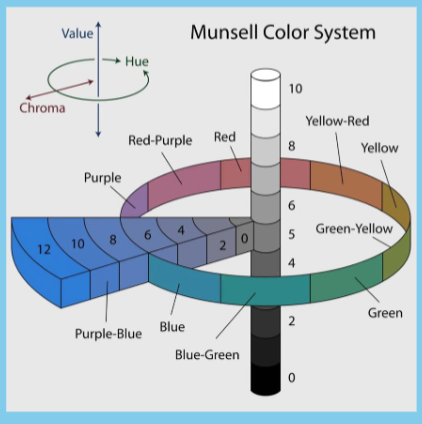
know this
shade guides
Shade matching devices
Order of shade selection is done by + ensures
first selecting the value, chroma, and then hue
ensures accuracy, uniformity, and predictable results for esthetic dentistry.
Shade or color selection in dentistry involves
matching the color of a dental restoration to the patient's natural teeth.
by systematically evaluating the tooth's hue (color family), chroma (intensity), and value (lightness or darkness).
This process is crucial for aesthetic results.
impact of operating Site Lighting on Shade selection
Sunlight in the middle of the day is optimal for shade selection -- contains an almost equal blend of all wavelengths of light
In clinics which do not have proper access to sunlight, artificial light should be used to simulate sunlight.
impact of the Environment on Shade selection
Bright-colored surroundings should be avoided as they interfere with proper color matching by influencing the colors in the reflected light.
A drape can be used to mask undesirable colors in the patient's clothing and jewelry.
Lipstick should be removed so that it does not affect color perception
impact of Teeth Condition on Shade selection
The tooth of interest and its adjacent teeth should be:
free of plaque and other deposits and surface stains.
moist with saliva as dehydration results in a whiter appearance.
why color matching should be done before applying the rubber dam
impact of Operator distance From the Tooth, position of the Patient, and Timing on Shade selection
2 feet to 6 feet distance from the oral cavity is ideal for shade matching.
positioned in the dental chair so the patient’s teeth are at the level of the operator's eyes.
The operator should stand directly in front of the patient, with light focused
on the teeth.
Shade selection and shade matching should be done by the dentist preferably in the morning, when eye fatigue is minimal.
Use a natural gray background to to provide a neutral base to relax the eye
Healthy enamel is
semitranslucent and appears grayish-White or yellowish, depending on the underlying dentin
Enamel shade opacity
a change in the normal tooth color, resulting in white or opaque areas on the
surface of teeth, which is caused by developmental issues or defects in the enamel's mineralization
Translucency
a measure of how much light can filter through the enamel.
Thin or worn enamel can appear more translucent
in contrast to opacity (i.e. blocks light),
Opacity vs hypoplasia
Opacity = a change in color
enamel hypoplasia = a defect in the enamel's contour.
Dentin
The layer of mineralized tissue beneath the enamel that makes up the
bulk of the tooth.
naturally a lighter yellow color.
less mineralized than enamel, has a lower hardness .
contains tiny tubules that are connected to the tooth's nerve.
Enamel Shade versus Dentin Shade
Enamel is a translucent, hard layer, while
Dentin is softer and more opaque, with a natural yellow hue
The difference in their structure and color creates the overall shade of the tooth;
the yellowish dentin provides the color foundation,
while the translucent enamel allows light to pass through and scatter, creating the tooth's final appearance.
what Interaction determines the tooth's final shade.
The way light interacts with both layers is what determines the tooth's final shade. The yellow dentin provides the color, but it's filtered through the
translucent enamel, which scatters light and affects the final hue and brightness.
Advantage of composite regarding shades
the possibility of using different shades, opacities, translucencies, effects, pigments, that allows high esthetic results.
long-term color stability, resistance to fading, and adaptable light-handling properties that allow for a seamless and natural appearance. In applications like dental work and window.

Opacity in composite tooth shade selection
crucial for achieving a natural look, as it determines how much light is blocked or transmitted through the material.
why is Dentin is more opaque and yellowish-brown, while healthy enamel is more translucent and whitish
This difference is due to enamel's higher mineral content compared to dentin.
what is responsible for the tooth color?
The opacity of dentin is responsible for the tooth's color, which is viewed through the semi- transparent enamel laye
Composite Layering advantages
offers superior esthetics by mimicking the natural depth, translucency, and color gradients of a tooth
especially beneficial for visible anterior restorations.
creates desired opacity and translucency
reduces shrinkage stress
proves a more lifelike result compared to single-shade techniques.
visual Shade Guides
The traditional method of shade selection
the most popular and convenient way in selecting tooth shades
proficiently match the color of the dentition with a standardized reference
shade guide.
The selection of tooth color by the shade tab method completely
depends on
human eye observation.
Custom Shade Guide
The standard shade guide cannot encompass the entire range of hue and chroma values of human dentition.
useful for 85% of the color selection, and its alteration or preparation of custom shade tabs is necessary for the 15% remaining.
creation of custom shade guides
Fabricate custom shade guides via composite resin, ceramic, or acrylic materials.
Surface colorants can be used to perform shade guide modifications or via surface abrasion using aluminum oxide.
Fine line markers and colored pencils may also be used to reproduce the tiny variations between shades, similar translucency, and designating colors
Dentin and Extended Shade Guides
Dentin system can be used for the fabrication of translucent.
helps in specifying a specific shade to the dental laboratory. Specially colored die materials corresponding to the dentin shade are used, which allows the practitioner to appraise the esthetics of the restoration.
The extended shade guide comprises the tabs of all materials used to fabricate the restoration.
may also be utilized to expand the choice of shade
Disadvantages of Shade Selection
Color shades can vary between manufacturers.
Porcelain used for restoration may not match that of the guide.
Synthetic resin of the shade tab can be thicker than the crown.
Shade tab reflects and transmits lights as compared to the restoration (dense and opaque).
Color Measuring Instruments
Colorimeters
Spectrophotometers
Digital cameras
Hybrid devices
Spectroradiometers
Colorimeters
a device that mimics the way humans perceive color.
Using an internal light source, a colorimeter shines light down onto the surface of the sample. As the light reflects back up to the device, it passes through three filters: red, green and blue.
These filters distill tri-stimulus (RGB) values that match how our eyes see
color.
Spectrophotometers
An photometer that measures
the amount of photons (the intensity of light) absorbed after it passes through
the amount of spectral reflection from the body.
intensity based on color, or more specifically, wavelength
Digital cameras
the most basic form of an electronic shade-matching device
this device records images using charge-coupled devices (CCDs) to make photosites.
These digital images can then be transferred to the computer for easy shade and translucency mapping
photosites.
thousands or even millions of minute light-sensitive elements
Hybrid devices
SpectroShade provides a combination of digital imaging and spectrophotometric analyses.
Utilizes ClearMatch software system and can run on a digital camera or Windows computer
Spectroradiometers
most accurate
introduced as an alternative instrument to the spectrophotometer for
measuring color in dentistry.
Measures the intensity of light across a wider range of wavelengths. Breaks light into its component wavelengths to give a detailed profile of the color
Limitations Digital Shade Guide:
The occurrence of edge loss affects the accuracy of color measurement.
Translucent mapping is inadequate for all systems.
Placement of the probe or mouthpiece is important for the repeatability of the measurement.
The lab must have up-to-date systems in order for the successful application of this method
summary
Determination of the correct shade is key for superior esthetics.
It is a challenge to closely match and reproduce the same appearance and form of teeth.
The dentist must fully understand the science of color in order to provide an optimal esthetic restoration to the patient.
The outcome of a satisfactory appearance to the patient allows the dentist to achieve a successful treatment.
Conventional and digital shade systems should be used during the shade selection process to achieve optimal esthetics
 Note
Note  Flashcards (46)