2. Cells & Tissues
 Call Kai
 Learn
Learn Practice Test
 Spaced Repetition
 Match
Match Flashcards
 Knowt Play
1/27

There's no tags or description
Looks like no tags are added yet.
Name | Mastery | Learn | Test | Matching | Spaced | Call with Kai |
|---|
No analytics yet
Send a link to your students to track their progress
28 Terms
Cell materials can be located in 2 locations parts of the cell. What are these 2 different locations?
Intracellular & extracellular
What are intracellular materials?
Cell materials found inside of the cell membrane (ex. cytoplasm, organelles & inclusions, like fat, hemoglobin, glycogen, keratin, etc)
What are extracellular (INTERcellular) materials?
Materials outside of the cell’s membrane or in between cells in a tissue. Can also be found in body cavities
What are the 5 components of extracellular material?
Fluid
Matrix
Proteoglycans
Fibers
Attachment proteins
A component of extracellular material is fluid. What can be found in this fluid?
Water, other stuff (inorganic materials) dissolved in those fluids, & small organic molecules (ex. glucose, amino acids, etc.)
A component of extracellular material is the matrix. What is the matrix?
Stuff (proteins & polysaccharides) that is secreted by the cells of a tissuehaW
What are the 6 functions of the matrix?
Determines physical properties of a tissue
Stabilizes physical structure of tissue
Regulates cell division
Regulates cell migration
Regulates cell proliferation (growth & division)
Keeps cell shape for their specific functions
A component of extracellular material is proteoglycans. What are 2 examples of these proteoglycans?
Hyaluronic acid, glycosaminoglycans (GAGs)
The structure of a proteoglycan looks very similar to what?
Fuzzy caterpillars
Where are proteoglycans found?
What is their function?
Between cells & in other connective tissues
Lubricate joints & cushion bone contact points
A component of extracellular material are fibers. What are the 3 different types of fibers that could be in extracellular material?
Collagen fibers
Elastic fibers
Reticular fibers
A component of extracellular material are attachment proteins. What are attachment proteins?
Non-collagen proteins that organize the matrix & help cells attach to the matrix
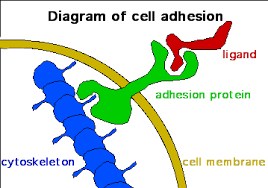
What is cell adhesion?
What is cell-cell adhesion?
What is cell-matrix adhesion?
Cells being able to stick to each other or molecules in their environment
Cells sticking to cells
Cells sticking to the matrix
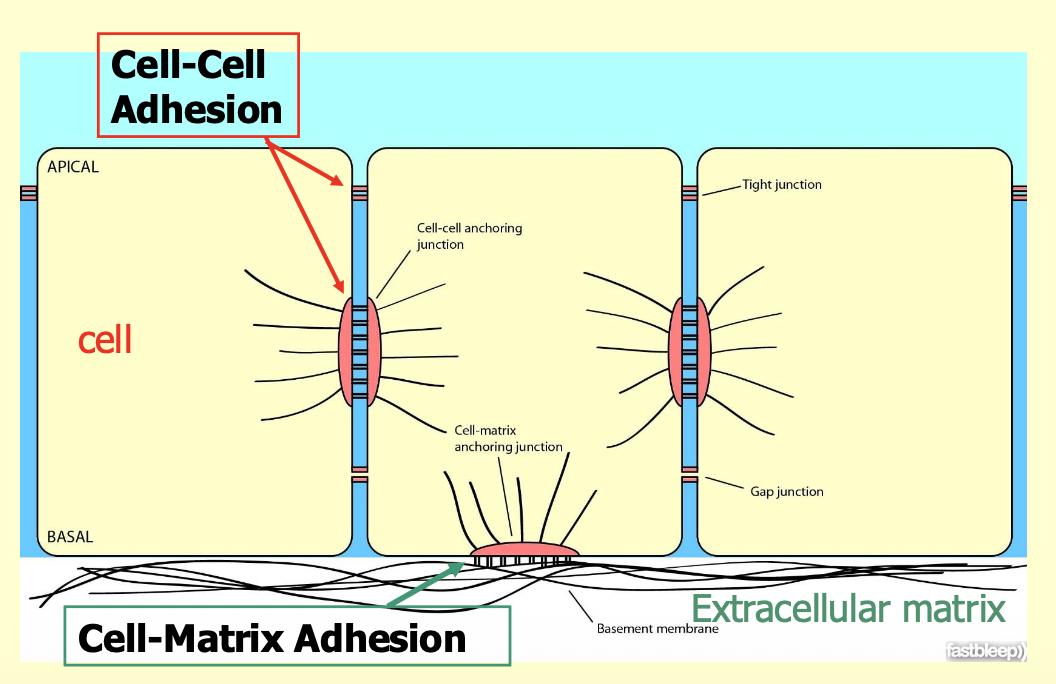
What allows cells to adhere to each other & to the extracellular matrix?
Cell adhesion molecules (CAMs)
What are the 4 functions of cell adhesion molecules (CAMs)?
Guiding the movement of cells during embryonic development
Guiding the movement of cells during wound repair
Attach cells to each other & to the matrix
Help to control cell shape
What are the 3 types of cell-to-cell adhesion?
Tight junctions
Desmosomes
Gap junctions
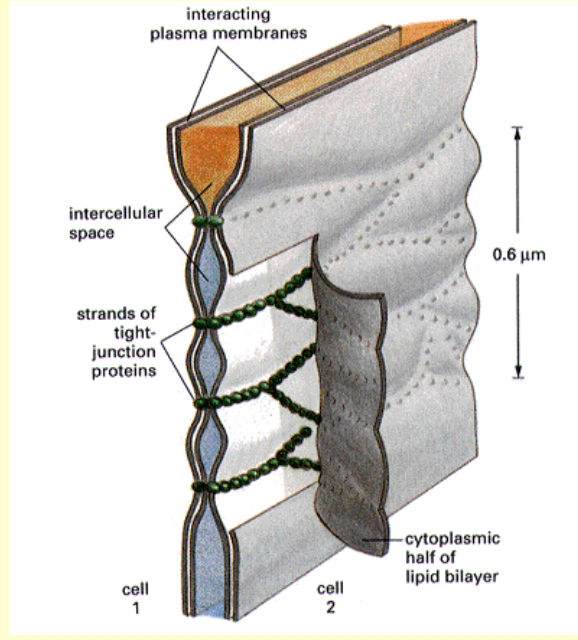
What are tight junctions?
Type of adhesion where 2 cells are held so tightly together that it forms an impermeable barrier, so that fluids can’t between them
What is the function of tight junctions?
Forming an impermeable barrier so fluids can’t pass between 2 cells
Generally, when would you find a tight junction?
What 3 structures would you find tight junctions?
Found in areas where diffusion between cells is unwanted (where you WANT to keep things separate)
Intestine, kidney, urinary bladder
What are desmosomes?
Type of adhesion that hols cells tightly together, but does not form an impermeable barrier
What is the structure of desmosomes?
Interlinker proteins are attaches to thickenings (thick parts) in the plasma membrane called plaques (like ropes attached to the cell)
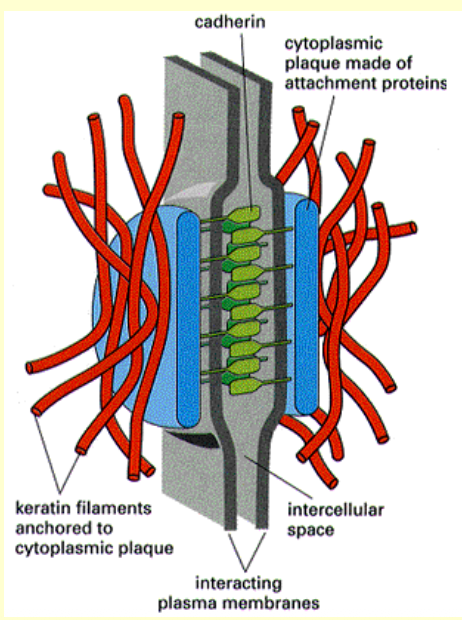
What is the function of desmosomes?
Helps 2 cells stay in place when they are being pulled apart
What 3 structures would you find desmosomes in?
Between cells in the skin
Muscle
Cervix of the uterus
What are gap junctions?
Type of adhesion that allows for a small opening from 1 cell to another to allow them to communicate by passing materials through
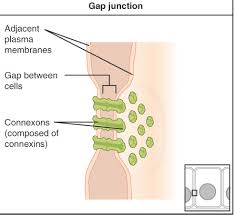
What is the function of gap junctions?
To hold cells together, but also allow ions to pass directly from cell to cell
What are 3 places you can find gap junctions in the body?
Between embryonic cells for nutrient transfer
In muscle cells for rapid transfer of electrical signals
In nerve cells for rapid transfer of electrical signals
Why would heart muscle cells (cardiomyocytes) be connected by gap junctions and desmosomes?
Gap junctions have a small gap to allow ions to pass through. In cardiomyocytes, having a gap junction allows electrical signals—the signals that allows the heart to contract—to pass from one cell to another. The heart pumps as one unit rather than individual cells
Desmosomes keep the cell together despite pulling. In cardiomyoctes, desmosomes hold adjacent cells together to resist pulling apart during contraction

