Genetics Exam 2 - Quiz Questions
 Call Kai
 Learn
Learn Practice Test
 Spaced Repetition
 Match
Match Flashcards
 Knowt Play
1/40

There's no tags or description
Looks like no tags are added yet.
Name | Mastery | Learn | Test | Matching | Spaced | Call with Kai |
|---|
No analytics yet
Send a link to your students to track their progress
41 Terms
Which sequence is the complement to sequence 5’-ATCGACCAG-3’?
A. 5’-CTGGTCCAGT-3’
B. 5’-TAGCCTGGTC-3’
C. 5’-CUGGUCCGAU-3’
D. 5’-TCGGCTGAC-3’
E. 5’-ATCGGACCAG-3’
5’-CTGGTCCAGT-3’
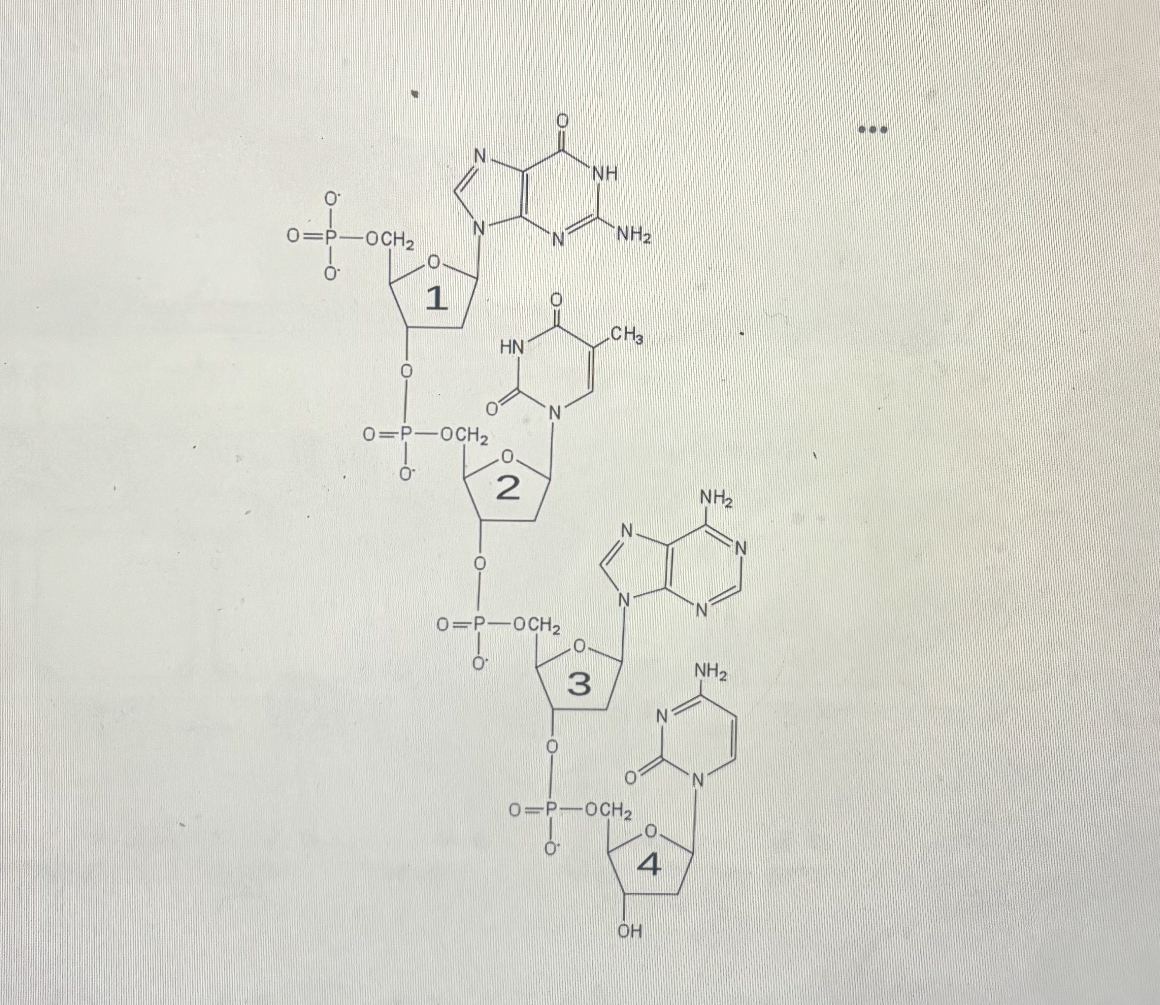
The figure below depicts a single stranded nucleotide molecule. Nucleotides 1 and 3 are what type of nucleotide?
A. Deoxyribonucleic acid with a purine base
B. Deoxyribonucleic acid with a pyrimidine base
C. Ribonucleic acid with a purine base
D. Ribonucleic acid with a pyrimidine base
E. Deoxyribonucleic acid and an unknown nitrogenous base
Deoxyribonucleic acid with a purine base
Adenine and thymine form ___ hydrogen bonds between them, while cytosine and guanine form ___ hydrogen bonds.
A. 2:3
B. 3:4
C. 4:3
D. 3:2
E. 2:2
2:3
Griffith’s Principle of Transformation in 1928
Some component of virulent, heat-killed bacteria are taken up by non-virulent, growing bacteria causing them to gain virulence
Avery, McCloud and McCarty show transforming principle is DNA in 1944
Virulent bacteria filtrate îs treated with either RNase, protease, or DNase enzymes then exposed to non-virulent bacteria. Non-virulent bacteria that were exposed to RNased and protease filtrate become virulent, while non-virulent bacteria exposed to DNased filtrate does not transform and remains non-virulent
The Hershey Chase experiment confirming DNA is the inheritable material in 1952
Bacteriophages, viruses that only target bacteria, had their phosphorous-rich DNA and sulfur-rich protein coat radioactively labeled. Once the phages replicated in their bacterial host, it was observed that only the labeled phosphorous entered the bacterial cells, indicating that DNA, not protein, is the genetic material
Franklin, Watson, and Crick uncover the 3D structure of DNA in 1953
Using X-ray light to visualize diffraction patterns that provide information about atomic spacing and architecture in molecular compounds
Cells are treated with a drug that blocks purine synthesis. Which bases would NOT be made in those treated cells?
A. Cytosine, Thymine, and Uracil
B. Cytosine and Guanine
C. Adenine and Guanine
D. Adenine and Thymine
E. There would be no impact on all nucleotide synthesis
Adenine and Guanine
The researcher or researchers who initially used X-ray diffraction to gather information on the DNA molecule was ___
A. Franklin
B. Watson and Crick
C. Hershey and Chase
D. Pauling
E. Chargaff
Franklin
From the list of statements below, select any differences between nucleotide triphosphate (NTPs) and deoxynucleotide triphosphates (dNTPs):
A. NTPs have two phosphates, while dNTPs have three
B. dNTPs use the single-ringed uracil as one of their four nitrogenous bases, while NTPs use thymine
C. NTPs have a 1’ hydroxyl group, while dNTPs do not
D. NTPs have a 3’ hydroxyl group, while dNTPs do not
E. NTPs use the single-ringed uracil as one of their four nitrogenous bases, while dNTPs use thymine
NTPs use the single-ringed uracil as one of their four nitrogenous bases, while dNTPs use thymine
Many noncoding RNAs take a complex stem and loop secondary structure. Which statement best describes why this is so?
A. Hydrogen bonding between adjacent phosphates
B. Stabilization by complimentary base-pairing with itself
C. Covalent bonds between adjacent nitrogenous bases
D. A and B
E. A and C
Stabilization by complimentary base-pairing with itself
The fact that the helixes of the DNA strand are arranged in opposite directions gives DNA its ___ characteristics
A. Complementary
B. Antiparallel
C. Semiconservative
D. Dispersive
E. Conservative
Antiparallel
What function do RNA primers play in RNA replication?
A. They stabilize the single-stranded DNA so that the replication bubble remains open
B. They act as a template for DNA polymerase to read what new nucleotide to incorporate
C. They play a role in terminating DNA replication
D. They provide a 5’ phosphate for DNA polymerase to begin synthesis
E. They provide a 3’ hydroxyl for DNA polymerase to begin synthesis
They provide a 3’ hydroxyl for DNA polymerase to begin synthesis
DNA replication is ____
A. Dispersive
B. Conservative
C. Semi-conservative
D. Displasic
E. Sporadic
Semi-conservative
Which enzyme is responsible for fixing nicks at the end of the replication process, replacing them with a 5’ to 3’ phosphodiester bond?
A. Primase
B. Ligase
C. DNA Polymerase 1
D. DNA Polymerase 3
E. Topoisomerase
Ligase
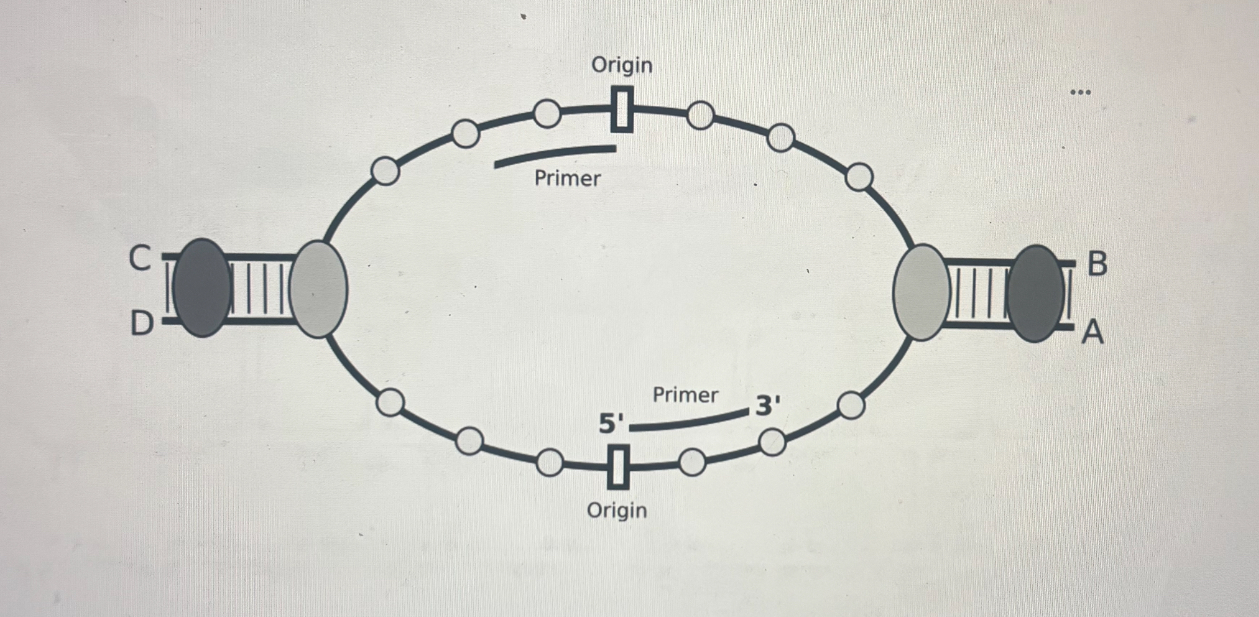
Given the figure below, match the end (A,B,C,D) of each DNA strand with the correct polarity (5’ or 3’)
A - 5’
B - 3’
C - 5’
D - 3’
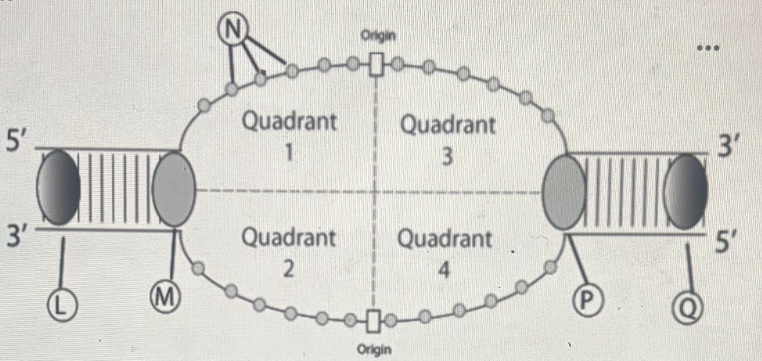
Match the letter to the enzymes and quadrants they correspond to:
What are enzymes L and Q?
What enzymes are M and P?
Where are the lagging strands located?
Where are the leading strands located?
L and Q are Topoisomerase
M and P are Helicase
The lagging strands are in quadrants 2 and 3
The leading strands are in quadrants 1 and 4
Indicate which statements are TRUE:
A. DNA Polymerase can only add new nucleotides to an existing free 3’-OH
B. Topoisomerase relieves mechanical strain on DNA caused by Helicase
C. Cytosine and Guanine need two hydrogen bonds for stability
D. Purines are single ring structured nitrogenous bases, while pyrimidines are double ringed structures
E. DNA ligase seals breaks in DNA to complete replication
F. DNA replication takes place in the mitosis phase of the cell cycle
G. DNA Polymerase can only add new nucleotides to an existing free 5’ phosphate
A. DNA Polymerase can only add new nucleotides to an existing free 3’-OH
B. Topoisomerase relieves mechanical strain on DNA caused by Helicase
E. DNA ligase seals breaks in DNA to complete replication
DNA replication is extremely accurate. What feature of the process contributes to this accuracy?
A. DNA Helicase’s role in complementary basepairing of new nucleotides
B. Exonuclease activity of polymerase
C. Ligase’s ability to repair broken DNA
D. DNA Gyrase and its ability to proofread misincorporated nucleotides
E. None of these contributes to replication accuracy
B. Exonuclease activity of polymerase
True or False: Most eukaryotic chromosomes have a single origin of replication
False
What function does an mRNA 5’ methyl cap have?
A. Prevent degradation
B. Allow ribosome binding
C. Terminate Pol 2 transcription
D. Both A and B
E. Both A and C
Both A and B
The following sequence of DNA is the template strand to make an RNA: 5’-TAAGGGTTCTAAGC-3’
What would be the resulting RNA (written 5’ to 3’ direction)?
A. 5’-GCUUAGAACCCUUA-3’
B. 5’-GCTTTAGAACCCTTA-3’
C. 5’-ATTCCCAAGATTCG-3’
D. 5’-AUUCCCAAGATTCG-3’
E. 5’-UAAGGGUUCUAAGC-3’
5’-GCUUAGAACCCUUA-3’
True or False: tRNA anticodons are antiparallel and complimentary in nucleotide sequence to their corresponding mRNA codons
True
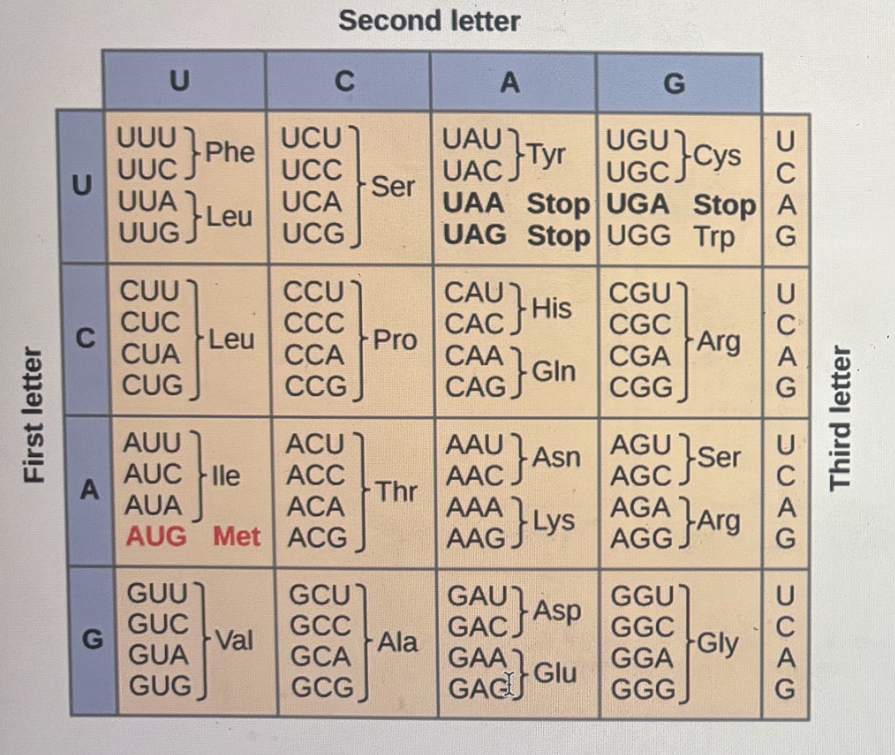
The DNA contains a gene of a short polypeptide. Determine the amino acids that will be encoded by this sequence:
5’-TAGCTGATCGAATATGCGGTCTCTATCTTCGTAGACGA-3’
3’-ATCGACTAGCTTATACGCCAGAGATAGAAGCATCTGCT-5’
A. N-Met-Arg-Ser-Leu-Ser-Ser-C
B. N-Met-Pro-Arg-Asn-Asp-Ser-C
C. N-Asp-Pro-Lys-Ser-Val-Ile-C
D. N-Met-Lys-Val-Glu-Ala-C
E. N-Met-Ala-Asp-Pro-Lys-Ser-C
N-Met-Arg-Ser-Leu-Ser-Ser-C
How does a ribosome “know” where to start translating an mRNA?
A. It finds any AUG in the mRNA
B. It finds the TATA box
C. It identifies the poly-adenylation signal
D. It begins translation at the Kozak sequence
E. It finds a nonsense codon
It begins translation at the Kozak sequence
Of the proteins listed below, which are not part of the basal transcription apparatus?
A. RNA Polymerase 2
B. DNA Polymerase 1
C. SSBP
D. RNA Primase
E. TFIID
F. TBP
DNA Polymerase 1, SSBP, RNA Polymerase
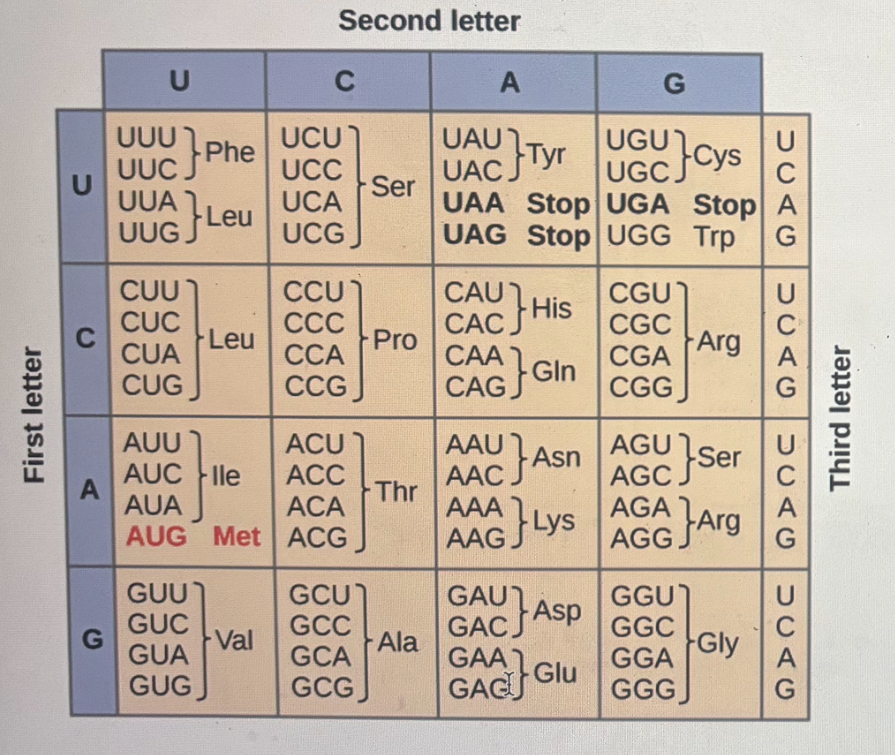
If the anticodon sequence of the tRNA is 5’-UAC-3’, what amino acid would be added to the polypeptide chain?
A. Valine (Val)
B. Tyrosine (Tyr)
C. Methionine (Met)
D. Histidine (His)
E. None of these
Valine (Val)
Humans have 20,000 protein-coding genes yet make 100,000 proteins. What makes this possible?
A. Most genes have multiple transcription start sites resulting in multiple OFRs
B. Most mRNAs have more than one start codon resulting in several polypeptides from the same mRNA
C. The poly-A-tail length can alter the ORF reading frame
D. Alternative splicing allows different combinations of exons to be used from the same gene
E. The premise of the question is incorrect. Humans only mane 20,000 different proteins
Alternative splicing allows different combinations of exons to be used from the same gene
What kinds of bonds are synthesized between amino acids in a growing protein?
A. Hydrogen bonds
B. Phosphodiester bonds
C. Ionic bonds
D. Peptide bonds
E. Treasury bonds
Peptide bonds
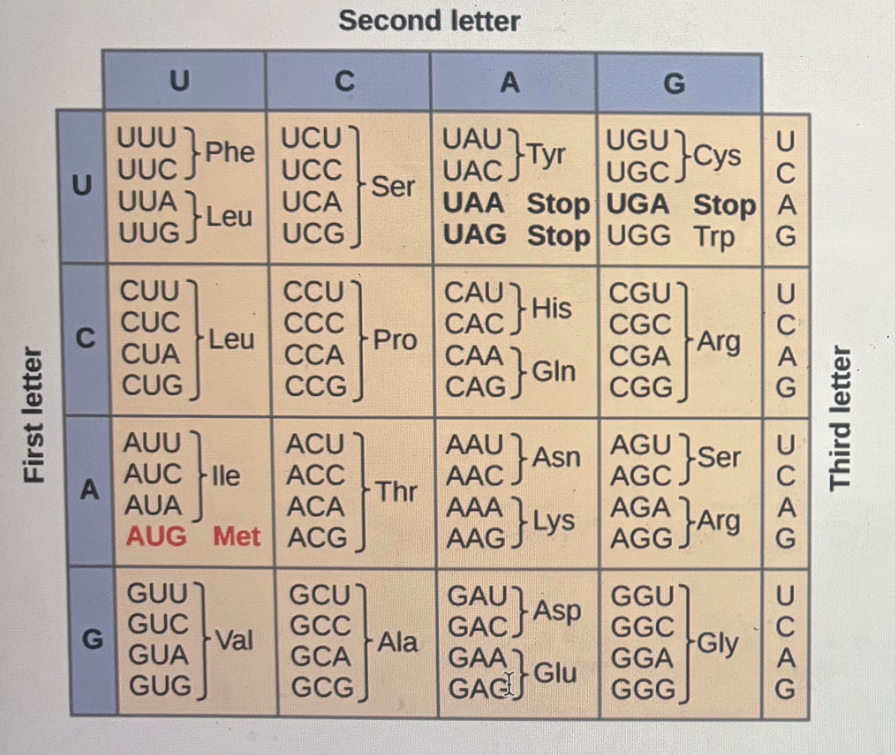
The following segment of DNA has a single open reading frame. How many codons does it have?
5’-GACTACCGGCACCAGTAGATATCAATACGGAACCATCGTCAGGACCGAA-3’
3’CTGATGGCCGTGGTCATCTATAGTTATGCCTTGGTAGCAGTCCTGGCTT-5’
A. 4
B. 5
C. 7
D. 10
E. More than 15
5
You are studying a mutant strain of E. Coli where the operator sequence was mutated in a way that prevents repressor binding. Would you expect the lac operon to be:
A. Only active in the presence of lactose
B. Always inactive regardless of whether lactose is present or not
C. Only active if large concentrations of lactose are present
D. Always active regardless of whether lactose is present or not
E. Only active in the presence of sugars other than lactose
Always active regardless of whether lactose is present or not
Histone acetyltransferases are directly involved in which of the following?
A. Removal of histones from chromatin
B. Movement of nucleosomes
C. Chemical modification of histones
D. Termination of gene expression
E. Insertion of variant histone proteins
Chemical modification of histones
True or False: Although transitions are more common, the number of possible transversions is double the number of possible transitions
True
CpG islands are associated with which of the following?
A. Nucleosome location
B. DNA methylation
C. Steroid hormone activity
D. cAMP pathway
E. Constitutive euchromatin
DNA methylation
True or False: DNA methylation usually activates gene expression
False
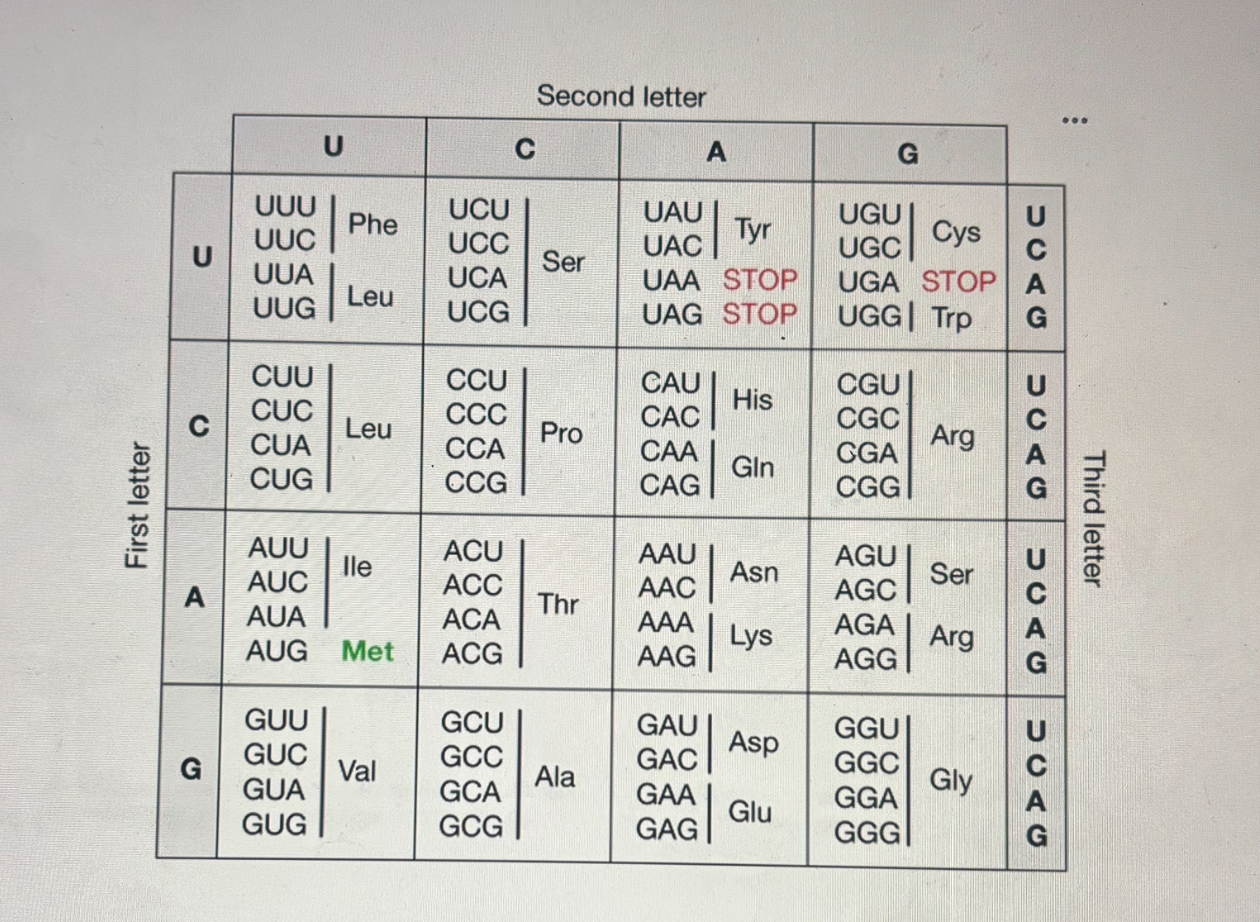
5’-ATG-AAA-ATG-GAC-ACT-CGT-TTG-GGG-CTC-AGA-CTA-TCA-TAA-3’
You find a single nucleotide substitution where the 10th nucleotide changes from G → A. What is the resulting amino acid change?
A. Asp → Asn
B. Asn → Asp
C. Asp → Stop
D. Leu → Leu
E. Leu → Stop
Asp → Asn
Assume a single base insertion has occurred in an ORF. What type of mutation would this most likely cause at the protein level?
A. Frameshift
B. Missense
C. Nonsense
D. silent
E. N/A - the gene would no longer be transcribed, and thus never translated into a protein
Frameshift
True or False: DNA that contains actively transcribed genes would most likely contain chromatin in the closed configuration
False
Families with expanding nucleotide repeat genetic diseases often experience worsening of the disorder with each subsequent generation. The disease tends to have an earlier onset, more rapid progression, and a worse outcome. What is the name for this phenomena?
A. Truncation
B. Anticipation
C. Multigenerational Gain of Function
D. Mutagenesis
E. Unequal crossing-over
Anticipation
True or False: Meiosis and sexual reproduction pass germ-line mutations to ~50% offspring
True
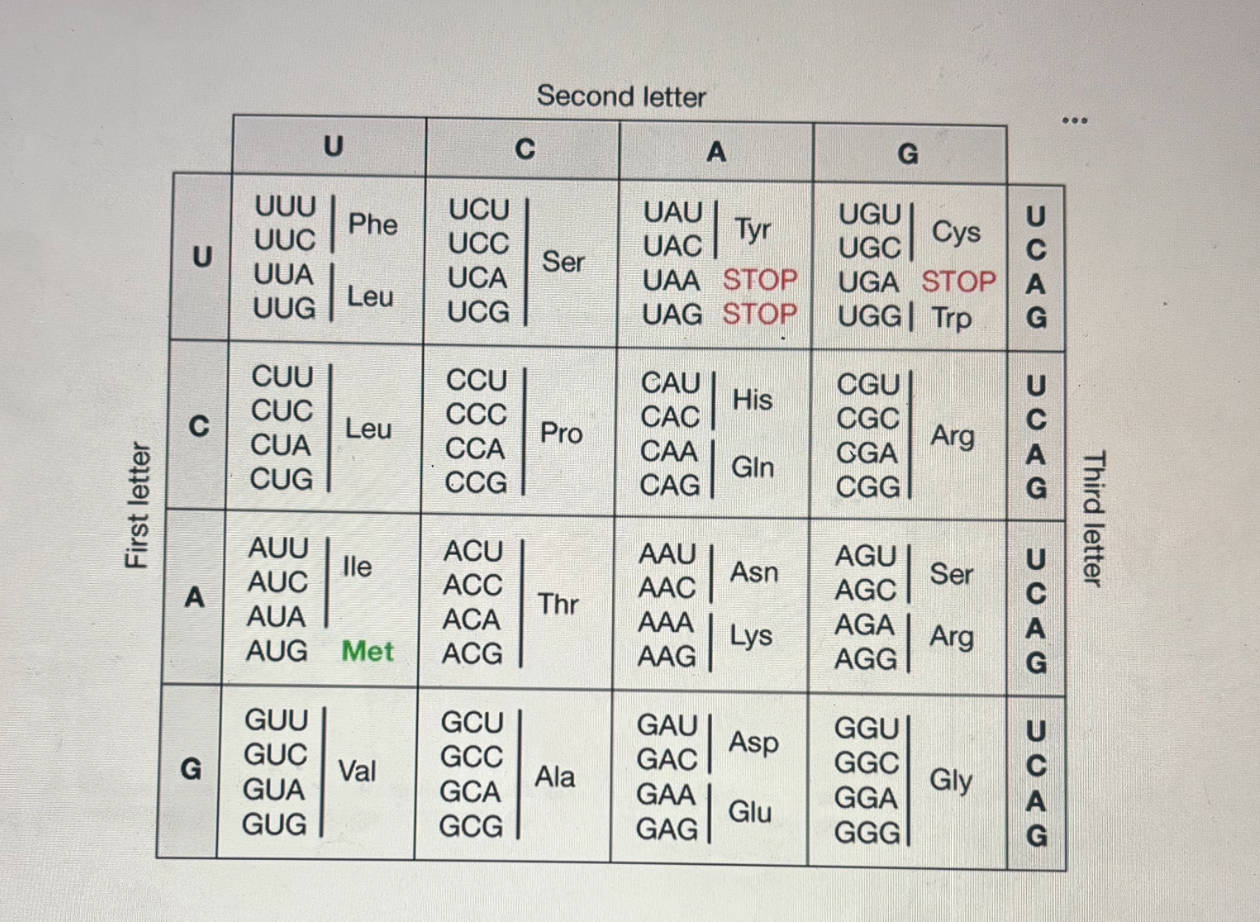
5’-ATG-TCA-AAG-GAC-ATT-CGC-TGT-GGG-CTC-AGA-CTA-TCA-TAA-3’
You find a single nucleotide substitution where the 18th nucleotide changes from a C to a T. What type of mutation is this on the DNA and protein level?
A. Transversion and silent
B. Transition and nonsense
C. Transversion and nonsense
D. Transversion and missense
E. Transition and silent
Transition and silent

